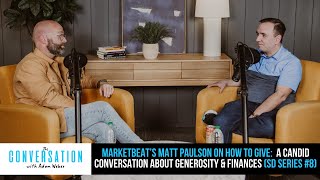
This YouTube interview (Marketbeat’s Matt Paulson on How to Give) features a conversation between host Adam and Matt Paulson about Christian generosity. Matt offers practical, tactical advice: prioritize consistent giving to your local church, use percentage-based giving (start small and increase), limit focused support to a few organizations, budget with a spouse and reserve a portion for unspecified needs, and practice discernment — including the ability to say no. He shares personal examples (starting with $5, later $400/month; ~20% unspecified giving; stopped supporting a missionary who only solicited funds; donated to an unregistered group by mistake) and contrasts corporate vs. personal giving approaches.
Questions this video answers
Start with any percentage; Bible suggests 10%, but you can start at 1–2% and grow 1% at a time.
He started with a $5 amount and later gave about $400/month after a year or two.
About 20% of their giving budget is left unspecified for things that come up during the year.
The local church (write a check to your local church on a consistent schedule).
He gave to someone who wasn't a registered 501(c)(3) and who used his name to raise money without permission.
Chapters
I really want to talk with you about giving specifically as a Jesus follower. I find, and this is in friends, even in the church, but even outside the church, who giving is just a hard thing. Jesus talks about it a lot and you shared so honestly, that was awesome. Even hearing about that being such a pivotal moment for that person. Again, whether I'm a banker, a teacher, a nurse, kind of even picturing yourself several years ago, advice how to give, maybe even specifically as a Jesus follower, like what were your hang ups? What did that look like for you? Because it's honestly, it was away from when I started following Jesus. For me, when I started to give, it was the second pivotal moment in my life because it was such a big deal for me.
I mean obviously the main thing, like if you're not giving to your local church, you're doing it wrong. Like that's the first thing. Like you should write a check to local church every month, whatever Jesus leads you to do. And then after that I think it's kind of a calling of where you feel called to give and what issues has Christ put on your heart and what people have Christ put on your heart. And like sometimes it's a person in need, sometimes it's an organization or a non profit and, and really kind of kind of start that way when you get to, when you become like a name in the community like you are, you know, then it's a whole different thing because you're on every nonprofit's radar. There are probably 3,000 registered nonprofits in town. Maybe of those, 300 have more than one employee. But they all, like, all the big ones have development people whose only job is to ask you for money. So like think about that. Yeah, so yeah, I can see why it becomes a source of not joy for people.
And maybe, maybe, maybe start with so start with that first kind of before kind of getting to a place of having means. So let's say I'm not giving, I'm a Jesus follower. I'm a teacher, banker, nurse. Like, okay, how do I actually start? What would you, I want to hear if not from a pastor, like what would you, would you say like how do I begin?
Well, I think the way to think about it is you always want to go off of percentage. And you know, The Bible suggests 10 is, you know, the number, but you can start at one or two and just kind of grow it 1% at a time. And you know, the first place I think anybody should give and not just saying this because I'm a podcast. It's in The Bible, you should write a check to your local church and, like, you should do it every week or every month, but on some consistent schedule where, like, it's like, that's the schedule and, like, you just don't miss it. And really, even when it gets hard, like, this is one of the last things you want to give up because it's such an important part of your Christian walk.
Did you. And this might. Don't hesitate to answer this question. Did you kind of go from zero? Like, did you start like this when you started giving, what did that look like? Was it a percentage? And I actually encourage people to the same thing. Yeah. Because I think a lot of people are like, I didn't give 10%. Well, it's like, well, we should also read our Bible for an hour a day or whatever. But, like, we. We're a work in progress.
Yeah. We're growing people.
Yeah, yeah, yeah.
I think it was a rough percentage for me. Like, initially it was a $5amount. And I remember it being like, after a year or two, it was like $400 a month, which was a lot back then in my world.
Yeah.
And just kind of scaled it from there as my income scaled. And now, like, I don't even know how much money I make in a year until I do my tax return. So, like, you kind of, like, guess, like, okay, I want to be at this percentage, so I need to give this amount away. And it gets complicated within your, like.
First, like, year or 2 at MarketBeat, before it took off, was giving still to something you're growing in. Share that part of things.
Yeah. When Markov was taken off, like, it was an established pattern in my life. Like, there were a few missionaries we supported, like, as a family, gave to the church, gave to the seminary. Some other organizations as well, like, have been always a big fan of our friend Tom Henderson and his work and supported him for a long time. So it was a pretty established habit by then. And, you know, kind of had a, you know, made a giving budget every year. Wife and I talked it over and kind of that's what we stuck with. And then had some, like, extra money for like, well, we know stuff's going to come up, but we don't know what it is yet. So maybe 20% of the giving budget is kind of unspecified for things that come up throughout the year.
That's so awesome. At that point, kind of pre. Market be taken off. Was there any hard things when it came to giving of stuff? Like, man, this is why people become jaded. This Is why anything before kind of the. At taking off that you walk through.
Yeah. So one thing that I kind of experienced since probably 10 years ago now, maybe not quite, maybe 10 to 8, like there was a missionary we were supporting and we only ever heard from them when they wanted money. And that was just not a great experience. So we ultimately stopped giving to them because it just felt like the heart wasn't right. Like we were a check to them and not a relationship. Yeah. So we just said okay at that. I think, I think we're gonna be done doing this. And that's just how it had to be. Because if you're not a cheerful giver, you're doing it wrong. And if you're not able to give cheerfully, maybe you don't give until you can give cheerfully.
That's so good, man. Okay, so now as MarketBeat has taken off, even whether I'm a lawyer, a small business owner that's just had some success advice when it comes to, for that person giving, like, it's like, okay, I'm already faithfully giving to my church. How do I do this in a way where I'm not angry or I feel like I'm being asked constantly and I don't know what to say yes or no to like, you know, I got a team of five people and yes, I have success, but I just, yeah, I'm struggling with what to do because that is the person that's coming to me saying, hey, Adam, I'm not sure what to do with this.
Yeah. The thing that I kind of come back to is like Jesus says the poor will always be with us, that the need is unlimited. Right. I've never met a non profit that says they have enough money and don't need more. You've had the same thing. So I think it's okay to not respond to every request that comes in. Yep. And I think you just have to be okay with that. And like, you know, people, you know, if you're an attorney in town, you're a banker, you're somebody kind of seen of like upper middle class means, like you get invited to stuff all the time and it's, you know, I think it's better to focus on probably three or four organizations versus trying to write hundred dollar checks to everybody. The focus is really good because then you can have a deeper relationship with, you know, the organizations and then you really just have to protect yourself beyond that. Like you're gonna get stuff in the mayo and maybe just throw it away. Maybe you don't take fundraising Phone calls or if somebody you've never met before, like, asked to meet with you to talk about their organization, like, if you weren't already interested in it, just don't take the meeting. Really protect your heart and just kind of think and pray about the things God's placed in your heart and focus on those things and. And be okay calling it there. Because there's just no shortage of needs in the world that, you know, organizations or people that would think they need your money more than you do.
When it comes to the discernment process, again, kind of away from church, like, is that just something you and your wife talk about? Like, how did you kind of. Even in the last, like, four years, how did you kind of start getting your arms around? Like, this is where I really feel like I'm supposed to. Supposed to and where I'm not. And I just want to say, like, the ability to say no is such a wise thing. I think we feel like we're faithless or we're doing something wrong, and it's like, no. I think it's so intentional and wise to be intentional with what you've been entrusted with. And, yeah, any. Like, how is. How does that process. I know now you have a very kind of strategic process, kind of. Before that got set up, how did you wrestle with. How do you wrestle with that?
Yeah. So in my world, there's like, the professional corporate giving and then, like, the personal giving. And, you know, I think we've developed a good system for the corporate giving, but on the personal giving side, kind of after the church bucket, you know, Karina and I just talk about the things that we care about. One thing that she cares about is, you know, her father passed away in 2011, and, you know, he's buried at the Emory Community Cemetery. So we write a check to the cemetery every year to help maintain the cemetery.
Wow.
We've had family members in need before that. We've written some pretty sizable checks to. To kind of help them get out of the mess they're in. So it's. It's more like, okay, what do I care about? What do you care about? What do we care about together? And then what can we agree on that we want to do with what we've been blessed with? That's so good.
Is there anything in hindsight that you think you've done? You're like, I probably wouldn't do that.
Again or all the time. Yeah.
Explain that. Like, gosh, I gave. Yeah. Share that. Cause I think people feel that and they're like, yeah, if you'd be willing to share. Matt, that's incredible.
Yeah, well, like, there was a time where somebody I knew from just from the community was starting an organization and, you know, really brand new, hadn't quite figured things out yet. I thought, I'll give you a check to help get going. And what I learned was that person didn't actually have, like, a registered nonprofit. They weren't a 501C3. And that was, you know, surprising when I found that out. And I also found out that person was kind of using my name to go raise money, and I hadn't given them permission to do that. So you're gonna make mistakes in giving, and you just gotta be okay with that. Like, you just get smarter for the next time.
Hey, crew, it's Adam from the Conversation. I'm so glad that you've tuned in to this episode. If you haven't done so yet, make sure you go and click the subscribe subscribe button Whether it's on YouTube, Apple Podcasts, Spotify, or on Pando, so you don't miss a single episode of the Conversation. Also, I need to give a huge shout out to these partners. These partners help make this episode of the Conversation possible. They're organizations that I know and trust that I want you to know about as well. Have a great rest of your day.