Startup Q&A #20: Partnerships, Convention Booths, SEO, Understanding Financials, and Book Publishing
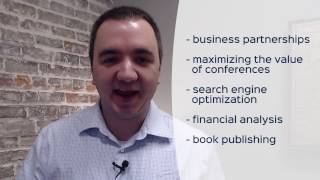
Episode 20 of Startup Q&A (host Matthew Paulson) provides practical, action-focused advice for small business owners and entrepreneurs. Key topics: choosing and structuring business partnerships (trust, alignment, written partnership agreements and templates), whether to take a conference booth (sell directly to an audience vs. attending to network), SEO fundamentals (prioritize quality long-form content and backlinks rather than chasing algorithm minutiae), simplifying financial reporting for non‑numbers people (one-page summaries or a short list of key metrics), and a modern self-publishing workflow (Amazon KDP/CreateSpace, Draft2Digital for other stores, ACX for audiobooks, plus online marketing via Amazon ads and BookBub).
Chapters
Hey everybody, Matthew Paulson here. Today we are going to talk about business partnerships, maximizing the value of conferences, search engine optimization, financial analysis and book publishing. Let's do this. This is officially episode 20 of Startup Q and A. The online video show that helps small business owners, startup founders and entrepreneurs grow their businesses faster and achieve their dreams of financial freedom. So whether you're just getting started or if you have 100 employees, this is the show that will give you actionable ideas and advice that you can implement in your own business. Now at Startup Q and A, we believe the best way to achieve financial freedom is to build a cash flow generating business and invest the profits into income generating investments. We don't believe in building big high growth businesses that you'll hopefully eventually sell out to a big company for one day or go public with it. We believe that your business should actually make profit and that you should benefit from that profit. You should take that profit, you should put it into income generating stocks like closed end municipal bond funds, dividend stocks and real estate. You put all the money from your profit in your business, you put it into these income generating investments and eventually you'll be at the point where, where your income generating investments throw off enough cash to cover your living expenses and then you're essentially good for life because your investments will cover all of your expenses and you don't need to make any money from your business or from a day job and you can literally do whatever you want. I'm not saying that you stop working at that point, but then you have the complete and total freedom to only work on the things that you want to work on even if they don't make you any money because all of your expenses are covered by your investments. So start a business, make some profit, put it in income generating investments, live off those income generating investments, do whatever the heck you want. That is the plan that I am following with my own life and the plan that I advise other people to. And that is the plan I will teach you on this show. All right, so before we dive into the questions, let's move into the tip of the week. Provide you a tip, trick or idea that will help you grow your business faster or achieve your dream of financial freedom. So this week's tip is to use the tool called Slurpee S L E R P E E to improve how your web pages appear in search engine results pages. Now Slurpee is a tool that will allow you to preview how your web pages will look when they show up in Google search results. So how it works is you give Slurpee a URL and then it'll show pretty much what Google's listing for the page will look like. Now, most people do their page titles and page descriptions wrong. They make them too long and then they end up getting in Google because the title or description was too long. And half your message is seen, half the message is not seen, and then it just becomes kind of an unreadable mess that people are just less likely to click on than if you had really taken the time to think, okay, what is the best text that I can fit in these? 70 characters available for the title or around 160 characters for the description. So Slurpee will kind of take a webpage, make sure you're under Google's limit, make sure it looks good, and will give you more compelling search result listings in Google search results, which will make people more likely to click on your results than somebody else's. Over time, this will actually increase your search engine rankings because say you type in a keyword, somebody's rank seven, somebody's rank eight. The person at rank eight has a really compelling title and description that fits in the space allotted. More people click on rank 8 than rank 7, and then eventually those two will flip and what was your site that was rank eight is now rank seven because you had the better search listing. So go ahead, check out Slurpee. It's a free tool. It's slrpee.com hard to spell that name, probably not a good name, but it is a really nice, simple tool that does one thing and does really well. So go ahead and check it out. So that is the tip of the week. Let's dive into the questions. So every week we take four or five questions asked through Facebook or through our website and answer them as best as I can with the skills and knowledge that I've collected throughout the years. So if you want to submit a question to the show, go to the domain startupqa Co that will take you to my website. In the navigation there is a menu item under Startup Q and A. I'll ask a question. There's a form there to submit a question. I also periodically just ask on Facebook and LinkedIn and Twitter if people have questions. And I take questions from there too. All right, the first question comes from Daniel Gold. I saw Daniel over the weekend in San Diego conference called Traffic and Conversion. And he's good to run into him again. But he says, what does a good partnership look like? Or what does a good business partnership look like? What kind of operating Agreement should you have in place with your partners. I met with a young entrepreneur for coffee the other day, and he had two separate companies that wanted to partner with him. It was a construction company, and one partner was in a tangentially related business that wanted to expand to doing more construction. And the other one was kind of a business services firm that takes equity in people's companies in exchange for providing some services. They were going to look over his legal stuff and maybe help with marketing and maybe give him some connections. I really don't know what my first question to him was. Okay, you have these opportunities, but do you know, like and trust either of these parties enough to marry them? Because that's what a business partnership really is. It's a marriage. You are going to be spending a lot of time with anybody that you are a business partner with. You're going to see their good side, you're going to see their bad side, and everything in between. There is just no escaping the raw personality of your business partners. You can't fake it because you're around them so much. When you're in business together, you're going to be seeing them a lot. So really that's kind of the bar you need need to reach with a business partner. Gender and sexuality issues aside, you really have to like somebody enough that you're willing to pitch your wagon to them for maybe a decade. Sometimes businesses will go on for that long, and you have to be prepared to be spending eight hours a day with that person, many days for that long period of time. So it's really, you may spend as much or more time with your business partner as you do your spouse. So you really have to think of it like, I'm going to marry this person and I'm going to spend a heck of a lot of time with them. Now you and your business partner are going to be sharing money together. You're going to be moving toward a common goal. You really have to trust them because you're sharing money together. If you know somebody enough, you like somebody enough, and you trust somebody enough, that's really at the point where it's okay to start thinking about becoming business partners. I asked this person, I was having coffee with this question, and he said he wasn't there. I was like, well, that kind of answers your question. You probably shouldn't be business partners with these things or with these people. Now, if you are a successful entrepreneur, you are going to have a ton of people that want to partner with you on lots of different things. People love to attach themselves to success. Sometimes it works out well. A lot of times it's just a complete and total waste of time to partner with somebody on something because they're expecting you to make it successful and you're expecting them to make it successful. And then nothing really happens because you are both kind of banking on each other. If you're making money, it is really only a matter of time before people start showing up volunteering to work with you. They want you to invest in their business, they want to join your business. People love success. People love to attach themselves to success. So if you're having any amount of success in business, this is going to happen to you if it has not happened already. I probably get two or three requests every week for people that want me to invest in their business. They want to invest in my business, they want to work for me. I got a cold email yesterday night from some guy that wanted to apply to be a systems engineer, level three in my company. I don't think that Guy realized that MarketBeat has three employees. So you get a lot of crap like that. Just be prepared. That's part of the. Part of being in business is that you are successful. People will want to attach themselves to you. So for me, given that there are all these opportunities that keep presenting themselves, I really set the bar pretty high on these things. Sometimes I just joy mentorship, somebody's looking for a job. But unless the answer for me is a hell yes. Yes, absolutely. Let's go do this right now. This is a brilliant idea. I can't not possibly do this. This is something I have to do. Unless it's that I won't do it. Because I don't know. Was it Derek Siver somebody? I think that was who it says kind of first kind of popular ideas of something has to be either a hell yes or no because you only have time to do the things that you're most excited about. That is kind of the bar that I have set for partnerships. I've got to be really excited about it. Can't not do it. Otherwise it's a no. Because there are just too many mediocre partnership opportunities. And I don't need to say yes to any of them unless I really, really want to do it. Finally, last part of my answer to this, my long answer to this question is that you should definitely have some kind of partnership agreement in place. I have one for all of the businesses that I have partners in. So us, Golf tv, we have one of these. Google photo contest, we have one of these. Every company I've invested, has some kind of legal agreement in place for their limited partners, which in most cases, that's what I am. So the agreements that I write for, like if I'm, you know, I'm in business with Jason and Stevie Shay on Google Photo Contest, we've got a written agreement. You know, it's not something that's necessarily all that long. I think our agreement is maybe three or four pages. We never looked at it, you know, had an attorney look over it because, you know, we just know we like and trust each other enough that. Well, or if somebody, something, if the business isn't going to work out anymore or one of us doesn't want to be in it at that point, we'll figure it out, negotiate it from there. Maybe you should have your stuff reviewed by an attorney. But I never did, and it hasn't bit me in the butt yet. The agreements that I write, they pretty much just outline the responsibilities about both parties. What happens if somebody wants to get out who owns what percentage of the business, what money people are putting into the business, what rights they have, and how disputes are settled? There are plenty of templates online for this kind of thing that can get you started. Other than the legal value of these things, the real value is just getting everyone exactly on the same page. So it's on paper. We all know what we agree to, and there's not a he said, she said situation later if there comes to be a disagreement, because it's all on paper, you all signed it, it's all clear, and nobody can argue with what the piece of paper says. So definitely have a business partnership or partnership document in place. All right, the next question comes from Josh Sapienza. Josh asks, is it better to attend conventions as a presenter with a booth or an attendee mingling with other attendees? I really think this kind of depends on whether or not you have a specific service that you are trying to sell to the audience of that convention or the conference. If you don't have anything directly to sell to people, you're just looking for maybe some business partnerships. You don't really know what they are going in. You probably don't need a booth. But if you have a very specific product that you know that the customers of that product for or at the conference, you're going. That's really when I would consider doing a trade show booth or a conference booth. I mentioned I was just in San Diego for Traffic and Conversion, a conference put on by digital marketer. I have a couple friends, Dave Parkinson, Andrew Pincock, they run a company called Spreadeffect. It's a search marketing firm and they are coming out with a product called Spread Local, which does local reviews for local businesses. That conference was a perfect fit for them. A lot of their potential customers went to this conference. So they got a booth, they got over 100 leads, they had several people sign up right there on the spot, swipe their credit cards, and they definitely made back the amount of money that they invested into that conference and then some. So they had a really nice looking booth. They had a competition going on. They just did a good job of standing in front of their booth, not behind it, and just talking to everybody that came by, giving them their pitch. So, yeah, if you can get a good conference booth in a good heavily trafficked location, you've got something to sell, it can definitely work out for you. I know there are people that are my age and think it's an old marketing strategy, it's a waste of time. But people keep paying for these things year after year after year, so clearly it must be working out for them, otherwise they wouldn't be doing it. So if you've got something to sell that's relevant to the audience that's there, it's definitely worth considering. Next question comes from Will Powell and he asks, how important are written and video content in regards to improving SEO? What are some techniques that you have used to improve your SEO so you can go really far? And deep down the SEO rabbit hole? There are entire books, conferences and companies dedicated to following what Google does and providing information and advice about how to improve your search results. This is something I'm not a huge expert in. I know enough to be dangerous, but I'm not the guy that follows it every day. That's not something I have time to do. So you can go just really nuts learning about SEO. You can listen to podcasts, you can read books, you can go to websites every day. Really, it's just a question of how far down that rabbit hole should you go? How deep do you want to get into this? I do think there's kind of an 8020 rule that applies to SEO. You should do probably the basics well, but for most businesses, you probably don't want to be an expert in SEO because that means you spend a lot of time on it and you're not spending time on other parts of your business because there is a trade off with what you spend your time on. For most companies, I don't think SEO should be a key marketing strategy because it's not something that you can control. Google can Change their algorithm 24 hours from now and you could lose your business. If your primary marketing strategy is Google search results, they change the game. You're not ranking well anymore. There goes all your business. That's probably not something that you want to bank on. To answer your question, I think for SEO there there's probably just two things that you want to think about. One is having good content. Google likes long, rich, unique content with videos and images that you're not just going to find on any webpage on the Internet. They love unique content. Their search algorithms are smart enough now to ferret out unique content and separate the good stuff from the bad stuff. It really is that good these days. So make good content. Write about the questions that your people are asking. There's a ton of people that have built businesses around creating great content for companies and sharing ideas for how to get ideas for your content. Copyblogger is a great example of that. They have a ton of resources on how to figure out what to write about and then how to write good content. That's kind of step one is to have something unique to offer the marketplace. Good long form content with rich media in it. Images, audio, video, all that stuff is really good for your search rankings. You want to have stuff that people actually find valuable. Then over time Google will surface that in their search results. Then the second part of SEO basics is just getting some links back to your website. Most people know that Google ranks. A good chunk of why they rank their sites is based on the links that go back to your website. So if ESPN links to your sports site, that is going to mean you are probably more authoritative than if somebody with a no name blog links to your website. If espn, CBS Sports, Fox Sports, whoever else is linking to your website on a regular basis, Google is going to see your website as being authoritative in sports because all these other authoritative sports websites are linking to your website. So really the question then becomes how can I get these websites to link to me? And there is a whole other sub industry of SEO dedicated to that. But sometimes you email people from ask for links, sometimes you do a guest post on your website. There are a ton of different ways to build links that are very legitimate and stuff Google will never complain about. But it is something you have to actually do. You can't just wait for links to show up. And getting into the details of how to do this is probably too in depth or will take too much time for this show. But those are really the two fundamental components of SEO. It's content and it's links. So if you can do both of those well, you're going to rank pretty well in Google search results without having to go too deep down that rabbit hole. So the next question comes from John. I think it's Royce. John. Sorry if I pronounced your name wrong, but John says it hurts my head to look at spreadsheets and interest rates and stuff. Is there something smarter an ADHD guy like me can do instead of throwing my own mail away from Edward Jones without having to put trying to put a square peg in a round hole? So if you're not good at math, you've got a learning disability, adhd, whatever. However your brain is wired, you're just not good at poring over a spreadsheet. You just don't have the patience, energy, intellect to do that. You know what, what do you do? John has pointed out one solution. You can just not think about it and pretend it's not there. That's not a good solution. I really do think that everybody has the capability to understand finance at some level. Really, the question is, you don't have to prepare your own budget or your own set of books for your business. I don't do my own books in most of my businesses, and that's because it's not a good use of my time. So really the question is, how much detail do you want to see or should you be seeing? So at Sioux Fall Seminary, I'm on their board of trustees. And one really interesting thing that they do is that there are two sets of financial reports presented. There is one that is very detailed, has all the little different budget items, and that gets shown to the Finance committee so that we can. I'm on the finance Committee. We can dig into just every little line item and see trends and changes in those things. But then the larger board, they only get a summarized version of it that's kind of a one pager that shows just kind of the big picture. So the people that love math and want to get into it are on the Finance Committee. We can see all the detail we want. But the other board members that aren't so financially inclined, they get a one pager that shows kind of the big picture trends. So if you're a financial advisor or your accountant is handing you reams of paperwork that are too complicated or just too much for you to read, ask them to simplify it. Say, show me the 10 most important numbers that I need to pay attention to and how they've changed. Do that. That way anybody can look at a piece of paper with 10 numbers on it, how they've changed. That will take you five minutes to do, and it will give you a basic understanding of how things are changing in your a retirement account or in your business. All right, the last question is a question I heard just a few times over the last few weeks. Nobody specifically has answered this question or asked this question, but really it's how would you recommend publishing a book in 2017 and beyond? So first, a ton of people are asking me this lately. I guess when you have eight books in the market, people think of you as a publishing expert. Even if you don't want to be seen as a book publishing expert, you are the expert because they don't know anybody else. So let's say you want to sell a book this year. How do you do that? I think first, it's very important to start with a recognition of how books are sold today. Half of all books are sold through Amazon. They literally have 50% of the market share. Another good chunk is sold through other online ebook stores. So Kobo, Apple, Ibooks, Google Plays bookstore. A lot of books are sold that way. It's a very small minority of books that are sold into places like Barnes and Noble or, you know, Walmart in the popular press section. That is actually the minority of books these days. And you're probably not going to get your stuff there anyway. So I just wouldn't even focus on it. So given the reality of how books are sold today, I think that really means you need to adjust what your publishing strategy looks like. I would start with an online first strategy. So your Kindle book, your ebook, that's probably your primary copy of the book. And then the paperback and the audiobook are kind of secondary to that. So all the books I published, I've never really bothered to get a traditional publisher. I applied to one publisher. They said yes, believe it or not. But the deal just wasn't very good because I already had all the people to do all the stuff they would do for me, and it was just cheaper to keep using the system I had than to have them do it, learn their system, and pay them half of my royalties. Just wasn't a good deal. So I didn't do it. So I've been offered a publishing deal. I said no. So the way I publish all my books is primarily through Amazon and then through other ebook channels as well. So the paperback copy that we sell, you can buy that on Amazon.com they're created through CreateSpace. Whenever Amazon sells one, they print one off and then they ship it. I never have to hold inventory. I make the same probably royalties as anybody else does. I think I make 25, 30% on a paperback book that gets sold. I pay no production costs or anything like that. Amazon just prints the books, ships it out, sends it to the customer. I never have to do anything other than receive some money. Ebook I publish through Draft 2 Digital and then Kindle. So Draft 2 Digital covers pretty much everything that's not Kindle and then Kindle covers Kindle or Kindle Direct Publishing covers Amazon Kindle. So Draft 2 Digital is an aggregator. They send it off to Kobo, Apple, Ibooks and a bunch of the other smaller ebook stores. I think it's good to kind of cast a wider net these days and not just hit Amazon, but you want to hit Amazon, but you want to hit everybody else as well. Then for the audiobooks that I do, I use acx, that is another Amazon company, but they publish audiobooks to itunes and the Audible bookstore. I've done very well with my audiobooks business. Audiobooks tend to do pretty well because it's a lot of people listening in their car or on planes or in places where they just don't want to read books. So, yeah, that's kind of how we do it. I really think that you need to just take a more moderate approach to book publishing. Don't beg a publisher to approve you and give you the thumbs up. You just don't need that anymore. Any contractors that you need to do your book cover or editing or layout, you can find these people online and they're really not that expensive. If your book is successful, it's going to cost you much less to hire these people out directly than it is going to be to have a book publisher do these for you and take a good chunk of your royalties for literally the rest of your life. I just don't recommend that. I also think you need to take a more modern approach to marketing. The old idea of going from town to town, bookstore to bookstore, doing a bookshelf, stuff like that, trying to get popular press. I think that's a strategy that's largely come and gone for most smaller authors. I just don't think it works as well as it used to. If we're operating under the assumption that most books are going to be sold online, then really you need to take an online approach to your marketing. So I want to put ads in places where people are already looking for books so then they can find my book, buy it, and then I get A sale. Two ways that I do this that work really well. One is Amazon Marketing Services. Amazon has a whole sponsored post or sponsored product section. You can pay a little bit of money here and there to get your product into that for other people's products that are relevant. So let's say I want to promote my book Automatic Income. I might target the investing section of Amazon where I might target target other investing authors. So when you're on their authors page, there may be an ad for mine. You click through, you buy it. I make money. That's worked out really well for me. The other ad kind of buy I do is BookBub ads. Now BookBub is kind of a discounted ebooks newsletter. So every now and then I'll put my books on sale for like 99 cents and then I'll do a BookBub ad saying, hey, go buy my book for 99 cents. And then somebody will buy it. Usually the ad campaign breaks even and then after that, hopefully I get another reader that will go and pay full price for all of my other books. So those are the two kind of key marketing strategies that are completely online that have worked well for me. I can't say that I'm a huge New York Times best selling author. I probably sold between probably around 25,000 ebooks so far or 25,000 books between ebooks, paperbacks and Kindle ebooks, paperbacks and audiobooks. And I probably also gave away another 25,000 for free back when I was using free downloads on Amazon as a strategy. Don't do that so much anymore. But I could argue that I have 50,000 downloads of my books or sales or whatever, and that's pretty good. But there are definitely people that have done a lot better. To me, one thing you don't need actually is a huge audience before you get started. So my friend Steve Scott, if you search on Amazon and nonfiction books, you've probably run across his stuff. But he has, I think about 60 books on Amazon and he makes about $30,000 a month in book royalties, which is, you know, good for him. But he didn't have a huge audience before this. He still doesn't have a giant audience. He has a website called the Authority pubacademy where he teaches how to do nonfiction books. But those probably aren't the people reading his books. So he has done just very well doing his online owning strategy using some of the same marketing strategies that I've mentioned. And I think he's really providing us a model for what book publishing looks like. In 2017 and beyond, he didn't have a big audience and yet he outworked everybody else, wrote a bunch of productivity books, promoted them well, and now he's making about 30 grand a month in book royalties. So good for you, Steve. All right, those are the questions. So if you would like to learn more about building an online business, make sure to grab my latest book. It's called Online Business from Scratch. You can get a copy of that on Amazon at the domain fromscratchbook.com if you watch any video, it should be on the bottom. Here we have that book available as a paperback, an ebook and an audiobook. If you would like to subscribe to next Monday's show next get it delivered to you automatically go to the domain startupq and a co. There are links to subscribe via email. Facebook r iTunes, YouTube and Stitcher. We really try to be everywhere we can be with this show. You can also follow me personally on facebook@facebook.com MatthewPolfonPage if you want to be Facebook friends, that's facebook.com MatthewPulfsen Twitter is MatthewDP. So Matthew D as in Dale, my middle name P as in Paulson. I'm also on LinkedIn. Find me there. If you enjoyed the show, go on itunes, take a few minutes, leave me a review, give me some feedback and advice for the show. The best way to get a podcast out there is to get a lot of reviews on itunes and hopefully Apple will raise it up in the rankings and then more people will find out about the show and get inspired to start a business and work toward financial freedom. So please leave an itunes review if you've got a few minutes. I think that's it. So thanks for watching. I'll see you next week.








