What happened when I agreed let people "ask me anything."
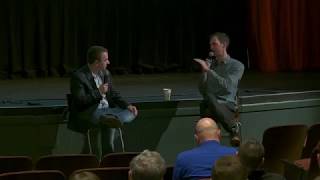
Matt Paulson, founder of MarketBeat, answers audience questions about building his financial data company, how it makes money through ads and subscriptions, and what he learned from seminary about leading people.
Chapters
Everyone, come on in. Grab a seat. We're gonna get started here. It's a great morning to have a coffee. So I was giving everyone a little bit extra time to enjoy your nice, warm coffee here at one million Cups. How's everyone doing today? Good, good. I knew that. I told Matt, I said, matt, you're gonna be a big draw. People are gonna come out to ask you anything they want to ask you. So we actually had a cancellation in our original speaker lineup, and I said, what if we try this? And I think it's going to be a lot of fun. So we are doing our first ever AMA with an entrepreneur, and it's the person who usually gets to. Who usually tries to ask all the questions. So now it's our turn to ask him the questions. So show of hands. If you are a first timer at 1 million cups, first time you've ever been. Oh, wow. More than I thought. Okay, we're gonna do this, Craig, so we're gonna do this quickly, but just give us your name where you're from. We'd like to introduce our newbies, so tell us who you are.
Well, good morning, everybody. My name is Josh Hayter, candidate for state treasurer.
I'm from Huron, and it's a pleasure to be here.
And this is my wife Amanda, from Huron as well.
Say hi to Amanda. She can introduce herself. There you go, honey. Get up and do it. Sorry.
Amanda Hayter here on Supplement Dakota.
Welcome. Thanks for coming.
Christy Golden, Hartford, South Dakota. And I work with Cyber Climb, in which we do digital marketing.
Okay. She's been here before. She's a regular, I think the gentleman in the blue coat or. No, sorry. Oh, yeah. Valerie, you've never been.
Yeah, it's kind of embarrassing. Valerie Wilson. I am with the Sioux Falls Area Chamber of Commerce. I usually watch this online, so, yeah, it's a little embarrassing. This is my first one, but wanted to come see Matt, so. All right.
Valerie was one of our co organizers of the Jesu Falls event, so she's very helpful. Yes, sir.
Shields.
I've been here in Sioux Falls about three months, work at kdlt. Will comes in, does a Wired Wednesday and invited me down. And so I'm a musician and pretty impressed with Sioux Falls, so good to be in the room with y'.
All.
Great. Three months. So welcome to town. This. This is definitely one of our goals of 1 million cups is just to meet new people, so. Yes, sir.
Mark Opp.
Edward Jones, first time coming to us.
Of course, and financial advisor here in town.
Welcome, Mark. Did we get everybody gentleman over there in the back.
Mike Stevenson. Mike Stevenson, I'm with Miristar Real Estate.
Thanks, Mike. All right, so for those new people, since did we get it? Okay, cool. What are you signing up for? What did you just come to? 1 million cups is a weekly event. We do it here at the Orpheum or sometimes on the other side of the Orpheum and then one time a month out at Zeel, the center for entrepreneurship. But this is an event that goes on in about 150 plus cities across America started by the Kauffman foundation out of Kansas City. So to help and grow entrepreneurship and foster community, we're here every Wednesday and usually you hear from a speaker. They get six minutes to tell you their story, their origin story, what they started, the company, the project, the nonprofit, you know, where they got the idea and where it's going and growing. And then you guys get 20 minutes to ask that speaker questions. And so this time today we're going to change that up a little bit. I'm going to ask questions with Matt until I get sick of asking questions and then I'm going to let you guys ask him questions. And we're just going to do an AMA with Matt, one of our, I'll say most notorious one million Cups attendees. So one thing we do here at Sioux Falls every week is a quick calendar of events. So let's see, it's late October. If you have an event in the next, we'll say three ish weeks that are coming up, you may make your way over to the microphone and tell us about it. There's so many things you can do that now. There's so many things going on in our great city of Sioux Falls and we want you to know about them. So if there's something you want to share, this can be community related. Entrepreneurship, business, networking, art, culture. We're open to hearing about it. So Craig will give you the mic and tell us the who, where, when, what, why.
Good morning, I'm Greg Boris and you all work hard so you need to have fun. And tomorrow is the first of about eight nights of ceilid dancing at this old courthouse museum. Irish ceilid dancing. You don't need a partner, you don't need to know anything. Just come and have fun. Live music and starts at 6:30 to 8:30 Thursday, usually the fourth Thursday of the month. And there are posters in various places in Sioux Falls. So live Irish Kaling dancing will teach you what to do and you'll have live music.
There you go. That's something. Something new for sure. Yes, ma'. Am.
I am gabby with Core Cares in home services and we're having a community education event on communicating with those who have dementia. It'll be on November 1st from 12 to noon at our office, which is by Fuddruckers. It's 3101 West 41st Street. And you can find more information on our Facebook page, facebook.com corecares and that's with a K, K O R e. And then cares.net. facebook CoreCares.
You bet. Valerie.
Hi, guys. Valerie, as stated before, I'm with the Sioux Falls Area Chamber of Commerce. We actually have our morning mingle coming around the corner. October 31st, we are going to be at the Boys and Girls Club and we're going to. It's just basically a networking, socializing coffee. Coffee's provided by Caribou. And we're encouraging Halloween costumes because it is the 31st and we're gonna have a prize for the Halloween costumes. The location of this Boys and Girls club is the one that's on Sneeve. It's about three blocks from Sturtevan's Auto Parts on East 10th. Yeah, East 10th Street. I'm going to break the rules again. We also have our holiday fair coming around the corner too. That is going to be November 20th. It is a expo. We have 42 booths that we do have booth space available for anybody that is a chamber member that is interested in having a booth at our holiday fair. The cost is $175. So contact me if you guys are interested in having a booth.
Cool. Thanks, Valerie. All right, there you have it. Things to do in Sioux Falls. So let's get right to the show with that. Let's see. Oh, we got a mic. Perfect. Let's welcome to the stage one of our co organizers of One Million Cups and the founder of MarketBeat.com, matt Paulson.
Hello.
So give us the. For folks who don't know, what do you do?
So, Matt Paulson, I run a financial media company called MarketBeat. It is a service for people that invest in single stocks. So typically the scenario is our audience is primarily a male, 50, 60, 70, 80 year old. So kind of an older audience, affluent. And they own 20 to 30 companies. And if they want to know what's going on with their stocks, you have the choice.
They own like stocks or they own 20 companies or 20.
So to keep track of them all, you'd have to go to Yahoo Finance or go not Google Finance anymore. Like one at A time just to, like, see what's going on. We aggregate all of the news and relevant financial information, then personalize it based off the stocks you own, and we send out a kind of a daily news update for the companies that you're invested in.
My understanding is you wrote the code for this, like in college, right?
It started, yeah, the code.
It was like a blog at first.
Yeah, yeah, the code base originally. Yeah. So we started personal finance blog. It was called American Consumer News. I'd write four articles a day, then I'd share them to like dig.com and all the other social sites of that day and just try to scrape traffic and. Or scrape as much. Scrape up as much traffic as I could get. And I kind of grew that to maybe it was probably 100 grand a year business by three or four years into it, but it kind of capped out there, and that's kind of when the pivot kind of started to investing.
Okay, so I probably will ask you less questions about Market B. I mean, you guys can ask whatever you want. That's the idea. I like to know more. The origin of, of people as entrepreneurs. So did you think that you would be an entrepreneur when you were, say, a young buck?
So I was the kid that went through the park next to my house and picked up aluminum cans and recycled them for cash. I had a website about SimCity in 8th grade, and I made like 25 bucks a month from it. And that paid for a lot of mellow yellow back in the day. This is before I switched to diet Mountain Dew dmd.
Okay, and what, what drove that? Like, were you motivated by, like, the game? Did you want to make money so you could then buy things that you wanted as a kid? Or, like, did. Did your parents instill that in you?
No, I think it was mostly out of necessity. Like, we were not a super wealthy family. I mean, there's always food on table and a roof over my head, but, like, I didn't really get a lot, like get any significant allowance. I think I got like maybe a dollar a week and then $5 a week in high school. So if I wanted money, it was pretty much I had to find a way to like, work. And at the time, I used the best options, what I thought were the best options available to me.
So a lot of people, I feel like, who grow up learning how to code and have some sort of origin story with technology or with machine computers, you took them apart or you got your first computer at a certain age. What was your introduction? Or did you not do coding until you went to dsu?
No. So the kind of unfair advantage that I had was my parents had bought like a home computer for us. Geez. Maybe fourth or fifth grade or sixth grade. I can't remember now, but it was like a Pentium 133, 16 megs of RAM and in I think 98 or something like that. We were like one of the first families in the city to get cable Internet. So when everyone else was limited to like 10 or 20 hours a month, you know, we had a couple megabits the phone bill. Yeah. And just unlimited Internet time. And then with my SimCity website, I was able to save like 800 bucks and I bought my own computer in like 8th grade. And then it just went, you know, went from there.
Still have the SimCity website?
No, I've been trying to find a copy of it on archive.org and I just, I can't find it.
I bet you still have the domain though.
No, this was like before. This was like when domains were $100. Geopher.
Geopages.
Yeah, it was geocities. Com.
Look it up, look it up. Bookmark it. Favorites. Okay, cool. So you go to dsu. I think most folks probably know this, but they put out some really talented young students who many of them get placed in really great jobs in the government and Microsoft. And did you think, yeah, I'm going to go get this great job or did you say, I'm getting out of here and doing my own thing?
Yeah, I mean, early on in college I thought that would be the case. You know, I'm going to graduate college, I'm going to get a job and I could make 40 to 50 grand a year. That's going to be a lot of money. You know, as a college student that, you know, made 10 bucks an hour, that sounded pretty good. And I did get that job out of college. I did web dev work for a company out of Peer for four or five years.
Oh, you did? Okay.
Yeah. Yep. And you know, it was pretty. We had an office for the first kind of year or two and then it was all remote, so everything kind of just kind of blended in. And when we had our baby, Micah, that's kind of when I said, well, I don't have enough time to be a dad, have a job and run my business. So that's kind of when I made the jump to run MarketBeat full time.
Sure.
That's probably six years ago now.
Okay. So it started as a side hustle and then became its own thing.
Yep.
I always like to ask this question. It's a two part question. What is your. What does your greatest day as an entrepreneur look like? And then conversely, the worst.
That's a good question. I think my greatest day involves work. It's not a day off. I like to build things, I like to create things, turn nothing into something. So a great day is for us to launch something new that people find value in. The worst day is. I don't know, I think the worst day is either. So like our previous web host was down for like 48 hours, which is just like death in the Internet business world. And there's literally nothing I could do about it. That was probably the worst day.
So like the site crashed, you mean?
No, like they had to move the server to a different rack and there was some weird power stuff.
Oh, the site was just down for 40 hours. Got it.
So I ended up restoring from a backup to a new web host, like 24 hours into this. And it was just a terrible, terrible day.
So then, similar to that question as you, I think as entrepreneurs we learn so many things as we go. Right. Everything we learn is probably because of making mistakes. So what looking back at MarketBeat is still going, but looking, we'll say like 10, 30,000ft at MarketBeat. What do you love about your business? Like, what are you like, man, I, I really did that. Right. Whether it was accidental or intentional. And what do you wish you could change about MarketBeat?
Yeah, so MarketBeat, it's a business that relies heavily on automation. It's a mid seven figure business that works with. Just works. There's four employees that work at the company. Two of us are full time, two of us are part time. So in terms of leveraging technology, did.
You guys hear that? Two part time, two full time, mid seven figures. That's impressive.
Leveraging labor and automation and systems and processes is like the best thing about MarketBeat. I often do wish, you know, I could work with an audience that's maybe a little bit more tech savvy, so we could do some more innovative and new things, you know, to get like none of our, none of our, like, we can never advertise on Facebook because our audience of primarily older men are just not on Facebook in large numbers. So I was like, that's not available to me. So I don't know, it would be nice to work with a younger audience. But we never really set out to target the demographic we have. They found us and that's kind of where we're at. And we're going to be at as long as they own this business.
Sure, sure. I'll take two more and then we'll open it up. I remember meeting you. I think it was 2013. Will Bushy actually introduced us. Thanks, Will. Because we were putting on the very first Startup Weekend here in Sioux Falls. And I remember Will was like, I need you to meet this guy. I think he might be interested in sponsoring. So we met at, I think, Spizia, that we had lunch and we ran this event and ended up running out the. Running the event for like three or four grand that year. It was for our total cost. And so I remember sitting down with Matt and I was like, well, I think, you know, we need. Do you think you could do like 1500 or 2000? And he's like, yep, I'm in. Then I was like, shit, I should have asked for more. Because I think he ended up being like, I would have just said yes to whatever you said. But I think that. Because that was really. I remember, I tell the story because it's funny, but also that was a moment where I met you. And then it felt like all of a sudden you either. I don't know if it's strategic or just a mind shift, but to me, you were. Not that I know all the entrepreneurs, but I felt like I knew a lot of the entrepreneurs and I hadn't seen you kind of in the game, right. I hadn't seen you at places out and about, and that made a big, monumental shift. And now you're, you know, very involved and very passionate. You write posts about what our entrepreneurial community needs, you. You help us with events like this. What. What was the change?
Yeah, so I'd been working at home by myself for probably two years by that point. Kind of maybe a year, year and a half on at my day job, and then a year self employed. And I kind of realized, you know, I'm an island here and I probably won't grow if this is what my plan. And I wanted to be engaged in the community to build relationships to, you know, have opportunities. And, you know, also, like, you know, like, there's the idea of kind of a third place. You know, you have your home family, your work family, and then maybe a place after that. I had my home family, love, my wife Karine, great person, but I didn't really have the work family, and I didn't even really have the third place either. So just like, I was kind of looking for where are my people at? And I think I found them.
Aw. All right. So we're Going to open it up. I haven't given you any hard questions yet, but last one, who made that amazing logo?
You guys have this local design company called Lemonly.
Oh, nice.
Not sure I'd hire them again, kind of hard to work with.
Had to get in there. Okay, raise your hand. Let's questions AMA for Matt. We'll get to as many as we can. As long as you guys want to stay. Well, up until 10, because that's always my promise. Gotta really walk the long way. Yeah, just raise them up, guys. We'll just go. We'll just go by proximity. Matt's an efficient answer.
And Matt, congratulations on what you've done.
And I guess two questions, not really related, but I mean, where do you see the ceiling for your business? And obviously there's competitors that offer a similar service that you offer.
How are you going to continue to.
Innovate that and then shift gears here a little bit? 99% of the people in this room will never code anything in their life. But you've proven that you can take your skills and magnify that into a bigger business. Those of us that will never code, do you have any advice to how we would work around that problem and still be able to figure out something to magnify to build?
Okay, so the first question is, you know, where do you think you're going to cap out at? So we were at 2.5 million two years ago, and I honestly thought I was capped then. We've doubled the size of the business since then. So I don't know if it's how my brain's wired, but I always think I peaked and there's nothing else that I can figure out how to work. But we keep hitting new milestones every year.
What do you attribute that to?
I keep learning stuff and trying different things.
New exposure to new people, new ideas.
Yeah, our competitive advantage, to answer that question, what a lot of our competitors do, they use kind of third party, off the shelf tech. And that kind of limits how creative they can get. So for us, if somebody clicks on a sales link to a landing page, I can just log them in automatically. And other people, they would have like a step in between. So I can reduce kind of that friction between the customers and what they want them to do with my technology that other people can't. So if I can kind of simplify that funnel, you know, it would be higher conversion rates, better sales. I'm also better at acquiring email signups than about anybody. We are between the leads that we buy and then the Organic signups we get. We're at over 50,000 email signups a month, and nobody else in our industry just knows how to do that as well as I do. Your second question was, how do you leverage automation?
I want to take inventory quick. I hope this room is a little bit better than that. Raise your hand if you've written code before. All right, there you go. I know. Typical rooms. Typical rooms.
Yeah.
Just wanted to rep the people who were writing code.
Yeah. So I think the key with, like, how I've been able to scale MarketBeat is just have really good processes and they don't have to be written in code, like, for. There's a lot of tasks that are in our business that you can't really automate. So we write a standard operating procedure for each of those, and then we set kind of a recurring task for somebody to do that. So it's almost like writing code for people. And that works pretty well for us. And that way, if somebody leaves, which honestly. My first employee, Stevie's been working for me for five years and is still around. Rebecca's still around. Nobody's quit on me, so I haven't had that problem yet. But I like the idea of having repeatable processes that you can handle about anybody. So I'm willing to spend more time on that documentation up front, and then hopefully it'll save me some time down the line.
Yeah. That's one thing I definitely admire about Matt, his automation. And I think all of us, if there's something you do in your business at least a weekly basis, you need to write a playbook, like a process so that it can be either automated or even delegated down. Right. Like, what's the value of your hour, the value of your time? And if it's something, if someone can do it for less, and I know you think this way, then, you know, delegate that down and spend time on the high value task. All right, who are we going to next? Yes, sir.
Go up to the 30,000 foot level again. We've got an election coming up in a couple weeks. And what do you see local, state, or federal government doing right or wrong that helps? That affects entrepreneurs. And what would you like to see local, state, or federal government doing to help entrepreneurs?
Yeah. So I'm pretty happy with our state in terms of. Mostly in terms of what they're not doing. You know, it's really easy to start a company here. There's not a lot of red tape, and they mostly leave you alone. The Department of Revenue has never bothered me in any serious way. So in terms of that stuff, that's really good. Federal stuff, I think is kind of a mess for everybody and I don't know how to fix that. One thing I would like to see is, which is kind of hard to do because we don't have a state income tax, but North Dakota has tax credit for angel investing. And so I think it's, I don't know what the rules are, but if you put money into, invest money into startup companies, you can get some kind of tax deduction or credit for that. And I think that has helped them spur more risk, kind of risk capital or venture capital investing in that state than what we have. So I don't know if it's politically feasible, but I'd love to see something like that where it's incentivized to take risks on companies.
Matt, do you ever think you'll be involved in politics?
Maybe. It'd certainly be at the local level if I was, and I don't think it'd probably be for five, 10 years.
You heard it here first.
Hey, Matt.
Hey, Clint.
I just have to say before my question, I so appreciate you because I think you're probably one of, if not the most generous 30 somethings I've ever met with your time and finances. And I know you're very, very private about that. But for those of us who've seen it happen or recipients, you're a life changer. So I appreciate that. One of the questions I have for you, and I think, because people know I know you, so they ask me, is I think you're a misunderstood character, partially because you put yourself in the spotlight and partially because you're a strong personality and speak your mind. What do you think is one of the most misunderstood things about Matt Paulson?
I think there may be. There probably is. I know there are some people, like in our space that think I'm a bit of a jerk or I'm intimidating and some of that's probably deserved.
Yeah, I agree.
But if I tell you I think something's like a terrible idea, it's because I love you and I don't want you to make a mistake.
Yeah.
So I do come across as cold and hard sometimes, but I'm doing that out of love.
And I think especially in a part of the country where we maybe aren't very good at being as direct and honest, you provide that which I think is valuable. For sure.
Maureen, you haven't come across as a jerk to me yet, but there is probably some value in being a once In a while. I've got two questions. So one, in this day and age, we are all saturated with input. One type of those input is email. And in some ways, email is starting to feel like it's going out of style. People are like, text me. Or people are like using Slack or all these different apps. I could see a person not wanting another email cluttering their inbox. And that's like what you do in a good way. But anyway, do you see something else coming, a new format, like an app, or do you have any fear around email going out of style? Second, unrelated question is curious if you would just talk about like the sources of revenue into MarketBeat, advertising, subscriptions, things like that.
Sure. So I think what I feel like every three to six months there's an email saying, or an article saying, email is dead. We're all moving to Slack or I'm moving to Facebook Messenger. The reality is that there are 3 billion people in the world that use email and compare that with like 1 billion that use Facebook. So if you think of email as a social network, it's three times the size of Facebook and the usage is actually growing. I mean, there's a reason that Facebook and Twitter and every other social network wants your email when they sign up. They don't want your Facebook account. So I'm not too worried about that.
The way I always test that. Raise your hand if you check your email before you get out of bed. Yep, there we go.
Your other question is, you know, revenue sources for MarketBeat. You can kind of think of us as like a newspaper. So we have kind of paid subscriptions and we also have advertising. The kind of breakdown between those two do shift back and forth. But right now we're probably about 70% advertising, 30% subscriptions. And it's not that I designed that business that way, it's just that the demand for advertising against an audience like ours, it's just has been at an all time high and continues to grow and has been that way for the last several years.
Is this banner ads and just media.
Buys or some banner ads, some placements in our newsletters. A lot of it's from email, stuff like that.
Do you have, Is that how you want, Is that the ratio you want or would you like that to be 50? 50?
I'd honestly flip it if I could. I mean, that's just the business reality of where I'm at.
Yeah, makes sense. Andy.
Hey, Matt. Hey, Andy.
So on the topic that Clint talked.
About generosity, everybody knows your business for the most part. You're very transparent about your finances. I bet the least known fact about you is that you're a graduate of Sioux Falls Seminary, which is completely in.
Left field for most business people. How does that. And your faith.
You're a very strong believer.
How does that play into any of this?
Sure. So I got. So I had a computer science degree out of college and I moved to Sioux Falls. And I thought, you know, I don't feel like I'm an effective. I don't feel like that was enough for me to be an effective leader. So I kind of looked at like maybe like an mba, and I also looked at the seminary program. You know, I'm certainly. I'm a Christian. I'm certainly very active in my church. And I just wanted to be a better leader in all aspects of my life. And I kind of looked at the curriculum and like, you know, what could I learn from this versus what could I learn from an MBA program? And I picked the seminary option because I just felt like it would make me a more well rounded kind of leader in kind of all areas of my life. So I got to learn about, like, church history. I got to learn about, like, people management, church leadership, and just a lot of different areas. And I think that's been a very beneficial thing to me. No, I mean, no, I'm never going to get the pastor job. But the reality is that most people that go to seminary these days aren't going to be pastors. They're people that are in their careers that, whether it's business, nonprofit, church, that want to become better leaders. And I was happy to be one of the early examples of that.
Yeah. And we've heard from the Sioux Falls summer. They have a very innovative program that's not just about pumping out pastors. Right. It's building leaders. And.
Yep. And I learned today that Sioux Falls Seminary is now the fastest growing seminary in the country. And they've done some really innovative stuff. So go talk to Nate if you want to hear more about that. But it's. They're doing a lot of good stuff.
Very cool. All right, Dwayne.
So, Matt, you crank out a market B press pass, and with your inimitable persistence, you land a one on one interview with Elon Musk. You get three questions. What are they?
Well, I want to challenge the basis of your question because we don't do journalism. MarketBeat is not a journalism organization where we're an information aggregation service. So, like, I would not call myself a journalist. I wouldn't do an interview. I Think there's a lot of interesting things we can learn from Elon Musk.
You're becoming a politician already. What? Yeah. What would you do? Okay, one million cups. We bring Elon Musk to Sioux Falls. What? You usually get the first question. What do you ask him?
I feel like. I mean, he's got the Trump problem of, like, not being able to keep his hands off Twitter.
Totally.
And I would just ask them, like, what are you hoping to achieve by being active on Twitter and engaging haters and people that are calling you out? And I just, like, does something beneficial come from that? What motivates you with that? Why? I mean, don't you have other things to do?
Yeah. Run two companies, Mr. Gackle.
Yeah. So you said MarketBeat, predominantly males who are older, recognizing that's your audience. Do you have any plans to spin off or to create a different model that would cater to the younger subset and maybe female subset? Like, I'm thinking about those who, in the financial planning world have changed from being selling products to like, $100 per year to meet with people, to give just advice in finding their business exploding. Like, have you thought of spinning off in any way to try to cater to a new market?
Yeah, I mean, certainly the new market that is everybody in our space is trying to hit now as crypto has been for the last couple of years, and that's that very different demographic. So right now we have a crypto section on MarketBeat for our people can look up coins and see information about them. And I kind of wonder if we should move that to a separate kind of domain, a separate brand, because there is not a whole lot of overlap. So we have the trademark for crypto beat. So we could do that if we wanted to.
We could do that logo for you.
Yes, you could.
Always hustling.
I mean, the reality is, like, we're a service for information about stocks, and the people that invest in stocks primarily are older people, and they're primarily men. And that's just the reality of the situation. Younger people, when they invest, they tend to do mutual funds, kind of either work with an advisor or they do like a betterment or wealth front. And that's just not our target audience. And you can't be everything to everybody. And I just don't see a need to try to do that.
Well, I suppose your market is still huge. Like, you still have a lot to go for.
Sure. No, there's. Yeah, I mean, there's. There's people.
It's not old. Old men out there.
Yes.
Linda.
So similar question to that. So you've been doing MarketBeat for 10, 15 years now. So you're probably kind of in the maturity phase. You're young. What's next for you? Do you have any new innovations, new products, new business lines that you're thinking about?
Good question. Yeah. MarketBeat, like the current model, has been around for seven years now. It is getting to the point where it's a mature business. Every year we do a survey of like our customers and say, you know, what are we missing? What should we add? What should we change? And we've kind of hit all the low hanging fruit. So yeah, I never really know what's next because if I knew what was next, I would have already done it. So I never have a good answer to that question. I'm the type that when I see an opportunity, either, yes, I'm all in, let's do this. I'll get it done right away. Or that's not for me.
What's your criteria to identify that?
A lot of it is I get a lot of people that.








