What Sioux Falls Whispers
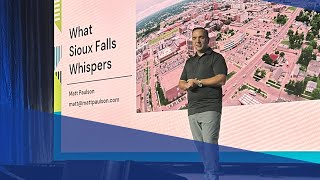
Matt Paulson (founder & CEO of MarketBeat) delivers a keynote to Sioux Falls young professionals describing five observed city core values—philanthropy, collaboration, institutional leadership, expert knowledge, and integrity—and advising listeners how to leverage them to advance careers and improve the community. He illustrates each value with local examples (Jacobson Plaza/All-Abilities playground, Forward Sioux Falls, Sanford/Avera, Startup Sioux Falls), gives concrete steps for volunteering and becoming a local expert, and emphasizes reputation management in a small-city network.
Chapters
Now it is time for our first speaker. Matt Paulson is founder and CEO of MarketBeat, an Inc. 5000 financial media company that empowers individual investors to make better trading decisions with in depth market analysis and best in class research tools. Matt is also an active real estate and venture capital investor, serving as General Partner at Creston Capital and Homegrown Capital. He is a driving force in Sioux Falls Startup ecosystem, having founded Startup sioux Falls in 2019 and helping organize the Falls Angels Fund in 2016. Matt cares deeply about Sioux Falls and is proud to call it home. Everyone, please help me welcome Matt to the.
Good morning everyone. You know, Merton Haken got some pretty good applause, but what he doesn't know is that I told my employees that their next quarterly bonus is entirely tied to whether or not I get a standing ovation at the end of my talk. So there's the old saying, show me the incentive and I'll show you the outcome while the right incentives are in place. So we'll see what the outcome is. All right, let's start with the actual talk. So every city has an unwritten set of core values. Sometimes a city's core values are obvious, and sometimes they're a little bit more subtle. Different cities value different things. They have different priorities. What's important in one city may be totally unimportant in another. If you've traveled to different parts of the country, you probably already know this. If you've been to New York City, it's obvious that the city values wealth, sophistication and professional status. On the other hand, Los Angeles values celebrity, social status and having personal connections with powerful people, especially people in the entertainment industry. Silicon Valley values disruption, innovation, and social reach. Austin, Texas values creativity, uniqueness, and just plain being weird. Washington, D.C. values political power, having access to insider information and knowing all the right people. If you can understand a city's core values, you'll know how to be successful according to that city's standards. You'll know how to present yourself to the city. You'll know what you should get involved with. You'll know what companies can provide you with the best career opportunities. You'll know what types of people to build relationships with. You'll know what to wear, how to act, what to do, and just as important, what not to do. If you can align your focus, your career, your community involvement, and how you present yourself to the city with your city's core values, your city will reward you. Business and community leaders want to elevate young people whose values align with their values and if you want access to opportunities in a city, you have to align yourself to its values, at least to some degree. By understanding and embracing your city's core values, you'll learn how to achieve your career goals. You'll be able to elevate your standing in a community and create the positive change that you want to see in the city. So today we're going to ask the question, what are Sioux Falls core values? And once we understand the city's core values, how do we leverage them to our advantage? How can we utilize our city's core values to further our career and our standing in the community? And how can we use them to make a positive impact in our city? We are going to explore these questions over the next 40 minutes or so, and hopefully we will all become better business leaders as a result of the conversation that we have today. So let's talk about our city's core values. When we ask the question, what are Sioux Falls core values? We are really asking a question. What does the city care about? What are its priorities? What are the things baked into the community's DNA? What are the things so prevalent in a city that you might not even know they're unique to Sioux Falls until you spend some time somewhere else? Well, I'm not going to make you wait. I'm going to tell you right now. So I believe Sioux Falls has five core values. And those core values are philanthropy, collaboration, institutional leadership, expert knowledge, and integrity. First, philanthropy. Sioux Falls is a uniquely generous city. We support our nonprofits well, and there is a long history of business leaders giving back in big ways. Second, collaboration. We as a community set aside traditional business, organizational and political divides to solve problems and make Sioux Falls a better place. Some people call this the Sioux Falls Way. Third, institutional leadership. We are a city made up of institutions. These are our healthcare systems, our universities, our banks, our government entities, our real estate developers, our other businesses, our financial media companies. And we trust our institutions to steward their aspect of the city well. Fourth, expert knowledge. We are a relatively small city, and there are some categories that we just don't have a lot of experts on. When somebody has expertise in a specific area and they are willing to use their expertise for the benefit of the city, we are happy to lean on their wisdom and their experience. Fifth, integrity. We've all heard of the idea of the six degrees of separation. But in Sioux Falls, there are really at most two or three degrees of separation. If you treat somebody poorly or don't act with integrity, others in a community are going to find out and your negative actions will leave a long term stain on your reputation. Now, this isn't an official list of the city's core values. They're not written down anywhere outside of the conference doc notes or your conference talk notes. You couldn't walk into City hall and ask Merit and Haken if they're written down somewhere on marble that you could read. These are just the values that I've observed as a member of the business community over the last 15 years. I've bounced this list off several other business leaders that have been around much longer than I have, and I think it's pretty close. So if you can understand that these are our core values as a city and you can embrace them in your life, you'll be able to go further in your career and be able to get things done in a community. You'll be a well rounded person with a collaborative nature, a generous sphere and integrity that nobody can question. You'll also become more attractive. You'll grow six inches taller and everything written on your fortune cookies will come true. Maybe I made that last part up, but I think the rest of it is true. These are really the core values that you want to embrace as a member of the business community. And you want to embrace them not just because it's good for your boss or because it's good for the company you work for. You really want to embrace them because they're good for you and they're good for the people around you. We're now going to dive into each of the five core values and talk about how they are embodied in our city and how you can internalize them and implement them in your life. First, philanthropy. Philanthropy is simply using one's time, talent and treasure to promote the welfare of others. Sioux Falls has a uniquely philanthropic spirit and. And nothing embodies this better than the Jacobson Plaza currently in development at Falls Park West. So Gary and Diane Jacobson had significant success with their industrial equipment business known as Malloy. But they never sought the limelight. They never tried to make a name for themselves because they're just humble people. The story is that Gary Jacobson kind of had seen what Joe and Jennifer Kirby had done with the Kirby dog park that's downtown at Fort Sod, and he wanted to do something similar. So Mr. Jacobson approached Jennifer Kirby, who also happens to run the Sioux Falls Parks foundation under the Sioux Falls Area Community foundation, and just asked, how did this project come together? Maybe I want to do something similar. So the community foundation set up a meeting between the Jacobson Family and the mayor to talk about what they could work on together. So Mayor 10 Haken pitched the idea of developing an all abilities playground along with the downtown ice ribbon that the Jacobson's were interested in supporting. And the Jacobson family committed to making a multimillion dollar gift on the spot. But the story doesn't end there, of course. Like every other construction project in the world, including our own new office, the costs were coming in much higher than expected. The Parks department thought they would have to do the project in two phases to keep the cost manageable. But the Jacobsons really wanted to see the project completed all at once. So they made a couple phone calls. He called his old friend T. Denny Sanford, who agreed to contribute $1.75 million to find a spray park at the site. And then he also called Craig Lloyd. And Craig and Pat Lloyd agreed to contribute a million dollars to fund a dog park at the site to finish the project off downtown Rotary is in the process of raising $250,000 to fund play equipment at the All Abilities playground. So residents of Sioux Falls are going to benefit from a brand new $16.5 million parks complex that has an ice ribbon, a playground, a dog park and a splash pad. And half of it was funded by private donors and who came together to create something that benefits the entire community. I'm personally excited about this project because my daughter Addie, who does have some special needs, will have a place or park that was specifically designed for her where she can play alongside her brother Micah in a safe and fun environment. This is the philanthropic spirit of Sioux Fall offs at work over the last several decades, there is a long history of business leaders who have stepped up in a big way to support nonprofits and fund community projects that benefit everyone. T. Denny Sanford really set the example for the rest of us in 2007 when he donated $400 million and then a whole lot more after that to Sioux Valley Health, now known as Sanford Health. He tells people his goal is to die broke and to give away as much of his money as possible before he passes away. More recently, there's been a bunch of other examples too. Dick and Kathy Sweetman just gave $2 million to the Washington Pavilion to fund the first ever planetarium in Sioux Falls. And this is really the only one in the region, so that's really exciting. Of course, the Kirby family has donated to numerous projects in the city. The Kirby Science Discovery center, the Kirby Dog park, and the Kirby Place at Walsh Family Village. There are just so many families in our community. That have stepped over the years. The Beacons, the Broins, the Dykhouses, the Knutsons, the Schonemans, and of course the late Marion Sullivan from Sullivans. And the list could certainly go on from there. There are many people that have given back. But philanthropy is not just for wealthy business owners. It's for everyone. It's for all of us. If all of us in this room make a small gift to a project, it is just as impactful as a couple of large donors making a couple of large gifts. It's also not just about money. Philanthropy is much about your expertise as it is your money. So a typical volunteer hour is worth about $25 to a nonprofit. So if you spend two hours at the banquet preparing meals or packing meals at Feeding South Dakota, your two hours was a donation of $50 to those organizations. It's also about your expertise. Whether you realize it or not, you are an expert at some subject, you know more about something than most people do, and that expertise will come in handy to some nonprofit in our community. My suggestion is that you can find one or two causes that you can get uniquely passionate about. You don't want to get involved with an organization just because you want to show community involvement or because you want to look good to your employer. You really have to put your volunteer efforts behind causes that you are truly passionate about. Otherwise you're going to get busy with other stuff and you're probably not going to put the effort in needed to truly make a difference. So I suggest you limit yourself to volunteering with no more than two organizations at once. The reality is you just don't have the time, the money or energy to be everything to everyone. And your resources are only going to get more constrained as you get married, have kids, you get further in your career, and then you just wondered what happened to your free time and why you don't have any time to play Diablo 4 and your Sorcerer is only level 65 when everyone else is Sorcerer is at level 100 and you're just mad at yourself because you don't have time to play. You know, it's just better if you can be a key resource for a couple of organizations versus trying to be mildly involved with everything. If you're just not sure where to begin or what volunteer opportunities are out there, I'd encourage you to go check out the helpline center website, helplinecenter.org they have a database of volunteer opportunities where you can easily see which organizations need help and what kind of help they need. You know, one of the great things about the Sioux Falls business community is that there's no wrong answer about volunteer work. Your employer typically does not care where you get involved. They just want to see you involved in a community and giving back in some way. So once you've kind of locked in a nonprofit that you really want to get behind or cause or an issue, find ways to get involved. Start going to their events, ask for a meeting with one of their board members or their employees. Get on their mailing list, donate some money to them, promote the cause on your social media channels. No, you might not get on a board of directors right away, especially with larger organizations, but there are committees to serve on and ways to get involved, even if you are just getting started in your business career. Community involvement with nonprofits isn't just about what you can give to others either. There's something in it for you and your career as well. These days, we push our kids to be involved in every activity possible because it's good for them when they're applying to colleges and trying to get scholarships. In a way, the same thing is true about adults looking for their next career opportunity or their next promotion at their job. Business leaders in Sioux Falls want to work with well rounded people that give back to the community. And if you can be that person, new opportunities are going to come your way. You also make a bunch of connections by giving back. Some of my closest business acquaintances and allies today are people that I met by being involved in nonprofit work in the city. Some of the busiest, most successful and most prominent business leaders in our community are also the same people who are the most engaged and giving back the most to the community. They give back time, talent and treasure. And so should you. And you shouldn't just give back because it's good for the city or it's good for your boss, or it's good for somebody else. You should give back. You should find ways to get involved because it's good for you. The truth is that generous people are happy people. And if you can put your focus on something outside of yourself, something that isn't selfish, you'll live a happier and more fulfilled life. Sioux Falls is a uniquely generous city, but Sioux Falls is also a uniquely collaborative city. Our leaders are willing to set aside traditional competitive boundaries to work on projects that are beneficial for the entire city. We recognize that a rising tide lifts all boats, and if we can work together to make Sioux Falls a better place, you know, vibrant community, that will be good for each of our individual businesses as well. In other cities, business Leaders ask, why should I get involved? What's in it for me? But in Sioux Falls we ask, is this good for the community? And if it is, we do it. We act as if we're all on the same team. And nothing demonstrates this reality better than Forward sioux Falls. Forwards 2 Falls is an economic development program that's organized by the Chamber and by the Development Foundation. It's funded entirely by voluntary contributions from area businesses, government entities, nonprofits and universities. Since 1987, more than $52 million has been raised through Ford Sioux Falls to enhance our region through economic development projects. It's funded projects like Startup Sioux Falls Foundation park, the USD Discovery District and DSU's upcoming Cyber IT facility. In Sioux Falls, even the Chamber's Young Professionals Network is a direct outcome of a previous Four Falls initiative. None of us would be in this room today and I would not be giving this keynote without 402 follows. Now you might be thinking, yeah, I understand that 402 Falls is an economic development program, but what's so impressive about that? Don't other cities have economic development programs as well? Like yes, other communities have economic development organizations. But bringing together private businesses to fund economic development projects is on a voluntary basis is a uniquely Sioux Two Falls state. There's no analog to 402 Falls in rapid City, Fargo, Omaha or Minneapolis. Our city is much stronger because 402 falls exists and there are tens of thousands of jobs in Sioux Falls that were created as the direct result of 400 Sioux Falls initiatives. Perhaps what's even more impressive about 400 Sioux Falls is the amount of collaboration that happens between competing businesses. Paul Hanson from Sanford Health and Dave Flecheck from Avera co chaired the most recent Florida Sioux Falls campaign. Competing businesses set aside their differences, their competitive differences to participate in forward to follows. Even more astonishing, they're donated money to recruit new businesses to the city that will compete to hire their employees. Why would they do that? Why would they give away time and money towards an initiative there will ultimately increase competition for both talent and just for business in general. It's because they care about the community and are willing to make small personal sacrifices to to make the entire city a better place? This is the Sioux Falls way in action. We are a relatively small city in a low population state. If we want to grow the city and can continue to make it a better place, we sometimes need to set our side or differences and all row in the same direction to get things done. But what does this look like from a practical perspective? How do we embody the idea of collaboration in our day to day work and inner service the community first. I think we need to recognize that the thing that is best for us individually is often not the same thing that is best for the entire City. In 2019, I created a startup ecosystem organization called Startups who Falls that offered online networking, community events and different resources for startup founders and small business owners. You know, if I just wanted to make a name for myself and make myself look good, it would have been better for me to personally continue to control Startup Sioux Falls, to fund it, to take all the accolades that came with running a cool project like that. But ultimately I realized that it was best for the people that we were trying to help, it was best for the city and it was best for the organization if I handed it over to a kind of professional management that had the backing of Florida Sioux Falls. You know, if I'm honest with all of you, it was really a struggle for me to give up Startup Sioux Falls. It was my brainchild, it was my baby and I had a vision for it. It was like giving up a foster child or a child to a foster family so that the child could have a better life. To me, giving up Startups who Follows was a sacrifice, but it was a sacrifice worth making. Startups who Follows would not be anything near it is today. You know, as an organization. If we hadn't kind of done the merger and the transition, Startups who Follows wouldn't have the fantastic downtown facility that we had today that we opened in June. It wouldn't have the Co Starters accelerator program, it wouldn't have a large mentor network, and it wouldn't have the breadth of programming that it has now. It took a team of volunteer board members. The backing of Forward through follows support from the city, the chamber, the development foundation and the professional staff, including the fantastic executive director, Brian Maynard. You know, all these people, you know, required all these people to make these things happen. I think the lesson that we should take away about collaboration is that if we want to make a lasting change in the city, we shouldn't try to do it alone. We should sit around the table with like minded people from different businesses and organizations that have the same passion and the same vision that we do. Then we should try to come up with solutions together as a community to solve problems. There's the old problem, or excuse me, there's the old proverb that if you want to go far or go fast, you go alone. But if you want to go far, you go together. That's true with Any community project that you might want to take on, you might have a great idea and be really excited about it today. But will you still have that same passion five years from now or ten years from now? I've seen some people go it alone on community projects and ideas that generate a lot of buzz and excitement initially, but eventually they fizzle out because not one person can sustain a community project or a non profit initiative alone. To make a lasting change in the city, you need a team of people with different backgrounds, skills and connections with working collaboratively to achieve a common goal. This is what happens with Florida Sioux Falls, and that is what should happen with every community benefit project in town. So Sioux Falls is a city that values collaboration. It's also a city that leans heavily on its institutions for leadership. We have public and private organizations that have been around for a long time that have informally been designated responsibility to take a lead on specific aspects of the city. A great example of this is our healthcare institutions, Avera and Sanford. We asked them to take the lead on community health in our city because they're the best equipped to handle those issues and they do a pretty Good job. When COVID 19 hit and Merritt Hagan was doing their daily press conferences, there were leaders from both Sanford and Avera, with him helping develop the community's response to COVID 19. We trust Sanford and Avera to take the lead on these issues because they're the best equipped for it. There are many other types of institutions as well. We rely on city and county government to make sure we have functioning roads, utilities and other essential services. We rely on the school district to educate our children and in many ways address childhood poverty issues. We rely on our economic development organizations to recruit people to the city and help grow its economy. We rely on key nonprofit organizations such as the Community foundation and United Way to evaluate, fund and manage social service initiatives. Major employers like Smithfield, Hy Vee, First Premier and MIDCO are also institutions in the sense that they are responsible for a significant number of jobs in the city. Most of our institutions have been around for decades. Some have been around for more than 100 years. Avera, Sanford Health, First Premier, John Morrell, now known as Smithfield, and the Chamber of Commerce were all founded before 1910. That's 113 years ago, meaning those organizations have spanned across more than five generations. They employ large numbers of people, they bring money into the city, they often have a deep bench of leadership, and they are focused on developing the next generation of business leaders in the city. And they feel Our community's shared responsibility to get involved and give back to others. Our institutions have largely served us well over the last several decades. They provide excellent services to the community, they have fostered the creations of thousands of jobs, and they have created substantial economic growth. Our city's population has doubled in the last 30 years and will likely double again in the next 30 years. The success our community has had in the last few decades is the direct result of forward thinking, responsible leadership from our institutions across the board. No, none of them are perfect. But anybody that spent time in other cities know that we have things pretty good here. Nobody would say that Sioux Falls has bad schools, bad healthcare or crumbling public infrastructure as young people. And I'm going to include myself in that group because I am still eligible for YPN for another two years, one month and six days. We sometimes get it in our head that our city's institutions are kind of behind the times. They are slow moving or just out of touch with the next generation of leaders in our community. We think that we have better ideas and that the city would be much better off if they had just listened to us and done things our way. We feel like we're not always heard and nobody wants to listen to us and our ideas. We sometimes feel kept out and not given the opportunity to engage in the opportunities that we think we deserve. While not some leaders or while some leaders, excuse me, while not every leader feels that way, some leaders do. Honestly, I felt that way for many years. Some people feel like they can't engage with the city's institutional leadership structure and they opt out. They just don't get involved with kids community and they stay tightly focused in their own lane. Other people decide, I'm going to launch my own community organization and create a new and better version of something that already exists. You might say, you know, I really think the school district is missing out on this specific group of kids. I'm going to start a school that specifically serves that group. Or you might think, I'm going to start my own membership organization that better serves this specific group of businesses that aren't being served by the Chamber of the Development foundation and Startup Sioux Falls. You'd be shocked at the number of people that I hear from that want to start their own nonprofit or community project and they want the business community to fund it. Even though there are two or three other organizations doing the exact same thing in Sioux Falls. Or if you're me, you start your own startup ecosystem organization called Startup Sioux Falls because you feel like the existing organizations Working on these issues are missing the mark a little bit. While yes, startups, who Follows is successful in shaking up the startup ecosystem and getting it refocused on the things that are needed to serve today's entrepreneurs, it really only stayed successful because it merged with the Zio center for Entrepreneurship and gained the institutional backing of the Chamber, the Development Foundation, Fort Sioux Falls, a great staff, and 15 committed business leaders who serve on its board. If it were just me and my assistant Maureen, who works at MarketBeat running it, it probably would have fizzled out because we would have gotten burned out running it and we would have gotten distracted by some new and shiny object throughout the process of launching, growing, and ultimately handing off startups who Falls I've ultimately come to respect the institutions that lead the various aspects of our city. No, they don't always move as fast as they should. And yes, there are some things they could do to modernize and get with the times, but they've been around a long time. They have resources, they have buy in and they have respect from leaders in our community. If you want to make a true impact in the community and make something that happen that doesn't fizzle out after a couple of years, you have to figure out how to work within the system of institutions that already exist today. As the next generation of leaders in the business community, we shouldn't ignore the organizations created by the generation that came before us. We should embrace them, we should engage them, and we should prepare ourselves to eventually take them over, because eventually we will take them over. There's a future United Way campaign chair in this room. There's a future Chamber board chair in this room, There are future state legislators in this room, and there could even be a future mayor of Sioux Falls in this room. The institutions that lead our city are our institutions. We should engage with them now because then they will be in a much better spot when it's our generation's turn to lead them a few years down the road. No, you're probably not going to get on the board of a big organization like Sanford or Vera a few years out of college. But I guarantee you both of those organizations have volunteer opportunities for you today. And more opportunities will come your way if you develop a relationship with an organization over time. Leaders in our city, likely including your employer, value the leadership that our institutions have to offer. You know, it's easy to be the person that rejects our city's system of institutional leadership and be the person that does their own thing. But honestly, you're going to be much more respected by your employer and by the community. If you can make the positive change that you want to see by working within the system of institutions that we have today, you also be much more respected by your employer and by other people in the community. If you can position yourself as the local expert on a specific industry or area of expertise in the city. You know, Sioux Falls is a relatively small city and there are just some topics and industries and categories that we don't have deep bench of expertise on. You know, if we need an expert on the topic of community banking, I'm guessing we can probably find plenty of people we can lean on to learn about that topic. However, that's just not the case with things like venture capital and walkability and tiny homes and ride shared services and digital media and artificial intelligence. If you can become the person that knows the most about something that is a relatively small issue now in our city, but will become a bigger issue over time, you can position yourself as the city's trusted expert on that subject. Becoming the local expert and creating contextualized local content is the fastest shortcut to building a personal brand in Sioux Falls. Sioux Falls really embraces people who know a lot about a topic and want to use their expertise for the benefit of the city. Becoming a local expert will also make you a more attractive candidate for job openings at another company or promotions at your current company. It will also position you to be the person that the city leans on when an issue surrounding your expertise or areas your area of expertise comes up in a city. This might mean that you get asked for media interviews. You might get asked to speak to community groups about the topic, or you might get asked to serve on a task force that addresses the issue related to your expertise. Only good things happen when you. Excuse me. Only good things happen when you brand yourself as the person that knows the most about XYZ topic. Now, you might be thinking, you know Matt, that sounds awesome, but turns out I'm not an expert at anything. Also turns out that doesn't matter that much. You don't need to be the expert today. You just need to do the things that will allow you to become an expert over the next couple of years. So let's say you want to become Sioux Falls artificial intelligence expert. You want to become the person who knows the most about that subject. Here's what you do. First, you have to become a practitioner. In other words, you have to do the thing for artificial intelligence. That means going and playing with the tools that are out there. The chatgpts, the midjourneys and there's a list of 100 different tools. After that, go play with the tools, go experiment with them, learn how to use them, and learn how to apply them in your career setting, but also maybe other people's as well. Second, attend one or two national conferences on this subject. So for artificial intelligence, that would be AI Expo in Austin, Texas or the Data Science Salon in San Francisco. By going to a national conference, you'll be able to learn what people are working on right now and make valuable industry connections. Third, read every major book you can on the subject. Of course, that works for a lot of topics, but artificial intelligence is changing so quickly that anything that's written in books is probably three years out of date. So you want to go and read white papers and more current stuff being published online. Fourth, set up a continuing education plan. This can be as simple as subscribing to some YouTube channels about your topic. You can also set up a Google Alert so that new articles are delivered to your email inbox every week about the topic. Fifth, try to develop some national relationships. You don't have to know everything about your topic or your area of expertise, but if you have a few national connections that you can lean on when a question comes up that you don't have an answer to, you'll have somebody that you can lean on to get a better answer than you can give today. Finally, as you develop your expertise and continue to learn about your topic, you're going to need to create some content about what you're learning and put it out into the universe. If you want to be seen as the local expert, you have to offer your expertise to the city. So how do you do that? Well, you create content about your topic and how it relates to Sioux Falls and then you submit it to local media for publication. If you created an article titled How Artificial Intelligence Will Change sioux Falls by 2030 and it was a good article and you sent it to Jody Schwann, do you think she would publish it? I really think she would. The same goes for other local media outlets such as the Chamber News, the Dakota Scout Pigeon 605 Sioux Falls Simplified, Sioux Falls Live, the local magazines, and of course, you know, there's a long list of them. These days, local media outlets are hungry for content, and if you can create good written content that is relevant to their audience and to the Sioux Falls community, you can almost guarantee that one of them is going to publish it. And then try to do this on an ongoing basis. If you can get a piece of content published every other month or so, you're going to position yourself as an expert very well over the next couple of years. Now, doing these things might sound difficult, but it's actually really easy to become the go to expert. Almost nobody is doing it and frankly the bar is not very high. So 64% of podcasts never make it past 10 episodes. Think about that statistic. So I had a podcast in like 2016 and I made it to 26 episodes before I quit. So if you can record 10 podcasts with Buddy, you're already ahead of two thirds of content creators. If you can develop five hours, if you can spend five hours a week learning about a topic and creating content about it in the context of your city, you'll be seen as the go to expert in a year or two. Many people in our community have already done this. Well, if you want to plan a high production event, community event, everybody knows you call Addie Graham Kramer at the event company and then you call Pinnacle Productions right after that. If you want to become better at company culture, everyone knows you call Vani and Tamian at think 3D. If you want to export a product to another country, you call up Luke Lindbergh at South Dakota Trade. If you want to raise a lot of money for a non profit, you call up Cindy Peterson with Maximizing Excellence and hope that she takes you on as a client. These people have effectively positioned themselves as the go to experts in their given fields by learning about their craft, becoming practitioners of what they learn about, and then communicating what they learn in a localized context. And you can do this too. You just need to identify the professional topic area that aligns with your purpose and your passion, and then become a student and practitioner of the topic area. While you consider for a moment what topic that you might want to become the expert on in Sioux Falls, you also should think about, how do I want people to think about me in the city? Do you want people to think that or what do you want people to think when they hear about your name? Do they want to see you as a young professional with a bright career path that gives back to their community? Or do you want to have a reputation of only looking out for yourself? You want to be seen as somebody that always tells the truth and acts with integrity, or do you want to be known as somebody that bends the truth to meet the needs of the day? You know, while The Sioux Falls MSA has a population of over 250,000 people, the professional business community is still a relatively small place where we all kind of know each other. From a network perspective, this is the event for young professionals. And think about there's only 600. You know, there's 600 people in the room, which is a lot, but really not that many from a network perspective. You know, most of us have heard of the concept of the six degrees of separation, where you're only six personal introductions away from being introduced to anybody else in the world. Well, the entire world has a population of 8 billion people. So imagine how much more closely we are connected, considering we are a population of just 250,000 people that basically all live near each other as well. So in Sioux Falls, you are at most two or three degrees of separation connected from anybody else. So if you know 65 people in Sioux Falls, and those people know 65 people in Sioux Falls, AND those people know 65 people in Sioux falls, that's almost 275,000 people. That means you are two introductions away from being connected to everybody in the city. We also kind of need to consider the impact that social media platforms have on a reputation in a community. If you get introduced to somebody for business reasons or personal reasons, like, hey, maybe you should go on a date with this person, what's the first thing that you do? You go look them up on social media. You look them up on Facebook or Instagram or Twitter or X or whatever we're calling it now, or LinkedIn or Threads. If you're still one of the people using that app, you can see how they're presenting themselves to the city, and you can also see what mutual connections you have with that person. Social networks tell you exactly who you need to talk to to get a good read on someone's reputation based on your mutual connections. Say, I hear about Will, and I know that my mutual friend Andrew is connected to him. I can just go ask Andrew and hear everything I need to know about Will ahead of time. Yeah. So we also need to remember that other people are looking up on social media as well. So be mindful about what you're putting out there into the world and what you keep offline. So I asked Lacey, who did my slides, to find the craziest pictures you could find of me on the Internet, and that's all she found. So that tells you I am a pretty boring person. Or either that or I scrubbed all my college photos off Facebook at one point, but that's besides the point anyway. It's just harder to hide past bad behavior than ever before. Last month, somebody reached out to me, asking me to talk about their business idea. I Mentioned the name. And then one of my employees said, hey, I think I've heard of that person. They just moved to Sioux Falls from out of town. Turns out they'd gotten divorced, they cheated on their spouse and moved to the city. And their ex spouse posted about it on social media. And here's the video that they made about them and why they got divorced. And like, you know, this stuff follows you these days. This is the world we live in today. If you make a bad business deal, leave a company on bad terms, or commit a crime in another state, or just treat people poorly on a consistent basis, these things are going to come back to haunt you in the future. It's more important now than ever to protect your reputation. And there's just no magic secret to this. The best way to avoid having a bad reputation, or excuse me, the easiest way to avoid having a bad reputation is to be a good person and be kind to others. Don't burn bridges. Don't create drama on social media. Find ways to give back. If you don't give people a reason to speak poorly about you, they're not going to speak poorly about you. And if you give people reasons to speak positively about you, they're going to speak positively about you. It's pretty simple to be a good person and it doesn't cost a thing. So how do we take this a step further and proactively build our reputation in the city? First, embrace the Sioux Falls way. Find ways to give back to the community. Second, consider who you associate yourself with. Try to build relationships with other star rising stars in the business community. Third, associate yourself with respective community groups like Leadership, Sioux Falls Rotary, ypn, the Chamber and SME. Finally, learn how to become an advocate for yourself. If you aren't going to advocate for yourself publicly, who will? If you're doing good work in the community and in your business, consider highlighting that work on social media channels, especially LinkedIn. No, you don't want to be too like, hey, look at me, I'm great. But you can highlight your contributions to your job or to a nonprofit in a way that lifts up the nonprofit or your job, but also lifts you up as yourself. And you can do that really tastefully. It takes a long time to build a great reputation, but it only takes a couple of bad decisions to ruin your reputation. No, we don't need to be walking on pins and needles out of fear of being canceled, but we should consider what message we're sending out into the world about ourselves, with our actions and with our deeds. Your Reputation matters more than ever, and it's important to protect it if you want to go far in the world. As we wrap up today's conversation, let us remember the five core values of the city. Philanthropy, collaboration, institutional leadership, expert knowledge, and integrity. We've discussed the significance of each of these values and how they shape our community's identity and future direction. These five values are the bedrock of how our city operates. These values whisper to us from every corner of the Sioux Empire, lighting the path towards greater success, satisfaction, and influence within our beloved community. Adopting these core values will enable you to navigate the city more effectively, but will also empower you to become a respected business leader among your peers. By aligning with these values, you position yourself for both personal and professional growth, and you will also be contributing to the betterment of the city. And so I challenge you to live out these values, find ways to give back, collaborate with others to do good, lead with integrity, seek and provide expert knowledge, and embrace our city's institutions. As you instill these values in your life, you'll further your career, enhance your standing in the community, and be able to create the positive change that you want to see in the city. So let's carry these values with us each and every day. Because in some ways, Sioux Falls core values are an extension of our personal core values. Because Sioux Falls is part of us and we are part of Sioux Falls. If we do our part to make Sioux Falls a successful city, the city will conspire to make us successful as well. That's what I have for you all today. Thank you very much. And I can take it if it's what I want to do.








