Your Hiring, Leadership & Growth Questions - Answered | Part Two
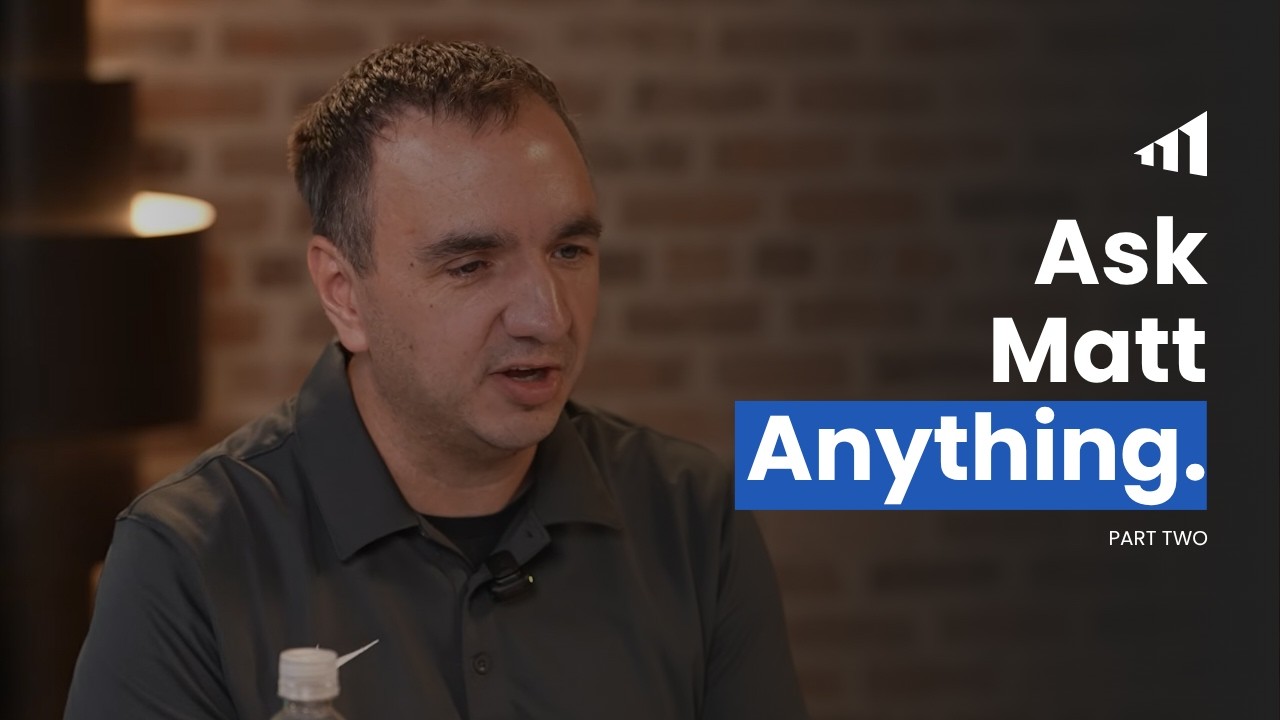
In this Q&A video, Matt Paulson (founder of MarketBeat) and host Lacey Kloon field questions from Twitter about building and scaling MarketBeat. Matt outlines his hiring philosophy—building a strong local brand to attract talent, recounts the first hire (Stevie Shea, 2013), and explains when hiring makes sense based on workload. He discusses why MarketBeat stays a lean team of ~21, focusing on high‑leverage activities like email, SMS, and YouTube content. Matt identifies common financial mistakes for first‑time founders, especially rapid expense scaling and failure to audit recurring costs. He shares strategic pivots: shutting down a costly mobile app, increasing email/SMS frequency, and maintaining disciplined cash‑flow with net‑30 ad invoices. He admits side‑projects have distracted him, noting that a singular focus on MarketBeat would likely accelerate revenue growth. The core differentiator, he argues, is MarketBeat’s proprietary data infrastructure—custom CRM, ad server, and cohort‑tracking system—that lets the company test, measure, and double‑down on profitable ad channels. The conversation ends with a plug for his email‑marketing book and a call to subscribe.
Chapters
Hey everyone, uh, welcome back to the Matt Paulson Presents YouTube channel. We're going to do a video about some questions that came from X or Twitter about building and scaling MarketBeat over the years. I have Lacey Kloon, she is MarketBeat's original YouTube host with me here today, and she's currently a digital marketing specialist at MarketBeat. She does a lot of great things for us, so Lacey's going to ask the questions that came from Twitter today and I'm going to try to answer them. So Lacey, let's start with the first question.
So let's talk a little bit about kind of the people at MarketBeat and how you've hired them. What is your approach when it comes to hiring? What was the first MarketBeat hire that you've ever made? And kind of with that really quick, do you feel like you need the money to hire someone first or do you assume that that added employee is going to kind of make back the money that you need to pay them?
My approach to hiring is to build a company brand so good that the best people want to work there. You see this if you live in Sioux Falls, you know all about it. We do tons of stuff in the community. We have the MarketBeat Open Tennis Tournament. We've got the Loud and Cooler Music Festival. We're big sponsors of Augustana Hockey. You could name 10 things just like that that we do in Sioux Falls. So people know about MarketBeat long before we ever have a job posting. It costs us quite a bit of money to do that, but we do it and It brings us great people like you. The first hire MarketBeat ever made was in 2013. It was a gal named Stevie Shea, and she was our customer support specialist. So when people emailed MarketBeat before it was even MarketBeat, she would be the person that replied to the emails. She worked maybe 20 hours a week. It was really like during COVID post-COVID, when we started to scale up the team. Like we only had 5 people before COVID Now we're up to 21. Yeah, so let's see what else. In terms of money, I think if you have like, you know, you're going to hire a full-time employee and you feel like you've got about 20 hours a week to fill up their time, like half their time, like you're going to find ways to fill up the rest of their time. So if you feel like you can keep somebody busy for half the day, like it's probably worth making that hire. And then, you know, With hiring, typically it doesn't free up your time a whole lot, but what it enables you to do is go do more. So if I can hand off some of my low-value tasks to an employee and that frees me up to work on higher-value things, that typically pays for an employee and then some. Does that kind of COVID it all?
Yeah.
Awesome.
So when we compare MarketBeats to other companies and we look at like MarketBeat obviously does make a lot of revenue. Sometimes people assume with that that you have a massive team. Like you said, we only have 21 people. Why do you choose to remain small instead of hiring more people to do more things? Like what is your mindset behind that?
Yeah, MarketBeat's always been a pretty high leverage company in terms of what we do with the number of people that we have. And we focus on activities that really are high leverage, so like building an email list, building an SMS list, doing one-to-many content things on YouTube. And that's worked for us. I just don't know what I would do with a ton of people. Like, we have 21, and there are some people here I can't keep busy. So I think a lot of it is just focusing on what matters in business. You know, we're a media company. So our mission is to go get attention of investors through YouTube or email or website or SMS or whatever the channel is, and then redirect that to our advertisers. And we have plenty of people to do that. We don't need more. So I just don't know why we would go hire more people.
So now let's talk kind of founder mental status here. What would you say is the biggest financial mistake that you see first-time founders make? Once they start getting that real revenue in their business?
Yeah, and I'll say real revenue is maybe about $1 million a year, at least for the purposes of this question. I think people often, especially when you're venture capital funded, you scale up your expenses really quickly. You try a bunch of stuff, but then like if something doesn't work, you let it run too long without cutting it. I'm on the board of a media company and they were trying Facebook ads and Facebook ads just weren't working for them. And it's like, okay, they let it run for 3 months and we should just cut it off because it wasn't working. So really just auditing your expenses on a regular basis. Every quarter looking through every expense saying, should we still pay for this? And there are so many subscriptions and SaaS things that are on autopilot these days. You really have to be proactive about looking at your expenses and cutting stuff.
What would you say as MarketBeat continues to grow, people, revenue, what is something that we stopped doing that's helped MarketBeat grow faster?
Yeah, I think we've been pretty good at taking things that we thought were worth trying, and then if they didn't work, not doing them anymore. One of those things was our mobile app. We had an app on the Apple App Store and the Google Play Store. That did some of the things that the MarketBeat website did, maybe not as well. It was very difficult and expensive to maintain. Not a lot of people used it. So while it was a good idea because apps were huge when we built the thing first in 2018, the average number of apps that people install on a monthly basis is maybe one at most these days. The app opportunity just isn't what it used to be. So we cut the $50,000 a year we were spending to maintain on it. Plus staff time and nothing bad happened.
Kind of on the flip side of that, what is one of the smallest changes that MarketBee has made that on the other side of it ended up producing crazy good results?
A lot of that is just doing more of what you're already doing. So instead of sending one email a day, send two emails a day. Instead of sending one text message a day, send two. Just ramping up the volume of stuff that you do will make you more money. For very minimal effort.
Okay, but what do you have to say to the people that say MarketBeat sends too many emails to me, SMS?
Then you should go to some other website. That's what we do. It's our business.
Kind of on the ad side of things, what is your approach to cash flow management when you're dealing with net 30 offers at a large scale?
Yeah, so if you're building an email list and you're running paid ads, typically like, at the end of the month, like, you'll send an invoice for the ads that you ran, and then you get paid for them 30 days later. So the challenge is, like, when you— if I'm spending money on Facebook ads, I get billed for it next month, but my break-even on Facebook ads tends to be 60 to 90 days. So that means I'm outlaying 3 months of cash before I really break even on that money. And that's just kind of how media businesses work, especially kind of more performance marketing based media companies like we are. And the way to do it is just to kind of scale up to it. You start with a small number, then as your money's coming back, you just kind of scale that number up over time. So right now, MarketBeat probably has kind of $5 million at a time that's kind of like out of like stuff that like money we've spent on Facebook, but we haven't gotten the return yet, or Google, or wherever. And that's just a feature of the business. It's not something you can really avoid. The key is just to kind of work your way up over time. As you have more cash, you can put out more in advertising and kind of wait for that to return.
So when we're thinking about MarketBeat, alongside all the other things that you're involved in and that you make investments in, if you just focused on MarketBeat, no other investments, do you feel like you'd be more successful?
I think yes. I've gotten distracted often over the years. I wrote 6 business books. I've gotten involved with some other businesses that are not easy to get out of. I had a business in the— there was a golf media company I was involved with. There was a SaaS company that helped animal shelters raise money. I think I could have got where I am today a lot faster had I not gone on all those side quests and focused on MarketBeat. Today I've got a great team, so I can be distracted a little bit, but I definitely get too distracted, not with other businesses as much these days, but more community stuff, different boards and nonprofits that I'm involved with. And that's just kind of a decision I've made. Like, yes, MarketBeat would probably get to $100 million in revenue faster if I wasn't doing as many of these things. But at some point, how much money do you need in life? I really do want to do some of those kind of give back volunteer kind of things.
Well, we'll drop the link below to your books if anyone wants them because they're still out there.
They sure are. The good one is Email Marketing Demystified. The domain for that is myemailmarketingbook.com. That will take you to Amazon. I think it's like $3 at most. So if you want to spend $3 on that book, it's still pretty good. I think I updated it 4 years ago. Go check that out.
Okay, I have another question for you. I feel like this is one of the best questions kind of in this set actually, but why is MarketBeat, why does MarketBeat stand out? I mean, you talk a lot about, I swear you share all of your secrets. You're just good at what you do, Matt. But why are we making so much more money than everyone else? If a competitor came to our office, followed you around for 24 hours, they'd see you drinking a lot of lattes, but what else would they notice? Are you, really that much better at analyzing data than anyone else? I mean, me, yes, but is it your sending volume? What is the number one differentiator, you would say?
There are a lot of companies like MarketBeat out there in the financial media space. There are the software companies, companies like TipRanks or Finviz or Stock Analysis, where their primary business is making investment research tools. That's where MarketBeat started with MarketBeat All Access and MarketBeat Daily Premium. Those were our products, and initially that was our main focus. The investment research tools business, you can get that to $5 or $10 million a year, but it's really tough to scale beyond that because these are consumer products that have pretty high churn rates, 5 to 8% a month. And it's really hard to grow that because you just kind of— You're starting backwards every month as people churn. So those can be okay businesses, but they're hard to scale past 8 figures. What MarketBeat figured out is that we should really focus on advertising. And we had to build our own systems. Like, we built our own CRM for email that's powered by SendGrid. We also built our own ad server. And then in the middle of that, we built this really sophisticated cohort ad tracking system where I know that say during the month of June, you know, we spent say $500,000 on Facebook and have made, let's say, you know, now we're at the end of July, we'll probably break even on that number. So for any given channel, for any given month, I know what we paid, how many leads we got, exactly how much revenue we had, what percentage of those users activated, what percentage of those are still active, and then I just look at the cohorts back in time. So how did June do? How did May do? How did April do? How did March do? And I know which specific channels are driving sales. So sometimes there are channels out there like certain co-registration platforms that will show you a lot of engagement metrics that like there's lots of clicks, there's lots of opens, but turns out nobody's buying anything. If you didn't have the ad system that we had, you would never know that. You would say, "This is great. These people are opening my emails, they're clicking on stuff, everything's perfect," but you would never know that they're not buying anything. So I think Markbeats' data game is probably the best in the industry, at least in terms of what we do. And that's kind of the magic to it. It's— I can test out any new ad platform, spend $25,000 to $50,000 on it, and then I'll know if we're making money off of it. And if it is, we just do more of it. And if it doesn't, we stop doing it. And that data is kind of a cheat code in terms of media buying and then ultimately our profitability.
Awesome.
Yeah, so that's the last question in this set. We're gonna cap off the video here. If you like this video and want more of them, go to the Matt Paulson Presents YouTube channel. Like it, subscribe to it, tell your friends, anything you can do. Write your parents about it, send them a letter, tell them to subscribe. We'd love to have you guys subscribe to the channel, and if you guys like these, we'll do more of them.








