How Get Loyal Clients Naturally without Hype and Gimmicks
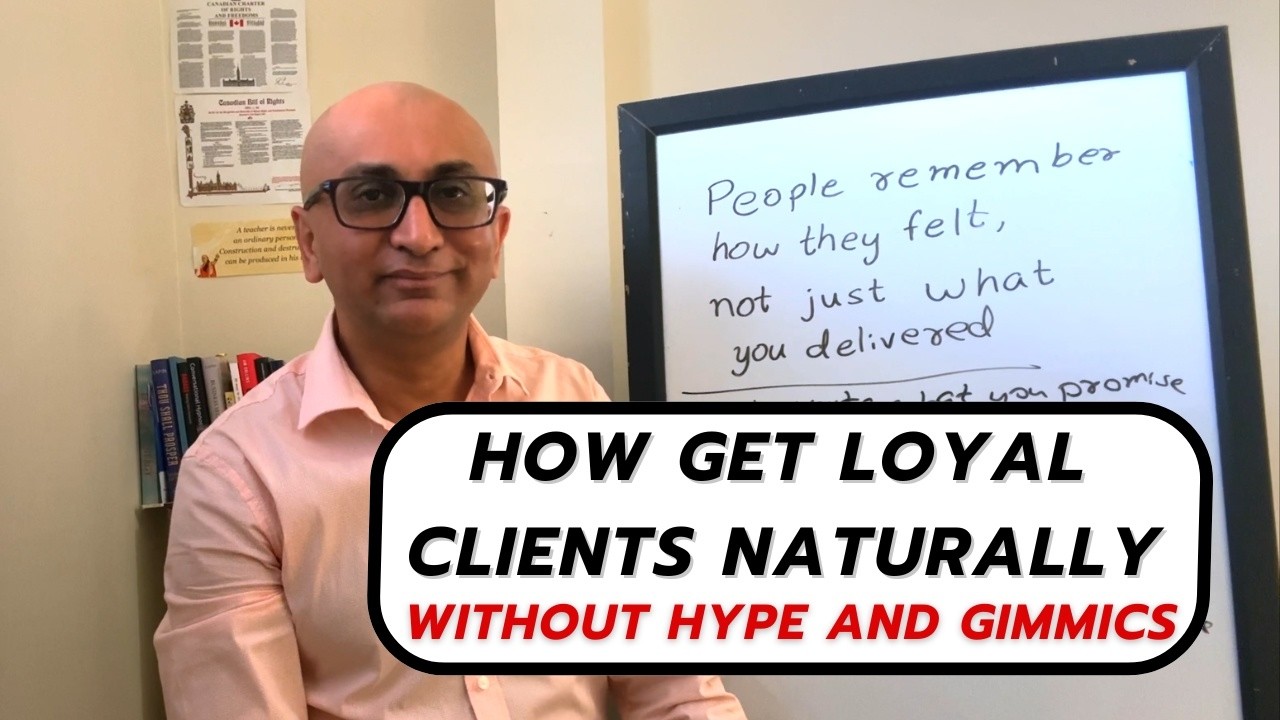
Mayur Bardolia shows why overpromising kills repeat business. Instead, underpromise and add one small genuine extra each time, like a free upgrade or unexpected gift. This builds trust as a compound investment: keep promises, maintain balance; underdeliver, you withdraw; overdeliver, you deposit.
Chapters
This is Mayur Bardolia, a success coach, author, and facilitator from North Star Angel Coaching and Spiritual Solutions. I feel blessed and fortunate to share tools, ideas, and insights That can positively impact your life. Welcome to the video. Here's something that probably happened to you at some point. Let's say you hired someone, a contractor, a consultant, a service provider, and they gave you a confident pitch, a very polished pitch to convince you, very promising. And then when the work came in, it was just about okay. Nothing terrible, nothing great, just sitting right at the edge of what was promised, maybe a tiny bit below. And here's the funny thing, you never hired them again. Now flip that. Think about the last time someone quietly gave you A little more than you paid for. Maybe it was a small bonus. They just gave you a faster turnaround, a faster service, a small note that did not help you, right? But they still left a note, good note for you. And you thought, oh wow, that was nice. You recommended them. You went back, you trusted them. So the question is, what exactly are those people doing differently? Because it's not talent, it's not even about the hard work. It's actually something much simpler than that. And that's what we are going to get into today. But before we do, let me just tell you upfront what this video is going to give you. We are going to look at why most of us accidentally erode trust. We lose trust without realizing it. What that simple shift is, what it actually looks like in practice. And then at the end, I will give you a set of action steps you can use before your next client interaction, before your next sales pitch. Before your next meeting with your customer, so stay with me. So here is something I would like to begin writing. The first thing, and I like this rule. Now to understand why overdelivering works, we first need to understand what most of us are doing instead. And this part might feel a little uncomfortable because. Most of us do this without even realizing it. When we are pitching, when we are meeting customer, when we want to impress someone, when we want to win the work, we overstate, we promise more. We say what we hope we can do on a very good day. We make big promises because we think that's what closes the deal. That's what wins the customer. It's almost like we are writing the menu before we even check what's in the kitchen. And that's exactly the analogy I want to use here. You know those restaurant menus where everything sounds so extraordinary? Slow-roasted, handcrafted, authentic, organic, locally sourced. Mm-hmm. Homemade. The description is so beautiful that by the time the food arrives, your brain has already built a whole expectations of experience around it. And then the plate comes out and it's just fine and very average. It's just a sandwich, a perfectly good sandwich, but now you're a little let down because the words set you up for something else. And that is something when you make big promises, right? And when you deliver average things, then what happens as a result? Disappointment. Disappointment. The problem isn't the sandwich. The problem is the menu. The promise inflated the expectation and the delivery could not even match it. And even when the work is just okay and average, that gap between what was promised And what arrived makes it feel like a little letdown. And that gap, that small quiet gap is where trust starts to erode. You start losing the trust. And here is what's important to understand about that loss of trust. It's not dramatic. Nobody storms off. Nobody says anything. They just quietly stop coming back to you. And that's what makes it tricky because you don't always get feedback. You just stop hearing from people. You stop seeing them again, and you wonder why they're not coming back. So if that is the problem, what is the solution? Well, it's simpler than you would expect. And that's when I want to take you to the next level, which is Let me give grab a different color pen, or I will say give promise, give promise and deliver plus one. What I mean by that? Let me tell you what I'm not saying here, because I think this is where people get the wrong idea. I'm not saying work yourself into the ground. I'm not saying add 3 hours of free work to every project that you do. I'm not even saying you need to make a grand gesture or exhaust yourself trying to impress people. I don't want you to sacrifice your time, energy to impress people. That's not sustainable, and it's not what I mean. What I'm saying is make a little bit more your default, not just massive extra, just a small consistent one. Think of it like taking your car for a routine service. You expect the oil change and the basic check. When you pick up the car, the mechanic says, we also cleaned the windshield inside and topped up all the fluids, right? Without any charge. You did not ask for it. It was not part of the bill, but you drive away feeling really cared for. The cleaning took them a few extra minutes only. The cost was small, but the trust it built was large. Next time your car needs work, you do not search around. You go back to them. This is what happens when you quietly add a little more than expected. Another example: Think of it like booking a hotel room. You pay for a standard room, and when you arrive, the receptionist says. We upgraded you to a better room, no extra charge. You did not demand it. It was not even advertised. Nothing dramatic happened, but the experience feels different. You sleep better. You remember the hotel. You recommend it later. That upgrade may have cost the hotel very little, but the feeling it created was much larger than the cost. That is what quiet overdelivery does. That quiet overdelivery, that means you slowly delivering something extra. And that is the whole idea. A small gesture and great memory created. So what does that actually look like in your work? Because I don't want this to stay abstract. Okay? So Not really vague idea. So let me just give you a few, few real examples. So let me share with you some examples here. Let's say if you are in the consultation business, it could be something as simple as documentation that is clearer than what was expected. Not just a big manual, just too many words, but just a cleaner note, more thoughtful notes than the person was prepared for. Or it could be, let's say if you're in the product business, or it could be a small bonus resource you can just give in. Maybe if you are in the, again, consultancy or advising industry, you can give an extra template, a checklist, something that took you 10 minutes to put together, but saves them an hour. Sometimes it's just a faster response time than they were expecting. So for example, if you're in the service industry, if you're prepared doing some projects, you can deliver something faster than they expected. They thought they would hear back from you by Friday. You got back to them by Wednesday or maybe Thursday. It's unexpected, right? Also, what you can do, you can also do an unexpected Follow-up note a week later, just checking in. Okay? Follow up after a week or something after you finish the project, or even one extra tip or advice at the end of the session or a meeting they did not ask for, but walked away thinking about it. Just a small piece of advice. That's it. Now, none of these are really big. None of them require you to work an extra day. None of them cost you a full extra day of too much of money, but each one quietly signals the same thing, that you were thinking about that other person beyond just completing the task. And that is the thing. It's not about the size of the extra, it's about the extra that communicates. It tells the other person that you were thinking about them beyond the transaction. Now that brings me to important thing, right? Because doing this once is nice. Doing this consistently is what builds something much bigger. And to explain that, I want to use a slightly different way of looking at it. I want you to think about trust like a bank account. Every time you make a promise and deliver exactly that, you are keeping the balance the same. You are not overdrawn, but you are not growing either. It stays neutral. Every time you promise and underdeliver, you're making a withdrawal. A small one sometimes, a bigger one at other times, but withdrawals add up. And at some point, the account runs dry. And every time you under-promise and over-deliver, you're making a deposit. And just like any savings account, deposits also compound over time. So, Trust. Trust is your reputation's bank account. And here's the interesting part. You can have brilliant marketing, a great website, a very sharp and polished sales pitch, a beautiful logo, a beautiful packaging. And still be overdrawn on trust because marketing does one thing. It attracts attention. It grabs attention. It brings people through the door. A lot of people around do a lot of hype to attract the clients. No problem with that, but how are you going to get them interested? How are you going to retain them? How are you going to make them come back again, not only once, but many times? And this is where the trust is very important. Trust is what makes them stay, come back, and tell others. Marketing brings people in, but trust keeps them. And once you have that trust, Once people know that when you say something, it's going to happen and probably happen a bit better than you say it, they stop shopping around and they stop comparing prices. They just come back. That trust is essentially invisible in most of the places. You cannot put it in a proposal. You cannot quote trust in a brochure, but it does more work for your reputation than any single piece of marketing ever will. All right, so now we know the problem. Now we have the idea and we understand why it matters. But knowing something and doing something are 2 different things. So let me show you exactly how to start applying this. Here is the rule I want you to remember. It's simple, but don't let the simplicity fool you. Most of us promise what we hope we can do, what we intend to do, what we plan to do if everything lines up. But intentions are not commitments. And when life happens, and life always happens, accidents do happen. Not all days are good days. Not all days are the best days, I would say. The intention falls short and the gap appears. So the first step is to be honest with yourself before you commit to anything. Ask yourself, is this what I know I can deliver? Or is this what I hope I can deliver on a perfect day with no surprises, no accident? Remember, promise what you know, deliver what you can. Scale your promise to what you know, not to what you hope. And then once you've done that, look for one small thing you can genuinely add. Not just forced extra, right? Not just randomly put things together. Not something you're secretly resenting while you do it. I don't want you to just lose something much more than you gain. I told you earlier on, right? You do not need to overdeliver by putting yourself in problem, right? By exhausting yourself. No. A genuine one, something that makes you think, you know what, this will actually be useful for them. Okay? You can say, okay, you know what, this will actually will be useful for them because here's the key distinction and it's an important one. The extra, the extra is A gift, not just a line item. Think back to the mechanic, you know, who topped up your pressure tire or did a, you know, cleaning work, a tiny cleaning work, and that took him only 10 minutes to do and not much more money, but he did it for free and he did it without being asked. Now imagine instead he handed you a bill at the end. With a small line item that said tire inflation or cleaning the windshield complimentary, for free. The moment you read that, the moment you notice that, something shifts. It's still free, but now it feels calculated. It feels like a tactic. The warmth is gone because he announced it. So don't write in your invoice. Don't write, okay, here's something I did it for you for free. No. Same with the hotel. Imagine the receptionist upgraded your room and then said, we do offer complimentary upgrades to loyal customers as part of our retention program. Suddenly you're not feeling looked after. You're feeling managed. You feel like, you know, oh, that's the marketing Gimmick. The upgrade did not change. The price did not change, but the feeling changed completely. That is the difference between a gift and a transaction. A gift is quiet, right? When you give someone, you don't say it out loud and you don't just you know keep shouting about it. You quietly gift it. It doesn't ask for anything in return. It doesn't announce itself. It just shows up. And that quietness is actually where all the power lives. The moment you start logging your extras, pricing them in and pointing them out, they stop being a reflection of your character and start being a marketing strategy. Don't do that. And people can feel that difference, even when they cannot quite put into words. It's a feeling thing. They cannot express it. Now, I know what some of you might be thinking at this point. You're thinking, if I consistently promise less, won't people think I'm not capable? Won't I lose work to someone who promises more? And that is a fair question. So let me answer it directly. In the short term, I mean, in the shorter term, maybe sometimes the flashiest promise wins the first contract, but in the long run, the person who delivers quietly and consistently more than expected wins the relationship. And the relationships are worth far more than a single contract. Think of it like two runners. One starts fast, sprints the first few hundred meters, and then slows down. The other keeps steady, reliable pace and finishes stronger. Which one do you want your team for a marathon? That's what this is—a marathon strategy, not a sprint strategy. And once you understand that, the payoff becomes really clear. I had done so many contracts. I worked with so many people without a piece of contract, like paper contract. It's just a matter of trust. And this is more powerful than any written contract. So let me show you what this actually builds over time, because this is the part that makes the whole thing worth it. Here is what consistently overdelivering builds for you when you do it over months and years. Repeat business, referrals, a reputation that arrives before you do. And the last one is the self-respect. I think this is the most underrated of all of these. When you know that your word equals or understates your performance, that is acquired confidence, and that's very hard to manufacture, but very easy to feel. You stop worrying about competing on price. You stop anxiously checking if someone else is cheaper because you know what you bring. You know what you're doing, and so do the people. So do the people who have worked with you. Think of it like a street food stall that's been in the same spot for 20 years. No fancy signage, no advertising budget, no social media strategy, no Facebook ads, just the same person showing up. Every day, making the same thing, creating the same thing with the same care. At first, the people who walk past just notice this smell, and and few of them really stop. Then they come back. Then they start bringing colleagues at lunch, and at some point. Without any ground announcement, there's a queue. People line up, not because of a campaign, not because of Facebook ads, not because of social media posting, not because of cool logo, not because of hypey marketing gimmicks, right? No viral social media reels. Not even because of a discount, but because enough people experienced the same reliable thing enough times that the word just traveled on its own. The trust was built. That queue, that lineup did not appear overnight. It was built one plate, one bowl, one portion, and one Quiet act of consistency at a time. And that's what I love most about this approach. It doesn't require reinvention. It doesn't require a new skillset. No, you cannot learn this skill of trust. In fact, there's no such thing as skill called, I mean, like trust. It just requires a small shift in how you think about your commitment, how you care about your customers, and a small habit of adding just a little more than was asked. And let me bring this all together for you now, because I want to make sure you leave with something. You can actually use starting today. When you overpromise, you set an expectation you then scramble to meet, you struggle to meet. And even if you meet it, people feel nothing special because you said you would do. And you also have to do that work, extra work every single time. You always have to struggle. But when you underpromise and deliver just a little bit more than expected, people feel surprised in the, in the best way. And that feeling is what they remember long after the work is done. People remember how they felt. Not just what you delivered. Here's an example. The gym that promises dramatic results in 30 days, they often disappoint. And on the other hand, the trainer who quietly checks your form, sends you a short follow-up note, and adjusts your diet plan or exercise plan slightly makes you feel supported. One oversells transformation, the other one builds the trust. Or think of like hiring the graphic designer. So one promises a clear draft by Friday and delivers it on Thursday with 2 thoughtful variations. You feel relieved. You feel like you chose well. Think of like Ordering the book online, the seller promises delivery in 5 days. It arrives in 3 days, carefully packed with a short handwritten thank you note inside. You did not expect it. It was not required, but you now feel valued. The faster shipping and small thank you note cost very little, but the experience feels personal. Next time you need a book, you search for that seller again. That is the difference between meeting expectations and quietly exceeding them. People rarely remember the loud claims. They don't remember this gimmick marketing. They remember the steady delivery that exceeded what was promised. That is the whole game, and it's very simple once you see it. So here is what I would like you to do before your next project, your next meeting with the clients, before your next sales pitch. Just 4 steps, nothing really complicated. Step number one, write down what you're about to promise. Okay? So write what you promise. Simple. Or write down what you're about to promise. Step number two, ask yourself honestly. Is this what I know I can deliver? Right? Can I deliver on what I hope I can deliver? Right? And step number 3, if it's a hope, Scale it back to what you know, right? Scale it back to what you know. Hope is not a strategy. Step number four, then find one small. Just small, genuine extra. You can add something small and genuinely extra. You can add something that costs you a little bit. But means something to them. That's it. Just four steps before your next commitment, before your next project, before your next conversation where someone is replying on your or relying on your words. Sorry. Promise less than you can do, and then quietly. Do more. Over time, the small difference compounds, and the people around you will notice it. Even when they never quite say it loud, they feel it, and they just keep coming back. And that's how you know it's working. Start using what you learn. I understand it takes work to do this on your own, There will be times when you are tired, unsure, or stuck. When that happens, you can reach out to me. I can help you every step of the way and teach you new tools that work for you. Do you have any challenges you want to fix? Any problems you want to fix? Maybe it's about your health, job, relationship, money, or beliefs? I can help with this in personal one-on-one coaching sessions. To book a success coaching session with me, go to northstarangel.com/coaching. We can meet online, by email, or in person. If this video or lesson or lecture helped you, Tell other people about it. I would like to hear what you think and how it worked for you. Share it with anyone who needs help. Share it far and wide. My name is Mayur Bardolia, a success coach at North Star Angel Coaching and Spiritual Solutions. If you want to book a session, Organize a workshop, or invite me as a speaker. Email me at contact@northstarangel.com. I'm wishing you the best. I hope good things come your way. I wish you peace and prosperity. Have a nice day.