Tips to be an expert communicator
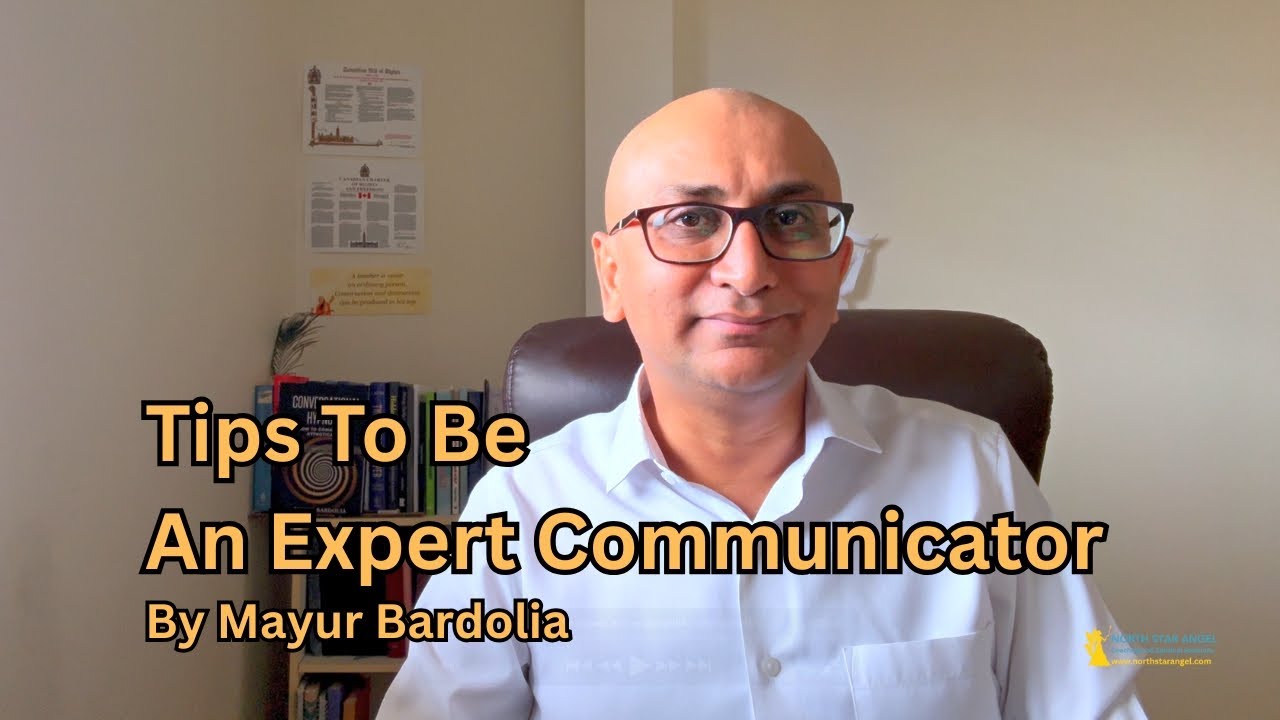
Success coach Mayur Bardolia breaks down five traits of expert communicators: setting clear outcomes for conversations, reading verbal and non-verbal cues, using your own behavior to build rapport, adapting to feedback, and taking responsibility when communication fails.
Chapters
Some tips to be an expert communicator. Welcome to the video. Everything you now have, or ever will have, or become, or you do. Or you experience, you will get and through other people. Life is communication. Your communication is directly responsible for relationship, success, employment, sales, and business. You get what you ask for and what you negotiate. Suppose you wish to create and nurture a relationship. Whether it is personal or professional, with the power of communication. To get the desired job or to get promoted at the job place, you need to communicate well. You need to ask for it. In business, the success of your business depends on how you communicate your message, how you sell and And how you negotiate. So your life is largely governed by or depends on the way you communicate. In one of my workshops called the Communication Course, and also on conversational hypnosis, that means how to communicate hypnotically. I teach how to communicate effectively so that you can connect with others, make others understand, get better employment, sell your product, and be charismatic. So in this video, I'm going to share characteristics of an expert communicator. Let's begin with characteristics of the expert communicator and what you should do. Number 1 is the expert communicator has the ability to identify and achieve desired outcome in communicating with others. So this requires setting well-formed outcome for the communication, and they know the process of how to get it and know exactly what you want as an outcome. That's the tip for you. How do you want to end this conversation? What results do you want at the end of this conversation? The outcome of your conversation could be to share information, to convince, to educate, to motivate, or maybe to build and nurture mutually beneficial relationships. The outcome of your conversation could be to entertain, to make others happy, to give instructions, to make a request, or to win the business deal or job interview. If you don't know what exactly you want at the end of the conversation, Your conversation will most probably lead to the outcome that may not be what you want. Once you know precisely what you want at the end of conversation, you can lead the conversation effectively the way you want. Then, number 2, see and hear accurately. By using clean sensory apparatus to notice verbal and nonverbal communication elements. Pay attention to what's happening, what's happening around you, what's happening in your conversation. Most people don't listen to understand, but they listen to respond. They can't wait until the other person speaks and finishes. And they're far too occupied with their own thoughts, so they cannot focus on what the other person has to say. So to be a good communicator, see and hear to know exactly what's going on and how the conversation is going. Seeing the other person's body posture, facial expression, hand movements, and gestures. Listen and pay attention to their tone, the volume, the speed of their voice, the tone of their voice, the fluctuation in their voice, and what words were emphasized and in what sentence the tone and the volume were changed. Tip number 3, the expert communicator utilizes their own verbal and nonverbal behavior to develop rapport. And deliver precise messages. I've been teaching in one of my workshops on the topic of how to create a rapport and how to create rapport sometimes even without speaking much or speaking nothing. Say things clearly and try to use as simple words as possible. People do not understand the best messages or idea. Your message could be the best one, the really good one. People understand things that are communicated most clearly. If you clarify your message, people will listen. People hate to be confused. Tip number 4, the expert communicator has the ability to demonstrate flexibility in their own behavior. And this is the hardest to achieve because most of us feel we already are fairly good communicators, and maybe we are. It is particularly difficult to be flexible if we just do the mind reading and claim that our belief, actions, and attitudes are right, or decide that the other person is not willing to communicate with us. Both things are not going to help you. I would recommend that if what you're doing isn't working, Try something else. The meaning of your communication is the response you get. Judge the effectiveness of your communication by what other people do rather than what you think you say. Look at their responses. And when you have more flexibility in your communication, you can influence others more easily. There are no mistakes in communication. There are only feedback. The idea is to learn to become flexible so that you can communicate with a wider variety of people. So, to be flexible means to use your body as an instrument to create harmony with others, your body, your tone, and your words. And expert communicators seem to have the ability to adjust their communication so that it is appropriate for whom they're communicating with. They're being able to adopt the logic, the body posture, and facial expression of the other person, and they become flexible in that. Flexibility in your behavior will allow you to receive a wide range of responses from people with whom you're communicating. All communication produces response. The question is, are you getting the response that you want? If not, that means that your client or friends or people are stuck in their own ways. You need to help them to get to your level of understanding. But on the other hand, if you notice that what you're doing is not working and immediately change your behavior in some way, your voice tone, what you talk about, Your sentence structure, your body movements, your clients and friends will respond accordingly. Learn to match the communication to establish rapport and also learn to mismatch because if you don't have a choice, you are a robot. Sometimes you just need to mismatch. You know, some, you don't need to agree all the time. Expert communicators notice what results they are getting and will change their behavior to get the best result. Other people will judge themselves and others. Experience is not good or bad, not right or wrong. It's just, it is, it's just experience. That's it. Don't give meaning to it. Every voice tone, every sentence structure, everything you say is a set of choices. And the first thing that will give you effectiveness is to understand that if you have more flexibility, wide range of variability in your behavior, you will be able to bring a wide range of variability in your clients, in people around you. So, responsible communication is where you notice what response you are getting and adjust your own behavior accordingly. Lastly, I would like to share a very important tip. Take responsibility of your communication. If others don't understand you, assume it's your failure. Well, it may not be 100% correct, but at least it makes you more resourceful and flexible in your communication. If you believe the opposite, such as, if others don't understand, It's their fault. Well, it won't work. So take the responsibility for the success or failure of the communication from the beginning of the conversation to the end of the conversation. I hope you like this video and share your feedback with me. If you benefit from this video, please recommend it to someone who can benefit from it. Please share it far and wide. It's Mayur Bardolia, a success coach from North Star Angel Coaching and Spiritual Solutions. If you wish to book a coaching session or workshop or invite me as a speaker, reach out to me at contact@northstarangel.com. Have a nice day.