Webinar- How to Craft Compelling Marketing Offer & Communicate Hypnotically?
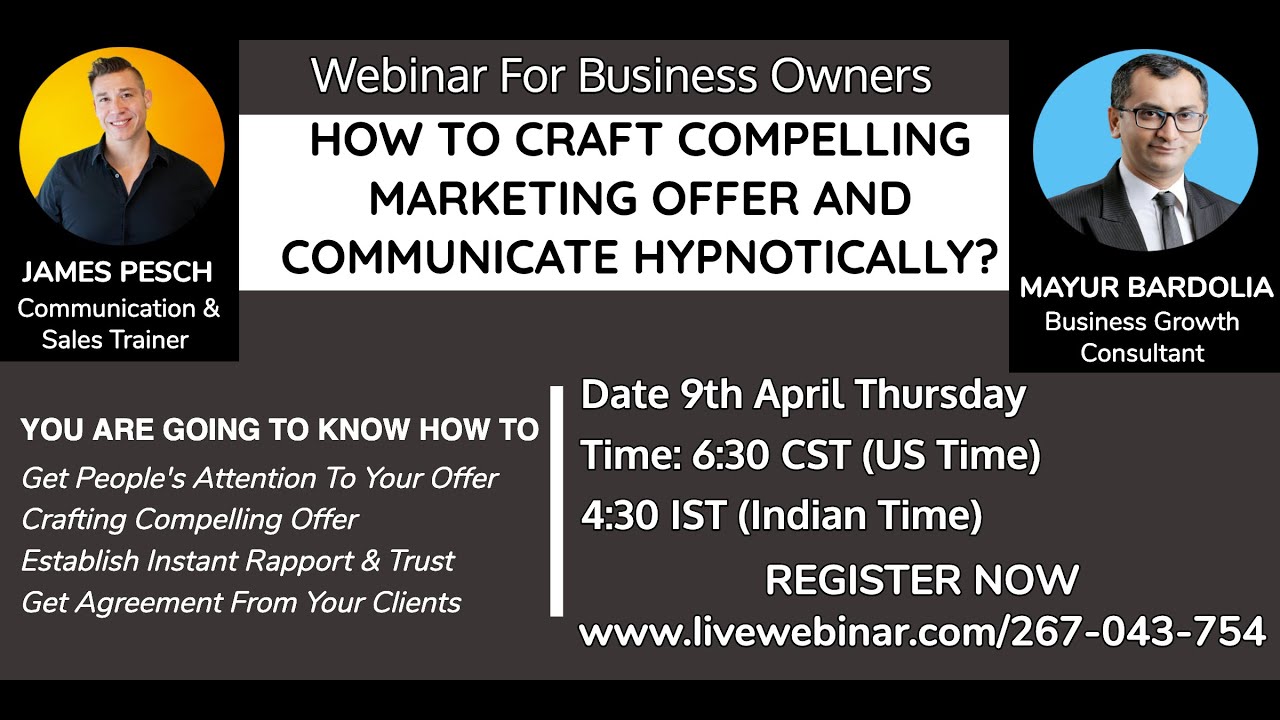
In this April 10 2020 webinar, Mayur Bardolia (joined by James Pesch) teaches a practical framework for creating marketing offers that capture attention and persuade prospects. The session begins by highlighting a common mistake: assuming clients know the product as well as the seller. Mayur introduces a scale (1‑10) to illustrate the knowledge gap and stresses the need to educate the client from their level up to full understanding. He then outlines four essential milestones for any offer: (1) defining the target audience, (2) pinpointing the big problem, (3) articulating a big promise (solution), and (4) crafting a big idea (a trigger that cuts through the noise). The webinar blends concrete business examples (injury‑free yoga, baby‑photo service, digital marketing for SMBs) with communication techniques drawn from NLP and coaching. James expands on the “communication hacking” side, covering positive emotional anchoring, well‑formed outcomes, sensory modalities (visual, auditory, kinesthetic, internal dialogue), frames of reference, and mirroring/matching body language and language patterns. Both presenters stress the importance of clear, lay‑person language, positioning the customer as the hero, and aligning the offer with three high‑value market categories (health, wealth, relationships). The session ends with Q&A, actionable tips, and calls to action for further coaching.
Chapters
Many people make this mistake that they think they know as much as what their clients know, as much as they know, right? So which is not— I mean, you may be you know, in love with your product or service, but your clients don't. You know, you are just a stranger for them, and you're probably the last person to trust for them. So you are not your client. And then, uh, I think there is—
Okay.
Now here's a scale in front of you that number 10 is the complete understanding about your product and service. The problem is that you know about your car, about your product and service, like number 10. I mean, you know everything about your product and service, but how much your client actually know? And they don't have very good understanding about the your product or service. They're at the number three or something. Yeah, or probably two, or probably don't know anything about your product. So most people when they are trying to Convince the clients. They assume that the customers knows everything about. No, they don't know anything that you offer. And what do you need to do? You need to make them understand understood that they know what you already know. So you gotta lead them to a point where they can understand your offer as much you understand your offer. And I think this is where people make a lot of mistakes. People use jargons, people use some technical words when they're trying to impress the client, and the clients don't pay attention. They just lose, they just turn away. But you need to understand that you need to go to that level. You got to reach to that level. You need to understand what they already know, and then you have to gradually educate them about your product or service. And you have to take them to number 10. So now how are we gonna do that? In here we're gonna talk about 2 topics, you know, from my side. How, how we gonna get and keep their attention? And what's your big idea that how to get them really interested in what you're going to offer? So this is really interesting. People don't buy the best product or service. Right? They buy the product that are communicated clearest. You probably have the best thing in the world, but if you fail to communicate, they are not going to buy from you, which is clear. You can share your comment or questions in the chat box. I'm more than happy to help you. The thing is, you are in love with your product or service. But they don't understand. They don't listen what you're trying to say. So obviously you have to communicate so clearly that they understand. Now if you clarify your message, they will listen because the last thing they want in life is to get confused. People don't want to be confused. You got to explain your offer in a layman language. Even the small child should be able to understand that. It should be so clear. It should be so simple. Now, how are we going to get their attention? Let's talk about that. The thing is, we need to guide them from the scale of 3 to 10. And there are many milestones in between. You can't just expect them to jump over to number 10 automatically. You have to guide them along the way. And there are some milestones. You have to take them on all, all those milestones. And because they don't see the complete picture, you have to help them out to create a complete picture in their mind. Because the way you offer, it's confusing for them. And if you confuse, you lose. I want you to write it down. If you confuse, you lose. You have to guide them along. You have to educate them like you educate a child. Okay, so what are those 4 key milestones? Let's talk about that. I'm not going to share all milestones which I share with my clients, but I'm going to share 4 key milestones. Number 1 is the target audience. Number 2 is the big problem. Number 3 is the big promise. And number 4 is a big idea. So what do I mean by that? So I'm, I need to assure you that if you follow this process, which I'm going to share with you, you're going to use that in your sales pitch, in your Facebook ad, in your video sales letter, In your sales presentation, in your product description, in your landing page, whatever. If you are going to sell, you need these components. You can't ignore this. So the first one is the target profile, your client. And when most people try to sell, they think my product is the hero, I am the hero, I am the best one. That nobody cares, by the way. We are here to help people to solve a problem, and that's— I mean, with our product or service. And we have to make our customer hero, not you. I mean, you are not— you're not a hero. You're nothing. If, if there is no customer to buy, there's no business. Now, many times people ask me, how can I grow business? And my only answer is, give people what they want, right? Make them feel important. You need customers to run the business. People always confuse, you need, I mean, I need a lot of investors and I need a lot of money, I need a cool logo, I need a good brand or design or something. No, you just need clients to run the business or a profitable business. And you need to see your customer as a hero, not your brand at all. So what's the first thing? You got to find out who is going to buy, who is your ideal, ideal client, who is your target profile. And it cannot be everyone. You cannot say I'm serving everyone. No, you can't. And it's a very crucial thing everybody needs to understand that. How are you gonna choose that one person? You're gonna start with small. Are you going to serve locally in your town, in your city, or in your street only? Are you going to serve in your Your nation, your country. If you're going to serve people from all over the world, but at least you should be having an idea what country you want to start with, who is your target audience. You can't talk to everyone, not everyone is your client. People make a mistake that they want to serve everyone. You can't serve everyone, it's impossible. And then you need to choose a real person, and this is a very difficult task. And it has to be done before you start any marketing campaign. You can't do any marketing or sales before you do this. You got to find out that one real person that you want to serve. You got to speak to that person and find out the list of problems that your product may solve. Okay, this is very difficult. Why? Because we can't— we don't have the courage to ask people that I got something to offer to you. All right, uh, do you think you'd be interested to buy? And you have to clearly tell them upfront that you don't have to buy. You just tell me if it's available in the market, would you buy or not, right? What's— what sort of things you want to add? What you don't like about this product? Help me out to understand. And then ask them what are the problems that they are facing that my product may solve. And they will list down all the problems. And then you have to choose only one problem that you think you can solve. And you have to get the real person to get the feedback. And this is where most people don't do, because this is the hardest part. Everything, you know, you do before you write any single word in your marketing message, right? And so the thing is You got to do it first, right? So you got to identify what's your target audience. Okay, so I got a question from Robin. What are 4 milestones? We already discussed earlier: target audience, problems, promise, and idea. So let's move on. The first component is done. The second part is the big problem. Okay, so a lot of mental work for you now. The thing is, nobody cares about what you're gonna sell. People are selfish. I'm also selfish. You're also selfish. The reason why you're here because you want to learn something. That's why you're here, right? So everyone is selfish. They have to be, by the way. So concern, you know, about if they have the pain in their teeth, they are more concerned about their pain in their teeth rather than 200 people died in an earthquake in the other part of the world because they are more concerned about their own problems. People care for their own problems. They don't care about you. You got a cool product? Nope, they're not interested. Can you solve the problem? Can you solve my problem or not? That's the only thing they want, right? So that's the first principle you need to understand. And people generally ask me, what are the big problems? What is the problem? And the thing is, you got to solve the problem in the business. And what is business? So the famous motivational speaker called Zig Ziglar, which I highly recommend you to read, he said that if you want to get what you want, you have to help others to get what they want. Simple as that, right? The entire economy, each and every business in the world is, is running on solving a specific problem, nothing else. Okay, solving a specific problem. If you can't solve a problem, you can't run the business. Every single business in the world is solving the problem. I'm going to share with you some example what I mean by that. But if you want to get what you want, you have to help others to get what they want, and they have to— they will pay you in exchange of their solution. So what— how are you gonna find out the problem? So when you're talking to your, uh, client, your target audience, they have mentioned the problems they are facing that your product may solve. You got to Identify all problems associated with that, and then you have to find out one problem. Okay, and why problems are so important? Because problems in a problem, it is okay. People raise a problem. Very simple. And then emotional problems are more powerful than the logical problems. You have to create the emotion in them in order to generate the the need to buy from you. Now, what are some biologically rooted problems? These are the real emotional problems. If you can help people, you know, to deal with these challenges, you can make really good money. Now, some of the examples of biologically rooted problems which are, you know, not making enough money so they can't support their family, they can't— they're not knowing how to make friends because they want— they're feeling lonely, and they're not being able to lose weight because they want to live longer, they want to live healthy, and they're not being able to prolong physical attractiveness because They want to look younger. So they want to slow down the aging process. These are the real big problems. I think this— I mean, if you understand this message really well, you can learn marketing a lot better than anyone else out there. Now, list out all the problems that your clients are facing. What keeps them awake at night? What is the real, real big problem from them? So list out all these problems. And find out the 3 main problems, the main problem, and rank those out. What is the most important problem to the least important problem? Rank them, give them rank number 1, number 2, and on and on. And find out the one big problem for them, right? And it's a big problem. Why I'm saying the big problem is because it is big for them. If not solving it it will cause greater pain than spending big money to solve it now. For example, there are 2 types of doctors. One is the general practitioner, you know, a doctor who knows a little bit of everything. And there's a specialist. The specialist charges a lot more than the general practitioner because he's a specialist. He knows how to solve one big problem. That's why he can charge Really big money compared to the general practitioner. And now, friends, I need to share. I need to give you a golden tip. These are the three biggest problems. These are three big niche, three big markets in the world where people are making really good money. Number one is the health market, right? People will do anything to look good, to live longer, and to look attractive. Number two is. People will spend money to gain more money or to save their money, but people are really concerned about their financial security, right, or prosperity. People will pay a lot of money in that niche. And the third niche is the relationship. People want to be seen with the great people. People want to have a really wonderful relationship. People want really good friends, really good, you know, partners in their life, and people pay a lot of money in this You need to remember that if you can understand this message clearly, you're going to do really well in the business. And now, friends, the 3rd component, which is a big promise. What's the solution? And it's pretty simple. The problem that your clients are telling you, you got to flip the problem. You have to provide the solution. It's, it's not— no rocket science about that. What solution you can provide that can help people to solve their their problem. So the role of a problem is to increase the heart rate, and the role of a solution is to decrease the heart rate. It's, it's pretty simple. So first of all, we talk about your target audience, who you're gonna serve. Second is what problem you want to solve, and the third one is the solution of the problem they are facing. Now the important part is you need to stick to one big problem One big promise and one big idea. So what do you mean by one big idea? So like I said earlier, people are bombarded with a lot of information out there, right? Everybody's trying to catch your attention. Like we go to social media, you see the adverts over and over again. They're trying to catch your attention. But where do you stop the most, which grabs your attention? The big idea. Something really catchy. So I will share with you exactly what would it take for something to cut through those 50 messages. How are you gonna create your big idea or a trigger? The trigger means you say something and they pay attention to you immediately. A trigger is simply the ability of a message to stand out. You get the attention and you respond in a predictable manner. How are you gonna find out? So let's discuss. When you say something that catches their attention, they say, oh, that's nice, hmm, that's really interesting. And when the client says, what do you mean by that? Tell me more, right? That means you found the best idea, because there are a lot of people who are selling exactly the same thing as you. When you communicate your big idea, they will pay good attention to you. So friends, let me give you some examples what I mean by all. I mean, I want you mix all these components together. So let's say, let me give you some examples of some of my clients. I have a client who is running a yoga institute, and she is actually serving. She is delivering the alternative form of exercise. And she has noticed that the problem that yoga can create a serious injury. So the solution she is providing is the injury-free yoga. So when someone asks her, you know, what do you do? She introduces herself as most people who practice yoga don't realize how much harm you could be doing to your joints, your knees, and your spine. We teach students injury-free yoga. So when you say injury-free yoga, they pay attention, right? And they ask you, how do you do that? Okay, so we got the questions coming again. So if anyone has a question, please share with us. So Robin is asking, can you take a scenario of a cold-pressed juice detox program complaint? Um, what's the problem that you're solving? You know, you, you got to find out. Like I said, you have to go through the journey. You gotta find out who you're serving because you can't serve everyone, right? I may not be the client, you know, your client who is looking for cold-pressed juice, okay? So you got to find out who's your target audience, what problem you're providing, and what's the big idea that you are doing better than anyone else. So I think that'd be— you have to do that homework, right? I'll give you the framework and that will help you. Let me give you another example. There's another client who is having the online digital photo processor company, right? So his target audience is very specific. He's targeting the mothers who have kids 1 year old or younger.
Why?
Because problem is looking after a baby is a full-time job. They can't go out and take the photographs of their— of the children because it's the best time to take a photograph, but they are not professional photographers. So what solution they are delivering is they're taking a picture of the baby so the mother— mothers can upload them without ever leaving the home and get the pictures delivered home the very next day with all those Photoshop and all those beautification. So when someone asks him, what do you do? He explains, mothers with babies 1 year or younger love to print photos of their babies but have no time to go to a photo studio. And we provide a service where mothers can get top-notch pictures without ever leaving home. And this is clearly defined target audience, clearly defined problem, clearly defined solution, and the big idea. Very good, very effective. The next example is the digital marketers, and he's running— he's targeting small to medium businesses. The problem is, I don't know digital marketing. His clients' problems are I don't know digital marketing and I want to reach the right audience. So the solution he's looking for is I want to sell more. So when someone asks my client, what do you do? He says, I help you market your message to the right people at the right time to make them choose you over and over again with the lowest cost per click in the market. So that's really catchy. He's not targeting everyone. He's not targeting big corporations or the individual or personal brand. He's targeting small to medium businesses. And, uh, he is telling people, we can take you to the right audience with the lowest cost. So we got, uh, some explanation from, uh, Robin. I have put together marketing plan, but main challenge is Who has that much time to understand my message? Few of my competitors are throwing ridiculous money on paid channels and taking aggressive approach and feel the strategies are fading my brand and our message away. How are you going to stand out? Like I said, you know, it's a lot of mental work. There's no ready-made answer. You know your product very well, better than anyone else. Find out what will catch their attention. I've given you some examples, Robin, that you can have a look at that. Okay, and I will also invite you to have a call with me. So wait until the end, and I got your question. Dennis is asking, I'm in a real estate business. How can I identify my target audience? It's pretty simple, by the way. You can't target everyone. Who do you want to serve? Is it a residential? Is it a commercial? Is it small business owners or big business owners? Is it big corporations? You got to find out what are the problems. What is this? What is something that nobody else is doing? Okay. Yeah. Thank you, Robin. Thank you for the answer. Now, Dennis, you know, the thing is, if you want to stand out from the crowd, stand out from the market, you've got to do— you've got to present what no one else can do. I see many real estate consultants out there who do a lot of things, and they all do the same thing. But their clients are missing something. So you need to find out your clients, what is it something that nobody else is providing and you are providing? You find out, do the homework. I think that will help you because when you do something what others are not doing, your clients will pick you over someone else immediately. Okay. And that, I think that's the golden tip you can begin with. Right. So I think that will help you. So 2 advices, let me ask, me just share with you what exactly these big brands are doing. So Coke is actually not selling the drink, they are selling the happiness. If you look at the advertisement, the classic advertisements of Coke, you know, they are selling happiness, right? Okay, so just one second. Yeah, Coke is selling happiness. If you look at any advertisements of Of the past of Coca-Cola, you will see they are selling happiness. What Gucci, Louis Vuitton, and Rolex—they are selling perceived security insecurity. And what is McDonald's selling? Amazon Prime. They're not selling any food or product; they're selling short-term gratification. They give you instant result. You go to McDonald's; you instantly get your food. If you buy from Amazon Prime, you get your goods delivered as soon as possible, the shortest amount of time. What is Apple selling you? Apple is selling the status. It makes you, you know, it makes you look good in front of others. And Uber is selling you time. It can take you from one place to another in a shorter amount of time. So you need to find out what exactly you are selling. So here's my session is ended. So first of all, I need to thank whoever is present today. Dennis, thank you for coming. Dhiren bhai, thank you. Hardy, Hardik, Hetal, Jikesh, thank you very much for coming. Kalpesh, Muhammad Salman, thank you. Peter, good to see you, man. Right, Robin, uh, Sheetal, yes, thank you very much for joining. So if you have any question, you can post in the comment box and we'll try to answer as many as we can in the end. Or if you like this presentation, just leave a comment, you know, we'd be very happy to hear. So now I invite Mr. James Pesch to take over the presentation. James, please jump in.
Hi, okay, great. Thank you, Mayur. It's always an honor to present with you. I really appreciate it. Please let me know if I'm not coming through clearly or if I need to elaborate or enunciate a bit, a bit better. Obviously, we are here to grow and help one another, so I'm happy to also learn from the attendees. Today we're going to be talking— my portion is going to be talking about communication hacking, which this applies in 2 ways. First, we're going to focus on having prospects right in front of you that you're talking to. This is if you've already booked an appointment. And if you are beginning to connect and build that bond and rapport with someone else. And then secondly, we're going to talk a little bit about how to craft an ad in a way that is compelling to your audience so that you are really hitting on all the points that they need for them to really connect with your message. So let's get started. First, I always start every webinar, every workshop that I do with With setting a positive emotional state. So what we wanna do is really connect with a time in your life. You can imagine it, or you can recall a time in your life when you were truly proud of yourself, when you accomplished something great, whether that was graduating from a university, or whether that was finishing first in a race, or maybe it was making the perfect meal for a loved one. Whatever it was though, you have a moment in your life whenever you did something that made you feel proud of yourself. And you accomplished a great goal. And I want you to think about that now and go back to that moment visually in your mind, connect to it, see it really vividly and clearly. I want you to also— uh-oh, is my voice cutting out or is it coming through? Somebody in the chat—
You can carry on. I can just— I can really clearly hear your voice, but I'm instructing people to shut down all of the internet activity. If you have other browsers open, please shut it down. because it consumes a lot of bandwidth, you know. So please, uh, open this browser only, right? So I think that'd be enough. Please, over to you, James.
Perfect. Okay, so what I want you to do now is I want you to visually begin to connect with that moment and play it out like a movie in your mind. Make it really vivid and clear. Notice the colors in it. Notice if there are any sounds in that memory that you can remember that person saying something to you. Are you saying something to yourself? Or if there was applause If there was laughter because you told a great joke. And then finally, notice how it makes you feel and if there are any sensations that run throughout your body. And whatever you feel that on a scale from 1 being I barely feel it or 10, I feel it a lot, I want you to just crank it up, just turn it up, and then just feel that even more and connect with it now. And just take a minute to do that because science has shown and studies have shown that when you go from a state of Being able to know that you can achieve something. Whenever you go from that position, it's a lot easier for you to learn a new concept or a new thing more rapidly. So we want to go from that positive mindset that I can get this, I can achieve this, I can accomplish this. So just take a moment to do that, and then we'll go ahead and advance to the next slide.
Okay.
So this is a 4-step model that I follow, and this is anytime that I want to connect with clients, prospects, family members, even friends. So the first thing that we want to do is we want to create a well-formed outcome. And whenever we get to this portion, I have to thank Mayur for introducing me to this model. But I know that this may not have originated with you, but you're the one who introduced it to me. So. I appreciate it. Um, but so we want to create a well-formed outcome. So we want to determine the ethical and authentic applications, the way that we want to use this. Um, so you want to be able to make— realize the beginning goal in mind before you ever even start. And that, you, you know, neurolinguistic programming, that's a— that is like a foundational aspect of being able to use any of the skills, any of the techniques that we learn. In hypnosis, in neuro-linguistic programming, you have to know the exact outcome as pre-framed as possible that you want. Secondly, we want to develop sensory acuity or emotional intelligence. We want to be able to read microexpressions. We want to be able to know when we're connecting with an audience, know whenever you have really done the right thing, and be able to read that feedback in real time. And in order for us to do that, we have— there are some different things that we have to begin to notice. And begin to practice on. And that's something that people can contact a coach like myself, Mayur. There are other NLP practitioners out there who teach sensory acuity, but that's something that you have to develop and learn. Third, you want to study your subject. You want to note their language patterns, which are also called sensory modalities. We'll talk a little bit more about that. You want to notice their body language. You want to notice their attitude, whether they're in a positive emotional state or a negative emotional state. And, and adjust your own body language, attitude, and language patterns accordingly. And finally, you want to mirror and match them. And we'll talk about those different aspects whenever you're with a client in real time, a prospect that you are meeting with in person or even on webcam. And then we'll talk about finally how to craft your pitch around this same model and the same method. All right, so this is, uh, something that Mayur introduced me to. This is, uh, how to create a well-formed outcome. So the first thing that we always want to do is make sure that whatever the outcome is that we want, we want it positively stated. In other words, you need to really put down on paper, say out loud to yourself, or get a good idea of what it's going to look like when you have what you do want, not whenever you're focusing on what you don't want. So you want to— I have people, clients that will come to me and say, I don't want to be overweight anymore. I want to stop overeating. And I'll say, okay, well, both of those were negatively stated. So instead of telling me what you don't want, tell me what you do want. The reason that this works is it's just like if I said, don't imagine a black cat running across the screen, your mind automatically begins to generate the ideas and the images of a black cat running across the screen. So whenever you say, don't do this, your mind doesn't hear the negative. It only hears the actual images that are being spoken out loud. So we don't want to activate mirror neurons in that way and start to experience those negative emotions. We want to experience the positive emotional state that we want on the other side of this issue. So positively stated. Secondly, you want it to be under your control. So we can't make people buy our product. We can't make people listen to us, but we can focus on us being the best version of ourselves, us focused on using the right language that is most appealing to our audience. And we can focus on showing up with the inner champion inside so that we actually connect with our audience in a way that's compelling, that's authentic. And then we look, we appear to be trustworthy. And so you have to make it under your control, nobody else's. Secondly, or thirdly, we want it to be real. So just like we did whenever we were setting a positive emotional state, you want to connect with the visuals, you want to connect with the sounds, and you want to connect with the feelings of what it's going to look like whenever you're at the end of this. When you do reach your ultimate goal, you want to focus really intently on making that real. So if it's in black and white or if it's in color, you need to know those things. You need to know if it's shiny and big and bright, or if it's kind of dull, and you want to really connect with that. How's it going to look? You want to connect with any sounds. What are they— what will they be saying? What will I be saying whenever I get to that end goal? And then finally, you want to connect with the emotions. How will I feel whenever I get to that end goal? How are they going to feel? How is everybody going to feel whenever we arrive at that end goal? If I've really done a good job of setting up this well-formed outcome. And then finally, we want it to be ecologically balanced, which just simply means that everybody has to win. So you have to know in your mind whenever you're creating this well-formed outcome that you're not going to sabotage yourself by somehow in the back of your mind thinking that this could be a bad thing for them, or this could be a bad thing for myself. So, you have to know that everybody wins. It is going to be really well balanced for everyone, that this is a good goal. This isn't a bad goal, and there is no negativity attached to it. It has to work on every level of your life. Is there anything that you would like to add to that, Mayur? Oh, your mic is muted.
Oh, sorry. So wait a second. Oh, can you hear me now?
Yes, you're good.
Perfect. So I think it's perfect. So we need to understand that, you know, when you're offering your product or service, you know, when you state— when you pitch your product, it has to be good for them, right? It has to— it should not make any negative impact in their life. And you're— when you're creating the offer, uh, you have to be— it has to be very positive stating. And what James is trying to say that when you have full confidence in, in your product or service, your pitch becomes clearer. Okay, so I mean, when he said that you have to be a better version of yourself, and it is a very deep meaning. So I request James, you know, to say 2 things about, you know, becoming a better version of yourself.
Yeah, so whenever we focus on becoming the best version of yourself, I actually have a 4-part sales training where the first thing that we do is we focus on clearing out head trash. And connecting with that best version of ourselves. So you have to really focus on the version of yourself that's already on the other side of your problem. If you were, if you were the best version of yourself right now, this instant, you just were that version, what would that look like? What would that sound like? How would it feel to be that version of yourself? Connect with that version of yourself. And we have several different NLP techniques and different models to where we can make that happen rapidly. To where whenever you walk into a situation, you are very literally bringing in your best character traits. And the only person who knows what that looks like, knows what it sounds like, and knows how it feels is you, because it only exists inside of your own mind. So connecting with that best, that inner champion, that hero within, that's the first step in becoming successful at sales, is focusing there and, and pre-framing who it is that you are and, and who it is that you're going to bring in. to every meeting, to every— before you start an ad, before you do any marketing campaign, you want to connect with that best version of yourself so that you know that your message is clear.
I think there's a question from Robin. James, can you please read that?
Yeah. So Robin asked, I understand you talked about setting a positive emotional state, but how do you stay positive and motivated until you get the desired goal? That's an excellent question. That's why we talk about creating the well-formed outcome. The first step is obviously connecting with your inner champion, focusing on that version of yourself that's the best version of yourself, and then creating a well-formed outcome and connecting to that in such a way to where you'll know what it looks like. And your mind, on a subconscious level, your unconscious mind will be constantly driving you to that end goal because you know that it's positively stated. You know what it looks like, you know what it sounds like, you know how it feels. You know, it's under your control, so you're not focused on what they do. You're only focused on what you do. And then finally, it's ecologically balanced, so you know it's a win-win for everybody. I hope that helps, Robby.
Yeah.
All right, um, so let's talk about frames of reference. What's the purpose of focus, uh, finding out what, what are sensory modalities? What's mirroring and matching? What's all of this? So, um, frames of reference are merely a set of criteria or stated values in relationship to which measurements or judgments can be made in any situation. Language is comprised of an infinite number of variables which can be used to establish frames of reference. However, much like the ternary system in mathematics of X, Y, and Z, like in physics, which helps us understand a standard, our sensory modalities can be used to also establish a ternary system for communication. So what that means is that we have ways of communicating— you're welcome, Robin. I hope that helped. We have ways of communicating visually. We have ways of communicating auditorily, meaning sounds. And then we have feelings that we talk about. There's also a 4th that we'll talk about called internal dialogue, and that's like the conversation that you have with yourself inside of your own mind. But those different, those different sensory modalities are frames of reference. They help us to establish what, what it is that we want the client to see, what it is we want them to hear, and what it is we want them to feel. So by establishing linguistic frames of reference, we can better assess the differences in communication styles between our audience, and, and that's in situations with a client, an acquaintance, or even our friends.
Perfect.
All right, so what are sensory modalities? Sensory modalities are any of the relatively independent sensory systems such as vision, hearing, smell, taste, and touch. Those are the traditional 5 senses originally identified in about 350 BC by the Greek philosopher Aristotle. So anytime we talk about sensory modalities, that's just a fancy word of basically saying your senses. So here are some various words, and this isn't by any means a complete list. This is just a short list. It's kind of like a cheat sheet for you to refer back to whenever you're trying to create an ad campaign or whenever you're trying to identify the way that somebody else communicates the world to themselves. Even it can even help you identify how you prefer to communicate. I noticed that Mayur uses a lot of auditory A lot of, it sounds like this, tell me more about this, I want to hear more. Mayur uses— he's an auditory type of communicator, which is— there is no right or wrong way to communicate, guys. This is just— this is what we do as humans. We have a preferred sensory modality system, and sometimes we can be creating ad campaigns and marketing campaigns the way that we talk to ourselves. The way that we see the world and the way that we feel whenever we're not really focused on hitting all of those points for our audience. So it's important for us to focus our ad campaigns on hitting every single modality so that we hit a more diverse crowd. So once you've identified the pain points, which Mayur did a fantastic job of pointing out, once you identify what's making people upset, frustrated, what they're sick of hearing, what they're sick of seeing, Once you've done that, then you can begin to craft your ad campaign and your marketing around using the different sensory modalities to fix those problems for anybody. And so that they can see it, they can hear it, and they can feel what it is you're talking about. So here's a, not a complete list again, but whenever we think about people who are visual, they're going to use words that are like sights, see, imagery, Look, map it out, diagram it, paint a picture, vivid, high definition, crystal clear, transparent. So anytime you're trying to craft an ad or if you're communicating with somebody who's a visual type of communicator, you want to use a lot of those. Oh, it looks like this. Have you seen this? I'd like to show you something. I want to make this crystal clear. Can, can I paint you a picture of this? So that way you're communicating with them on a visual level. And I have also at the end, I'll be offering a free sensory modality test to anybody who's here in attendance today so that you can identify what your preferred sensory modalities are. And we'll talk about a few ways that you can start to get good at identifying other people's. If someone is auditory, they're going to use words like I hear you. Listen, I like the way this sounds. Let's talk about it. I want to chat later. Can we discuss this? We need an interview. And maybe you tune in tomorrow. There's— it's been rumored. I'd like to remark on this. I want to say this to you. And so it's clear as a bell. So if somebody's auditory, they're going to use words like that, language patterns like that. And if you want to connect most to an auditory individual, you need to also adopt that type of style of communication. Next, we have kinesthetics. So people who are— these are people who are feelers. They could be very emotional, or they could like, you know, a lot of things with texture. They want to feel things. They have intuitions. They check their gut. They get a grasp on things. They like it when things flow. They want to hold on to things. They want They want you to support them. They could get stirred. You know, they might feel a stir in them, somewhere in them. They wanna touch base. They wanna touch things. They wanna reach out. They like emotional states and they're sensitive and they don't wanna feel rushed or they do like to rush. But either way, that's more kinesthetic type people. So those are feelings people. I really have to work on that because personally, I'm not a kinesthetic communicator by nature. So I've had to really focus on being able to grab those words and be able to find them and use them better in my marketing because that was a gap that I had that I noticed that I was missing out on connecting with the emotional state that people were in. Finally, you have these internal dialogue communicators, and out of the 4 different types of sensory modalities, internal dialogue and kinesthetics are typically the least amount of communicators in the general population. So if you get really good at just using visual and auditory, you're pretty much going to cover most of the population, but you don't ever want to forget about these other, other 2 modalities. So internal dialogue, people will use words like, I'm processing the information, this makes sense to me, it's very logical, I have a good understanding now, this meets all the criteria. I've become aware of this and I'd like to analyze it a little further so that I can comprehend it. You've given me good reasons. I like the system. I want to integrate it. I'd like to learn more and consider it. And I've realized that this is important. So you'll have those types of words. And that's the internal dialogue communicator. You'll probably notice that one of these probably you responded to more than the others. Just like you, your audience does the same. And sometimes you can't even hear or see or feel what somebody else is trying to communicate to you unless they use one of your preferred modalities. You'll, you'll notice people just glaze over if you're— if it's not their preferred language pattern, they'll just— they won't even have heard that. So a lot of times some people that are listening will be able to identify and spot that I am trying to use all 3 different— or all the visual, auditory, and kinesthetics as much as possible when I'm communicating so that everybody that's listening is getting their preferred language pattern and so they can connect with the message. So, all right. So in order for you to connect with your audience when you're creating a product or a service, You need to write out your offer. And just like Mayur was explaining earlier, once you identify their big problem, you identify, you know, your— I don't know, you said it was a big solution or something like that. Once you've identified all of those different areas of what your product or service does, then you want to write out your offer and check to see if it includes a way for your audience to see what it looks like, hear what it sounds like, and know how it feels. Whenever you have What does their problem look like? What does it sound like? How does it feel? And then the solution on the other side, how you're going to solve that problem, how's that going to look? How's that going to feel? And how's that going to sound? So you want to focus on making sure that you craft your message in such a way that covers those bases so that you don't miss anybody who's potentially in your audience and that you provide that. So Make sure you check that, run it through that filter, and that way, whenever— if you're just trying to send out a general Facebook ad or something like that, it will cover all of your bases. Also, make sure that it has a compelling visual with it so that whoever's scrolling through Facebook, whenever they see that visual, they're more likely to click on it because the visual image impacts them if they're visual. If they're— if you can do a video and you can have audio included, then that would be great for somebody who's a listener who wants to just run through and listen to things. And then finally, use compelling language and be empathetic so that people can see how you feel, so that they can, they can see how it makes them feel, and that way you can connect more with your audience. All right, let's talk a little bit about mirroring and matching. Mirroring and matching is a very powerful tool that we teach in neurolinguistic programming, but it's something that we all do innately, instinctively. So this is if you are sitting across from a prospect, if you're on a webcam, but it— you need to be focusing on, on them and watching them intently. We all do it. Mirroring and matching body language is what happens naturally as people bond and develop mutual understanding without even being aware of it. You'll start to notice if you're around family members, a lot of times you begin to have a lot of the same mannerisms. So the forms of instinctive mirroring we are most familiar with are like yawning or smiling. And, you know, I don't know, of course we're all in quarantine right now. I know worldwide we're all experiencing the same thing, but whenever I go to meet somebody, I go to reach out my hand. I don't have to tell them, hey, I'm about to shake your hand, please extend your hand to me. They just— when my hand goes out, their hand goes out, right? So it's— this is matching, this is social mirroring. We do this thing. Just like yawning. You see somebody yawn, sometimes you even mention the word yawn and people will begin to yawn. Smiling is the same. You see somebody smile, you begin to instinctively smile. So you want to start to focus on your client, your prospect, What are they doing? And then try to mirror it and match it. Okay, according to research, there is a neuron called a mirror neuron that affects part of the brain that is responsible for recognition of faces and facial expressions. Now, the reason we have this is because back whenever we were first evolving, it was necessary for us to identify whether or not somebody was a friend or an enemy very rapidly. So being able to identify that and being able to know Is this person like me? Is something that people want to do, and our brains do it instinctively, just rapidly, 1/25th of a second quite often. So you want to, you want to focus on copying those facial expressions that you see in others and then helping them to identify that there's a part of me that's just like you. Okay, and that mirroring body language is a nonverbal way to say, I am like you, I feel the same way. Okay, and people like to do business with those that they know, like, trust, and value. So if you mirror and match well, that will tell their subconscious mind that they can trust you. Okay. All right, so there are 3 different types of mirroring and matching. These are, these are ways of bonding and rapport. The first one is one that I encourage you to avoid. And that is the act of imitating someone or something. Typically, this is in order to entertain or ridicule. I don't know if any of you have children, but children, whenever they're really young, do this thing where they copy everything you say and, and begin to say it back to you verbatim. And it really can drive parents just up the wall sometimes, where they're just like, ah, stop, don't, don't keep saying everything I'm saying. Or if you had a sibling, brother or sister, but that's, that's something that, you know, you want to avoid because it doesn't come across as flattering. It just feels like that you're being made fun of. So you don't want to do mimicry. Mimicry is something that we want to avoid. Mirroring, on the other hand, is the behavior or skill in which one person subconsciously or intentionally parallels the physiology, the gestures, the speech patterns, the body language, the breathing, or the attitude of another. Mirroring often occurs naturally without any person involved knowingly participating. This in social situations, this typically happens when you're with a close friend or a family member. You'll begin to mirror one another. When they take a drink, you'll take a drink, things like that, and you won't even notice it. It's totally subconscious. It's just something that we do. The other skill that you want to develop is matching. So that's the behavior skill in which one person subconsciously or intentionally acts similarly, but not identically to another. This happens naturally in social situations as well. So one of those things— thanks, Robin, I appreciate that. So this is one of the things that I do quite often is I teach matching and not so much mirroring, but matching is something that I try to focus on. That would be an example of that is like if Mayur was to wave at me and I wave with the— yeah, so that's mirroring. Mirroring and matching would be if I looked identical to him. See, that would be a mirror. But if he does this and I do like— Like that, that would be more like a match. Okay, so it's, it's something that's close, but it's not the same. So there, there are good, good times to mirror, and there are great times to match. Quite often, whenever you're doing discovery and you're meeting a client for the first time and they're using certain hand gestures, that's a great time to, whenever you talk back to them, use identical hand gestures to what they were using when they were communicating to you the problems that they're facing. Because body language is more— we communicate only 8% of what we communicate in words. The rest is mostly body language, microexpressions, tonality, all that type of thing. So mirroring back identically to your client is very important. Okay, so here's the different things that you want to mirror or match. First of all, the language. So the words, the gestures, and the movements. So start to identify and watch closely your prospects and listen for their words. What words do they use? Watch their gestures and then what type of movements they have. The next one is tonality. So that's, that's your intensity of how you speak. There are different pitches. If somebody has a really like high squeaky voice, they're probably going to be intimidated by somebody with a low booming voice. So, and vice versa, if somebody has a low booming voice, they're probably going to be annoyed by somebody with a higher voice. So you want to make sure that you're trying to match similarly the pitch of the person that you're communicating with, because this could also come across as like, oh, well, they're really high-strung, or, or man, he's dull. So you want to, you want to focus on, on matching their pitch so that they feel like you're more like them. Okay, cadence. How fast do they talk? In the United States, on the East Coast, we have people who talk very, very rapidly. They are very fast talkers. Down in the South, everybody slows way down. So the idea is that whenever you start to talk to somebody from the East Coast and you're from the South, the idea is that guy from the East Coast is just a— he's just a fast-talking salesman, he's just probably not trustworthy. And then people from the East Coast think people in the South are stupid because they talk too slow. So you wanna be able to try to find the speed that your audience is communicating in and try to match it. And this takes a little bit of practice, but you'll get it. The timbre, so the quality in the way that somebody speaks, are they speaking with a fullness of authority? Or are they kind of timid and reserved? If they're speaking with a full, verbose voice that's full of sound, you want to kind of match that. But if they're kind of reserved and they're kind of— they're a little bit lower on that timbre, on that quality, you want to match that as well. That way they're feeling they're like me. Posture. Be mindful. This is really important whenever the quarantine is lifted. This is really important in real person. So that means minding that bubble. If people have a bubble around them, you know, making sure that you keep that personal space. Also, a lot of times if your people are not opening their chest to you, then you don't want to open your chest to them. You want, you want to kind of— it's called blocking. So you kind of want to have your, your kind of turned if they're turned. So be mindful of body posture, and if they're, you know, crossing legs and things like that, or crossing ankles, You want to kind of do that as well. Breathing— focus on the pace, the location, the intensity. Where are they breathing at? Are they breathing high up in the chest, low into the abdomen? Microexpressions— this takes a little bit of practice, but you can start to read microexpressions in the eyebrows, the mouth, the eyes, and unconscious tells. I actually have a course on this as well. And I think Mayur— actually, we both have studied Dr. Paul Ekman. On that. So he does a great job in that area. Personal space, distance between as dictated by physiology. Again, physiology, the mannerisms associated with emotional states. And an emotional state is just a metamodel of reality. We understand that what we're feeling isn't necessarily reality. It's just the way that our brain is representing to us what our reality is. So it's important to be flexible on that. Finally, cultural generalizations, assumptions, and biases. Now, this one I want to focus on for just a minute. We have to make sure that whenever we're trying to mirror somebody's cultural generalizations, assumptions, and biases, you're not violating your own ethics and you're not adopting their biases, their assumptions, or their generalizations. You're just trying them on, basically. You're just accepting them temporarily for for the sake of them so that they will feel heard, understood, and valued. But you don't have to adopt it. That's not something that's ethical. All right. If you're having trouble identifying somebody else's language pattern, try parroting back just the last 3 words. So repeat the last 3 words someone says to you in the form of a question. For example, so you would suggest asking some form of a question? To someone? So that was just an example of me using the last 3 words of the sentence before and framing it in a question. That will help your audience to identify with you better and help you communicate better. All right, so if you saw something you like, if you heard something that sounded interesting, if that made you feel anything, to schedule a consult, to see how this will help you overcome a self-limiting belief, bad habit, or fear, it might make sense to grab a free transformation experience from my website right there at jamespesch.com. Send me an email. We can do a brief, free 15-minute consult, and I'm more than happy to communicate on that. And then finally, I'm offering a discounted package For Mayur's and my clients only that are here, any attendees who are here, reach out to me. I'm doing the sales training that I typically do for $99. I'm going to be offering it for $30. And if anybody wants a free sensory modality test for you to be able to identify your preferred language patterns, send me an email and I'm happy to send that over. And that's it for me.
Perfect, man. Perfect. That was great. I mean, when, when James was talking about the languages, I mean, the modalities, when you're presenting something, you have to use the— use all kinds of modalities in your presentation so that you don't even know whether who's going to read your advertisement or who's going to listen to your advertisement. Is it visual, auditory, kinesthetic? No, you never— you don't even know. So you have to use all those vocabularies. I understand that it's actually in a Quite a bit difficult to just get the mastery over these things. But the thing is, you got to practice from somewhere. You have to start from somewhere. The, the concepts, you know, what we shared earlier on, like I talked about those 4 components, and it's, it's— you can't be master, but you have to start from somewhere. You know, it takes a long time to perfect it, but you got to do it anyway. The way the points that James explained in this presentation. And when he talks about matching and mirroring, it's not like doing mimic mimicking. You know, he clearly warned you earlier. You gotta subtly match their body language, their tonality, and their words, right? Without their awareness. And it takes some time. It takes it requires some practice. So you can start giving yourself presentation to your nearest ones, to your friends, and ask them to give you feedback. And I think that's how you can improve. And The best thing is you have to go to the market. Like I said earlier on that, you know, the hardest thing is to do is the work that you're supposed to do before you go for any sales campaign. Okay, you got to reach to the market, you have to talk to them, you have to pitch your product, and you got to knock on so many doors in order to get your first product sold, right? So I think that's the tip from my side. So he's James, you know, his website is jamespage.com, his email Email is james at jamespesh dot com. He can be found on Facebook, Insta, LinkedIn. Are you on Twitter? I am, yes.
It's James P. Pesh. Okay.
All right, cool. And you can find you can watch many of his videos on YouTube. It's quite cool. He shares so many ideas. And also that's about James. That's about me. If you can go to mayurbardolia dot com. Email is mayurbardolia at gmail dot com. And that's my mobile number. And once you finish this webinar, you'll be redirected to a case study video. You know, I request you to take a look at that. It's only 20 minutes long, but you will find a lot of great ideas just like you got from this webinar. So if you, if you like the offer what James has presented, just send him an email. And James, can you please write down the email on the chat box, please? So you can note down his email, you can reach out to him, and you can buy his product which he's going to offer. And, uh, what I mean, I, I really thank you for joining. If you have any questions, just keep it coming. And, uh, please share your experience, how you like about this webinar, what do you like, what is the best thing you learn, so that, uh, you know, we can know, you know, we can improve. And, uh, so yeah, I mean, in summary, you got you Create the your promotion using those four components. Like you got to find out who you're selling to, what's the problem you that you're gonna solve, and I mean what's the big problem that your clients are facing, what's the solution, and what's the big idea. Start working on that. I'm more than happy to help you. You can always reach out to me, send him an email, and definitely gonna help. And once you finish this webinar, you will be redirected to a page where you'll be shown a free case study video. Go to the free case study video. You will love it. If you love it, then you can schedule a call with me. There's a link below the video. You can schedule a call with me directly, and I will help you to solve your problems. So thank you once again, James, for coming, and all the participants for joining in from all over the world. And wonderful meeting all of you, man. Thank you very much. Thank you very much. Take care, dear. Thank you. Bye-bye.