Why a Bad Decision Is Better Than No Decision
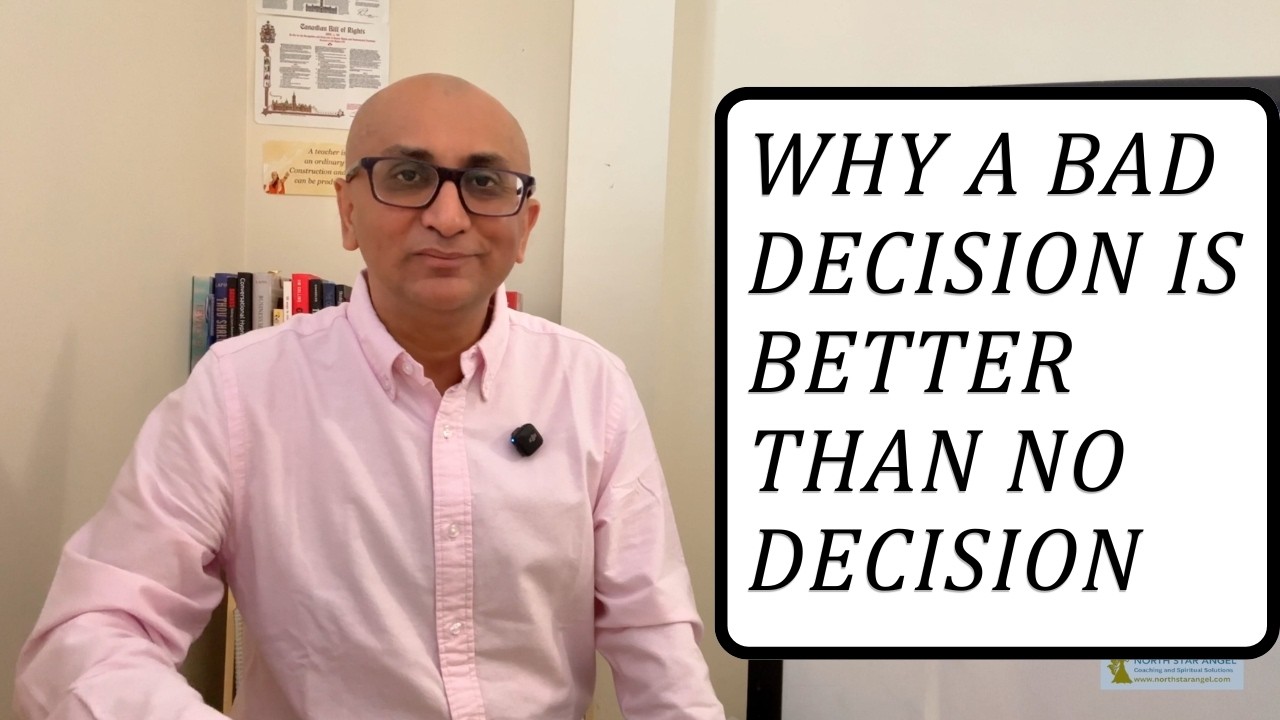
Mayur Bardolia argues that a bad decision beats no decision because it gives you data and feedback to improve. He walks through a six-step framework: pick a small decision, set a time limit, define one action, do it, adjust based on what happens, and repeat. Decision-making is a skill you build through practice, not something you're born with.
Chapters
This is Mayur Bardolia, a success coach, author, and facilitator from North Star Angel Coaching and Spiritual Solutions. I feel blessed and fortunate to share tools, ideas, and insights that can positively impact your life. Welcome to the video. You know, I was thinking about the last time I had to choose something. Could be anything—a new project, a new assignment, a new work, a conversation I needed to have, or even just what to have for dinner. It's funny how simple choice can turn into this big, heavy thing. We stand there looking at the options, waiting for the perfect signal that says, "This is the one, guaranteed success," and we just don't start. So we wait, we gather more info, we wait for certainty, we analyze more and more, we think more and more. And while we are waiting, life just keeps moving. It does not wait for us to make up our minds. We become indecisive. We don't decide. And in this video, we're going to solve that problem. I will show you how to stop treating decisions like a life and death trap. And start treating them like something much more useful, something that actually gives you your power back. We will look at why waiting too long is often worse than picking the wrong thing. And I will give you a simple step-by-step framework to start practicing today. And this is the exact framework that I share in my private workshops and coaching sessions. So, okay, let's talk about this, this season. And I want you to imagine you are in a kitchen. You have a recipe in front of you for a dish you have never made before. It looks delicious. Maybe you check on YouTube, maybe you look at any recipe book. But you are not sure about it. You start reading the ingredients, you read the instructions, then you read them again. You start wondering if you have the right utensils. You wonder if your oven temperature is accurate enough, you have the right tools. You wonder what if it turns out terrible. So you stand there reading the recipe over and over. And never actually start working in the kitchen. You wait and keep waiting. The ingredients sit on the counter, maybe in your fridge. Meanwhile, someone else just starts cooking. They follow the recipe. It comes out a little not so perfect, maybe a bit too salty. But they taste it and they learn, and next time they adjust. And you are still standing there in your kitchen with a recipe you have memorized. You're really interested in doing it. You think you can do it, but never really tried. And this is what happens when we wait for the perfect season. We think the risk is in choosing the wrong thing. But the real risk is in never starting to work on your ideas or your plans or your projects. Here's the truth that sounds a little backwards. Let me write it down for you. A bad decision is often better Than no decision. A bad decision is often better than no decision. Now, I'm not saying you set your kitchen on fire, but think about it. If you make a choice and it does not work out, what do you have? You have data. You have experience, you have information exactly how it did not work out, and you now know, okay, that part goes to a dead end, it doesn't work. Let me try that other part. Let me try different things. You make the dish, but it was too salty, so next time you use less salt. Things did not go exactly how you plan. But if you make no decision, you have nothing. You have no information, you have no data, you have no experience. You're still standing in the kitchen with the recipe in your hand or in your mobile phone. You have not learned anything. You have not tasted anything. You are at the same spot. People get paralyzed because they think decision-making is a talent. You either have it or you do not. But that is not so. Decision-making is a skill. Remember that it's a skill, and skills are awkward at first. No matter what skill you wish to learn, it's always uncomfortable and it's embarrassing in the beginning when you learn a new skill or learn anything. Think about learning to ride a bicycle. Did anyone, including you, expect to ride the first time perfectly? Of course not. You wobble. You might tip over. But each time you put your foot on the pedal, you learn. You learn about balance. You learn how fast you need to go to stay upright. You get better. Decision-making is the same bicycle. You do not learn it by reading a manual about bicycles. You learn it by getting on and pedaling, even if you wobble. The same can go in learning how to drive a car. You can't learn how to drive a car by keeping your car in the car park, parking lot. So let's turn it into a simple experiment. This is all it is. It's not a life sentence. So what should you do? And here's the solution. You just decide. And I would suggest that you understand and follow this. So let me explain in more detail how exactly you can implement this. So first you decide, just pick something, a project, a habit, a simple conversation, any assignment, any work, or any goal. Set an intention. I'm going to try this for a week. Okay, set this intention. I'm going to try this for a week. I'm not expecting to be perfect. Okay. Then you act. You take the step. You turn the utensils on, you turn the gas on, you turn the oven on in your kitchen. But you just act. You just start working on it. You take action that is taking you closer to the completion of your goal. That's it. You just take the first baby step, okay? You will fail, okay? You will not be perfect. However, you know, you may be perfect, but expect it to go wrong, okay? Just— but don't judge yourself at this, at this stage, okay? Then you observe. You do not judge yourself. You just look. What happened? Did you like it? Did it work? Was it too much or too little? Did it go slightly better than not just doing anything? And in the example that we discussed earlier on about the recipe and kitchen, how did the dish taste? And then you Adjust. Then you adjust. You tweak it. You add little salt next time when you cook. You steer the bicycle a little to the left or right, and this cycle continues. You adjust. You try to do it in a different way. If something doesn't work, try something else. If one way did not work, you always have a choice to do the things differently. But if you keep doing the same thing, you get the same result. Now, here's another way to think about this. Imagine you're learning to play drums. You have a pair of sticks in your hand, and you want to keep a steady rhythm right from the start. But instead of playing, you sit there, watching the drum kit, waiting for the perfect beat to appear in your head before you make any sound. The sticks stay still, the drums stay quiet, and you never find the groove. But you have to start playing. Your first beat might be uneven, your timing might be off. You might hit the wrong drum or drop a stick, but that is okay. You listen, you adjust, and slowly your hands and feet begin to coordinate. The drums are forgiving. The goals don't— doesn't judge you. The project doesn't judge you. They just need to be completed. That's it. You just need to take action. And just work on your project, work on your assignment, and just do something. The drums will wait for you to find your rhythm, one beat at a time. The same can be said for learning any musical instrument or literally anything. Your decisions are like that drumbeat. You can always adjust your rhythm. You have the freedom to adjust. The only time you never find the groove is when you never start playing at all. Then the sticks just sit there unused and the drums stay silent. I hope you understand that. And I want to share one more analogy with you because I think this is where it all comes together. Think of your life like a garden. Every decision you make is like planting a seed. You do not know exactly which seed will grow into the tallest plants or the most beautiful flowers. But you know for certain that if you hold the seeds in your hand and never put them in the soil, nothing will grow. Some seeds will grow slowly. Some might get eaten by birds. Some might need more sunlight. So you move them, but every seed you plant teaches you something about your soil, your climate, and what you enjoy growing. Over time, your garden becomes richer because you plant it, you observe, and you adjust it. Now imagine standing at the edge of that garden, Holding all your seeds in your hand, waiting for the guarantee that each one will bloom perfectly. The season passes, the summer gets over, the soil sits empty. That is what happens when we let perfectionism freeze us. The garden does not wait. The life does not wait. See what is happening here? You are not failing. You are gathering data. Each cycle sharpens your judgment. You start to learn your own preferences, your own strengths, and your own limits. You may not need to do exactly how others are doing. You create your own style. You do it in, in your way. And here's the Beautiful part. Over time, you stop being afraid of being wrong because you realize there is no wrong. There is just information. There is no such thing as failure. It's only feedback. And you trust yourself. You trust your ability to see the data and course correct. You adjust. The real loss is not in taking apart that needs a little adjustment. The real loss is staying frozen. It is staying in in the kitchen with the recipe, but you're not making anything. It is holding the seeds while the garden is waiting. Your life is waiting. You need to take a decision. So let me share with you the step-by-step action plan, exactly how you can implement this. So let's get practical. I want to give you a step-by-step action plan you can use starting today, and this is not complicated, but it works if you actually do it. So step 1, Pick a small decision. Just pick anything, anything small. Pick one small decision you've been putting off. Do not pick a huge life-changing decision like quitting your job or moving to a different city. Pick something really small that you can manage. But maybe it is starting a 5-minute morning routine, maybe doing a meditation, maybe doing exercise in the morning for 15-20 minutes, maybe learning a new skill and working on the skill for 15-20 minutes or half an hour a day. Maybe it is having a conversation you have been avoiding. Maybe it is signing up for that class you keep looking at, you want to learn. Just one thing, small enough that even if it gets sideways, the cost is low. And then step 2, which is set a time box. Set a time box. This is crucial. Do not say, I will try this forever. That is too heavy. Instead, say, I will try this for 1 week, or 3 days, or even just 1 day, maybe 1 hour. Give yourself a clear start and clear end. A time box makes a decision feel like an experiment rather than a life sentence. You are not committing forever. You are just committing to start a trial. Okay. Just to try. That's it. And step number 3, define an action. Just define one action, one single action you will take. Not 10 different actions, not a complicated plan, but just one action. Maybe tiny action. If you're trying a morning routine, the action might be wake up and drink a glass of water before checking your phone. Maybe reading a book before you check your phone. Just one thing. That's it. And make it so simple that you cannot talk yourself out of it. Okay? You can do it very easily. And number 4, do it and Observe. That's step number 4. And during your time box, just take that action. Do not judge yourself. Just watch. Just watch. At the end of each day, ask yourself 2 simple questions. What happened? And how do I feel about it? That's it. Just 2 questions. What happened? And how do I feel about it? Write it down if you want. You are just collecting data, not grading yourself, not judging yourself. It is not a competition. And step number 5 is adjust. Adjust, or just keep on the board step. Okay, if something is working, now you keep it. If it's not working, then you adjust. At the end of your time box, look at your data. Ask yourself, did this work for me? If it did, it's good. If it did not, you adjust. Maybe you need to change the time of the day. Maybe you need a different action. Maybe you learn that this thing is not for you at all, and that is perfectly fine. That is valuable information too. You either keep going, tweak it, or drop it and pick something else. Either way, you learn something. Number 6 is repeat. Just repeat. Pick another small decision and you keep improving, keep improving. Take this again, small action, or take the same one or run another time box with your adjustment. This is how you build the muscle too. One small experiment at a time. So let's wrap up this webinar with quick summary and your next step. What we covered today is simple. One, perfectionism around decision is a trap. Do not aim to be perfect. Nobody is, by the way. It keeps you standing in the kitchen with a cold oven And nothing. Recipe in your hand, recipe in your video, and nothing is moving. So just don't stare at your project. Just don't stare at your vision. Just don't stare at your goals. Number 2, a bad decision that gives you data is always better than no decision that gives you nothing. No decision, no experience. So you better take a decision and get the experience. At least you will not regret most of the time. Number 3, decision-making is a skill you build by doing small experiments, not a talent you wait to be struck by. No, it is a skill. Number 4, your decisions are a lot changeable. You can change it. You can always reshape them based on what you learn. And number five, you now have a six-step action plan to start using today. Take a small decision, set a time box, define an action, do it and observe, and then adjust or keep and repeat. And I want you to pause this video right after we finish. Take out your phone or a piece of paper. Go through the six steps right now. Pick your one small decision, set a time box, define your one action, and that's it. Do not overthink. Just write it down. Then start your experiment tomorrow. That is how you build the muscle. That's how you turn your roadmap. That's how you move on. That's how you learn how to start bicycling, and then that's how you learn how to plant the garden. Start using what you just learned. It takes work to do this on your own. I believe that it's difficult sometimes, but I really wish you start somewhere. And there will be times when you are tired, you are unsure, or stuck. And when that happens, reach out to me. I can help you every step of the way and teach you new tools that work for you. Maybe you have something you want to work on. Maybe it's about your health, your job, relationship, career, money, business, or belief. I can help with these things in personal one-on-one coaching sessions. To book a session with me, go to northstarangel.com/coaching. We can meet online, by email, or in person. If this video helped you, please share it far and wide. Share this with someone who needs it. I would also love to hear from you. Your story, your feedback matter to me. My name is Mayur Bardolia, a success coach at North Star Angel Coaching and Spiritual Solutions. If you want to book a session, organize a workshop, or invite me to speak, email me at contact@northstarangel.com. Thank you for being here. I'm wishing you the best. I hope good things come your way. Have a nice day.