Compounding Will Fail You Unless You Understand This
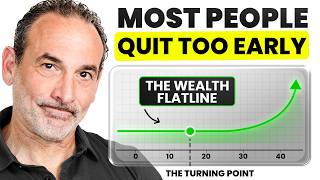
Mel Abraham shows why most people fail at compound growth through three case studies: Maya starts at 24 and reaches $1.5 million, Carlos panics during a market dip and ends with far less, and Diane waits until 40 with a smaller nest egg. Missing the best market days dramatically cuts returns.
Chapters
Compound is the most talked about concept in personal finance and the most misunderstood. See, everyone's seen the chart, that magical curve, the flat line, and then it curves up and it turns patience into a mountain of wealth. Well, and nobody tells you is that the chart has rules. And most of all, most people, they break all of them without even knowing it. Today we're gonna fix it. 3 stories, 3 rules, 3 different outcomes, one very simple lesson that most people learn way too late. This is Building Your Money Machine, where we help you master your money, eliminate financial stress so you can live life of choice. Because earning more doesn't make you free, a money machine does. And I'm your host, Mel Abraham. And after 30+ years as a CPA, an entrepreneur, and a money mentor, and someone who's walked the financial freedom path from nothing to something, then broke it and had to rebuild it again, I've seen what real wealth is, and it isn't about bigger numbers. It's about bigger and better choices. So let's get the 3 rules in your life and get them working for you. So if you're ready, let's do this. You've seen the chart, you know the one. It's this little flat line that just barely, barely moves for years, and then all of a sudden, seemingly out of nowhere, it starts to bend, and it starts to bend upward, and it turns into something Extraordinary. A mountain of wealth. That life-changing number. The promise of compound interest. Every single financial educator, including myself, every retirement seminar, every well-meaning parent, whoever sat you down, told you to start early. They all may have shown you a chart like that, and the message was always the same. Just start. Stay consistent. Time does the rest. And here's the thing. They weren't lying to you. In fact, you've heard me say that over and over and over again. Compound compounding is real. It's genuinely one of the most powerful forces in building wealth over a lifetime. Now, supposedly Albert Einstein said it's the 8th wonder of the world. I don't know that that's the case, but either way, it's still a wonder of the world. Warren Buffett credits it as the foundation of his $100 billion fortune. Now, these aren't exaggerations, but here's the thing that nobody told you. And this is the part that changes everything. Compounding has rules, and most people, through no fault of their own, they break every single one of them without even knowing it. And not because they're careless, not because they didn't try, but because nobody explained what the rules really are and how to fix it. So today we're gonna fix it. We're gonna, we're gonna look at 3 people, 3 stories that show exactly how compounding succeeds how it fails, and what makes the difference between arriving at retirement with a machine that is running for decades and arriving with almost nothing, wondering where the time went and where the money went. But first, let me show you something that I think you'll then see this line that we're talking about. I call it the wealth creation curve. Most people imagine wealth building like it's some straight line that goes up and to the right. And that's just not the case. Every year you're putting money in, you get roughly the same growth back out. Linear, predictable, steady. That's what they think it is, but that's just not how it works. And that's where we start to lose people, because what's actually happening looks more like a hockey stick. It's long and it's flat. For a while, and then it turns, and it turns sharply, and, and it starts to go up. And that's the power. That's when your money gets working harder than, than you can, and it's working harder for you than you did for it. The thing is this, is that that flat zone on the wealth creation curve— in my book, I talk about it saying this is the wealth flatline. Everyone has to go through the wealth flatline, but most people don't have the patience to get through it because the only thing that gets you through the wealth flatline is time. And most people will spend their entire financial lives in the flatline because what do they do? They start, they start putting money away, money away, money away. They lose patience because it's not getting them anywhere. And so they go spend the money, they break the rules, and they have to start all over again. It's not rigged. They just didn't understand the geometry of it. See, I want you to picture this. I want you to picture a snowball and you're at the top of a long hill. And you pack the snow together and you start rolling it downhill and it starts to collect more snow and more snow, slowly at first. And the first few feet, barely anything seems to be happening. But the longer it rolls and rolls, the more snow it has, the faster it accumulates, the bigger it gets. And imagine now someone comes along and kicks the snowball Halfway down the hill. Maybe they had good intentions. Maybe they needed the snow or something urgent. I don't know. But now you're starting over again on a shorter hill with less time before the bottom. That's what's happening with compounding. Every single time you interrupt it, you've lost time. You have a shorter timeframe to now build, and now you have to start all over again. Time is the hill. The money is the snowball. Every single time, every time you start over, you're shortening the hill. And that's the people— that's the part that people don't want to talk about. And we don't talk about it enough. In the early years, wealth building feels invisible. You're putting money in, you're putting $500 in, you might earn $35 in returns. The next year you earn $37. You're doing all the work, you're doing all the effort, and the money is barely doing anything. But then something happens quietly, invisibly, and the base starts growing. So think about this: at $10,000 a year at 8%, that return gives you $800 in the first year. When you get to $100,000, that same 8% gives you $8,000. When you get to half a million dollars, that same 8% gives you $40,000. $1 million. Completely different life. See, the curve bends, and when the base is large enough, that growth becomes something that you actually feel. When you wake up on a Monday morning and your portfolio just gained more than you earned at, at the whole day at work, that's compounding. But compounding stops being a textbook concept and starts being a reality when you stay in the game and allow it to do what it needs to do. Because compounding doesn't care about your impatience. It doesn't speed up because you checked your balance more often. It runs on its own clock and your only job is to not unplug it. So the wealth creation curve has that flat part and the steep part. Your only job is to survive the flat part because the steep part will take care of itself. All right, so let me introduce you to 3 people and let's show you exactly what happens when you kind of kick that snowball off to the side and interrupt it. You're going to meet Maya, Carlos, and, and Diane. Same age, same income, same access to the same investments. So everything is the same. The only difference is what they decide to do and when. All right. By the end of this, one of them will be financially free. One of them will be scrambling, and one of them will fall somewhere in between with a powerful lesson about the cost of a single decade. So let's start with Carlos, because Carlos is the cautionary tale. And honestly, Carlos is most people. Carlos gets in. But then he gets out. Carlos is 25. He's smart. He's motivated. He does something that most people his age never do. He actually starts. He opens up a brokerage account and he starts to put $500 a month automatically away into investments. And he picks a diversified index fund or ETF like we talk about, and he lets it run. And for 3 years, it goes beautifully. His balance grows to, say, $22,000, and he's proud of it and everything's going well. And then the market drops. Not a catastrophic crash, but just a correction. So now his balance goes from $22,000 to $17,000 in a few months. Carlos is watching what happens and feels something that every investor feels, but few admit. That 5-letter word, panic. Okay. He tells himself, oh my God, but it's temporary. It's temporary. He holds for another month and then it drops a little more and his friends are talking about it and the news is loud and the noise is around. And one afternoon he logs in in, he sees the red numbers, and he pulls everything out. I'll get back in when things settle down. Famous words. It's exactly what I did. All right. They do settle down because they always do. But by the time Carlos feels safe enough to get back into the market, he's already behind the 8 ball because the market has already recovered. And then so he missed the bounce, he missed the recovery, he missed the best days, and he never quite found his way back in And he never had the same conviction. Yeah, he invested on and off for the next decade. Some years he contributed, some years he pulled back. By, by 50, he had less than he would have had if he had simply left the $22,000 alone. He never added another dollar. He would have still been better off than what he did. Here's what the math says, not opinion. Math. We can't argue with math. Dahlbar, which was a study that was done, they, they have been tracking real investor behavior for 30 years. And in 2024, while the S&P 500 return was averaging about 25% in 2024, it, it returned 25%. The average equity investor earned only 16.5%. That's almost 10 percentage points down. According to Dahlbar's 25 report, the same $100,000, if left untouched, would have grown to $717,500 over 20 years. The average investor making moves like Carlos made ended up with just $345,000, less than half. Not because the market failed, not because the market failed them, but because they kept leaving the market. See, trying to time the market is like leaving a concert because you heard one bad song and missing the greatest set of the night. The music didn't get worse. You just got scared and you went home. And here's the part that breaks my heart because I see it so often when it comes to people like Carlos. He wasn't wrong to be scared. He's human. I get scared too. I look at it. What he was missing was the understanding that the best days almost always follow the worst ones. 7 of the market's 10 best days in the past 20 years happened within 15 days of the 10 worst days according to JP Morgan. Okay, think about that. The people who fled, the people who ran for the hills during the crash, who endured all the pain, left just before the bounce, and they took a hit and they missed a recovery. See, miss just, just 10 best days over 30 years and your returns are literally cut in half. And the numbers showed that. Miss 30 of the best days and you've lost 83% of the potential returns. When, when we start to look at the studies, like, like the Hartford Fund studies over 30 years, missing the best 30 days took the annual average return from 8.4% all the way down to 2.1%, which is actually below average inflation. So at that rate, you're eroding your wealth. You're going backwards. See, Carlos didn't lose money because the market failed him. He lost money because he kept leaving the game and getting on the sidelines. So the first rule of compounding: you have to stay. You have to stay. Let's go to Diane. Diane, she's a different person. Diane's disciplined, she's responsible, and she makes what feels like a very reasonable decision. Like Carlos, She's 25, but she watches the market with a cautious eye and she tells herself she'll start investing once things make more sense. Once she starts to make more money, once she pays off her car, once she gets a raise, once she has more cushion. And I hear a form of this over and over again, but yet the years pass. Instead of 25, she's now 30. And at 30, she's still not quite ready. But then 35 hits and she feels like the timing feels off. But by 40, she finally says, "I'm ready." And she jumps in and she does something genuinely admirable. She goes in with real conviction, $500 a month consistently for 25 years straight. And she just does it no matter what the market's doing. She never pulls out during the corrections. She stays the course. And by Carlos's standards, She's the model of discipline, but the math doesn't reward good intentions. It rewards time. See, Diane, she started at 40 with $500 and maybe she got a 7% return. When she gets to 65, she only has about $380,000. Now that's real money. But now look at what, what Maya has, who starts with the same $500 at Uh, at 24, 25 years old, she starts with the same one, same $500. She will have over a million and a half dollars. Why? Because of time. Same monthly investment, same decision, same discipline, same rate of return. One person has 4 times more of the outcome. The only difference, 16 years. And this is the part that gets people. Diane didn't make a bad decision at 40. The decision she made at 25 to wait, that's the decision that cost her. The cost of waiting isn't paid when you wait. It's paid at the end when the math finally comes due. See, deciding not to plant a tree because it's not quite the right season and then wondering 20 years later why you don't have a tree, that doesn't make sense. See, the best time to plant was 20 years ago. The second best time is right now. There's a concept called the rule of 72. It tells you how long your money is going to take to double at a given rate of return. At 7%, your money doubles roughly every 10 years, which means Diane's late start didn't just cost her the years she waited, it cost her 1 or 2 full doublings of her money. See, a dollar that has 40 years to double becomes $16. A dollar that has 25 years to double becomes $5. That's not a subtle difference. That's the difference between retiring comfortably and retiring wondering if you'll run out. So the second rule of compounding: time is the one resource you can never get back. All right. Now, here's the thing. A lot of people go, "But I get it. I got to put money in, but I don't know where I'm going. What am I trying to get to?" Well, that's when you need to know your freedom number. So quick pause here for a moment because I want to give you a tool to help you understand how to calculate your freedom number, that number that's going to give you financial freedom, at least a ballpark. And I have a freedom number calculator that's totally free. It takes you 5 minutes, put some numbers in and you'll get it out. We'll hook it up down here, melabraham.com/number, and really start to understand That's the direction I'm going. That's the number I want to get to. And now we get on this wealth creation curve and we stay on it. All right, back to Maya. Maya's 24. She's fresh out of school, not making a lot of money, but enough. And she doesn't fully understand the stock market. She hasn't read 12 books on investing. She just knows one thing her dad told her as a teenager. The biggest financial mistake most people make is waiting to start. So she doesn't wait. Like I said, she starts $500 a month into a simple diversified index fund, ETF fund, like we talk about, maybe 2 or 3 or 4 funds. Keep it simple. Automatic, automated. She sets it up one afternoon and then effectively forgets about it. The market drops in 2008 and craters her balance, craters. She feels that she's human, just like I did. But she doesn't pull out. She keeps the automatic investing running. And in fact, she quietly thinks, "This just means I'm buying more because it's at a lower price and I get more shares." So the market drops again and she stays. It rallies and she stays. And decade after decade, Maya does one thing that turns out to be the most financially powerful thing a person can do. She stays in the game. See, the most profitable investment strategy in history and in the history of the stock market might just be set it up, go live your life, and resist the urge to be smart about it. By age 65, Maya has never made a 6-figure salary. She never got lucky on a stock pick. She didn't win the lottery. She never got an inheritance. By investing $500 a month, From age 24 at 7% average return, Maya gets to age 65 with $1.5 million based on compound interest projections at the standard market returns. Okay, over $1.5 million from $500 a month because she started early and just never stopped. Now, here's the beautiful thing, almost unfair part of Maya's story. The majority of that $1.5 million wasn't her money. She didn't put it in. She simply contributed $246,000 over 41 years. The remaining $1.3 million, $1.2 million plus, that was just compounding, doing its job. That was the snowball getting bigger because she gave it an uninterrupted time to run. See, remember the hockey stick, the flat handle, the sharp blade, that curve, the wealth creation curve? Maya spent 20 years on that handle, not because something was wrong, not because the strategy wasn't working, but because that's how the curve works. You have to earn the curve by surviving the flatline. Maya survived. And the curve rewarded her. So the third rule of compounding is stay in long enough for the math to matter. All right, so that's the three rules, and that's the things that I think people miss when they're trying to figure out compounding and growth and investing. Let's name them clearly because they're— they— these aren't options, they're the operating system of compound growth. Rule 1: you have to start. Not when timing is right, not when you have more money, not when the market makes sense. The cost of waiting isn't paid when you wait. It's paid at the end in full with interest. Rule 2, you have to stay. In 2024, the S&P 500 returned 25%, but the average investor only got 16.5%. Why? Because they were jumping in and they were jumping out. They have to stay in the game. The ones that got the 25%, they endured all the pain. They They didn't leave before the payoff. The market doesn't reward intelligence. It rewards patience. It rewards discipline. It rewards the people who can sit in the discomfort and not confuse the temporary red with a permanent loss. And rule number 3, stay long enough for the math to matter. The flat part of the curve is not failure. It's the runway. It's the path. And that runway only works if you keep laying the pavement, the pavers to make it happen. The decisions you make today or don't make are already compounding in one direction or the other. And the question isn't whether the compounding is working, it's whether it's working for you or against you, because it's always running in the background. So here's what I wanna leave you with, and it has nothing to do with numbers. When I went through the cancer the first time, I had the moment lying there in the hospital bed where I understood something about money, time I hadn't fully felt before. The assets I'd built, the system that I was running, the machine that kept generating, those things gave me something that no amount of active income could have bought me in that moment. They gave me choice. See, I didn't have to panic about money while I was trying to survive. And thrive and beat cancer. The machine was doing its job. That's what compounding done right actually gives you. It's not a big number on a screen. It's not bragging rights. It's freedom. The ability to handle what life throws your way without your financial life collapsing alongside everything else. If your money stops when you do, you're not free. Maya built a machine, not because she was brilliant, not because she had an advantage, because she understood 3 things. She acted on them early enough and for the time that she needed to so it would do its work. So start, stay, and stay long enough. 3 rules, 1 machine, 1 life to build it with. Because earning more doesn't make you free. A money machine does. All right, I hope that you found this valuable. I hope that this helps you, and I hope that you'll start to understand the power of compounding. And this game to try and jump in and out is a fool's game. Get in the game. Allow money to do the heavy lifting. Allow time to do the heavy lifting for you. All right, let me know what you thought. Drop me a comment, send me a DM. Let's have a conversation. I'd love, um, to hear from it. Let me know if you might be a Maya, a Diane, or Carlos. No judgment, just honesty, because knowing where you are is the first step to building it. And if someone in your life is thinking about fear in the market and trying to get out, send them this. Let them understand the 3 rules. Let them stay in the game and let them do the game right so the game will take care of them. All right. I hope that this was valuable and I can't wait to see you in the next one. And by the way, If you haven't subscribed already, do me a favor, hit that subscribe button and a thumbs up because you know what? The algorithm likes it and it warms my heart. All right. Until I see you in the next one, as I always say, always, always strive to live a life that outlives you. I'll see you in the next one. Cheers for now.









