The 8 Phrases That Tell Me Everything About Your Money Future
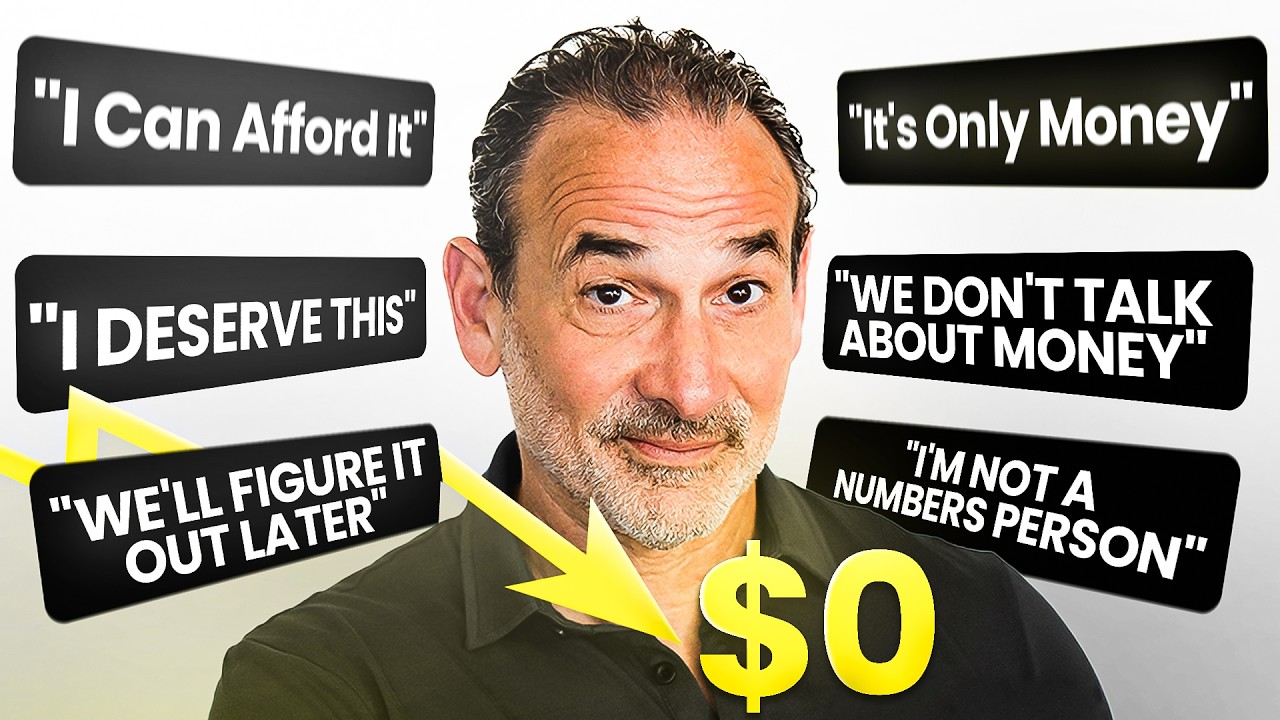
CPA Mel Abraham identifies eight phrases that reveal your financial future, drawn from three decades of client experience and his own $4.5 million loss in a 2005 Ponzi scheme. He shows how each phrase masks a deeper money mindset and offers concrete steps: audit your statements, replace harmful language with intentional questions, and have transparent money conversations.
Chapters
After 30 years as a CPA, I've sat across the table from thousands of people to talk about their money. And here's what I figured out. I can usually tell where someone's headed financially before I even see a single number. Not because of their bank account, but from their talk. See, your money has a tell, and it's not your face when you check your balance. It's your vocabulary. And there are 8 phrases I hear over and over again, and each one of them predicts something specific about where someone's headed. A couple of them might even be things you've said this week, maybe today. This is Building Your Money Machine, where we help you master your money, eliminate financial stress so you can live a life by choice. And I'm your host, Mel Abraham. 8 phrases. Let's do this. 8 phrases you said, probably at least one of these in the past week, maybe even today or recently. But let's find out which ones. And what specifically are they predicting? Let's start with the first one. And that phrase one is, I can afford it. This one sounds the most innocent. I can afford it. Now, before you get defensive and asking yourself, can I afford this, is one of the healthiest habits in personal finance. I get it, but I want you doing that every single day. That's not the problem. The problem is the other version. The one where "I can afford it" isn't a question anymore, but a verdict. It's the thing you say after you've already decided to buy it. And you just need a reason that sounds responsible enough to quiet the voice in the back of your head. See that little voice that is in the back of your head? It goes, "Didn't we just have this conversation about the espresso machine?" And that's the thing. Here's where this shows up. The payment. I can't tell you how many financial decisions I've watched people make not based on whether something actually made sense, but based on whether the monthly payment fits. "I can afford it" quietly becomes "I can afford the payment," and those are two very different sentences. I literally had a buddy from high school, good guy, smart guy, and over the years, you know, he made $50,000, then $100,000, then $200,000. You know what? It didn't matter. He always lived at the end of his check. Not because he didn't know what he was doing, but because every decision he made, he made through the eyes of a payment. A car payment, which was fine on its own. The credit card payment, fine on its own. Insurance, rent, fine on their own too. In isolation, every single one of those was just perfectly reasonable. I can afford it. But in accumulation, They ran him into the ground. See, car dealerships, they figured this out. Marketers have figured this out. And that's why they ask you, what can you afford? They ask, what payment are you comfortable with? Because they're going to play that game with you, not by accident. That's their whole business model. See, money can only be in one place at a time. And here's the part I think that nobody adds up. The 6 other times that you said, "I can afford it," in the last 3 weeks, each one of 'em felt like a one-off. But now you stack them together, and that's 6 small decisions that are no longer small anymore. That is a direction. And every time you spend on one thing, by definition, you're not spending on something else. The vacation, the investment, the breathing room, something always loses, and you just don't see it because the thing that loses is the thing that never happened. So if you want to test this right now, pull up last month's statement. You don't have to show anyone. Just count how many times, how many lines have a payment attached to them. The car, the phone, the subscriptions, the buy now, pay later thing from 6 weeks ago you forgot even was on there. The real question was never, can I afford it? It's, is this the best place for this dollar compared to everything else and everywhere else that it could go? That's the question. And I can afford it as a justification instead of a question is the problem. That's phrase number 1, and it quietly funds almost everything else in this list. Number 2 is the one that actually I think we use to feel good about a decision we already made for a completely different reason. Number 2, phrase 2 is, I deserve this. Look, I am not here to tell you that you don't deserve nice things. You do, actually. I want you to have everything you want in life if you plan for it, if you've been looking forward to it, if you can buy it and feel genuinely good afterward with no guilt, that's not a problem. That's the kind of the point of all of this. Stephanie and I, we plan our trips a year out. We fund them ahead of time. And when we go, neither of us are saying, Wow, we deserve this in the loaded way. We're saying we deserve this because we earned it, because there's nothing to justify. It was already decided months ago on purpose. See, nobody builds a money machine and then celebrates by clipping coupons. And at the celebration dinner, the version of I deserve this I want to talk about is the other one, the one that shows up right before the the purchase you already know somewhere in the back of your mind you probably shouldn't be making. See, I deserve this is doing a job, and the job is covering for something. Sometimes it's covering for guilt. You know the purchase doesn't fit the plan, but I deserve this lets you buy it anyway with a slightly quieter conscience. Sometimes it's covering for something heavier though. A brutal week, burnout, a fight with your partner, and the purchase becomes a reward for surviving, not for achieving. It's therapy with a receipt, frankly. And here's the thing about therapy with a receipt, it works for about an hour and then it joins all the other I deserve this purchases from the last few weeks doing the exact same stacking thing that payments did in the first phrase. Except this time it's not your car payment quietly bleeding you out. It's 100 small purchases, each one fully justified in the moment. Each one wearing the same costume. See, the purchase isn't the problem. What the purchase is covering for is the problem. And if you had a hard week and you want to go get yourself something nice, go get yourself something nice. I mean that. I mean, I do. But maybe ask yourself just for a second, am I buying this because I planned for it and I'm excited about it? Or am I buying this because I need to feel something different than what I'm feeling right now. Same purchase, but a completely different financial future. And trust me, I am not telling you not to buy things. I just want you to be clear, conscious, aware, and intentional. That's it. Okay? I deserve this. The difference between reward and rescue. That's phrase number 2. Number 3, this one is one that I almost didn't put in, in this episode because honestly, it's the one that hits the closest to home for me. And that is, "It's only money. It's only money." This one's sneaky because on the surface it sounds almost healthy. Like, good for you. You're not attached to the whole identity to your bank account. Okay? But in my experience, this phrase shows up in two very specific ways. And neither of them actually are about money being unimportant. They're both about avoiding something. Let me tell you about the worst financial day in my life. In 2005, a friend brought me into an investment. He was already in it, didn't know it was a problem either. I put money in, got a little back, put more in, and those are just the facts. No story yet. It turned out to be a Ponzi scheme. And between me and two friends, we lost over $4.5 million. And I personally lost one-third of everything I owned. And for a while, my brain went straight to the story version of those facts. I'm a loser. I should give up my license. I'm never getting back to where I was. I'm the CPA. What is wrong with me? I was asking all those questions. And here's what I didn't do. I did not say it's only money. And in some ways, I wish I had, because I actually did the opposite. I made it about my worth. But here's what "it's only money" would have done if I had said it and just moved on. It would have let me skip the part where I actually looked at what happened. The part where I separated the facts that I ignored my own due diligence from the story that I'm a loser. The people around me who could see straight when I couldn't are the reason I didn't stay stuck in the story. See, they helped me get back to the facts. And from the facts came the new rules, dogmatic ones. If an investment doesn't meet my criteria, it doesn't get my attention, let alone my money. No exceptions, no matter how good the story is. That process is the only reason I tripled what I lost in 18 months. If I'd have shrugged it off and said, "It's only money," I would have skipped the autopsy. And without the autopsy, you don't get new rules. Without the new rules, You're just waiting for the next version of the same mistake to find you. That's where this hits. And now this is where the second phrase, the second version comes in that you've probably heard this one too, but it's maybe someone else's spending. It's only money. Easy come, easy go. This version though, isn't about your own loss. It's about dismissing a concern, yours or someone else's, before the real conversation can even get started. If it doesn't get the weight it deserves, then it can't hurt as much, right? Yeah, either way, nothing gets examined, nothing gets felt, and nothing changes. See, it's only money? Sometimes it's skipping your own autopsy. Sometimes it's dodging someone else's. Either way, that's not a good place to be, all right? That's 3. If it's only money has ever been a line that ended a money conversation with someone you love, before it even started, I put together something special. It's called the Love and Money Guide, and I'm gonna put the link down here, but you go to melabraham.com/love and get the guide. It's gonna walk you through the conversation. It's gonna help you bring, use money to bring you together towards the common future rather than allowing money to tear you apart. All right, now let's go to phrase number 4. And this one is actually 2 together. One is this phrase of, well, I'm not a numbers person. And the second, goes along with it, I think, is we'll figure it out later. So let's just hit this from this perspective, 'cause one of these is an identity. The other is a deadline that never arrives. Neither one is actually about ability. Both are about permission. Permission to not engage. See, I'm not a numbers person. I hear this a lot, especially from creatives, individuals, I'm just not a numbers person. It usually started somewhere specific, a bad grade, a parent who said the same thing about themselves, a moment that maybe you felt confused or embarrassed and something along the way, that moment turned into a label. And once it's a label, it's not a skill gap anymore. It's an identity. And you don't have to work on an identity. You just have to be it. Then there's, we'll figure it out later. This is the timeline version of the same thing. It's not a no, it's worse than a no though, because a no would force you into a real conversation. Later just keeps pushing the conversation off. It kicks the can down the road indefinitely while life keeps happening anyways. See, you know that one app on your phone with that little red notification bubble that you've quietly decided is now just part of the icon. That's, and we'll figure it out later. That's the badge. Now here's what's sneaky about both of these though. In phrase one, bad decisions stack up quietly. Until they were a problem. This is the mirror image of that. Here, it's not the decisions stacking up, it's the absence of decisions that are stacking up. The gap between where you are and where you need to be continually widens every year, every day, and nobody's watching it. I'm not a numbers person means nobody's supposed to be watching it. We'll figure it out later means later is always one more year away. Someday, frankly, is not on any calendar. It's never been. That's the thing. Avoidance dressed up as an identity or avoidance dressed up as a deadline. Neither one is gonna move you forward. That's 4. Number 5 might be the one that explains the other 7. Phrase number 5, that's just how I was raised and we don't talk about money. Another one where I think there's 2 of them that relate to each other. So I want you to really sit with these 2 because I think they might be the most important phrases on this entire list. Here's why. We don't talk about money is silence. It's what a kid actually experiences growing up. I grew up with it. We don't talk about money. We don't talk about— it's impolite to talk about money. It's taboo. Now, maybe money only came up during an argument that becomes even louder. Maybe it never came up at all. And that's the thing that we need to think about. But kids are not great with silence. Give a kid silence and they will fill it with something. And that silence has its own volume. A tense look when the mail comes in. A conversation that stops the second you walk in the room. You don't need a single word for a kid to learn that money is a thing that we go quiet about. And here's the part that most people, I think, miss. A kid doesn't experience the silence as, "Oh, we don't talk about money." A kid experiences the silence and then writes their own story about what it means. Money's dangerous. Money causes fights. Money is something I'm not allowed to ask about. Money is shameful. And that interpretation, written by a kid with zero context, becomes an identity 20, 30 years later. I wrote about this in my book, the opening story about my dad, seeing him cry for the first time. And now, and you know, now it took 30 years down the road before I figured it out. See, 20 or 30 years later, it doesn't sound like an interpretation anymore. It sounds like a fact about who you are. And that's just how I was raised, like it's a description, but it's not. It's an inheritance, and nobody ever asked if you wanted it. See, this is what I call the money story dynamic. And the observation becomes the interpretation, the interpretation becomes the identity, the identity drives the behavior, and the behavior is this one drives is the one thing that ends up driving your results. But the behavior here ends up being avoidance and silence. The things we don't look at, as if it doesn't matter. I tell people, listen, if you put your head in the sand, the train is still gonna hurt when it hits you. You just may not see it coming. We don't talk about money actually predicts a couple of things. The first is that one that you might expect, the silence repeats. Someone who grew up in a house where money was never discussed often ends up running running a household where money is never discussed either. Not out of malice or ill intent, just because nobody ever showed them what the conversation even looks like. You can't repeat a script you were never handed. And if you're not willing to have conversations about money, the only way you're gonna get to learn about it is through mistakes. And now some of the other phrases start to come into play 'cause you made mistakes because that's the only teacher left is mistakes. Nobody taught you and you didn't go looking because why would you? It's not your thing. You're not a numbers person, remember? So the lessons showed up the hard way. The bounced check, the call from collections, watching your own bad decisions play out in real time and thinking, I guess that's just how I find out. See, we're not taught about money. We catch it. We catch it by watching what's happening by the media, by social media. I say that your lessons are caught, not taught. And if the household is silent, then there's nothing to catch. See, silence repeats and the lessons get caught the hard way instead of taught the easy way. That's 5. Number 6 is the one I think about more than almost anything else I've ever filmed. And that is, "Mm, my partner handles that." On its own, this sentence isn't a red flag. Division of labor is real, I get it. And if one of you genuinely loves spreadsheets and the other genuinely doesn't, fine, specialize, I get it. But the version I wanna talk about isn't about those who do the spreadsheets. It's about what happens when handles— the handles all that actually means, I have no idea. My dad and my father-in-law both ran all the money in their households, and it was a traditional, you know, generational thing. Both of them for their entire marriages, and within roughly the same window of time, both of them passed away. And I watched my mom and my mother-in-law, two women who had just lost the loves of their lives, go through something that I will never forget. Because on top of grieving for the loss, on top of everything that comes with losing a husband of decades, they were also trying to figure out something basic. Could they even stay in their homes? Could they even survive? And neither of them knew. Not because anyone hid it from them on purpose, just because my partner handles all that. Had been true for so long that nobody ever thought to ask what happens if it stops being true. See, they were mourning and trying to survive at the exact same time, and nobody should have to do both of those. And it's not just about losing someone. I've also seen the other version of this where one person quietly running up debt and the other doesn't even know about it, and the gambling problem that no one saw because nobody was looking. Because looking wasn't their job. Or one day, one day someone just decides that they're done and the other person's trying to understand 20 years of finances in the middle of a divorce and the worst week of their life. See, here's the thing about my partner handles all that. It's not the division of labor that's the problem. It's the absence of visibility. You can let your partner run point on finances just like I do in our household.. But you can still know where things are, what's owed, and what the plan is, just like my wife does. Those aren't the same thing. One is delegation. The other is a blindfold. It doesn't mean both of you sit down and do the budget together every month. It just means if someone asks either of you the same handful of questions, where the accounts are, what's owed, and what the plan is, you both would be able to answer it. Nothing goes wrong until something does. And the day something goes wrong is never a convenient day to suddenly learn how your entire financial life works. That's what happened to my mom and my mother-in-law, both in the same window, both asking the same terrifying question at the worst possible moment. That's 6. And that's one reason I wanna make this episode for you, all right? Because I think it's important. I think it's important to be there. Listen, 8 phrases. By now, you've probably caught yourself in at least one of them. Maybe more, but maybe most of them. I want to tell you something before we close out. None of these phrases are who you are. I can afford it. I deserve this. Ah, it's only money. I'm not a numbers person. We'll figure it out later. That's just how I was raised. We don't talk about money. My partner handles it. Every single one of these is a sentence. Somewhere at some point you picked it up. Maybe you heard it from a parent. Maybe it was easier than the alternative. Maybe it just worked for a while. But a sentence isn't a sentence in the other sense of the word. It's not a life sentence. You're not stuck with it. Here's the thing about the money story dynamic. The observation already happened. You can't undo that part. But the interpretation, the identity, The behavior that came out of it, those are yours to rewrite starting right now. Maybe the new sentence is, "Let me actually check," or, "Let's talk about this," or maybe it's, "I'm still learning and that's okay," or maybe it's, "We should both know where this is." See, I told you at the start that after 30 years, I can tell more about where someone's heading financially from how they talk about money than even before seeing a bank statement. The bank statement's the result. The language though, that's the cause. See, your language has been predicting your future, and which means that changing your language is one of the ways to start changing all of it. Because earning more doesn't make you free, the money machine does. And if you caught yourself in one of these today, do me a favor, share it with someone, share it with me, but share this with someone that needs to hear this to change their language. Because when we change their language, then we give them new tools. We can change their trajectory, we can change their path, we can change their way going, and we can give them the possibility of a different future. All right, at the same time, if you haven't subscribed yet, do me a favor, hit that subscribe button and the thumbs up. It tells me that the kind of content I'm making is, is meaningful to you, and I can make more of it. All right, let me know what you think. In the meantime, I hope to see you on your path to financial freedom. And until I do, always, always strive to live a life that outlives you. See you in the next one. Cheers for now.









