When Does Investment Income Finally Beat Your Day Job
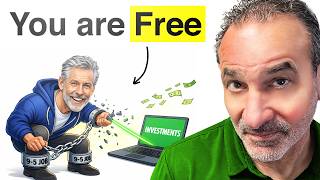
Mel Abraham explains when investment income beats your paycheck: when your money machine generates enough to cover expenses without work. He maps four stages from financial stability to freedom, shows how $1M invested at 8% yields $80k yearly, and warns that most people quit before compounding accelerates.
Chapters
When does investment income finally beat your day job? Well, and I'm going to say something here that might tick a few people off. If you're waiting until retirement to feel free, you've already lost. See, freedom doesn't start when you stop working. It starts when your money starts working harder than you do. Okay? And most people completely miss that moment because no one ever taught them what to look for. Well, today we're going to change that. I'm going to show you why investment income doesn't grow linearly. What? Why effort eventually loses the race to math, and how to follow a real system, not hustle, not hope, that changes the game entirely. This is building your money machine, where we help you master your money, eliminate financial stress so you can live a life of choice. And I'm your host, Mel Abraham. And after 30 plus years as a CPA, an entrepreneur, a money mentor, and someone who's walked this financial freedom journey himself. Listen, ole miss can can smack you in the face like they smack me upside the head when I didn't understand this. But I don't want you to get smacked like I did. So let's give it to you, and if you're ready to dial this in, let's do this. Let me ask you something. Have you ever woken up on a random weekday and looked at your calendar and thought, dang, I don't hate what I do. I just hate that I have to do it? Yeah, that feeling. Okay, that's what we're going to be talking about today. This idea of when does your investment income finally beat your day job? But what we're really talking about is when work stops being required and starts being optional. So we're not really talking about retirement or quitting your job or escaping your life. It's really about building that money machine to take the pressure off your soul. Now stick with me, because you're going to see where this moment actually shows up in your life. And too often, we don't see it. And we'll get an understanding of what stage the gateways, as I call them, the four gateways that you're in and what kind of system. What does it take to get you there so you're not guessing on your way to freedom. You know where you're at. I mean, if you just think about this picture, a random Monday, nothing special. You're sipping your coffee, you're half awake, you're scrolling your accounts like sometimes you do, and it hits you. Your money machine just paid for your groceries and your car payment and your insurance and while you were sitting there, you realize that, wow, you're not rich, you're not necessarily retired, but you're not trapped. See, and that's when the power dynamic literally shifts. It's that moment that nobody names. There's a moment on your money journey that people don't talk about. It's not the net worth milestone, it's not the retirement age. It's not the number you brag about. It's the moment you realize that if you didn't show up to work tomorrow, you'd still be okay. Not forever, not extravagantly, but okay. And once you feel that, you don't unfeel it. See, most people will work 40 to 45 years and never experience this. Not because it's impossible, but because no one gave them the map. See, hope isn't a plan. Grinding certainly isn't a strategy. It's really about us understanding that there's two ways to live. Work required and work optional. See, work required means that your paycheck is your oxygen. And there's 60 some percent, 66%, 63%, I don't remember the number, but a high percentage of people living paycheck to paycheck. So that means that if you're in that mob, no paycheck, no peace. But work optional. That means your money machine's carrying enough of the load that your job loses its grip on you. And let me be clear, work optional doesn't mean lazy. It just means dangerous in the best way. You negotiate differently. You tolerate less nonsense. You stop making fear based decisions. Freedom isn't about escaping work, it's about removing desperation from the equation. And there's two lines that you need to that literally decide everything. So you have line number one, which is your lifestyle cost. What does it actually cost you to live? Not the Instagram version, not the I think the number is, but the real one. The real one, your housing, your food, your insurance, your travel, your fun, your life, everything. Because this is where most financial plans fail. Because people lie to themselves in a polite way, but they lie. But that's the first line that you got to draw is what does it cost me to live? And line number two is the money machine, your money machine output. What is your invested money producing? What is that money machine producing? In the way of dividends, in the way of interest, growth, rents, cash flow, not side hustles. Okay? Not overtime, not working harder. This is about your leveraged income that doesn't require as much effort. Because here's the part that people, most people miss. That Lifestyle line, in most cases is relatively flat. But the money machine line, that's curved. It's very slow at first. Slow, slow, slow, slow, slow, slow. And then suddenly it ratchet up and it's not slow. Okay. See, compounding doesn't feel powerful at first. And it's because it's exponential, it's not linear. You're compounding your growth. Your money machine whispers most of the time, and then one day it starts yelling, okay. And it's this idea that I talk about called critical mass and acceleration. And so let's put some real numbers to this so you start to understand what I'm getting at. If you, if you underestimate the power of this, hopefully this fixes it. Say you got $100,000 invested at a reasonable rate of a return, let's say 8%, and you're making $8,000 a year. That's nice, but it's not life changing. But let's fast forward that. You keep investing, we'll talk deeper about this. And that 100,000 now becomes 500,000. Same return. Now all of a sudden you're bringing in $40,000 a year. And what happens if you keep going and it's a million dollars? Now it's $80,000 at 8% that, that, that's coming in. Same behavior, same discipline, same return. The only thing that changed is scale. That's critical mass. That's when the money machine stops feeling like it needs you to push it so hard and it starts pulling you along. It takes you along for the ride. You didn't necessarily get smarter, although I'd say that to get there, you built your financial literacy. So in a way you got smarter, but you didn't necessarily work harder. But the math finally showed up for you. And that journey, I believe, takes you through four gateways. One of the biggest problems I see with folks is they decide on what that number is that they need to give them the freedom that they want. And it's a million dollars, it's 5 million, it's 10 million, it's 20 million. I don't know, it doesn't matter what the number is, but that number becomes so sometimes that it's actually disempowering, it's defeating because you go, it's so far away. I'm never going to get there. And the challenge is that we don't know the milestones, the gateways, as I call them, on the journey to financial freedom. And we don't really have a definition of financial freedom that works for us. And so we don't really know where we are on the journey. Well, the four gateways to financial freedom, I think, will help you understand that, because this is where the map comes in. Because financial freedom doesn't happen at once. It doesn't just happen in a blink of an eye. It happens by moving through these four gateways. And those two lines, the lifestyle cost and the money machine output are what move you forward. And gateway number one is what I call financial stability. This is the place where stability is taking care of your survival. This is where your money machine, your invested assets are producing enough income that they can satisfy and cover your basic needs. Your survival only. That's it. So it's housing, it's food, it's medical, it's your clothes, it's your roof over your head, it's transportation, it's not necessarily your mani pedis, your technology, the luxury vacations. It's none of that. It's just your needs, your survival. Now, this is a place where panic finally leaves the room because you, you may not be free yet, but you no longer, you're no longer sitting in a place where you're one bad month away from disaster. And so the first stopping point is to get your machine. You're investing to a point where it's covering your needs. Because for a lot of people, this is the first time that money stops feeling like an emergency. Okay, now that's gateway number one. We keep going. And gateway number two is what I call financial, so security. This is about your lifestyle. This is when your money machine grows large enough that it can support the way you are actually living. In other words, it pays all of your current expenses. That means throw in the, the Netflix, throw in the mani pennies, throw in the technology, throw in the vacations, okay? And the stress literally drops away. Your confidence starts to rise, your sleep improves because you know that you have a machine that can cover all your expenses if you need to. Now, you still work, but work no longer owns you. And even if you're not necessarily work optional yet, you're no longer work desperate anymore, and desperation becomes expensive. And here's the thing to understand, because this is the place where things start to transition because it feels slow, like I said at the beginning, and it will then grow. So let me slow down for a second because this is where most people will quit and they'll quit too early. And I get it, the beginning stages of wealth creation is really unsexy. But let's just look at this. Let's say you're investing $10,000 a year, no magic, no moonshots, just consistently $10,000 a year, and you get an 8% return on that money. Okay? So at $10,000 a year, at 8% is going to take you about 7.6 years to hit your first hundred thousand dollars. Because you have to do a lot of heavy lifting. It's stressful, it's forceful, it's work. And this is where people get frustrated because you don't see a lot of growth, you don't see a lot of success because it feels painfully slow. Now, if you keep going, though, it takes you about 20 and a half years total to keep going at $10,000 a year to hit $500,000. Now you're looking at this thing at that point going, holy moly, 20 years, 20 and a half years to hit half a million. And it sounds discouraging until you hear this part, see, because we're now starting to accelerate. Because once you're there, and let's say that you want to now go from the half a million, the $500,000 to a million, and at $10,000 a year, it only takes seven and a half more years. That's it. Same behavior, same contribution, same return. The only thing that changed was the scale and the fact that now your money is working harder for you than you did for it. That's critical mass. That's the moment that your machine is doing more of the work than you do. And if you quit before this point, you never experience it. Not only that, you have to go back to the start. That's why you have to follow a system that's designed to do this. Okay? And so let me say this really clearly, because this is where people talk themselves out of freedom. The early years don't feel powerful because they aren't. They're foundational. They're teaching you. They're creating the muscle, they're creating the skills. The system isn't broken. You just happen to be early in the process. But most people quit right before the curve bends. Not because the plan didn't work, but because the results didn't arrive in their timeline. That's why patience isn't passive. It's strategic. And it's why following a system matters more than just some motivation. Because when we realize that your freedom shows up in payments over time. Here's what I mean by this. It doesn't show up all at once. Your money machine at some point will grow. And it covers your car payment, it covers your groceries, and then it covers your insurance. Then all of a Sudden it's covering your housing costs, and all of a sudden it covers your vacation. See, each time it grows, a little bit more is taken off your plate in the sense of required earning for it. Each one lowers the pressure on you and it raises the options for you and it creates momentum forward. And as you stay from financial security, you pass through then Gateway 3, which is financial independence. This is the gateway that most people think is the finish line, but it isn't. All right, Independence. This is where your money machine has now grown to a point where it replaces 100% of your income. Now, your paycheck. If your paycheck vanished, your lifestyle wouldn't. Okay, this is the work optional threshold. This is where you need to get. This is when the investment income beats your day job, not just in dollars, but in leverage. Okay? And it's why. And this is. This is why it works if you follow a system. Because someone that's investing consistently doesn't feel much. The first five to seven years, like I showed you, it's boring, it's slow, it's hard. It feels like nothing's happening. But then years 8 through 12, things start to move faster and you start to see it. But then 13 to years 20, the money machine starts producing more than the person can put out. That's the crossover. Not because you suddenly worked harder, but because time finally caught up with the discipline. That's when the investment income starts beating your effort. Okay? See, once you do hit that critical mass, it literally changes your role. You no longer are the engine. You're now the operator. Your job shifts from builder to maintainer. And that's when your money machine starts to feel like it's building itself. Now, the system that gets you there. And this is where most people mess up. They think it happens by accident, but it doesn't. It happens by following a process. It happens by following a system. It's why I teach the Wealth Priority ladder and the Money Machine blueprint. You follow a recipe, just like baking a cake. You don't skip steps, you don't chase shiny objects, and you don't gamble with a foundation. You build stability first by managing the debt, getting liquidity in place. Then you go to security by continuing and starting to put money away to do work for you. And then it grows to get you to independence. And then you scale to end up in freedom. See, systems beat motivation every time. But in order to do that, not only do you have to have the systems in place, you have to have the psychological shift to make it work. See, somewhere around 50,000 to 100,000 invested. Something changes for people. See, a 1% move is no longer coffee money. It's groceries, it's rent, it's options. And your money machine stops being fragile and starts being inevitable. It starts to look at you, go, wait a second. I no longer have to ask the question, how do I survive? I get to ask the question, how do I want my life to feel? That's the truth behind it. When you stop panicking in down markets, when you start to do that, because you trust a system, and that leads you to gateway number four. That's the financial freedom gateway. This is the final gateway. See, this is when your money machine doesn't just replace your income. It doesn't just pay your bills. It funds your vision, the vision you have for your life. And I don't care whether it's a tent in Montana or a yacht in Monaco, whatever it is you want to do with your life now, you have a machine that allows you to do it. You have more time, you have more generosity, you create more experiences, you have more impact. You're not escaping life, you're designing it. And money now becomes a servant and not a taskmaster. And in the process, you've built the chops that you understand that, hey, even if the market goes down, even if recessions happen, it's not failure, it's the process of growing. It's tuition. And that build phase, that volatility becomes fuel. Because down markets don't delay freedom panic does. The down markets give you opportunities. And when you're no longer relying entirely on a paycheck, you're in a good place. Now, as I keep going, I want to make a quick pause because if you're honest, I got really curious. Which gateway are you in now? Financial stability, financial security, financial independence, or financial freedom? Because the point of it, your job isn't to get to financial freedom tomorrow. Your job is to move to the next gateway deliberately. Because progress beats perfection every single time. But we tend to not celebrate progress. And the reason I designed the four gateways the way I did is to allow you to celebrate the progress every step of the way. To know where you're at, to know that as. As long as you're making progress, I don't care how slow it is, you're still moving in the direction you need to move. So what do you need to know now? What do you need to do now? Well, step number one is calculate your real lifestyle cost to know exactly what it's costing you to live today. And that's exactly why I built the Lifestyle Cost Calculator. It's totally free. You can get it. We'll hook it up here. Melabraham.com lifestyle forward slash lifestyle. You put the information in and you'll get an idea what it costs you to live. And then you move to step number two. Decide and understand by going through your calculations. See where you're at and figure out what gateway you're in. Not with judgment, but for awareness of what your focus is. Whether you're in instability, security, independence or freedom. And then step three. Follow a proven path, like the Wealth Priority Ladder to build your money machine to the next level. Follow a system that has worked, but don't just arbitrarily do things. Follow a recipe. No guessing, no gambling, no burnout. See, because the goal isn't to stop working. The goal is to stop being trapped. Build the money machine. Follow a proven system. Let compounding do the best work. Do the heavy work. Because the day your investment income beats your day job isn't the day you quit. It's the day you finally own your choices. And that is a life worth building. The fact of the matter is, is that until you start to understand the journey, you can't recognize the moment that your income, your investment income beats your day job. The purpose is this, is to start building something that is outside your efforts. If I can earn without having the efforts to earn it, I have a life of choice. That's the game you're going to play. But it needs you on the field to play the game with discipline, with consistency over time and then allow it to work. Knowing that at the beginning, maybe you don't see the progress, maybe you don't even feel the progress. Maybe it even feels hard. But don't quit because I promise you the math will always math out. All right, I hope that this helps. I hope that this gives you a perspective on how to look at your journey to financial freedom. Because that's everyone's journey to financial freedom. Doesn't matter age, stage or circumstance. So I'd love to hear from you what stage you're in, what's going on, you know, leave me a comment below. DM me. Send it to me. I'd love to hear from you. I love having conversations with y'. All. All right. And while you're there, if you haven't done so already, make sure to subscribe and give me a thumbs up. It makes me feel good and also makes YouTube happy. All right? Till I get a chance to see you on your path to financial freedom or out there as I'm out Speaking. As I always say, always, always strive to live a life that outlives you. See you in the next one. Cheers. For now.









