Why Dumb People Are Making More Money Than You
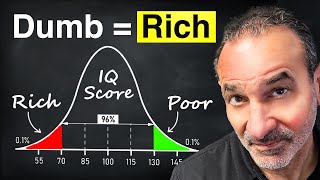
Mel Abraham argues that building wealth doesn't require high intelligence. Grit, conscientiousness, risk tolerance, emotional intelligence, and delayed gratification matter far more than IQ for financial success.
You ever look at someone else as their lifestyle, their bank account, and go, wait, how is that person that rich? Okay, I'm smarter than them. Yeah. I've done more than them. Yeah, I know the same. I felt the same. And meanwhile, you're out there, you're over there maxing out your Roth IRA like you're supposed to. You're meal prepping like a pro. You're making smart money moves, and somehow you're feeling stuck. So what gives? Well, we've been told that if you're smart enough and work hard enough and make the right choices, the right decisions, you'll be wealthy. But the more I've worked with people over the years, some broke, some billionaires, and everyone in the middle, the more I've realized that something doesn't add up. And that something is that the smarts don't necessarily equate to the wealth. It doesn't guarantee wealth. Not even close. And that's what I'm going to unpack today. This is building your money machine, where we help you master your money, eliminate financial stress, and live a life of choice. It's a bit of financial education with a side of sarcasm and a whole lot of heart. And I'm your host, Mel Abraham. And I used to think that success came from spreadsheets and strategies and staying in your lane. Now I know it's more about what you do than what you know. And in this episode, we're going to shift things. We're going to shift on how you think about intelligence, success, and how it impacts your path to wealth forever. So if you've ever felt too behind, too late, or not smart enough to build your wealth, stick around. You might just be a lot closer than you think. Let's do this. Have you ever sat there and looked at it and said, gosh, you got to be smart to make money. You got to be smart to be wealthy. It's the intelligent that make it, and they got to have this certain IQ and all that stuff. Look around. Okay, there's plenty of dumb people or less intelligent people that have lots of money. So why is that? Well, the first thing is this, is that there is this idea of this intelligence myth. Okay, let's deal with that first. Because you have to be smart to be rich. The answer, no. Do you know that study was done, Historical study that was done by Dr. Thomas Stanley showed that the average GPA of the USA millionaire, the American millionaire, is 2.9. 2.9. That's like barely a B average. Okay, so they're not they're not that highly intelligent when it comes to that. There was a Mensa study, okay, Now, Mensa is for the high IQ members. Clearly, I didn't get invited. I missed the invite. I don't know why. And it said that they had no higher net worth than the general population. And these are the highest IQ folks out there. There was another panel study that was done that looked at it and said there is at best a weak correlation. It was a German socioeconomic panel that was done that at best, there's a weak correlation between IQ wealth. So translation, what does that mean? Smart doesn't equal rich. Period. End of story. The fact is, you can build a better portfolio with consistency, courage, and compound interest than with a 1600 SAT score. It doesn't translate to wealth. But you start to say, well, wait a second, why do people with a lower iq? Why is there a difference? Why is there not a translation? Why doesn't it translate to wealth? Well, let's just look at it. Let's dig into it. And there's something called the Dunning Kruger effect. And that is a cognitive bias where people with less ability often overestimate their competence, their ability, whether it's driving, whether it's cooking, whether it's singing. They. Over whether it's knowledge. Okay, some folks, I mean, let's put this in English. Some folks are just too clueless to know that they should be afraid. And they go for it. And weirdly, it works. Weirdly, it works. Here's the interesting thing. There was a time at one point where I wanted to get something published, and I wrote the editor directly from a magazine to get it published. And they actually called me and I got something published. And someone said, how did you get it published in that magazine? I said, I just. I just reached out to the editor. You're not supposed to do that. There's this channel you're supposed to go through. It was clueless. I said, I want it published. I'm going to talk to the person that publishes it. Why not? See, the challenge, though, is that there is something that happens with people that have a higher level of smarts. And why I think that, that this happens is that we spend a lot of time over analyzing every side, every angle of every thing that we're trying to, whether it's an investment, a side hustle, or anything else. We don't launch, we don't start. And so what ends up happening is that we end up overanalyzing ourselves to a point where we don't do anything. And what Happened is, is the people that were successful, they just started, they took fast action, they tolerated mistakes, knowing that they would make mistakes. They knew that they would learn on the way, and they built confidence along the way. Here's the interesting thing. People say I just got to get more confident before I start. See, but confidence doesn't come from contemplation. Confidence comes from action. And many successes, micro successes, the people that have made it, no matter what their IQ is, they started, they got in the game. They didn't overanalyze themselves to get out of the game. They, they weren't buried in it yet. The smart folks, many of them, they're buried under 72 tabs of research, trapped in analysis paralysis. And they can't get on the other side of it. And this is probably one of the biggest factors that stands in the way. But the great thing is that if we know that it is not a matter of iq, smarts, knowledge, all that's. It's about starting, it's about getting in the game. I will say to win the wealth game, you have to be on the field. You can't be on the sidelines, you can't be in the stands. You have to be on the game, playing the game. And too often when we're trying to analyze, we're not in the game, we're on the sidelines or the stands doing the analysis. It's time to get in the game. You want to change your financial destiny? You want to change your financial future? Get on the field, start doing something, whether it's $5, put it away into a high yield savings account. $10, $20, $100. I don't care where you start. I need you in the game. I need you to start now. Let's just look at this. This isn't just speculation or anything. This is backed by science. Let's just look at some things. What actually builds wealth, and we'll flip the script here in a bit. The first thing I think, what are the characteristics you need to do this? Aside from smarts? Yes. You need knowledge. That's why you're here. Yes, you need understanding. That's why you'll get my book, all those things. But there's some characteristics that allow people to become wealthy that have nothing to do with iq, nothing to do with smarts, nothing to do with their formal education. The first Angela Duckworth talks about it, and that is grit. Okay, Grit is the, is passion. She says passion plus perseverance, it's the better predictor of success than iq. Wealth isn't a sprint. It's this slow burn of habits, patience, discipline over time. We say that wealth creation, 80% of it is behaviors. Behaviors are built on your habits. If we just. Math is math, it will always math out. If we just do the math right, meaning live on less than we make, put the money away. Over time, the math will math out. Habits, patience, continually showing up. Grit is probably one of the biggest elements to your journey to financial freedom. Start and stay in the game. Number two, there was another study said conscientiousness found that self discipline, responsibility and dependability outperform intelligence when predicting income. Okay, if we look at this, the way to kind of look at it is keep your promises, pay your bills, show up. Conscientiousness, keep your promises. But who do your promises are to? The people around you, the people you love, but more importantly, to yourself. To yourself. I've always said the world, we set goals too easily. I think we need less goals. We need less goals because it's so easy for us to set a goal. Think about your New Year's. You set your New Year's resolutions And then within 30 days, 60 days, how many of those New Year's resolutions are gone? And if you don't hit a goal, what do you do? I'll do it next quarter, I'll do it next year. You kick it down the road because goals are soft and fuzzy. They're not meaningful anymore. Here's what I think we should do. And you talk about conscientiousness. Set declarations. I will become financially free by this year. I will lose this weight by this month. I will do that when you declare you must. But it's scary for people to say I will do something because then they have to commit to it. But imagine how that would change. I will be a good father. I will be a good husband. I will be a good mother, a good wife. I will be financially wealthy. I will be a good person. Will, will, will, will. We need that, the declarations to keep your promises and keep yourself in the game.
Okay?
The third characteristic that I think does this is risk tolerance.
Okay?
High IQ folks. Sometimes we know too much and so we're, we're less. They're wealth less willing to take real world risks. Especially when it comes to financial risks. In the lab, they're bold. In life, not so much. And wealth requires some risk investing. There's no investment without risk. Wealth requires you stepping in. Wealth requires you asking, being curious, launching, doing things. That means that we have to be willing to take on real World risks that could bring with it real world losses. I've lost money. I've lost a lot of money. I've lost more money than some people will ever make in a lifetime, especially when you count the Ponzi scheme. But on the other side, I learned a lot, I grew a lot and I made a lot more. But we have to have the ability to navigate and tolerate the risk to make that happen. Okay, then the fourth thing is emotional intelligence. There was a study, it's called the Dunedin Study, where it showed that self control and emotional regulation at age three predicted success at age 32. Better than IQ. Better than IQ. Are you smart? Okay. Okay. But are you cool, calm under pressure, Wealthy?
Okay.
Self control, emotional regulation. And why do I think that that's the case? And I understand where this comes from because I've said it already, that emotional spending, emotional financial decisions are never good financial decisions, they never are. So we need to do is avoid emotional decisions. When I have people track their finances, when I have them track their spending, I ask them to track the amount they spent, what it was for, But I also ask them to track the feelings and the emotions they were feeling when they made the spend. Because what I want to do is I want to identify the emotional triggers that are causing the spending, if there are any. And we can see the thread and the pattern. And when we understand those emotional triggers, we can then put some processes in place to build the self control and emotional regulation. So those triggers don't have us overspending or spending on bad things or draining out our wealth because we're trying to satisfy an emotion. We find another way to do that. Number five, delayed gratification. Remember the marshmallow test? Turns out kids who could wait for two marshmallows, they didn't just snack smarter, they earned more, they stayed healthier and they saved better decades later. IQ didn't make the difference. Impulse control, that did, that did. Call it a different way. Discipline. The more you have consistency and discipline in your, in your finances, the better off you'll be in your wealth creation.
All right.
If you want real world proof that this is, this is true, let's just look at some people you might know. Richard Branson, he dropped out of school at 15 years old, but he built Virgin to a five billion dollar empire. He says, screw it, let's do it in his life. And that's his life philosophy. He says, just start, go do it. We'll learn. Has he had a rough road at times? Certainly he has. Okay, here's another One Damon Johns.
Okay.
Diagnosed with dyslexia. He started FUBA clothing from his mom's house. Shark tank mogul, nine figure net worth. Lindsey Schneider. She's the in N out burger heiress. Never finished college. She's a quiet billionaire. She runs the company with values instead of degrees. Now, what do they all have in common? It's not a PhD. It's not perfect SATs. What do they have all in common? They started, they stayed, they grew, they kept going. When you look at this, you kind of go, okay, well what can we do differently? What can we do differently to be on this path? How can we get our own way? If you would. Okay, first things first. Embrace B plus work. Stop aiming for perfection. Perfection is a form of procrastination. It's procrastination in a tuxedo.
Okay?
We are horrible as a society. To celebrate people's progress, we want to celebrate the destination. Why not celebrate their progress? If they were better today than they were yesterday, that's progress. And if they do that every day, that consistency compounds. B work over the long term beats a work that never launched. A work that has never launched. Rather than trying to make it absolutely perfect, let's put it out there. Let's start making the decisions, start making the choices, and let's perfect. You think that I knew exactly what I was doing when I started. If I did, I wouldn't have lost all the money I did. But I've learned along the way. I took the lessons, I put them in, I grew along the way, and I stayed in the game. That's what we need to do. The other thing that you do is lean into the earn pillar of building your money machine. If you don't have my book, get building your money machine and you can get a deeper dive on this. But I want you to align your income to do work that matters because that will fuel you when things get tough, when you hit an obstacle, when you have a downturn, when you have a challenge. Once you've aligned the income, I want you to amplify the income. To sit back and say, how can I increase the income? Well, the way to increase it is not to focus on increasing the income. The way to increase it is to focus on how do you increase your value to the people that you serve. Now that people that you serve may be the corporation, the company you you're employed by, but it also could be your customers, your, your co workers, your clients. When you create more value in their lives, in their journey by solving bigger problems, because you bring More talent, skills and strengths to it, to the problem or knowledge or perspective, they'll pay you more. It is a value exchange economy, like it or not. You want to look at it and say, how do I bring more value so I can become invaluable in their eyes? To get paid more, amplify your income. The third thing I would do in this, in this part of it is to now find a way to automate the income. Leverage your systems. Find a system. Building wealth is about your behaviors. But the more of those behaviors I can systematize, the easier it becomes to put a process in where the wealth building becomes on autopilot and then find other sources of income. Once I've increased the value, then we're going to look at additional income, building secondary sources and streams of income. As you invest, you'll get dividends, interest growth, things like that.
Okay?
Which is also the last piece of appreciating income. You will always be imprisoned by the earnings treadmill. If that is the only way to earn, the only way you will find freedom, the only way you'll get your time back, is when you are successful at separating your earnings from the efforts to earn it. That's the whole premise of the business of the money machine, is to separate your earnings from the efforts to earn it. It's the lesson I learned long ago, and that's what gave birth to this concept to build it out. So now what we need to do is take the income that we've optimized, that we've increased and amplified, and say, how do I take that and use it to acquire assets that can build and grow and create cash flow for me without my efforts. Now all of a sudden, you're in a place where this works. The fact is, you don't need a new brain. You just need a new system. You need a process to follow. And then the final thing here is to sit back and say, know your strengths. You know, what are your strengths? What are the things that you can bring to the game? Where can you then grow those strengths? And where do you need to supplement them? Through further education, mentorship, and help. Okay. That will move. Move forward. So here's the real truth. Being the smartest person in the room is kind of useless if you never take a shot. So start before you're ready. I hope you will ship the first version of whatever you're doing. I hope you will step into your first investment that is based on a process and a system. Build the system. Let it compound.
Okay?
Bold beats brilliant every time.
Okay.
Your wealth journey. It's not about iq, it's about behavior. It's about belief. It's about systems. It's about the things that will work while you live your life. That's the key. That's what we're trying to get at here.
Okay?
So as much as we started this whole thing saying, why do dumb people have more money or make more money than maybe you or someone else, that's not really the point here. The point is it doesn't matter what your IQ is. It doesn't matter what your smarts are. It matters what the actions are, the behaviors are, the beliefs are, and the system is that you're falling.
Okay?
I hope this helps. I hope this helps you get started to get in the game, to step on the field. Because until we get you on the field, we can't win the game. I want you on the field. We'll guide you. Will you stumble and fall? Maybe. Probably. Likely. Okay? But that's why we're here. That's why we have this channel. So subscribe to this channel. Stay with me on this journey. We'll be there to support you.
All right?
Don't be reckless, though. You get in the game, follow a process that's proven a system that works. Stay consistent, stay in the game. You gotta start to finish strong. Otherwise there's no finish if you never start.
All right?
I hope that this was valuable. And if you haven't done so, like I said, subscribe. Share it with a friend. Leave me a comment, let me know what you're thinking. All right, I'm here for you. And let's. Let's keep this rocking and rolling, all right? Until I get a chance to see you on the road to your financial freedom, always, always strive to live a life that I lose you. See you in the next one. Cheers. For now.









