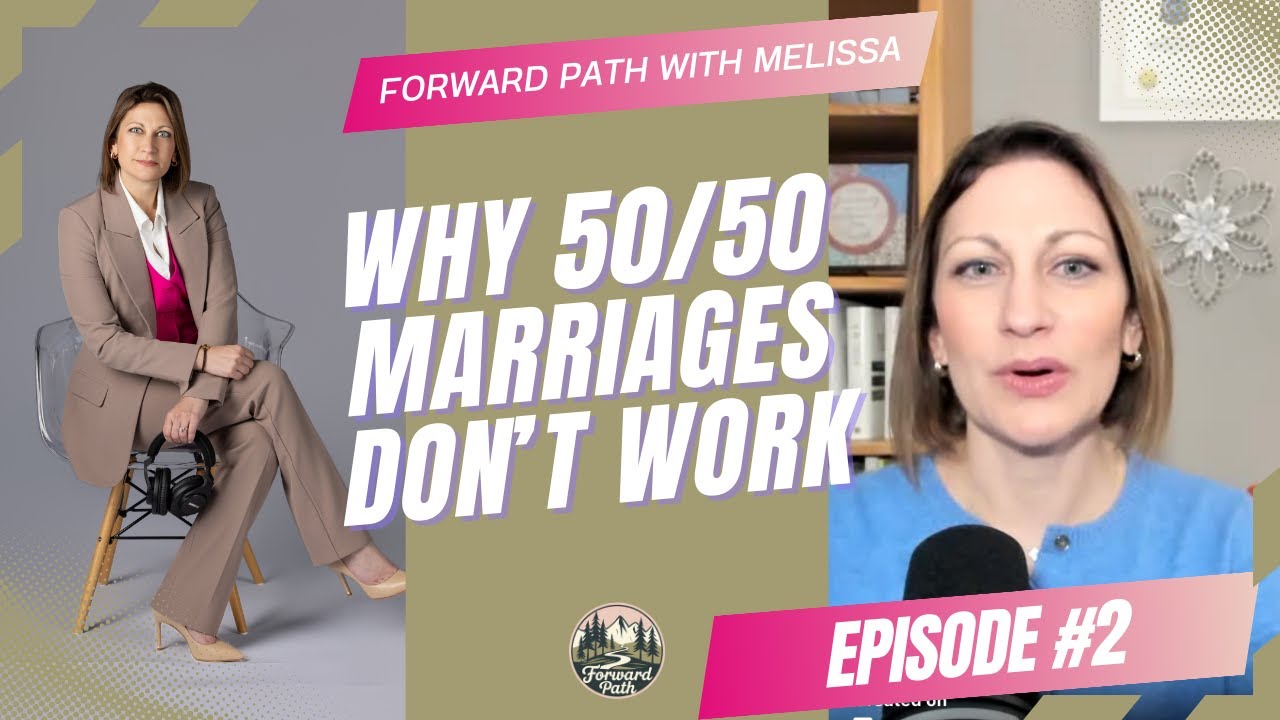
Melissa Gendreau, a therapist, argues that 50/50 marriages treating finances and chores as separate deals create business arrangements instead of partnerships. She uses 1 Corinthians 13 to show how this mindset fails, then proposes a 100% spouse model built on sacrifice and daily service instead.
Chapters
In today's episode, I'm going to explain why 50/50 marriages don't work. First, I'm going to discuss the lowered expectations for marriage, even Christian marriage, and the reasons people say they're getting married. I'll then define what a 50/50 marriage is and compare it to the 1 Corinthians 13:4-7 definition of love. I'll then share how a shift in your mindset changes your marriage foundation and creates key differences. Hey friend, welcome to Forward Path with Melissa: Life and Marriage God's Way. I'm Melissa, small-town Iowa girl, wife to my best friend since 2007, mom of 2, mental health therapist since 2009, and founder of Forward Path. I'm forever grateful that God took a shy, insecure kid and showed her who she really is. in Him, giving her just enough humble confidence to stand for what's true, because that changed everything. Forward Path and this podcast is a stirring God wouldn't let go of in my heart, because the world can feel heavy and dark, and we're called to be different, to shine His light, especially in our homes and marriages. So every week we are going to open scripture, Pull from real-life counseling experience, coaching knowledge, and talk honestly about the messy and the beautiful— how to disagree well, love deeply, heal, parent with purpose, and keep walking forward with Jesus. Because your growth isn't just about you, it's about glorifying the one who designed it all. So grab your coffee, let's walk forward. Together. There seems to be a lowered expectation for what marriage can be. There's the understanding of what the Bible says and how you're supposed to treat your spouse, but it's being viewed more as a theoretical approach than as a model to follow, and one that's even attainable. So where's the disconnect? Well, approximately 41% of first marriages and 60% of second marriages end in divorce. That's a significant number of people growing up without a solid example of what marriage can be within their home. It's not uncommon for me to work with married couples who will say they have no idea what marriage is supposed to look like and can't give me an example of a good marriage that they would want to ideally be like. We also can look at how is marriage represented in movies, TV shows, and even ads, commercials. Usually they're rude to each other or making fun of each other. Um, they're making the other person the butt of their joke. The husband is usually a buffoon and the wife treats him like another child. But none of these things are God's design. God's design is for male and female, husband and wife, to be equally yoked. They're meant to be partners. They're meant to love each other most beyond anybody but God. So how often do we hear the phrase, marriage is hard work? I, I so strongly dislike that phrase. Because synonyms of hard work are tedious, exhausting, drudgery, burden, chore, grind. That doesn't match God's design for marriage. I'm not even sure why anyone would want to get married if that's their understanding of marriage. So I'd like to change the phrase to marriage is intentional. Intentional means done by intention or design, deliberate. Willing, a determination to act in a certain way, resolve. So intentional means choosing every day to live out your vows, to get to do that for your best friend, the person you love most in the world. But I'm finding that's not why people are getting married. They aren't getting married to love and serve their spouse, to do life with them. to go on adventures together. They're getting married so someone will love them. It's to fill a void. It's selfish. It's this lack of understanding of the give and take. It's just the focus on the take, on the receiving. So if both enter into the marriage with that mentality, it's going to end pretty quickly. And usually around the time of the first baby, because the baby will love and need mommy. So her needs will be met by the baby and the husband is no longer needed. If the husband is entering into the marriage to receive love, he's going to be resentful of both his wife and the baby. If the wife entered into it to be receiving love, again, she won't feel the need to have the husband anymore because she has everything she needs in the baby unconditionally. If one spouse gets married to be loved and the other wants to give love, that may work for a while, but again, as soon as kids enter the picture, the selfishness of primarily wanting to receive love is going to cause problems, and the person who is willing to give the love After a while, he's going to get empty. The result of viewing marriage as hard work and getting married to be loved turns the marriage into a business arrangement of sorts. As a therapist, I've worked with many couples who came to me identifying their marriage as 50/50. Some couples choose that pattern, others fall into it. And in either way, it's generally presented as a positive thing. Life happens, and they began to view their marriage more like a business arrangement than a devoted couple. The trap was that they were going for ease and efficiency, but what it turned into is, we've fallen out of love with each other. And in doing so, they've robbed each other of the experience of what true love in a marriage is supposed to be. And that's when they would come to see me. Somewhere along the way, through careers, kids, activities, and volunteering, they lost the principles of God's design for marriage. Or like I prescribed— described, they never knew it to begin with. Ultimately, they became disappointed and resentful towards their spouse. So what is a 50/50 marriage? It's the marriages that fall into the mine and yours mentality. Examples include separate bank accounts, separate bills, designated chores, separate night off evenings for each spouse, separate vacations, et cetera. Now, most couples have some roles designated, and so that's not a bad thing. However, in the 50/50 marriage, the lines are firmly drawn and the focus becomes more on the task or agreement or arrangement and not on loving and serving the spouse. These are the your chores no matter what. These are your mornings to get up with the kids with no flexibility. These are your bills with no discussion of shared wealth and future plans. So in contrast, I'd like us to look at 1 Corinthians 13:4-7 to compare against the 50/50 model. Love is patient, Love is kind. It does not envy. It does not boast. It is not proud. It does not dishonor others. It is not self-seeking. It is not easily angered. It keeps no record of wrongs. Love does not delight in evil, but rejoices with the truth. It always protects, always trusts, always hopes, always perseveres. So let's start with the first section of that passage. Love is patient. Love is kind. When 50/50 marriages use a 50/50 mindset or the mine and yours, they tend to lose patience and kindness towards their spouse because in these relationships, the focus isn't on each other, but on the item or task. They focus on the amount of funds in each other's accounts or the chores that their spouse didn't Complete. They lose sight of their spouse as the person they vowed to cherish. They stop not only asking about the why of a situation, but they also stop caring about it. Let me give you a few different examples for this section. So for example, a 50/50 marriage may have designated chores. They decided that one of the husband's chores is to mow the lawn. The wife gets home before the husband, who has, has to work late. The yard doesn't get mowed. This happens a few nights in a row. The wife loses patience with her husband for not completing his chores, and then either begins nagging him about the lawn when he gets home, or begrudgingly mows it herself. But nowhere in this scenario did the wife show her husband patience and kindness. Recognizing the extra hours he has to work. The focus shifted to the chore, not her husband. It was viewed as a business arrangement, and he didn't hold up his end of the deal. We really can do this for any chore or any 50/50 rule or arrangement. It doesn't matter if we're talking the wife gets upset with the husband or the husband gets upset with the wife, because it happens in both situations. So let's say that there is— the wife makes dinner 3 nights a week, the husband makes dinner 3 nights a week, and then they go out to eat once a week. Okay, well, let's take the same scenario where the wife then has to work late multiple times a week, and so she's not able to come home and make the dinner. Well, the same situation happens if the husband starts getting frustrated or he begrudgingly makes the meals and is passive-aggressive about having to do it. In that situation too, the focus is no longer on taking care of the spouse and figuring out what was going on and loving each other well, but it was, how dare I have to do more than what our agreement or arrangement said? We can do that with bills. Let's say somebody had an unexpected car payment and that car is theirs. So they're required to have to pay all the bills. Well, if that means then they are running short or low on funds for other bills in this 50/50 firmly drawn line mentality, then the spouse again isn't going to have the heart and the compassion and the love to be able to help pay for the car payment maintenance. Then they just focus on, well, you should have saved better. Let's move on to the next area. It does not envy. It does not boast. It is not proud. 50/50 couples tend to brag about their accomplishment at their spouse's expense. The focus then shifts to boosting themselves instead of their spouse or the marriage as a whole. One will brag about their ability to pay their bills or complete their chores. They'll brag about their aptitude for saving and the items or vacations they plan to buy with their money. I worked with a married couple years ago who split all of their bills and expenses 50/50. They had their own separate accounts, no joint ones, and they kept a ledger to keep all of their household expenses and bills even down to the dollar. They set up their marriage this way, and it was both of their first marriages, so there weren't financial complications from previous marriages. This started causing issue when they both chose to spend and save their free money in significantly different ways— cars, separate vacations— and then when they had kids, they both would get their own presents for the kids and try to outdo each other with their gifts. The focus wasn't on who loved the kid more, it was who spent the more money on the kid, and then that was equated with the love. They shifted the focus and it no longer was on spouse. It wasn't actually even on the kids. It was about who had the more money and who was willing to spend more and show off more. Well, that's an extreme example. 50/50 marriages do tend to focus on themselves and how things benefit them. Let's move on to the next section of the Bible passage. It is not rude. It is not self-seeking. It is not easily angered. Marriages that have chosen or find themselves in a 50/50 mindset continue to fall down the path further away from Love. After the bragging and envy, they start being rude towards one another. If you were better with your money, you'd be able to take a vacation too. If you weren't so lazy, you'd be able to get all your chores done too. At that point, emotions are high, and a 50/50 marriage only focuses on itself. The focus becomes on hurting the spouse more than the spouse is hurting you. It turns into a desire to win the fight. They forget that it also means their spouse has to lose. And in actively trying to get your spouse to lose, you're breaking God's design for marriage. His design was for you to first and foremost focus on your spouse. Actively getting your spouse to lose goes in direct opposition of that. That old saying for kids, sticks and stones may break my bones, but words will never hurt me. It's a terrible lie when it comes to marriages. Words from spouses can hurt bad. You're talking about the person who has vowed to love you and cherish you. They're the person that can hurt you the most. Far too often, my therapy couples are taken aback when I tell them it's not okay to curse at each other and call each other names or scream and yell at each other. I've had some go so far as to say that's not possible. I assure you it is. Your relationship with your spouse is supposed to be second only to your relationship with God. Your marriage deserves more, your spouse deserves more, and your kids deserve a better model. So let's go on to the next section of the passage. It keeps no record of wrongs. Because of the wounds 50/50 marriages receive, They hold onto them. Unfortunately, they fester and keep coming up over and over. Over the years of being a therapist, I've heard so many stories of situations that have festered and corroded the marriages, but not big situations like affairs, gambling, or substances, but truly insignificant situations that the spouse just won't let go of. Leaving the toilet seat up, not keeping a certain amount of gas in vehicles, chewing loudly, stealing the covers, snoring, eating the last of the leftovers, hair in the sink, clothes on the floor. And yes, these are actual examples. And while these things can absolutely be annoying and important to talk about with your spouse, they aren't worth ending the marriage over. These marriages struggle to forgive because they lose focus on loving their spouse and strengthening their marriage. It becomes a selfish desire to receive love, but forgets to focus on giving it. Again, if both people wanted to take care of and serve and cherish each other, If a spouse brought up some of those little things, you would want to fix it. You would want to make it better. And unfortunately, there's people who hear me say that and they right away go, see, why won't my spouse do that? And they forget to think about, but what are you not willing to do because you just don't want to? Because honestly, you're being selfish. If we go on to the next section of the Bible passage, it says, Love does not delight in evil, but rejoices with the truth. 50/50 marriages end up in a place of minimizing and justifying their own actions because of what their spouse is or is not doing. Now, these are the big situations. The lying. I wouldn't have to lie if you didn't freak out every time I talked to you. Substances. I wouldn't have to drink to enjoy myself if you weren't so uptight. Affairs. I wouldn't have had to be with someone else if you had given me the love I needed. These are usually the couples who say, I don't know how we got here. Well, it got there because they lost sight of God's design for love, or they never knew it to begin with. They lost focus on loving their spouse, not despite their flaws, but loving them because of their flaws. These marriages drew too firm of lines. They stopped focusing on caring for their spouse. Which gets us to the last section of the Bible passage: it always protects, always trusts, always hopes, always perseveres. When a spouse focuses on protecting and trusting their spouse, they put their spouse first. It's about giving and serving first. It is the opposite of a 50/50 marriage, and it's God's design. So let's look at a 100% spouse model instead. This is the model I believe aligns best with God's design, and it's the coaching program I teach my marriage coaching clients. The foundation is on loving and serving your spouse daily. You put them first. It's on a daily basis finding ways that you can love your spouse, serve your spouse, put them first. It's trying to find ways that will help their day, make them smile, have things be easier for them, and help them be the best version of them because you're in some way helping or encouraging or cheering them on. It's not reactionary to how they're treating you. But if that's both of your intention, you both benefit. Think, in a 50/50 marriage, it requires both people to do absolutely everything for it to be 100%. And while that's not actually even the point of a 50/50 model, it's more about the mine and yours, That still remains to be perfect, to get that 100%. It is difficult and you're barely gonna be able to make it most days versus a 100% model. Even if both only hit 75%, if they're only focusing on their spouse and putting them first 75%, it's still far more than what you're gonna find in a 50/50. Because you love them, because you respect them, cherish them, and trust that they are a person of honor, integrity, and loyalty. It allows for stability and the willingness to be vulnerable with each other in your marriage, which creates intimacy and fosters growth, both individually and as a couple. It's based on God's best design for marriage. And it is possible. That's all for today, friends. Thank you for walking this stretch of the path with me. If today's episode encouraged you even a little, would you do 2 quick things? One, hit the subscribe button or follow on your podcast app or YouTube channel so you never miss an episode and share it with one friend who needs it. That's the easiest way this light keeps spreading. If you want to go deeper, come join the Forward Path with Melissa app and community. It's where the real growth happens between episodes. Inside, you'll get access to all of my courses. We will do a weekly live question and answer where we'll unpack the podcast episode of the week. You'll get daily prompts for your faith, marriage, and purpose. Downloadable PDFs to keep you on track, a private community of like-minded Christians cheering each other on, group coaching once a quarter, and discounts at the Forward Path shop, first dibs on workshops and retreats, and an affiliate program that gives you and anyone you refer a discount. Just head to melissagendreau.com or check the show notes for the link. I can't wait to see you in there. You can also find me on Instagram, Facebook, YouTube, and all other socials @forwardpathwithmelissa. And sign up for my emails so nothing good slips past you. Until next Monday, keep shining, keep growing, and keep moving forward God's way. See you soon, and God bless.
More from Melissa


Consistency Over Intensity: Why Small Faithful Habits Last | Christian Podcast







Busy vs Intentional: The Difference That Changes Everything | Forward Path Ep 39