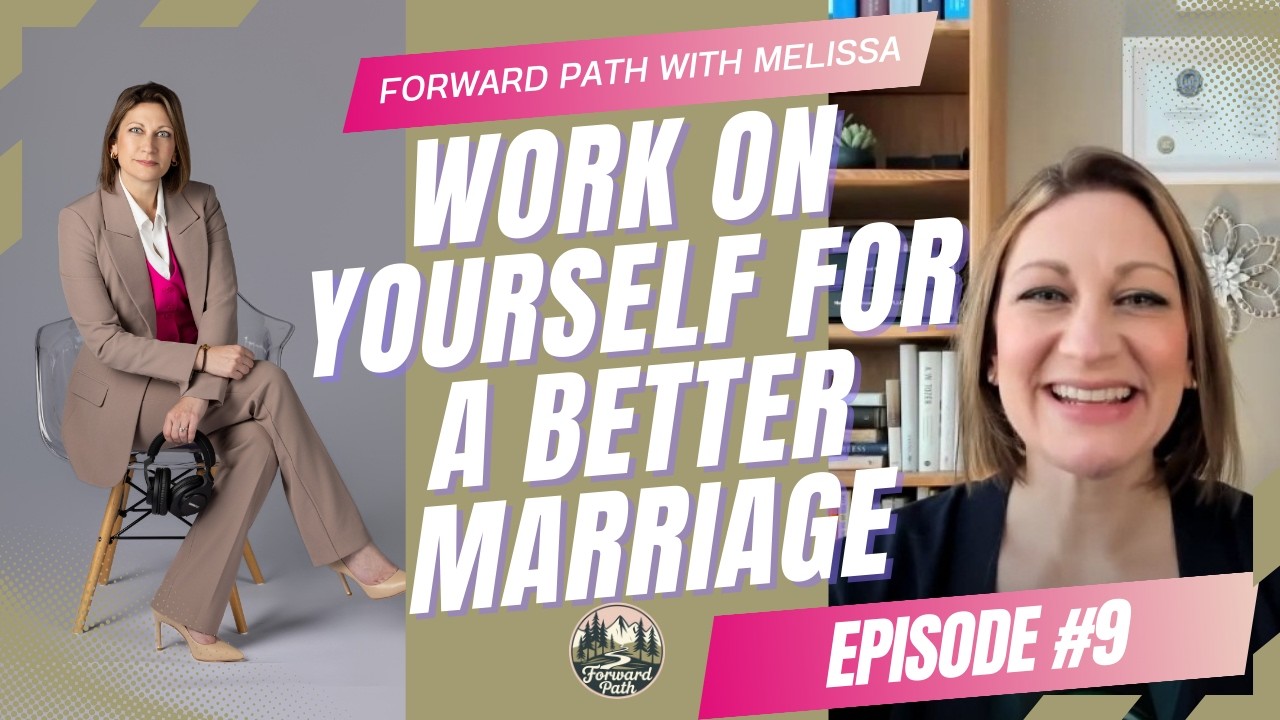
Melissa Gendreau, a therapist and founder of Forward Path, walks through four areas to work on in yourself for a better marriage: insecurities, negative core beliefs, emotional immaturity, and selfishness. She uses Scripture, client stories, and practical exercises to show how personal growth directly improves your relationship.
Chapters
Hey friend, welcome back to Forward Path with Melissa: Life and Marriage God's Way. In this episode, we're diving into 4 key areas where working on yourself can transform your marriage: your insecurities, negative core beliefs, emotional immaturity, and selfishness. We'll look at what scripture says, share real-life experiences from my counseling experience, and give you practical steps to start today. Because when you grow in these areas, you create space for deeper connection, more grace, and a marriage that reflects God's love. Hi, I'm Melissa, small-town Iowa girl, wife to my best friend since 2007, mom of 2 incredible kids, licensed mental health therapist since 2009, and the founder of Forward Path. I'm so grateful God took that shy, insecure version of me and showed me who I am in Him. Giving me the tools to build a marriage and life that honors Him, creating humble confidence that allows the journey to continue every day. This podcast is all about the stirring God wouldn't let go of in my heart to help shine His way in a dark and heavy world, especially in your home and marriage. So every Monday, we open scripture, draw from real counseling stories and coaching insights, And we talk honestly about the messy, the beautiful, how to disagree well, love deeply, heal, and parent with purpose, all while walking forward with Jesus. Because your growth isn't just for you, it's to glorify the One who designed it all. So grab your coffee, maybe a journal, and let's walk this forward path together. Today is episode 9, Work on Yourself for a Better Marriage. Marriage God's way isn't about fixing the other person. It's about partnering with Him to become more like Christ. And that starts with you. So if you're tired of the same cycles, arguments that go nowhere, feeling distant, or wondering why things aren't clicking, this one's for you. So let's jump in. All right, so let's start with why this matters. Marriage is a mirror. It reflects back our strengths, but it also reflects back our wounds and blind spots. Ephesians 5:25-33 talks about husbands loving wives as Christ loves the church, and wives respecting husbands, but that mutual submission starts with each of us surrendering to God first. Hmm. I remember early in my own marriage, I was really insecure, struggling with my worth, often feeling not enough, and that got put on my husband far too often. I worried he would leave me, but I had zero evidence that that was true ever. I would even dream and have vivid dreams of him leaving or saying he wanted divorce. I would wake up a teary mess. Thankfully, he's a wonderful man and would patiently reaffirm me, but that wasn't fair to him or our marriage. I was responding to my own past hurts that hadn't been appropriately dealt with yet. Thankfully, God gently showed me my worth and the areas I needed to work on, and working on myself through prayer, His Word, lots of reflection, Lots, lots of reflection, but that growth and healing has allowed for greater vulnerability and intimacy in our marriage. So here's the big idea: your marriage improves when you focus on becoming the spouse God calls you to be— not perfectly, but progressively. Proverbs 4:23 says, above all else, guard your heart, for everything you do flows from it. What's in your heart affects how you love, Forgive and connect. While you aren't my therapy client, you are the one listening to the episode. So here's what I say to my clients: you're the one on my couch. Meaning, right now, let's focus on you. Try to listen to the information for your growth and benefit, not about what your spouse should be taking away from this. Just about you. So let's break down growth into these 4 areas. So starting with insecurities, it's those nagging doubts. Am I enough? Will they leave? Do I measure up? In marriage, they show up as neediness, clinginess, dependency, and even pushing your spouse away to avoid hurt. From my years as a therapist, I've seen how unchecked insecurities create walls, One wife I worked with constantly checked her husband's phone, but he had never been unfaithful. However, because of past rejections and past boyfriends who had cheated, she felt abandonment was inevitable. He felt hurt for being blamed for something he hadn't done, which then caused him to be distant, and then his distance spiked her fear of rejection all the more. And overall, it eroded trust and left a Both of them exhausted. But here's the good news: God's Word speaks directly to this. 2 Timothy 1:7 reminds us, for God has not given us a spirit of fear, but of power and of love and of a sound mind. So how do you work on it? Well, first you have to identify the root. Maybe journal: when do insecurities flare up? What past experiences feed them? Step 2 is replace lies with truth. Memorize verses like Psalm 139:14, I am fearfully and wonderfully made, and then speak them over yourself daily. Step 3 is communicate openly. Tell your spouse, hey, I'm sorry. This is my stuff, and I am working on it. You are not actually doing anything wrong, and I do know that. And then step 4, seek help if needed, whether that's counseling or coaching. It can help you uncover the deep roots so that you can grow. And when you address insecurities, you free your marriage from unnecessary drama. You show up as a secure partner, able to give and receive love without strings. Security in your relationship allows for greater connection, And intimacy. So next, negative core beliefs. These are the deep-seated lies we believe about ourselves, others, or even the world, like, I'm unlovable, or, people always disappoint, or, I have to be perfect to be worthy. In marriage, negative core beliefs act like filters. If you believe, I'm not worthy, you might sabotage good moments or overreact to small slights. I had a client whose core belief was, men can't be trusted, and that was stemming from her dad being unfaithful to her mom and their resulting divorce. But it made her hypercritical of her husband, turning minor things like him forgetting to get milk on his way home into proof he didn't care. Or I had another client whose core belief was, women are bad with money. Stemming from his mom bankrupting their family to secret credit cards. It led him to micromanage his wife's spending, obsessing over bank accounts and wanting receipts for everything. In both examples, the clients had significant real-life experiences, but then they developed into generalized core beliefs. And scripture calls us to renew our minds. Romans 12:2, do not conform to the pattern of this world, but be transformed by the renewing of your mind. Then you'll be able to test and approve what God's will is— his good, pleasing, and perfect will. So practical steps to change negative core beliefs. First, spot them. Notice patterns in your thoughts. What do you believe about men, women, marriage, etc.? And then challenge it with evidence. Why do I believe that to be true? Based on what? What does God say? For example, I am unlovable, can be countered with Jeremiah 31:3, I have loved you with an everlasting love. And then rewrite the narrative. This happened, but that doesn't mean all. And use affirmations rooted in scripture like, I am chosen and loved by God. Ephesians 1:4. And involve your spouse gently. Share what you're unlearning based on your past pain and experiences, and ask for patience as you grow. And shifting from core beliefs takes time and is a continual process of renewing your mind, but it leads to healthier responses and a marriage where grace flows freely. So now let's talk about emotional immaturity. Emotional immaturity shows up as poor impulse control, avoiding hard talks, or reacting like a child, sulking, blaming, or exploding. And often emotional immaturity is our response to our insecurities and negative core beliefs. But also, emotional immaturity has become more acceptable in our society, or at least expected and sometimes even applauded. The crazy outbursts that go viral, the most damaged and dramatic character in a show becomes the fan favorite, or music lyrics of retaliation. All of these are examples of emotional immaturity. And in marriage, it creates chaos. Think of the husband who stonewalls during arguments because feelings weren't allowed when he was growing up. Or the wife who manipulates with tears to get her way. I've counseled multiple couples where one partner's immaturity stems from unhealed childhood wounds or past relationships, but then every disagreement turns into a battlefield, and so much more if both spouses are still responding to their pasts. And now, more often, I'm experiencing couples who assume yelling, screaming, cursing, and lashing out are just a part of marriage, but God calls us to maturity. Ephesians 4:15, speaking the truth in love, we will grow to become in every respect the mature body of Him who is the head, that is Christ. So how do you grow in emotional maturity? First, believe you should. Second, self-assessment. Track your reactions. Journal after conflicts or when you experienced a significant emotional reaction that What triggered me? What thoughts led to my emotional reaction? And then how did I respond? Next, learn emotional tools, whether that's practicing deep breathing or pausing before you speak. James 1:19, be quick to listen, slow to speak, and slow to anger. And then own your part. Apologize specifically. I emotionally responded, and that wasn't fair. And then build resilience. Read books, seek out courses, whether mine or others, or one-on-one support. Because as you mature emotionally, you handle conflict with grace, creating safety, security, and steadiness in your marriage for both of you. And then finally, selfishness. Selfishness is putting me first. Demanding your way, withholding affection, or ignoring your spouse's needs. It's the opposite of Philippians 2:3-4, do nothing of selfish ambition or vain conceit. Rather, in humility, value others above yourselves, not looking to your own interests, but each of you into the interests of the others. In marriage, selfishness erodes unity. This looks like prioritizing your own interests, hobbies, career ambitions, and other relationships over Checking in and connecting with your spouse. Now, I'm not saying ask for permission. I'm saying remaining connected. I worked with a couple where the husband was this hardworking guy. He was a great provider, loved his family deeply, but he had a habit of putting his own comfort first without realizing it. So after long days at work, he'd come home, grab his phone, or turn on the TV, and zone out. His wife would try to talk to him about her day, the kids' needs, or even just connect emotionally, and he'd give short answers or say, I'm too tired right now. And over time, she started feeling invisible, like she was managing everything at home alone while he checked out. And he didn't see it as selfishness at first. He thought, I worked hard all day so she doesn't have to. Isn't that enough? But when we talked, He began to realize that he was prioritizing his need to unwind over her need for partnership and presence. That one-sided focus was creating distance and resentment. Okay, now let me share from the wife's side. She was a wonderful mom and very involved in the church, but she had a pattern of wanting things her way when it came to family decisions, whether it was how the house was organized, how the kids were disciplined, or even what they did on weekends. She often dismissed her husband's input if it didn't match her vision. She'd say things like, well, I just know what's best for us, or get frustrated when he suggested something different. Deep down, she believed her way was right, and she didn't see how that made him feel unheard and unimportant. Over time, her husband started pulling back. He stopped offering ideas, stopped initiating affection, and the emotional connection faded. She felt hurt and confused, thinking, why won't he step up? But when we unpacked it in sessions, she realized she was putting her own preferences and control above unity. She was using her good intentions to justify selfishness. This is an important example because selfishness doesn't always look dramatic. It can be subtle, everyday choices that prioritize the me before us. Also, rarely is one spouse solely at fault for marital issues. They both had to acknowledge the part they were playing that was hindering their unity, and they each had to work on their own stuff. Pointing fingers at each other was never going to work, and it wouldn't help their unity or help them come back together. So steps to overcome selfishness. First, examine your heart. Pray Psalm 139:23-24. Search me, God, and know my heart. Test me and know my anxious thoughts. See if there is any offensive way in me. Practice generosity. Small acts: listening without interrupting, serving without expecting thanks. And then set mutual goals. Discuss, how can we both win? Indecisions. Remember, you're on the same team. And model Christ. Remember Jesus' sacrifice. Let that inspire selfless love. When selfishness decreases, intimacy increases. Your marriage becomes a testimony of God's selfless love. So wrapping this up, working on yourself— insecurities, core beliefs, emotional maturity, and selfishness— Isn't selfish. It's stewardship. It honors God, blesses your spouse, and is good for you too. So quick reflection: which area resonates most? What's one step you can take this week? Let me pray. Heavenly Father, thank you for the gift of marriage. Search our hearts, reveal where we need growth, and empower us by your Spirit to become more like Jesus. Heal insecurities, renew mature emotions, and replace selfishness with humility. May our marriages shine Your light. In Jesus' name, amen. Thank you for joining me today. If this hit home or encouraged you at all, subscribe or follow on your app or YouTube and share with a friend. And if you'd like to dive deeper, I'd love to get to know you in the Forward Path Community. There are daily prompts to help you stay on track in your faith, personal growth, and marriage, weekly live question and answer sessions discussing that week's podcast episode, and then quarterly group coaching workshops to grow your God-given purpose and marriage. You can go to melissagendreau.com for more details. You can also find me on social media @forwardpathwithmelissa, Instagram, Facebook, and YouTube. Until next time, keep growing, keep shining, and keep moving forward God's way. God bless. God bless.
More from Melissa


Consistency Over Intensity: Why Small Faithful Habits Last | Christian Podcast







Busy vs Intentional: The Difference That Changes Everything | Forward Path Ep 39