Partner Revenue Council Roundtable 5 21 2026
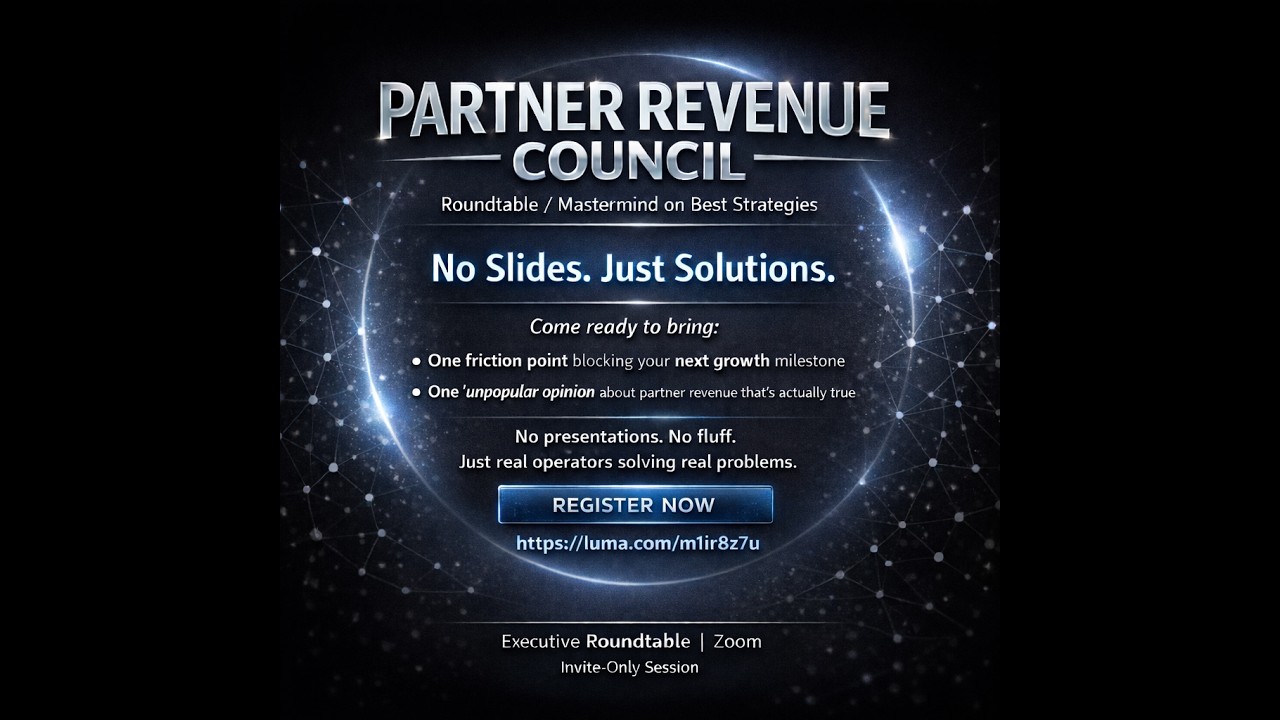
In this virtual roundtable hosted by Michael Falato (GTM Full Throttle), a panel of channel experts—including Craig Booth (Channel Force), John McCabe (Partner Architects), Harold Horgan (Channel Pros), and several guest contributors—discussed how artificial intelligence is reshaping partner programs and go‑to‑market (GTM) activities. The conversation covered a wide range of practical AI applications (note‑taking, prospecting, partner sourcing, content generation, real‑time translation, and revenue forecasting), governance and privacy concerns, the tension between automation and the need for personal relationships, and strategies for measuring and defending partner‑influenced revenue. Participants shared specific tools (Claude, Fireflies, Granola, Codex, Gemini, GTM Heroes, Luma, Crossbeam, etc.), frameworks (System 1 vs. System 2, 100% channel vs. hybrid models), and best‑practice recommendations for integrating AI into partner enablement, operational workflows, and strategic planning. The session concluded with a call for ongoing community collaboration and one‑on‑one networking.
Chapters
Here he is. Here's Harold.
All right, let's get him in.
Yep.
I don't see— I don't see my note taker for some reason.
I've got my own going, so no worries.
Okay.
By the way, John, good to see you, brother.
Yeah, you too. Been following all your posts on LinkedIn.
Yeah, we should, we should connect, man. I'm, uh, putting a big effort into getting a SaaS platform built right now, so I think I've got something. Hopefully it's gonna look pretty good and unique.
Yeah, Jeff and I are still interested after we had that demo a couple weeks ago.
Yeah, I'm gonna uplevel all of that, um, so I've got some really cool stuff going on in the background. So we'll see, see where it ends up. But, uh, but I, I think there's a place for what you've got and what I've got and how it sort of fits.
I like to Let's let's use the turtle talk for.
Yeah, yeah, I got you.
Don't be it. Don't be that guy.
No, no, no.
We haven't got started yet, so we're good.
We got started. They're like we're letting people in power. All right. Hey, tough guy.
Come on. I got you. And Harold's on. I like it.
Yep.
So we're gonna get started here in a couple minutes. We're just letting folks in. Um, but there's a couple couple things we just want to let you know. Feel free to put any information you want. In the chat, right? Like who you are, what you do, why you joined, you know, your LinkedIn, your email, yourself, all that stuff. But we don't want a bunch of people pitching their products in here. That's just a no-no. So we'll, we'll have to stop you if someone keeps on hogging time, then we're gonna have to boot you. We don't do that too often, but, um, and then if you do have something you want to engage or interact with, Try to keep it under maybe 90 seconds because a lot of folks—
I—
we want to get everybody in here. We're gonna have a huge room today of people, and people go on and talk for 3, 4, or 5 minutes and then they start repeating themselves. It's not a good look either. But, um, today we have 3, 4 people that kind of put this together with me. I'm personally Michael Falato. I'm at GTM Full Throttle, which is, uh, basically a lead gen, uh, automation company. I'm That does email, LinkedIn, roundtable masterminds, and all this stuff for top of funnel. Um, we got, you know, introduce these guys, then it could go. We got Craig Booth from Channel Force, John McCabe from Partner Architects, and who was the last one?
Harold.
Harold, where are you, Harold? I lost you on the screen. There you are, Harold, Oregon. Um, and basically these are the 3 partner guys that basically brought all these folks and from all the different walks of life. So I just want to thank all 3 of them for doing this. Um, obviously I'm your host as well and put this together. Um, so Craig, why don't you introduce yourself and tell, tell us why we're doing this today?
Yeah, so guys, my name is Craig Booth. I'm the founder and principal of Channel Force Incorporated. Uh, first, Michael, I want to thank you for putting this together. You always do such a great job hosting this. I think this is a, a community opportunity that is missing in in the channel today. So the ability for folks to come together, crowdsource ideas on how to solve some of the common problems that we're all facing. And, you know, as Michael mentioned, we have John McCabe and Harold Horgan with us, 2 phenomenal guys also that bring a lot to the table here. But again, this is really about you guys, and it's about how do we come together as a community, how do we help solve common problems together.
Go ahead, John.
Yeah, thank you, Michael. Again, thank you for putting this together, and Craig, thank you for kicking it off. John McCabe, I am CEO and founder of Partner Architects Group. We specialize in fractional channel executive consulting services for cybersecurity startup companies. We work with them to build out a framework and enact upon that framework. Looking forward to this session today because I invited a lot of people that I know who are in sales or channel to share knowledge. There's no scripted outcome for today. It's just a bunch of executives who are getting together to talk and share insights. Looking forward to it.
And Harold.
Yeah, Harold Horgan with Channel Pros, and I've just been doing channels for 30 years, so really deep understanding, and I'm a really big believer in collaboration, people sharing knowledge, And I'm hoping that's what we'll be able to do today.
So Craig, why don't you kick us off with some of the questions? And then, I mean, obviously we wanted to, to answer them for it. And so, and then hopefully everybody can raise their hand below and the react— no, I'm sorry, not the react button, but the one next to share. You'd be able to raise your hand and interject. But we have a couple things we kind of want to basically put towards the roundtable and then you can get some feedback. This is a Cohort, open chat, no one takes control of the whole roundtable. I'm moderating it, but we got Craig, John, and Harold that are basically the subject matter expertise along with you. So go ahead, Craig.
Yeah, I think we'll just start with kind of one, one general question, and I think we'll take it back to John and to Harold as well with specific questions. But I think one thing that everybody's challenged with today, we're all kind of scrambling around right now, but it's how are we leveraging AI effectively? in our partnering model. So I'll sort of put that out to the group. I know that, you know, we have a lot of AI that's coming in. How much of that is actually being used effectively, I'm not really sure. But I'd love to kind of get people's idea on how they're leveraging AI, what's working, what's not working. What would you share with the group?
So I'm going to call on John. To start this off if we have nobody raising their hands.
Well, honestly, AI is a sweet spot for me and what we're doing and from a number of different ways. I'd welcome the group to give us their impressions, but AI is being utilized in channel in many, many different ways. From my side and my perspective, I utilize it for my CRM. I utilize it for creating the right ICP and right IPP frameworks to bring to my clients and to utilize as a prospecting tool. But I also utilize it for common communications and organizing my workday. I'm just curious to the group, are you embracing and utilizing AI? I love this question, Craig. I love when you brought that up because I feel like if you aren't utilizing The AI that's available to you, you're not getting the full benefit or saving time or making yourself look that much better to your clients and to your prospects if you're not utilizing AI.
What AI do you like? I'm using Fireflies here for note-taking. The Fireflies alone, Just after a roundtable, after a meeting, any note-taker. Hey, could you regurgitate what, what we talked about? What I owe John? What's the key points? How, what, what did I promise him? And what's the next steps? It writes a beautiful message. I, that I would take me an hour to like remember.
I'm a big fan. I, I don't use Fireflies. I use, uh, Granola.
Any of those will work. Yeah.
Yeah. Granola's amazing. It does the same thing. It also has a feature that It will actually give you a synopsis of the calendar day that you have and go through and find any emails or notes or anything that was related to the meeting that you have to bring to the table when you have that meeting. I like Plod. Plod's been an original AI tool that I've used for several years. It does a phenomenal job of detailed note-taking. My CRM that I use right now, Atio, has a phenomenal note-taker as well, but that's not the main tool that I use. I use a tool called Marbleism, which is basically 5 or 6 AI agents that help me in my business. There's an executive assistant, there's a social media person, there's a blog writer, there's a lawyer, there's a receptionist, and they all help me with my day. I can ask them questions, ask them to prepare things for me, and they spit it out and make me look very relevant. So there are definitely tools that I use, but Prospecting tools, I use Claude to basically put together and compile these detailed lists of the ideal customer profile for my clients with the signals for buying. If there's had breach issues or anything that I feed into Claude, it'll pull it out and give me a scored ranking of the ICP list that I can go after and prospect more. You know, in a smarter way instead of just throwing, you know, a fishing line out there and hoping I get a bite.
This is a lot of really good—
We're getting a lot of good comments. Why don't we open to the floor and see how people are using AI? And I'd like to kind of frame it as, where does AI start and where does it end? Because some people are trying to use AI to automate everything. And at the end of the day, partnerships are people to people. So how are people in there around the table using AI and where do you see the limitations?
Let's go to Eric here.
Yeah.
Hey, yeah, thanks. I've gone on a huge transformation journey the last couple of months leaning into AI. I'll try to keep this short, but it's just completely changed the way I work. About 2 months ago, I mean, up till 2 months ago, I was mostly using it like another search tool. Then we hired a new product guy, well, contractor at Functionize where I've been working to help us with a big shift to kind of a new, very conversational version of our product. And I showed him that I was starting to use Claude to build a new kind of revised partner strategy, primarily focused on services partners. He took that and he used Claude with all sorts of inputs to build 3— the next 3 product requirements documents for Functionize, PRD 2, 3, and 4. And then he's like, Eric, what's your feedback on these? And at first I'm reading them going, gosh, how do I, how do I give feedback? And then the light went off and I'm like, oh wait, I took his requirements documents, I fed them into my version of Claude, you know, just trained a little bit differently, where I had been developing a service, a partner, a services partner strategy. And then alongside that, I was starting to develop a technology partner strategy because technology integrations are going to be super important.
Sure.
I had my Claude version interacting with his PRDs and giving him feedback, and we would go back and forth, his Claude to my Claude, and he wound up creating a 4th PRD for the product specifically because of gaps that I was calling out that were necessary in the partner strategies that I was developing. And so that alone was really powerful. And then Google Next was coming up last month. And so I said, hey, given what you know about my partner strategies and who's there, I fed it the list of contacts or of sponsors, you know, what should my strategy be for 3 days at Google Next? And it helped me build like a whole kind of a who I want to go after, who I want to talk to. And as I was going to every meeting, I'd say, okay, give me the elevator pitch for, you know, this company, for PwC or for Deloitte. And so it'd give me an elevator pitch, 2 paragraphs. I'd read that, I'd go in and have conversations. I'd give it verbal notes afterwards telling it how the meeting went. And by the 3rd day, as I was getting ready to hop on a plane and go home, I had a 14-page report on the Google Next conference with industry trends, Big big announcements, all this stuff.
You should definitely check out basically Claude helped build this called GTM Heroes dot AI. GTM Heroes dot A. It takes the LinkedIn, the disc, the disc background, the personality, what people. Hi there, it's Mr. Vander Zee. Check out my new single, Do Me Right, on YouTube.
Whoops.
GTM what?
Heroes. GTM Heroes. It's a friend of mine that built it, but it's like all that prep work you need to do when you're going to talk to someone. Don't have the same playbook and same deck so that you're going to be pitching it the way you want to pitch it.
Yeah.
It was pretty brilliant done. It's still almost— it's like 95% there right now, but it's a thing that I use every day right now. I'm actually his test case. So that's one of the things that I like about it. But there's also—
G-T-M-H-A-R-R-O-W-S?
GTM Heroes.
Oh, Heroes.
Yeah, Heroes.
Put the link in the chat.
Yeah. So that's definitely— we'll go to David and then Lloyd and kind of go from there. But there's also a thing that I wanted to bring up with this whole partner approach that we That Craig, John, and Harold put together too, is there's all these people that you have as trusted partners. And that's kind of what I did with Harold and John and Craig is that I took their LinkedIn. We said, listen, we're doing this partner approach together. Why don't we team up? Just like you would at an event. Maybe let's get a dinner together. Let's get some 5 people together and let's take them out. Think about who you know that has the same people you're selling to or that you want to partner with, and take those people that they're connected with, just like we did with them, and I automated theirs and said, hey, we're doing a joint roundtable, do you want to join? Right? I use Luma to have you guys, uh, register. Use that as a way to build your own partner program, either with me helping or these other guys telling you what we did, but It's a great way to get those sales approach without having to do one by one by one. David, go ahead.
Hey, everybody. I'm a little bit also focused on the technical side, and I think there's a massive amount of optimization and productivity on the alliance integration piece, not only between technology companies but also between MSSPs and technology companies by utilizing this technology to essentially get away from some of the old ways we did things, giving static documentation, giving access to APIs, and moving into a Markdown language context. We have completely been able to transform the way we work with partners in order to create opportunities in the form of messaging and documentation, as well as, of course, integrations by providing Markdown as opposed to more static information. Really transformed the timelines like we're seeing partners be able to build stories and integrations, moving that timeframe down from like months to weeks or even days. So there's a go-to-market component that we're absolutely tied into, primarily on the pre-sales motion in identifying opportunities, but also identifying gaps. And part of those gaps are being filled with this, this AI-accentuated productivity suite. And part of it is being, you know, doing some of the stuff you guys are talking about.
What are you doing?
Creating those, Yeah, sorry.
And what do you do, David? So when you guys say something, it's just a real quick kind of commercial, like, hey, I'm David. Yeah, sorry, co-founder of this company, and this is why I'm— this is why I'm answering.
So yeah.
Yeah, you bet. Uh, so I've been in IT for 28 years. I'm the Vice President of Technology Alliances at Netskope, which is a cybersecurity company. Okay, so everything you guys are saying I love, except There's so much concerns about sharing customer proprietary information using these systems that a lot of what we've been doing inside our company is focusing on pre-sales, non-proprietary information, curating and bubbling up opportunities either in the form of tools like Crossbeam or just using CRM-to-CRM mapping tools for opportunity identification. I've been primarily using AI for, you know, You know, things where there's not sensitive customer information. So just understand that's where I'm coming from, because cybersecurity is so sensitive to the way this information is being shared from a privacy perspective, from a governance perspective. I tend to have a slightly different slant on it.
Thanks, David. Another tip for you guys, if you look at John's and Craig's and mine and so forth, we put Dash, the company we're with, right? So when you— we have all these people with great faces, but we have no idea unless we look at the chat who you are. So in the— your, your video box in the top right of that, your own video box, there's 3 buttons. It says rename. Put like Michael and then CEO and then GTM here, you know what I'm saying? Like make it so that we don't have to figure out who, who you are. Lloyd, go ahead.
Hi, thank you, uh, Michael. Um, I haven't updated my name just yet, but I'll do it verbally. So Lloyd Smith, founder and lead at Wahoo Learning. I've actually got 2 points. One comes back to something you said, Michael, but I mean, the first is that, you know, we help— this is not a pitch, just a context. We help get— make partners more effective sellers. We do that through training. And in the training area, we've been utilizing AI for quite some time. Um, in a lot of different fields, but the one to highlight really is with, um, uh, localization, um, and, uh, especially for organizations training— sorry, not training, um, with partners globally, um, and with a need to train those partners. Um, so we're using AI technology to, uh, deliver local language and natural local language, uh, training programs that can be delivered to partners Uh, in, um, in a really cost-effective way. So where, where old way, it, uh, you have to have local instructors, uh, sort of narrating and delivering training locally. Now with, you know, a few clicks, as we're so familiar with, we can, uh, localize training, uh, in a really effective way.
I noticed in, uh, Apple Messaging it could translate like the language. I think you're saying something about languages. But I really haven't found a, like, a Zoom that I can figure out, or Google Meet, that actually, that actually translates language in real time. So if they don't speak English and I don't speak Spanish, how am I supposed to— you guys, does anyone have any solution for that if you're working outside the US in other languages?
I don't, I don't personally have a solution for that at the moment because we tend to deal with, uh, kind of self-paced e-learning more than, uh, sort of webinar, uh, type of training. So The real-time translation that I think you'd be needing in, in, in, in a tool, um, I've not seen yet.
Okay.
Um, probably coming though, because as you say, you know, Apple have got that tool, haven't they?
Let's go, Michael.
Rob, Rob, Air Force hat you got on?
Air Force Academy.
Yeah.
Right, baby. So, uh, Air Force here too.
Oh, uh, thank God for the Air Force.
Yeah.
Um, so you were just saying, Lloyd and Michael, about, um, just from a tactical perspective, I, I'm former Google and Amazon. The Google tools are absolutely outstanding when it comes to Google Meet, when you actually, you can turn on translation in real time. So I have a lot of clients in Germany, France, and Italy. And as we're talking, I instruct them, you can, if you're having a little bit of a time understanding me, even my Italian's a little broken, you could turn on the live translation, and it does an amazing job at doing that. I'm not sure if Zoom has that yet, but I could tell you that out of the box, Google Meet is, is probably one of the better ones that I've used. Um, so I'm happy to share, uh, my experience with that. Just, uh, contact me. I'll be happy to do that. By the way, Harold, hello and thank you for inviting me. So real quick, uh, great, it's been a while. So real, really quick, um, I've actually started Symbologic, um, and formed it out of my last company, Concilix, uh, to actually help the problem that we're talking about in general, how can humans use AI to get their jobs done more quickly?
Mm-hmm.
And I'm not pitching anything, but if you ever wanna know what I'm doing, just let me know. But the tools that we're using on a daily basis is really creating everything local, 'cause I think up to what Brian was talking about, highlighting information that's contextualized and confidential, you don't want to push it into the cloud, especially the SaaS solutions. The way that we've actually been doing is on our software is everything is local, right on your box, and you actually populate your drives and you can then have shared drives to your other teams and you can start dumping in information and start asking it questions. It looks like ChatGPT, Claude, and because the backend is, and I can always go into the cybersecurity reasons of why it's more secure, and we just start asking questions. I'm gonna go see the CIO of this Class 3 medical device company tomorrow. Here's our product set that you're already know in our shared drive. Here are the partners that we work with already. Take a look at the 10-Q, take a look at the 8-Ks that came to 10-K, and then look at the 8-Qs that have come out and formulate for me the agenda that I need to walk into. Formulate the suggested questions of discovery of how I can actually help my customer. And these are my notes that came from my last meetings. And it formulates a one-pager that I actually can hand out to my team and walk right in. Mind blown. We started doing this at Amazon. I ran the global ProServe division for IoT and edge. And then I was at Google. I ran the retail sales management for their new product, Google Distributed Cloud. And we were doing the same thing with the tools there. And I didn't realize that, that there aren't any tools outside of these big companies. So we built it. And let me tell you from a sales perspective, so this is about after you know who you're gonna go talk to and you put all the information together and it quickly saves you time on giving your sales team, your sales engineer, and your marketer exactly what you need moving forward.
Let's go to Badri.
Hello, everyone. Great to talk to you all. I'm Badri Badradian, founder of Hitwit.
Just one more thing. We want to make sure we keep these under 90 seconds so we can get other— everybody in. Go ahead. Sorry.
Yeah. So, yeah, Hitwit is an AI enablement startup. So we build AI agents to do Everything from training to join partners on calls and provide live insights from your product data and so on. What I do want to talk about is I was just at a summit with Ingram and TD Synnex and distributors like that, along with the channel chiefs of AMD and Cisco. And here's what's coming up. When they're looking at AI across in partnerships, There is a good framework that I came across that I thought I'd share. One is to think of this as system 1 and system 2, which is you should be using AI tools. We talked about note-takers and content generators and so on for your own personal productivity. And then second, if you're leading a large enough program, you should think about how, what parts of this you want to become standard workflow for everybody in your company. And the second part is important because that's how you get it to scale. If you have found a good method to do something, let's say for example, you found a good way to network with people at a conference, do you want that to be part of everybody's workflow? Or is it just the thing that you have unique context and insight? That's one key thing that came up. The second thing is a sort of a warning about AI content generation. It's great, but it's great not just for you, but for everybody else. people are sick of getting 10-page summaries of things. So when you're generating something, make sure it has 1 picture and 5 bullet points, and that's that. You'll actually stand out by doing that. So it is one of those interesting parts of the times we live in.
You wanna tell your AI, like, make it readable for a 5-year-old and keep it under 500 words or whatever you wanna keep it, make it the bullet point or something.
And truly personalize it, right? I mean, think about what an executive needs is very different from what a partner sales engineer needs. And just tell the AI that, but ask it to be brief because these agents are not, they don't understand brevity is the soul of wit.
Yeah, Melanie, go ahead, Melanie. You're on mute.
I should unmute myself. So I'm Mel, former Microsoft, former MasterCard, and then several startups. Novice in the partner space, more than 30 years. I like what Badri said about the System 1 and System 2, and I was a little bit puzzled by how the conversation is going. We can list tons of AI tools, but we also have to put the right content into those tools. So to have a solid partner strategy is where everything starts. And AI is super helpful, and we use it as Mastercard and with Microsoft, of course, obviously heavily to create partner pipeline and went through the whole lifecycle to partner readiness and everything that we talked about. But where it is challenging to use AI is still for the true partner strategy, channel conflicts, for which, for what channel do I want to use my partners? Do I want to use channel partners? Am I looking for development partners? Am I looking for the MSIs? How do I treat them differently?
Hmm.
And there's no real extensive, at least not that I know of, I would like to get the feedback, tool out there to create partner strategy. Of course, you can use Copilot, Claude, ChatGPT, to help you develop that for your individual situation, but there's no industry standard that can really be fed with AI that is building your partner strategy. And I think that is where we probably are all needed in order to feed the tools the right information or build the tools that are not out there yet. And this is where the whole partner lifecycle starts for me, and would love to hear your thoughts on it.
Before we go to Brian, like, does anybody have any Thoughts on what Melanie said? You raised your hand, just physically.
I think, and thanks, it's a great point. I mean, I don't think it solves the strategy side of it, but most of my work's been done in the customer experience space, and so there's been this rule around automation and AI and customer experience that it starts with a great knowledge base of what works. And so as I move into a role focused on the labor side of the equation, the same is true, but it comes through a managed and curated ecosystem of all the partners that we work with. And so where we've applied AI is taking all of the knowledge around performance and compliance and geography and staffing of those partners and then using AI to produce better results. on partner recommendations. And so what used to be a very manual process in response to requirements, we've now used a combination of Gemini and Notebook to produce those results more quickly and with higher quality. So as I said—
The Gemini has really been interesting for my decks. I kind of like— or for— they made a podcast or like an interview on Gemini Notebook. It was amazing. I'm like, this is nuts what you can do on that one.
Yeah, Michael, just a point on what Mel said. I think, Mel, you hit it spot on. It's, it's, you know, garbage in, garbage out, right? And I think one of the key things here is also Bree mentioned, uh, Badri's mentioned, is, you know, it, it, it— these models are meant to make us happy, right? So they think that giving you more, uh, is better. We all know Less is better. So one of the things that I use the AI for, and this goes to Joe's point, is about leveraging metrics. So we're actually in the process of cleaning out one of our partners because of poor performance for pushback. And one of the key things is linking in the, the data coming in to make decisions. And the problem with linking in numerical data is that LLMs hallucinate numbers. So you need to actually connect into your Power BI and your other networking analytics systems, or even just put in your spreadsheets, right? And ensure that the subsystem that the LLM is talking to can give you the real deal. Find connections on why certain things are connected that are making these results for, and that helps the strategy. But at the end of the day, there's no replacement for experienced people.
Thanks, Rob. How about Brian Howard?
Hey folks, thanks for having me on. Craig Booth, thank you for inviting me. Um, I just accepted a head of channels role actually today. Congrats. Thank you, thank you, appreciate it. For a company, uh, called UpGuard, which is cybersecurity related. Uh, having just left NetBrain, um, about 10 weeks ago. But I actually had to do some— a fairly robust presentation, uh, as part of this job interview. And I used a tool by ChatGPT called Codex, which runs on your desktop. And it's not just for coding anymore. Claude has the same thing, by the way.
Mm-hmm.
Um, but you download Codex or, or Claude. And what I had to do was I had to, you know, create some assumptions about the partner program and, and, you know, several different campaigns I wanted to run. in this new role. And it was able to— I literally just told Codex, here are the different slides I have. It connected to my slide deck, by the way. It also connected to Excel on my desktop. And I said, here are the programs, here are the inputs, here's the ROI that I expect from these programs, and here's the time to close of the company. Here's the average sales cycle of the company. I was able to almost effortlessly create a 1 and a 2-year revenue impact from the partner program that was very honest and very conservative. conservative, not overselling at all. I tend to— Craig knows I tend to be a little on the conservative side with my projections, and I really blew him away with, you know, frankly, I got to think about the creative side and the campaign side and the execution, and then the math part got to be done for me. So Codex is great. It'll work with your existing tools on your desktop. I also did use it to do real-time web search of G2 Crowd and to look at the reviews of UpGuard, to look at the company names, the verticals, company sizes, to get a sense of, you know, what is— as a software vendor, what, you know, where are their customers, what's the target vertical? Also, what were people saying in those reviews? All that was done from desktop using my normal ChatGPT subscription. And so that's a couple of types of analysis. So I think one of the things that you can do is you guys can focus on your expertise and your creativity and have these tools, and especially Claude Cowork and Codex, because they will use your tools on your desktop. But to do robust projections and analysis and vertical analysis and, and turn your idea and your campaign into actually ROI projections. And then if you, if you need to tweak it, you can tweak it and it redoes your slides and it redoes the underlying spreadsheet as well. So happy to send— it's not really particularly private— happy to send an example of that to anybody. But I recommend those tools and those approaches to turn your creativity into numbers.
Thanks, Brian. Yeah, Claude has mentioned almost every day to me for some reason. I've been using it more and more, but I'm like, I just said, hey, can you make a website for me? Because I'm changing my company from Full Throttle Flood of Leads to GTM Full Throttle, you know, and like it just popped out like a much better website than I can do. Uh, Vijay.
Oh, hi. Uh, thank you, John, for inviting, inviting me for this program. So my name is Vijay Venkatesh. I am— I represent— I am from India. So we are into one of the oldest space still struggling in the world, ERP solutions for the manufacturing industries. Okay, so the traditional softwares with the 75% failure across the globe, so we are talking about 95%, you know, success rate in our software today. We focus on the SMB market.
Let's focus in on Like what's your opinion is versus a pitch?
Uh, uh, see, I'm just sharing here because it is still, uh, relevant for the, you know, market what we do. Then, uh, I would be very happy to, uh, receive some kind of, uh, you know, feedback from, uh, this team.
Yep.
Uh, so, uh, the, the difference what we are making here, uh, specifically is about the success of the product to deliver value for the customers who are investing money on ERP. That's a business what we actually do. So, uh, so this format is new for me, so I am here for the first time. Probably, uh, for the following weeks when I, you know, for following months when I come and attend the program, we'll be able to get the sense a little more. And regarding AI, so we are wrapping AI around our product, and that is what we are currently doing because most of the customers are looking for predictive analysis and they are also looking for dashboards for, you know, immediate decision-making. We already started that effort, you know, that is what we are doing now, Michael.
Let's go to Harold. Go ahead, Harold.
Yeah, we're talking a lot about how AI is being used to develop content, develop strategies. That's all upstream of the partner management, and I'm a little bit nervous about the companies that think they're going to use AI to fully automate the partner management. And the holy grail for, for a lot of vendors has been never having to talk to their partners, that they can do, uh, everything can be automated through the partner portal. Uh, and now they're taking a step further, saying, well, great, now we have AI dealing with our partners. Uh, and partners want the, the, the personal touch. And so I'm wondering if anybody is using AI or what you see as either the opportunities or the risks of using AI downstream in actually interacting with the partners and trying to get the partners to engage.
Let's go to William.
Yeah, so William Stevens, MorphSec. As far as going downstream, working with the partners, I think it's in general AI is a useful tool to help speed up how you are operating and working in a day-to-day world. It's not going to replace Your ability or your mind on how you're going to use it. At the end of the day, what channel is going to now be is it's going to be project management and how we're going to actually operate with AI and then working with our different channel partners to be able to go and expedite growth or to compound those efforts. Some of the conversations that I'm having with partners is I'll actually use Cowork and create automated text messages going out to all of our partners. It's on a— I randomize it so it's not the same time every single day. But it's just a way for our partner team or even sales reps to just check in with somebody, say, hey, how are you doing? Hope everything's going well. And if you're having a couple hundred different partners you're working with that you have those relationships, it saves an astronomical amount of time. Then you can go on the one-off, but at least it's constantly there and you're staying on top of it.
Uh-huh.
Because if you go week to week to week and somebody forgets and then forgets and forgets, it keeps progressing on you being able to go and stay on top of those types of reachouts. And then we're trying to create a way of actually helping the partner where we're creating a project and a landing page for them to go and send in who is that customer they're meeting with. And the data in, data out is the most important aspect for the AI. I think there's actually been a couple of reports. There's some VC companies and others that leveraged AI to generate a lot of different reports, documentation that they were sharing with the board, and all of it was false information. So you have to make sure that's clean. It's the same thing as Salesforce, right? It's clean data in, clean data out. And I know Salesforce is always a headache for a lot of people, but making sure that you check it first, test it, go through a few iterations because it's going to take time for refinement.
Uh-huh.
And then, um, so when the customer is actually going and submitting, the end customer, we have fully generated executive briefings as well as playbooks that get automatically sent over to them so they don't have to wait on us. They can initially qualify the opportunity and pitch us, and then we can get looped in if there is a nibble on, on us to be able to be kind of the, the person to walk them through the solution itself. So it, it doesn't necessarily take us out of the equation, but it helps them to be more empowered in having the initial discussion point, especially when they're juggling 700 different vendors.
Yeah.
Thanks, William.
Thank you for that, because I think you're using AI very specific way as everybody's been detailing here. But I like the way you're thinking. And I also think everybody needs to stop worrying about, is AI going to replace your job? And in sales and channel, that personal interaction, face-to-face interaction, is still a critical part of what you do for your job. So I appreciate what you outlined there, William. And it's good to see you too.
Why don't you— I put a couple other questions in, John. Well, actually, we'll go to Latif, and then why don't you read off the next question after we get done with Latif?
Okay.
Yeah, can everybody hear me? I hope I'm off mute.
Yeah, we can hear you. Okay.
All right. Well, apologies for joining a little bit late. So I just wanted to— I'm just going to continue on the conversation about AI and this concern that AI's gonna take over our jobs and are we putting the right guardrails around AI? Our philosophy at Partner Assistant is very much, we've built an AI assistant to really help you with all the busy work, the 2 to 3 hours a day that you're sitting in front of the keyboard, whether it's deal registrations or responding to a question from a channel partner or a cloud service provider about a certain deal so that that frees you up then to do the real value-added stuff, you know, the relationship building and the, you know, building new sales plays and QBRs and all that good stuff.
Yeah, so we definitely want to talk about like, um, the things that you feel like you've, you've won or lost, or you, you lost and you learned. Um, so that's where we really want to focus in on, um, versus people talking about their products and solutions. If you guys want to do that I, you know, I, I— it just turns into one big pitch fest, and I don't know.
Yeah.
Turn this into— so I've asked, please, um, if you're going to mention yourself, introduce yourself, but say, hey, here's what I've learned, that has nothing to do with your product, because then it sounds really bad, right? So I've kind of mentioned a couple times, I just want to be very respectful to the guys that are, are in here to kind of learn as well. So let's go to John.
Yeah, so I know we're kind of bumping up against time, and I think this is a really important question for the group. How are you effectively tracking, measuring, and defending your partner-influenced revenue to your leadership, especially when you're talking about you're heavily impacted by deal reg and partner-influenced opportunities? How do you go about influencing that and defending it?
Yeah, yeah, I was passionate about that question. I was just trying to type my answer, but it's so difficult to keep it concise. Definitely, definitely, it's a great—
for this, uh, because the text is great for just information, but if you have a good answer, feel free to, you know, talk.
Yeah, I mean, I'm not sure whether it's a good answer because it's just a very good question that I haven't fully solved yet. Specifically, when you think about I think we have solved it good and well for providing partner ROI, for partner-influenced revenue that can be defined. There's tons of KPIs, happy to share those as well. What is challenging is what you mentioned, deal registration and channel conflicts also, and specifically with the direct sales channel. So as long as the company has a dual-channel model, so they work through the channel and they work through direct sales team, you often end up double-counting revenue and that makes your numbers very unreliable. So when you go back to your CEO and say, oh, this is my partner-influenced revenue, and he says, I can't add that to my direct revenue because this is not adding up to my total revenue. There must be an overlap. This is a Venn diagram. Don't show me the Venn diagram. What is partner really bringing me? Often led to conversations of we have to shut the channel down.
Can I interrupt you for one quick second? I've seen that scenario before, but are you aligned with your sales executives, your sales team, And making sure your CRM and your PRM kind of match up, or your partner, you know, sourced matches up to the deals that are actually in flow that are, you know, tracking to close, because that's where you see the mismatch, that the partner deal might come in at like $500,000, but in reality, it's like $200,000, right? Are you matching that up?
So we try to— so this depends on the size of the company. We were not that well aligned, let's say, in the size of the Mastercards and the Microsofts, softs. I had the chance to well align this in the startup community. And when you really build up a partner ecosystem and you build it up from scratch with your direct sales teams, I think you have to start at the legal contract design phase already. So when you sign up a new partnership, the definition of what is the revenue delivered through this partner and what is the definition of that revenue and how is it distributed in the geography, maybe per the vertical and industry. So we had models, for example, where we said for manufacturing, we are just selling through the channel. So all manufacturing revenue is really channel pure revenue, if that makes sense in your setup for the company. And those definitions can be defined at contracting phase already. And then, then it is clear and then it is easy. If you go in an existing big, large corporate partner model, it is extremely challenging. And I frankly have not found a solution to— Mingle this all out perfectly well.
Does your company invest in like a PRM solution, or is it just a CRM and you're managing partner deals through spreadsheets? Like, how are you, you know, tracking it?
So I'm right now company— I'm not working for any big company. When you asked me, it was recently with Mastercard. This is of course driven by a CRM solution, own developed agents, the help of developer partners that provide solutions, and it's mostly in-house, and it's very fragmented, and it's fragmented by the organizational chart, right? So if you have industry leads, then you have maybe a very solid solution for telcos, but you don't have a solid solution for the manufacturing space, but you do have partners that are operating globally over those 2 verticals, and then all this beauty doesn't really So again, yes, that works in a smaller setup. For the big corporate organizations or the larger organizations, it's really rough.
Yeah, I wouldn't disagree with that. But what about some of the other attendees here today? What are you using to justify your partner revenue to the sales executives and the senior executives?
Yeah, I was just going to add, I agree it's an open issue. and rather than offer a solution, just compound the problem a little bit. As we try to influence more deals across the channel, you now have the measurement of implementation partners, referral partners, tech alliance referrals. And so where I see it show up most frequently is on the compensation side. And so as organizations, larger organizations really want the channel to work, I think they need to focus on how they incentivize all the people aligned to the channel versus spending so much time on the measurement until there's a more elegant solution.
Yeah, and let me jump in real quick on this conversation as well. So what everybody's really pointing out is the need for more of a structured way that we go to market and how we align channels, marketing, and our direct sales teams together around territory planning. The problem that we've got is everything we're talking about is opportunistic partnering. That's why we've got all these issues. We don't know what's sourced, what's not. But we can get down to where we're really planning revenue. So let's say a territory account manager has 100 accounts. Why aren't we assigning marketing to those accounts, partners to those accounts, the direct sales team to accounts? Now we can solve that partner-sourced revenue or the— you know, marketing source revenue or direct sales source revenue, because every account has a plan, an engagement plan associated with it that follows that revenue back. So I think there's a tip of the spear approach here, that it's really about how we structure performance and align marketing channels, sales around a common go-to-market strategy. That's what's really missing.
Yeah, I wouldn't, I wouldn't disagree with that. I think David Willis just really made a great point in the comments here about, you know, running all business through the channel. I'm just curious, because I'm a big promoter of 100% channel and utilizing the channel to grow pipeline, especially when you're a small company. But even when you're a big company, there's such a key importance to having all your business going through the channel. And I think that helps to alleviate the question we just asked about defending your revenue. If you have everybody in line with channel running or business running through the channel, there shouldn't be any question about defending your revenue. You should have alignment on that revenue. Is there anyone in the group that has that methodology or that strategy for their company?
I imagine many of us are Working towards that, but getting there—
It's not easy. I'm not saying it's easy.
Yeah, getting there can be tough. Um, I made a comment earlier on this too. Relationships in almost all circumstances have a huge impact on this, right? If I, I usually try to focus a lot on developing relationships between the partner sellers and my sellers, because if they have a relationship and they talk They're a lot more likely to agree on influence, whereas if they are just ships passing in the night sort of thing and there's no personal relationship there, then, you know, that question of influence becomes very risky.
For sure, for sure.
Yeah.
William, did you have a comment also?
Yeah, I think you're spot on. So, I mean, starting an organization off Going 100% channel is going to be very important. Just the way I've seen it when talking to a lot of different value-added resellers, especially in the cybersecurity space, they will not work with you— apologies— they will not work with you unless you are almost guaranteeing that you're going to run it through them. They have the likes of CrowdStrike, they have Microsoft, they have all the big players. That is going to create a lot of their profit margin. And so they know that they're almost having to buy for it because they want to try to go and get, get a cut of that revenue versus others. If you're looking at some of the large nationals, I think 2 of the large, big large nationals have around 800 different vendors. And the only way to differentiate yourself is profit and the margin you're giving them off gross profit as well as are you willing to push all your chips in? For us, it was a little bit difficult because we were a historically 10-year direct company. And when I came in, I transitioned it to 100% channel. We're in that transitionary phase right now because you have a lot of multi-year deals that have to transition. But to be able to do it, you have to get board approval, executive commitment, rep alignment, and make sure you have those rules of engagement in place or in that report.
Yeah.
And the big thing of it is you have to prove the model, right? So not only are you getting more deals, but are you expediting those deals that you currently have? Because the channel influence is sometimes hard to measure. So can you reduce the time to close and can you increase the deal sizes, which we've been able to show?
Yeah, yeah.
No, that's a great point.
Now, one thing to keep in mind, if anyone here is not familiar with Jay McBain, then shame on you. You should be familiar with him because he's like the guru of channel and ecosystem. He has said on numerous occasions, each customer you are trying to penetrate has 7 to 9 different partners that they work with. So if you think about it in context of what we were just talking about, if you aren't committed to channel and you're trying to reach a customer that has 9 partner relationships and you want to go direct, you're probably not going to be very successful. But if you embrace that channel-first mentality, 100% channel, and William's spot on, executive alignment, board alignment, everybody has to be on the same page, um, you're, you're going to be missing out on opportunity. So I just wanted to make that note. Rob, you had your hand up as well there.
Yeah, so one of the things, um, I've done startups for a very long time as well, and this is a new startup that we're in, and what we're realizing is I have a— I have several people on my team like, let's go all channel right now versus let's go direct. And I think one of the, one of the key things is if you're not ready for the channel, it could wind up And this is a question now. Could it wind up just being a spin your wheels, right? Where you could have spent a lot of time with just getting your directs up and running. What I mean by that is you need to be prepared. We're talking to Amazon, we're talking to Google, and they're making particular statements of if you want to get into our marketplace, you want to actually get into our our our product sales and. piggyback off of them. Do you have X, Y, and Z? I anticipated that and I said, no, we're not ready yet.
Right.
So I think it's a balance of depending upon your— the age of your company, right, from a startup all the way up to a seasoned, experienced one, is you got to be ready for it. Because if you're not, you may be winding up spending a lot of your time spinning your wheels and not moving the ball forward.
Yeah, great point, great point.
How about Melanie, you have your hand up again?
Yeah, just real quick. I think it depends also on the product you are selling. If you have a very high complex product that is a very high-level IP, you will never be able to go 100% through the channel. You will have direct sellers in the mix and there might also be, so for example, I worked for a startup that provided spatial measurements. They developed hardware for doing that. Really hard to get the partner readiness and the ROI to create, took years. And you have to have a distribution over those too. So it's not— I think it's not that black and white as we are discussing it. And I wanted to throw that out there. And you can always make this diagram— the complexity of the product, less channel you can use if you have a higher complex product. The simpler the product is, it's just a simple SaaS application that is— You can go 100%.
I would argue if you had implementation partners that you could train and make expert on your product, you could push everything through them, right? And there are specific service and implementation partnerships that you can formulate, right?
It's a question of time. Yeah, very true.
Make a digital twin. That's what I do.
Yeah.
Make a digital twin of everything I know. Let's go to Chris. Chris has something to add.
Yeah, Chris Lefler. This is my first meeting. I've done strategic and product partnerships for Indeed and Expedia. And from my perspective, I liked what Melanie was saying, which was around the spectrum of complexity to simple. I had a different spectrum to look at. The way we run partnerships at Indeed has been around if it's bespoke or custom, it's almost all human. My team, myself managing the relationship, doing the initial prototyping. But if it's something that can be automated and scaled, so partnerships at scale, standard workflows, standard steps, we try to automate that or use AI to help people through that process.
Right.
Help our new partners go through that funnel. faster than we used to. And that is where AI has been much more effective at shortening the partner sourcing, development, and execution to launch workflow for us. That's probably true for others, I would imagine.
Is that right?
Great point. Very good point. Yeah.
Yeah. We have about 4 minutes left. I'd just like to say thank you for everybody that joined.
Yeah.
We're doing this every month. We want to make sure that everybody kind of engages, interacts, refers business, hopefully sets up subsequent conversations with each other one-on-one where they can talk a little bit more in depth about their product and what it does and the solution or how they— or just advice. But we just want to make sure that, you know, these things are definitely for us to kind of engage and talk about Practices, strategies, tactics, and tips. And then the, the one-to-one stuff, let's, let's definitely use your LinkedIn, use your email, and connect. Um, I'm doing this selfishly just so I can make more relationships and partners because I know how to expand the whole partnerships using automation and bots and roundtables and masterminds and stuff like this. So thank you so much for coming. Frank, did you have something to say before we— We jump off?
No, just same, same thing. Really appreciate everybody taking time. This, I think, is a, is a really important cohort that it's free, it doesn't cost anything. We get a chance to network. Again, great discussions around AI, great opportunities to learn from one another. You know, as Michael said, I highly encourage everybody to continue the dialogue after the fact. There's a lot of great tips. I got 3 or 4 people that I wrote down that I'm definitely going to be reaching out to share some ideas. But across the board, fantastic. And again, Michael, can't thank you enough for putting this together and sponsoring this. And as always, between, you know, Harold and John, a really good group of folks that are real experts.
So this is great.
Thank you, Michael. Thank you, Craig and Harold, for joining and everybody who participated. Appreciate it.
Yeah, we're—
thanks.
I'm sorry, this is going to be also on my YouTube channel, the whole video of today. Um, did everybody get the chance? Did Harold get the chance to say goodbye? Go ahead, Harold.
Yep.
Thank you very much, everybody. That's a great conversation.
Bye-bye.
Really good exchange of ideas on a cross-section of topics. So thank you.
And then Frank had his hand up real quick, so I want to make sure if we could get— give him a second here just to say anything.
Yeah, I think it's like after, after we closing up, maybe pick this up, uh, next time.
Okay.
I just had a lot of more, for me, very operational topics, strategic. Agree with Melanie. A lot of things has to be in the strategy and partner program for itself. I think general conflict, uh, I have implemented already a lot of good ways to avoid general conflict. And also for forecasting, you can do this just through operations, which one gets counted into forecast and which one not, based on what. And then AI is on so many topics, but to close it up I think what I see is that it frees up the time for people so they can focus on being a person again and just being a personal relationship. So that's actually what at least our salespeople appreciate, that we take off a lot of the operational part through AI, and finally they can go back and talk to people.
Maybe next time more.
I was a little bit late on that. Thanks for your time.
Great.
Guten guten night.
Good night.
Na bent.
Hasta la vista.
Bye bye.
You.
Thanks everyone.
Bye bye.
More from Michael

Full Throttle Leaders Podcast- Laura Fu is a (GTM) leader, author, and revenue systems operator




Full Throttle Leaders Podcast- with Gwen Lafage, VP Marketing at Sinch, on GTM

Full Throttle Leaders Podcast- with Spencer Ricks, Head of Marketing at BoxHouse




