Roundtable - Full Throttle Falato Leads 3 27 24
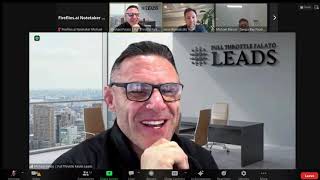
Michael Falato hosts a roundtable of entrepreneurs and agency owners sharing lead-generation tactics and business challenges. Participants discuss LinkedIn outreach, event scraping, webinars, and referral incentives. The group focuses on practical strategies for B2B lead acquisition across industries from mental health to blockchain.
Chapters
Hey Jesse.
Hi, how are you?
How you doing?
I'm doing well. Nice to see you.
See you.
Hey Omri, you're on mute.
Hey Michael, how you doing?
Good morning.
How you doing? Doing good.
How are you?
Good, good.
Just letting everybody in and we'll get started probably around 11:05 Eastern.
All right.
Hi, Michael.
Yeah, I'm right here.
Hello.
Take off your, your background thing. This freaking me out. Hey, Jeremy.
Michael.
Hi.
Long time.
Yeah.
How you doing, buddy?
All right.
Doing good.
Yeah.
A whole different Michael.
That makes sense. I was like, Jeremy, I didn't know we knew one another.
Yeah.
Michael, how are you?
You're his biggest client. We're going to get started here in a little bit. Just making sure we get everybody in here. Jesse, is this your first time?
Yeah, this is my first time. I tried to— you sent me the invite a couple, you know, few weeks back, but I wasn't able to join previously.
Where, where you from?
I'm in Brooklyn.
Brooklyn, okay. How about you, Michael? Tampa Bay, I guess, right?
Correct.
Yeah, see, Michael has the right idea. I have the right idea. You've always put your name and then your company, so We can figure out who you are. Barry Cohn, it puts a little publicist and publisher. So definitely a good way to change for any call you go on for like these types of things so people can get a sense of who you are while they're waiting to talk. But we, what we usually do is introduce ourselves, talk about some best practices. That you've learned, maybe something that you're working on for 2024 that you might want to kind of ask the crowd, hey, what do you think of this? How can you help? Or what's your feedback? It's kind of a sounding board approach as well. Let's see here. Omri, you got to fix your background. Let's see the car here because it's You— half your body's being dysmorphic. So, hey, Eve Valentini?
Yes, hello, Evan Valentini.
Evan, yeah, if you want to put your name in, in the, in the, in the, in the window, kind of like what I have for me, so you could tell— so we know who you are, what you do.
Yeah, yeah, let me work on it.
But yeah, everybody can put their, uh, their, um, signature data like Barry just did. Um, I'm gonna do that as well. That'll kind of— so we can basically refer business to each other, or at least reach out and network and stuff. So that's mine. But we're going to get started here in about a minute or two. Hey Lionel, is it Lionel? Forgot. You've been on once, I think, right? Chief eating officer. I want that title.
It pays dividends sometimes in ways you don't want.
So we're going to basically get started here. We're going to say who you are, what you do, what brought you to join the roundtable today. There's always some reason why you joined, right? And then some, like I said, something that you're working on for Q1, Q2 that's— that maybe we can help you figure out. I always like to kind of give tips and tricks as well. People find things that are going on that are like, oh, this is a great thing to go to. Here's a good tip. So I'm going to start just so you guys can see the cadence, especially for the new folks. But please also put your information in the chat. But I'm Michael Filato. I basically founded this group, um, a little over a year ago. I've been doing lead gen for 25 years in sales, for 25 years. In the last 3 years, started full throttle, a lot of leads, and basically have grown to about $80,000, $90,000 a month in revenue by just doing a repeatable and scalable approach on email and LinkedIn, and then doing these roundtables for my clients. So not just kind of a general one like we're doing here, but really kind of a focused approach. So that we're not inviting people to get a, get a, uh, an email from me. It's about selling them leads. I want to try to figure out what's going on before I start selling things. So I think roundtables or just doing discovery calls— the way you write the emails should always be: who cares, so what, why are you writing this to me, how do you help me, and who have you done this for?
Fear of missing out.
So if you can tie into here and here and help write the content, I'll always be helpful to help with that. That's a good thing. I live in Orlando, 2 kids, and I was an Air Force veteran and black belt in Brazilian jiu-jitsu and Muay Thai. So that's a little bit kind of how you start out, who you are and what you do and why you join and so forth. Make sense, guys?
Cool.
Let's go with the new folks today. So we're gonna go Jesse, Evan, and Michael. And then I'll add some more people after that. So go ahead, Jesse.
Sounds good. I'm Jesse Resnick. I'm here in Brooklyn, New York. I've been in the marketing advertising sort of, I would describe, sitting in between your creative services, brand strategy, technology, and entrepreneurship pretty much my whole career. My agency is called Experience Interaction or EI Digital as we go by. And we have full service creative technology and marketing teams and we basically build, you know, work on retainer across those services, building customized teams to service clients. Our clients include folks like José Cuervo. We work with some PepsiCo clients, but we also service small and, you know, mid-sized businesses, startups, again servicing them similarly. We have a lot of B2C experience. We've done some B2B as well. And we have pretty deep experience across spirits, food and bev, medical aesthetics, and some hospitality. You know, in terms of interesting things going on, we just won a big blockchain client, which is quite fascinating. Third biggest blockchain in the world. So we're just kind of, you know, I'm no blockchain expert, but kind of learning about that world has been really interesting. And then we also just signed on a cocktails client called Via Corotta. They make ready-to-drink craft cocktails, really high-end, like bar-quality cocktails that you can just buy at a liquor store and drink. So if you ever see those, they're actually quite good. And in terms of challenges or things going on, you know, I've run this agency now for coming on 14 years and we've really grown organically and it's been through a lot of referral and networking and maintaining long-lasting relationships. But we're always looking to kind of grow and I would describe myself as a pretty good kind of closer if there's a problem to solve. We're great at that. I'm not a huge networker. I'm not a big like going to conferences sort of person. It's never where I've put my focus. And, you know, our team's about 30 people and I'm just looking to find ways to kind of get out there and, you know, find connections. And in our business, you know, we just need 1 or 2 good leads a quarter basically. Is really what we're generally looking for. We're not a high volume kind of shop. We're looking to ideally bring on clients that we can land and expand with. And, you know, again, on a personal note, I also really enjoy kind of entrepreneurship and helping, you know, midsize small businesses that we believe in and always happy to chat and things like that. So I live in Brooklyn. I've got 3 kids. And I recently got back into skiing, which I'm like, can't stop thinking about, which is driving my wife crazy because I'm just trying to go skiing all the time.
Was your legs burning for the first couple of times?
Yeah, I would say so. You know, it, but, you know, really just can't— if anybody wants to go skiing, just hit me up. I'm ready. I'm ready to go any, any day of the week.
So is it more experiential digital? Is it in-store? Is it just digital or physical or cut?
So, you know, probably positioning has always been a little bit of a challenge in this format for us 'cause we are quite capable. So our services are pretty wide, quite frankly. But I would say going down sort of highest to sort of down the funnel level, we do brand and marketing strategy, right? That would be broad-based. Like with that cocktails brand, we're currently doing a whole brand strategy. Platform strategy for them, you know, redoing their vis ID, just real capital C creative service, like advertising work. And then we treat that as full service so that then we will rebuild their website, we'll run their e-commerce with them. And we will do all of their email marketing, CRM work, run their social media. Right? So it's kind of connecting what is generally thought of as brand marketing with performance marketing. Right? And we sort of are blending those two worlds. I think my argument would be, you know, I think historically brand and performance have been looked at very separately and performance is very short-term results driven and some people orient in that direction, but it loses the emotional connection and really the long-term value and then on the brand side, that can feel up in the clouds and a little bit ethereal to people. I don't know if you remember from a few years ago, Airbnb had this New York Times article. They were like, we're not doing any more performance, we're only doing brand. And it sort of, you know, really was a nice crystallization of that discussion. We believe that there are ways, we know that there are ways to really blend brand and performance for the optimal output at virtually any size business?
So, um, yeah, I think just for the group, I mean, if there's events on LinkedIn, it's a great way to kind of fish where people fish. So a little clue would be is go to register for as many events as you see that are interesting, and then basically look at all those people in the event, and you can easily pretty much either send them a message or, or connect with them. To me, that's like going, okay, they're already looking, they're already interested, they already have some sort of activity, right? Same thing with groups on LinkedIn. You can send them free in-mails as well. I automate that so you don't have to do it manually, but you don't need to automate that if you're not going full throttle. So, um, yeah, but if you want, we should definitely talk. Or my calendar is in there. Okay, I see. Um, any questions? This is really for us to kind of ask questions of Jesse as well. Um, so, so you could ask questions, or we can—
you could all—
if it's deeper into like more of like how do you help them, um, we could also— you could also schedule one-on-one with them too. But go ahead and ask. Evan, you got something?
Yeah, Jesse, I'm curious about your medical aesthetics experience. I run a behavioral health business, um, which for the most part is in-network insurance, uh, so a little bit different from medical aesthetics with the cash pay dynamic. But we are branching into cash pay, right? Um, so we specialize in interventional psychiatry procedures. One of those procedures is called transcranial magnetic stimulation, just putting an MRI magnet up to your brain, uh, and there's an accelerated version of that that is not reimbursed by insurance that we're starting to offer. Um, so It'd be interesting to hear a little bit more about your medical aesthetics experience and what you did there, because I think there's, there's a lot of similarities potentially.
Yeah, for sure. I mean, you definitely end up having the sort of, you know, B to B sort of HC, you know, healthcare provider relationship, but then you also connect that to the B2C side because ultimately you need an end consumer who is interested in that. Yeah, happy to. I mean, our biggest client in that world, we've had a few, but was Allergan Aesthetics. So the makers of Botox, Juvederm, and we've done all sorts for them. We actually did all of Allergan's whole loyalty program, rebranded the entire thing. We did the rebrand for their skincare line, SkinMedica. So yeah, happy to chat. I put my contact in there. I can also drop my LinkedIn calendar link, all that. But yeah, happy to chat and help in any way, brainstorm, etc.
Any other questions for Jesse before we move on?
Hey Jesse, just curious if you have a minimum retainer per month and then whether or not there's a particular customer acquisition value that works for your services and your clients. That way we just know that.
Sure.
You know, in terms of minimum You know, I've always said we don't really, you know, I'll take anything, any project or relationship where it makes sense. But it depends on the service mix, right? For most of our clients, I think where we're gonna unlock a real special feature is when we're blending our services, right? We're not just verticalized into one, just CRM or just web or just brand. Because that's where you create a lot more efficiency and we're really creating a full consumer journey, right? So that said, most of our retainers start about $10,000 a month, you know, $10,000 to $20,000, but it really depends on what the mix of services is. And we also do project work as well, right? We'll build a website. So typical client relationship for us is some amount of a retainer, and then there are typically projects on top, right? It's like, hey, here's what we're managing on an ongoing basis. We're gonna manage all your first-party data, all your CRM, all your email automations, how that connects to your website. And then there might be campaigns or projects or initiatives on top of that. I mean, in terms of your second question, apologies, I didn't really understand, understand it.
So customer acquisition value, in other words, what's a client worth to someone? Is it usually, are you usually dealing with people that are looking for a customer acquisition value? So in other words, it's worth $10,000 to somebody to get a new customer or $30,000 or $100,000?
I gotcha. Yeah, that's a great question. We don't work in too many B2B scenarios right now where we're doing that calculation, quite frankly. But I think it's a great question and our marketing department, we have a great, you know, marketing team here. That's something that, you know, if you're interested, we could have that conversation directly with them. That's definitely their language. I'm sort of born probably more out of the brand marketing world than I am out of the B2B sort of performance world, which, you know, that would be, but they're normally looking at sort of a similar metric, but customer lifetime value, right?
Sure.
We better, we better move on a little bit because I kind of get deeper and deeper in there. It's a good discussion, but I want to make sure everybody gets to introduce themselves. But absolutely.
I just sent you an email. Thanks, everybody.
I just sent you an email, Jess, so we can chat for Michael. And then Michael, you better have some good food trucks for me to go to. I'm in Orlando.
Yes, most definitely. So My name is Michael Blasco. I own Tampa Bay Food Trucks and Orlando Food Truck Catering, and we do catering and events with food trucks across Central Florida. We go a little bit north to Jacksonville, a little bit south to Fort Myers. Pretty much across Central Florida is what we do. We work with over 100 trucks, and so we're very much a boutique agency that wants to meet clients that want to be hands-off. They want things to happen. They don't really want to get into the details. What they want to do is sign a contract and pay and make sure that things happen. That's, that's really who our target market is. Typically it's large healthcare providers, people that want to feed large quantities of people in a short period of time and make them happy and want, want to feel special.
So that, that is— it's, it's event-driven?
It is.
Okay.
So like, I like Dr. Outside of Dr. Phillips, there's a lot of food trucks. Would that be any of yours, or that's more of us That's more of a permanent approach.
So we're kind of like a general contractor. We work with independent operators only, so we don't work with franchises or chains. And every truck is individually owned, and they have the ability to book themselves or be booked by others. We don't restrict that. So they're not our trucks. Um, so some of the trucks we work with absolutely could be there in Dr. Phillips or around there.
Um, or it could be that they're just almost like a marketing, like, uh, conglomeration of Hey, you want to eat a food truck? We have— we're the Google of that, right?
Correct.
Yep. And everything from matching up personalities to culture to make sure that everything is going to be a fit and it'll work is kind of what we do.
Yeah, I'm actually part of the Orlando tech community, so we should talk because we do a lot of events.
So.
Okay, awesome.
Yeah.
So send me some information. Any questions for Michael? Evan, is that a— is that you in Chicago? It looks like.
No, I'm actually in Las Vegas, but I've lived in Chicago in the past.
So that's—
I saw the Dreamin' 2. Yeah. Yeah.
So Evan Valentini, Chief Operating Officer at Mindful Health Solutions. We are a private equity-owned behavioral health business. So we do, as I was explaining a little bit to Jesse, interventional psychiatry. Primarily, as well as general E&M psychiatry and psychotherapy. What interventional psychiatry means is transcranial magnetic stimulation and then ketamine, both nasal ketamine and ketamine infusion. So, second-line therapies.
What does that mean, nasal ketamine?
There's a drug called Spravato, which is nasal ketamine. What does that do? It's a second-line treatment for severe depression. So it's a dissociative drug, right? I mean, you know, ketamine is obviously a recreational drug, but in smaller doses, it's— it turns out to be very, very effective for severe depression.
So what— not to get down path here because I'm gonna be stupid here, but I've heard of ketamine. What is ketamine recreational? Is that like pot, or is it— what is it like? What's ketamine?
I don't—
I know I heard that name before, but I don't know what it is.
It's just, uh, it's a drug, uh, you know, it's—
I think it's—
you put it in the psychedelic category. It has dissociative THC effects. So that's why people take it.
Yeah, not that I've done it, but I haven't.
It's also, uh, it's also used— it's anesthetic as well, right? So, uh, people under the— it'll be used as an anesthetic for people undergoing surgery.
I've heard the name then.
Yeah.
So, so what, what drove you to join the roundtable today?
Yeah, so I mean, I'm not really a sales guy, I'm a career operator, um, but As I progress, sales is becoming a more and more important part of my business. I've recently taken over the business development sales function at my company. So looking to really learn how that works, get smarter there. And I would say, you know, my two biggest challenges, right, are number one, recruiting additional referring provider practices.
right?
So looking to really understand how to do that well. And then the other, as I was explaining to Jesse, is, you know, the direct-to-patient component, right? So part of that is some of the cash pay stuff that we're looking to get into. The real nuts and bolts, bread and butter part of it is patients who call into our call center, prospective patients, and what we are trying to really do is educate patients who are not aware of these interventional therapies that call in looking for medication management or psychotherapy, really educating them about that. And if that treatment is appropriate for them, making sure they're scheduled to get a consult for that rather than a general psychiatry consult.
So it's kind of B2B and B2C in a sense, right? You're going after providers and then the end customer.
Correct.
Yeah.
I mean, it's even within B2B, it's, it's, there's two segments, right? So it gets even a little bit more complicated. You know, we have health system partnerships, right? Like we work a lot with Kaiser in Northern California and Washington. And then we have, you know, large sort of institutional provider practices that we work with. So more of an enterprise sale, right? Like One Medical as an example. And we're looking to break into other health systems. But then you have the small provider practices, right? Like doctor-owned, right? Which is a different sales process.
How you get it, how you get in, how you get in, in, into these right now? I mean, do you have some sort of sales team automation platform? What do you, how do you, how could this team help you kind of?
Yeah, it's, I mean, one, I'm looking like the model right now is to, you know, buy some donuts and walk into the offices. Right. But that's very high-cost lead gen. Right. So I'm looking for something that's a lower cost, a little bit more automated.
Yeah.
Well, I definitely, well, I'll definitely chat with you about that part, but I'm sure there's some other folks here that can help. Jesse has a question.
Do you do, I know it can be challenging with HIPAA regulation, but do you do any data capture kind of CRM work with your existing clients, HCP, providers, or direct-to-consumer?
We, so there's data capture certainly in terms of who the patients are and what treatment they got, right? And then we have, you know, clinician notes and stuff. And then we do track referrals from other providers and where they're coming from, right? So we can see that this provider practice referred 10 patients in the past 12 months.
Interesting.
Any other questions? Barry, you got your hand up.
Yes, a real hand. Evan, for the, for the individuals and for the small providers, have you considered doing webinars?
No, I mean, and I mean, I'm obviously on a webinar, right? This piqued my interest. So I was, I was thinking about that earlier. Right. Is there a way to do this with providers? Yeah, the challenge you've had is getting anybody.
So yeah, maybe a good way to start.
Yeah, there's, there's— I do a lot of podcasts and vlogs and stuff like that too, because a lot of them want you to be on it and they don't want to charge you. But I'd like to put those videos of what I did because it just makes you look more like an expert when you get interviewed. Yeah, for me, some of them don't have any audience or very little, but for me it's just the quality of the production. You know, if it's a Zoom call, great. But if it's— I want to— they letterbox me. My background's in TV, so if it looks like, like a big TV production, it's not going to hurt me, you know, unless I, unless I can't speak well that day. That's half the time. Um, any other questions for Evan? Then we'll go to, um, who was I saying next that I said had someone next? But, uh, we'll go to— I don't think— I think, uh, Samuel is, is new, and then Ray is new, so we'll go with Samuel. Yeah, we'll get everybody in.
My name is Samuel Timothy. I ran into Michael at an event last week at Sandler Sales Summit, but I'm also kind of embarrassed. You know, Michael is so good at follow through after he meets people. It seems like I have dropped the ball on so many people that I bet I would— I'll be in touch with.
I can kind of relate to Jesse there.
So I'm based out of Chicago where we're in a marketing agency. It's 18 years in the run. We primarily work with manufacturing and SaaS companies. Mostly well-established and well-funded organizations. We're on the demand gen and lead gen side, primarily through, like kind of Jesse explained, performance-based marketing, content marketing, and paid search is usually what drives it. And we're also a diamond partner of HubSpot. So we help implement HubSpot ecosystem for organization to run their entire revenue operation system on HubSpot. So yeah, one of our biggest struggle would be like, we did have a very good salesperson, but he decided to take a job HubSpot. So he was with me for 7 years, and then he got poached to buy HubSpot. And, uh, so that kind of put me back in the sales seat. Um, and that's kind of why I was like, hey, I gotta get freshened up on sales training.
Yeah, the biggest thing, guys, is just fish where people fish, right? I mean, there's events online, offline. Pull the— pull those lists. I mean, I— for that thing that you and I went to, I went to the app. The app had a website. The website had an attendee list. They had no email addresses. Scraped that. Enriched it, got the email database, and then sent you and everybody else 6,000 emails. And I had 30 meetings from doing that. So you gotta— don't always do one by one by one. There's a way to kind of do this right. And I'm always about passing tips and tricks like that type of stuff. Any type of— you don't even have to say you're going. You can say, hey, I'm going to probably be in Chicago and go to this conference. You don't really have to be going. You can just say I'm going to go, and then at the last second, you know what, I couldn't go. 'But can we do a Zoom call?' If they're really interested in talking with you, they'll do a Zoom call. Otherwise, it wasn't going to be worth your time anyways. So just keep that in mind. Whenever you're writing stuff, it needs to be here and here. And whenever you're trying to go after people, it needs to be about them. And if there's some sort of signal data, intent data that you can bounce off of, that's events, speak, you know, 'I saw you spoke, I saw you posted something on LinkedIn,' that type of stuff. So any questions for Samuel? All right, let's go with Ray.
Hi everyone, just real quick, I'll give you a little bit of my background. I'm actually a private consultant. And I actually flex work for most of the major consulting agencies out there. I specialize in software development for ERP systems. I do CRMs and a whole quantity of stuff. Um, I basically am here just to learn more about the sales process because I've never actually had a sales team in any of my businesses. It's always been through referral. So I recently moved to Florida and I realized after moving down here I don't have that local referral network in my back pocket. Um, so that's what got me down here. Manchester, New Hampshire, basically Boston.
Boston?
Yes.
And where'd you move to in Florida?
I am in Winter Garden.
Me too. Yes, I'm right behind, uh, the Costco in Clermont.
You're being the customer?
Okay.
Yeah.
Yes, I am actually, um, I'm just around the corner if I'm gonna try to think what the neighborhood's called. Hamlin area.
Yeah.
Cool.
Yes, welcome to Florida. It's, uh, I tell you, everybody, if you're not in Florida, you're losing out, guys, because you got ocean, you got lakes, You got no, no state income tax, and, uh, in the, in the cost of living is pretty good. But that's just me. I love, I love the beach. It sends me out. But, uh, and you could go— the water gets to be 85 degrees in the summer, so that's a good thing. But Vegas is fun. So I know Evan's going, yeah, Vegas is fun too. Um, any questions for Ray? All right, how about Roger?
Good morning, everybody. Apologies for jumping in late. When you're in the services and support business, client issues early in the morning can take your time away. Anyway, just, you know, I work for AVI-SPL. I'm the sales services executive for Western Canada, way up, way up north, looking after an interesting industry of clients that have typically in the past not seen service as always a, you know, a must-have or a value-added service. So we're looking to drive new opportunities, you know, all kinds of different tools. You know, I heard the comment, you know, fish where the fish are, in using different types of tools to go after some, you know, leads and new business and working clients that have really put service and support on the back burner over the past many years and not realizing that they're struggling to keep up. We've got some new offerings and a new approach to business that we're aggressively, and I'm leading it again in the West, trying to get in front of clients to talk about, hey, it's an important part of your business. We need to talk.
And what's your company name, Roger? And can you put your information in the chat so we can network with you?
Sure. AVI-SPL. We're the largest audio-video collaborator in the world. We're a private company. We're in 60 countries, about 5,000 employees. We've been doing AV and collaboration for 40+ years. You know, we're, we're one of Microsoft's and Cisco's largest global partners in the whole collaboration space— Zoom, Teams, etc.
Awesome. I actually worked in the IT space before this, and we did a lot of the Level 1, Level 2 IT support for companies like yours.
Yeah.
Any questions for Roger?
Cool.
All right, Sandy, I think this is— you're new for this one too, right, Sandy?
I am. I've never been here before.
Welcome.
So I don't know if it's the right fit because I'm tech all day, every day, all the time. I am the CEO of a company called Unstoppable. We do Web3 blockchain and artificial intelligence. So we create a digital identity for people. We just introduced one in Austin, Texas, for example. We introduced them for blockchains or for AI solutions, that sort of thing. I'm currently living in Scottsdale. I left my role at Amazon Web Services to come and help found this company called Unstoppable, and we're now a unicorn. Um, which means that we just did our, our raise and we're now valued at $1.5 billion, which is—
Wow.
Yeah, it's nice.
But pretty good for a startup. So I just wanted to come and listen in and, you know, kind of see what other people are doing for leads and prioritization of leads and how you, you know, are progressing your leads forward. So that's really what I was, what I was looking for today. I was actually born in Florida though, Michael. I was born born in Clearwater.
Clearwater.
Someone said it's not humid in Orlando. I would have to violently disagree with that.
I grew up in Chicago in the summer, and it was hotter in Chicago than, than Orlando, in my opinion.
Really?
Wow.
I can't imagine that, man.
I was in LA in the high desert. I was in Austin where it was really hot, and Houston's just a— yeah, if you walk out Yeah, I just don't think it's— it's so— it's not human here for long compared to like by the water. It's just, it's just a complete thing. And then you got, you know, where Evan lives where it's dry heat. I lived in Chandler— not lived in Chandler, worked in Chandler. It's like, that's very hot too, but there's, there's always something that you're not gonna like.
But yeah, it's true.
Where do you live now, you said?
I live in Scottsdale right now. Yeah, it's just temporary. We're going to decide to either go back to Austin or we'll go back to Silicon Valley, so Yeah, I lived in Steiner Ranch out there. Oh yeah. So we lived in River Place, which is just right off the 22.
Right.
That's right. That's right. And Barry, I see you're a publicist. I just published a book on AI and blockchain. So it's very technical though.
So yeah, yeah, definitely get in touch with me. We'll talk about it.
Yeah.
Yeah.
Oh, Solana.
Who said that?
Jesse says Solana is a client of yours. Oh, wow. I'm trying to meet with Solana. I go to New York next week and I'm meeting with the Solana Foundation next week.
So that's who are you meeting with? Well, we can talk offline.
Yeah, that's fine. Yeah, yeah, yeah, yeah.
Obviously, this, this is not always you're going to be your like, hey, I'm going to find the perfect fit as far as who you're talking to. Jesse, me, whoever else, Barry, we're all going to know people. That might be a good fit for it. So it's not really just to find leads at this, it's really to kind of find out what's the best way of finding, uh, using ChatGPT or AI or using automation. Um, just, just revenue ideas is really what this topic is today.
So yeah, but yeah, yeah, I just didn't even know if you guys would know what I do, but now Jesse does because he's got Solana.
Yeah, before you— I think before you got on, he was talking about he just signed a blockchain company, so Oh, I didn't know that.
Oh, I missed that. Sorry, but Jesse, wow, that's cool. Okay, we'll definitely have to talk.
Yeah, so, and then we got a, uh, Samuel does CRM, Evans in mental health tech, and we got a whole bunch of people doing things. We got a guy that, uh, feeds everybody too.
Yeah, I mean, I mean, two things I would tell you there. So, um, Evan, one of my dear friends is just starting a medical company for those with addictions. He's partnered up with— he's funded actually partially by CVS and is building an interesting tech platform. So that may be a good link for you. I don't know if you're like a VC and you, you get in, but it's really fascinating what they're doing. You know, since private equity took over a lot of the recovery centers, apparently the results have gone down dramatically. And so they've got an AI-based platform that hopefully gets those results back up for people who want to do that.
Oh, interesting. Okay. Yeah, that, that— let's, uh, let's explore that, Sandy. That could be a helpful introduction.
Okay.
I, I just sent you a LinkedIn, Sandy, so we can maybe chat too.
Um, but yeah, yeah, sounds good.
And I guess the other idea is here is why— what kind of grabbed your attention? Like, well, how can we help you? Like, is there something that you're working on in this quarter or next quarter that's like, you know what, I need to bounce this off some brains that's outside of my company so we can see this, this to see if you're going the right path or just to get their feedback. Is there anything you want to bounce off the team?
Yeah. So one of the things that we're doing is we're trying to bring blockchain technology as its output, not as the technology to Web2 companies. So I just signed the City of Austin. I just signed a group called Pudgy Penguins. I don't know if you guys know them or not. Jesse probably should, but Yeah, they have plushies, you know, stuffed animals in Walmart, and they match them up with a digital identity as well. So your, your child buys a stuffy, and then the stuffy transports itself to a virtual game.
And those— what are those called?
Those NFTs?
NFTs?
Is that a NFT, or is that something different? Sounds like an NFT.
It's, it's similar to an NFT. Yes, it is. That's right. There you go. Thanks, Jesse. Yeah. So we just signed those two companies, which I would consider probably more on the Web2 side. And I'm looking to bring what we do to more Web2 companies. We have over 1,000 what I'd consider blockchain partners today.
Yeah.
Awesome.
So that's kind of my, my big one right now is how to, how to help the Web2 guys understand what we do as the outcome. Not just focusing on the technology, because once they understand the outcome, then they want to do it, but they get hung up on the tech.
Hey, Roger, please fix your, your LinkedIn link. It's not working. Not for me, at least.
Mine is.
No, Roger's. Oh, yeah, it is.
I got you. You bet.
I got yours, Sandy. I said hi to you. Let's see who hasn't gone yet. We'll go with John, and then we got Barry.
So real quick, Michael, on the pudgy penguins thing, I would say some storytelling there with some non-tech people that are more on the creative branding side would probably be super helpful. You guys will get way too bogged down in the, the why it's happening instead of this is what happens.
That's great advice. I like that.
Yeah, I always say when you're writing something, who cares? So what? Why are you telling me this, right? How's this help me keep my job? And, um, who have you done this with? You know, that's the type of thing.
Now, to me, the good news is, the good news is we've already closed Pudgy Penguins, so we got them. We got the City of Austin, so we now have Web2 companies that are, are buying in. I just need some more.
Yep.
And it looks like a bunch of people are pinging me. A bunch of people have tech in the background too. So I've been doing AI since 2016.
So awesome.
Yeah.
Glad you're joining. I know I, I think I saw your name pop up from an email I sent out or something. That's— and you asked about Roundtable, I think. I'm trying to remember. But anyways, any other questions for Sandy? All right, let's go with John, and then we got, um, Jeremy, I think those are the last two here.
My name is John. Yeah, my name is John. I've been in the HR technology, um, kind of SaaS space for almost 25 years, primarily in the business development partnerships area. When, uh, I'm going back to the previous conversation, when I do, um, some sort of sales alignment or at cross-education The way I get sales attention in just a couple sentences is typically to talk about defending against incursion. So if you are SAP and you have Oracle coming out, or if you're Oracle and SAP is coming after you and you have a gap in your product suite, I say, you know, you can get a BMS or whatever kind of vendor that fills that gap. And that's, you know, because if they get a foot in on one piece of your product, then they try to expand there. So defending against incursion, how to make products and vendors more sticky, customers more sticky, and also revenue generation. I try to get that out in 3 to 5 sentences right up front, bottom line first. So I'm not, you know, I don't have any sales methodology. I just learned that the hard way. I think I found every landmine in the field.
Yeah.
So when I have a hard time getting people to the table, I think this may go back to I don't know if it's Evan or Sean. I have in the past done lunch and learns are a little bit of a thing of the past, but I had pivoted for a while to those, you know, order a, like, 2, like, drink things that you get at home or a small bottle of wine that people can do, or an Uber Eats thing where people now at home can just get a quick dinner or maybe two. The reason Hot Toddy stands out is because I saw that as one of the last orders. People just get a two-drink thing and they'll just listen and drink and kind of talk about what their problems are. And I try to chime in with how our solutions, or if somebody I know has a solution that can fill their gaps. Again, it's focused on HR technology typically. And so that's where—
Are you going to that event? Are you going to the event in Orlando? Learn and awards.
I'm still on the fence. Yeah, I'm still on the fence on that. I had— I'm tempted. There are, there are a handful of events going on right now, quite a bit. I mean, ADP just had theirs and there's SIA this week and a whole bunch of other things going on. But the other thing I do that you mentioned, Mike, is I'm not good at it, but I go to the conference attendee, typically the expo hall pages, where the vendors are listed, and I can manually—
yeah, I said if you could find people that are exhibiting that your clients are, because it's different, right? Either attendees, which is hard to find, so you're not going to get the list. But if you can find events where they're exhibiting, then they're, they're listing their whole company there.
Yeah, yep. So I then I start looking them up. It's a highly, highly manual process, but at least I can manually copy or scrape that list. Yeah, I don't have a good method, but, uh, I drop that into an Excel sheet and then I start working it, uh, the old, old way.
Um, yeah, you take—
scrape it.
There's, there's Chrome scrapers I can show you, and then enrich them using an email database like I use, and then send them a message saying, hey, I'm going to be at the event, even if you're not because you can always schedule a last-minute trip. You got 15 meetings, you, you should probably get on plane, you know, if that makes sense. But yeah, there's, there's spam and then there's reasons to meet, and that's what you want to really kind of do with this messaging approach is just, uh, make it about them.
Yeah.
And but so with that qualifying, like, hey, I saw your vendor, I was speaking— if they weren't at the conference, I was speaking with some folks, they told me I should reach out to you. Again, that's one of those kind of, um, yeah, leading type things that may not be accurate.
But, uh, yeah, I, I, I, I, I would say, hey, I'm thinking about coming to Web 2.0 HR Tech, um, in Vegas in, in July. Are you going to be joining? Because I'd like to meet with you. Versus saying someone said to meet with you. That, as soon as you say that, you're going to lose credibility. Don't make stuff that makes you look like a, a oil sales guy, I guess, right?
I use a name and, uh, I usually try to make it a little bit more qualified, but just in general, my reach out has to have, have purpose. But again, it's a very manual— I'm not doing 5,000 or 20,000 emails. I'm just, um, very—
yeah, time is money. Time is money. So definitely I'll, I'll help you as much as I can for free, and then if you want to obviously use me, great. Um, any questions for John? All right, I think, I think the only people we've got, Jeremy and Barry.
I can go. Uh, all right, Barry, I'll be the penultimate, uh, guest. So, uh, Michael, it's good— well, I guess both Michaels, but Michael, uh, good to be back here. It's been a while. I have a scheduling conflict, so I can't always make it. Um, So I'm also stuck here in Florida with the humidity, and I'm on the East Coast near West Palm Beach area, a place called Jupiter. Uh, uh, um, Burt Reynolds put it on the map, made it famous. And yeah, it's—
what, what, what did he do that made it famous?
Well, he lived here, I guess. He has a museum named after him. He, uh—
oh God. You know, he passed away, didn't he?
Yeah, a long time ago. So it may not be as relevant, especially to the young generation, but that's what I've been told. And, you know, that's— we've been here 17 years.
That was Barry's hero.
Oh, okay. Yes, we'll get to that, I guess. So what I do is I help small and medium-sized businesses business owners in all verticals better manage their cash flows and help them save time and money. The way to do that, my focus is on helping them streamline their processes, automating many repetitive tasks and the manual, tedious parts of a workflow that they can automate. I work with really industry agnostic, but I work with medical practices, restaurants, retail, manufacturing. I know that's a lot, but also trades, especially down here in Florida, landscaping, HVAC businesses are very good at what they do. They have great technicians. Things like that. But they are not— the owner or the management are not good at actually running their business efficiently. There's a lot of— they pay with checks, you know, they do a lot of paper trail. They do not automate what their processes are. So that is what I do, helping those businesses with that. I know my delivery hasn't been very smooth. I'm still nursing my morning coffee. Excuse me.
And let's be honest, you actually had a lot of liquor last night. You're not being honest with us.
That's it. That's it.
Yes.
And but I just want to say good to be here. And there's a lot of stimulating conversation. And I appreciate how people get pretty deep in their business and what they do. And also very AI and tech kind of dominated, which is what's happening in our industry, whatever business we do. And people like Evan, I don't know if he's still listening, but, you know, we may be in ops, we may be engineers, we may be scientists, data analysts, but we're all sales. We're all salespeople, whether we want to or not, reluctantly. I don't come from the sales background. Anything but, you know, but, uh, I'm kind of been thrust into this role and we're all selling ourselves, especially now in a, you know, a network group like this. So, um, that's, uh, yeah, just something to keep track of.
If all you also can, um, post the link for this for every Wednesday that we do this. I mean, we had like 3 or 4 people new today and I love it. I always I don't want to have the same people every week saying, here's what I do. It's always— if we can each bring a person, it's gonna throw out more people and basically say, okay, let's network. You know, I always suggest give people referrals. You know, I give 10% of my gross, not my net, to anybody that helps me. I say, listen, here's just for passing your name along. Great. One of the biggest things that I'm doing now is I take people's LinkedIn profile, automate their first connections for me, and I do their second connections. I do that for a month and I get tons of leads, they get tons of leads. It's kind of a barter, kind of get to see how it works. So the best thing you can do too is look at second— your first connections and their second. And if you have Sales Navigator, you don't even have to have automation. You could, but you could just say, okay, here is 25 people that are working with a friend of mine like I mentioned, or a competitor. And there's a really good way of kind of using as an anchor, I call them anchors. You know, why would I wanna talk and why would they be interested? So little more tip there for second connections. All right, Barry, is there anyone else that hasn't gone besides Barry? All right, Barry.
Okay, good morning. Barry Cohen, AdLab Media. I started my career in media and marketing in 1979, over 40 years ago. Started in broadcast and radio advertising sales and transitioned over to the small ad agency PR firm side. And for about 20 years, we handled small emerging brands of natural consumer products. If it was kid-safe, pet-safe, eco-friendly, or body-friendly, that was our niche. 5 years ago, my friend of 40 years, business partner of 20 years, died. I transitioned my practice over to now about 85% of my time is spent I'm working with people that want to become known as thought leaders. So I help them to raise their profile and credibility through publishing and publicity. So I help them create and promote their intellectual property, their books, their articles, and get those things published and get publicity around them so they're known as the expert. 50% of my client base are coaches and consultants. The others are attorneys, accountants, educators, professors, and just progressive entrepreneurs that want to stand out from the crowd. And I take my own advice. You know, I just had an article in New Jersey Manufacturing Extension Program's magazine called Manufacturing Matters. I've got 5 of my own books out and I've done about, I don't know, over 2 dozen for other people. And at any given time, I've had anywhere from 6 to 10 books in the works. I have an alliance with an independent New York publisher. So we have our own business imprint, Mentor Business Books. And also we're in the process of launching a university press for a small university up here in New Jersey. I've lived here all my life and am hoping to sell my home very soon and yes, move to Florida where I have family and friends in the— around the West Palm area.
Come on, Sandy. Come on back. Come on back, Sandy. Any questions for Barry? I saw someone pop on. Brent, are you there? And can you turn your camera on if you want to say hi?
Yeah, give me just one second to get my camera going.
On that one.
There you go. So, Brent, why don't you— I don't know if you— it's something you just jumped on. We're introducing ourselves. Where are you from? Why'd you join the roundtable? What's something that you're working on for this quarter, next quarter, that maybe you can bounce off the group here and kind of, uh, brainstorm?
Great.
Well, thank you for having me. And it's good to see you again.
We—
I met you a few years ago and always wanted to keep up with you. Done a better job. I wish I'd done a better job of it. Hi, I'm Brent Brightwell. I'm based in Austin, Texas. I'm a Central Texas-based consultant. I do a lot of fractional work around growth, revenue, marketing, and product. I've been in technology for about 25 years and started consulting about 10 years ago when I left HP. What was the other?
Why'd you join the roundtable? What's something that you're working on that maybe we can help you with?
Yeah, I'm going to come back with the ask next time if you'll allow me. But, um, right now I'm— I joined the call because you were so persuasive in your email marketing. I appreciate that. Um, but I want to understand a little bit more and do some networking, some fellowship, um, reconnect with you because it's been a long time, and just learn more about what we're doing here. And this is something I could benefit and benefit others with.
Yeah, just definitely networking, best tips and tricks, um, bouncing ideas, thoughts, um, advice off of people that are like-minded. Referrals, I think, is a big thing. Everybody should be able to give each other referrals, um, if you want. I mean, you obviously do like kind of the pay-it-forward approach as well. Um, but yeah, it looks like we have about 6 minutes left. Anybody have any Questions for anyone that we haven't kind of dove deeper on? No.
I have a quick question for, for Barry. Um, do you help folks, like, kind of— I always get hit up by like ghostwriter kind of folks who are like, oh, I'll help you write your book. Um, sounded like you were more on the I've written my book, you're helping get it out. Side of the equation. Is that right?
Let me answer that the best I can. I meet you wherever you are on the journey. So whether you need me to function as a ghostwriter, a developmental editor, a publisher, or a publicist, or all of the above, wherever you are on the journey, I can work with you.
And if you need voiceover, guess who has a good voice?
This guy. Yeah, you were saying radio. I was like, oh yeah, definitely.
Yeah, I've done a lot of that. In fact, I even recorded my own audiobook. I'm going to be doing another one soon. Yeah.
Oh, we got 2 new people that came, people that just joined about 5 minutes before we end. Guys, why don't you do a quick intro of who you are and what you do. Keep it to a minute because we only got 5 minutes left.
Uh, Elon.
Yes, my name is Elon. I'm based in Seattle and I do SEO. And, uh, who's your typical client? That's a really great question. We actually work with a larger variety of clients, and the reason why is because we've developed proprietary technologies that allows us to work with a handful of different clients. So yeah, we work with a wide range from construction to e-commerce-based companies. So yes, put your, your information in the chat here, just like your, your LinkedIn, your phone number, email address. Someone wants to interact with you, Jeff.
Hey, Michael, how you doing?
Great seeing you.
How you doing?
How you doing?
Not too bad. Just got back from Florida. So just, uh, after you back in, you back in New Jersey now? No, no. Back in Atlanta, but my Boston accent is never—
Oh, it's Boston, not even New York. Okay.
Yeah, I know that. But basically I specialize in social selling and the incorporation of AI in social selling. And marketing processes. A good client for me is someone who wants a workshop on how to sell more effectively in the social media area, utilizing the various tools that are out there, as well as incorporating AI in their business processes. Thank you.
What's your—
what's your— you say kind of what's your typical client, but is it a particular size of company, revenue?
I've done work for AT&T, IBM, a lot of smaller companies that might be a mortgage brokerage firm, it could be an accounting firm, could be a law firm. It depends quite honestly on the needs of the respective businesses. So it's somewhat agnostic with regard to the size of the firm, just someone that needs help in that particular area.
Yeah, guys, I'm going to probably start doing like a small highlight in front of each, in front of each roundtable where we talk about best practices based on your expertise.
These.
Like, I don't know, Sandy, if you want to do something next Wednesday, uh, because I don't— I really don't understand the blockchain thing too well. I know how to get leads for them, but I want to understand what's, what's best practices when you're looking for blockchain approaches and stuff. So I want to open it up to you guys. Can email me and say, hey, I'd like to do, you know, uh, 2 weeks from now, I'd like to do the 5-minute— I call it a highlight spotlight.
Of—
it's not really more— it's not really built for a commercial. It's really built for like kind of like what I did beginning, like here's some ideas around automation that you can do. You can help— I can help you, or you can do it yourself. But it's just really let's make this more into, um, an education first within the first 5 minutes, and then we can go in.
I think—
but I love how people can introduce themselves and talk about what's going on too, so I don't want to be, uh, doing a webinar either. But yeah, if anybody wants to kind of go deep into what you do, but why you do it and how it can help, and here's some tips without even hiring you, that's, that's the best thing, is kind of like, here's how to do it a little bit, and if you want to hire me, great. That's the kind of give to get I would love. It's always tease, tease them a little bit. So let me know who's interested in doing that. But Sandy, I'm particularly interested in learning more about blockchain, so I don't know.
Yeah, I'd be happy to do it next week though. I'm traveling to New York, so I'll be with clients Tuesday through Friday.
Okay.
But I could do it the week after.
Sure.
Just send me an email and just remind me and then I'll, I'll send you an invite to just so I can remember that you're going to do it that day.
Okay.
You got it.
All right. Anybody else want to chime in, Barry? No, you're saying goodbye? You're waving about? Okay. All right, God bless everybody. Thank you for joining. Please introduce anyone else to this roundtable and let's grow this thing into 40, 50 people. Once we get big enough, which I have— which I was doing once a month, I kind of broke us out into rooms of 4. But personally, I like to keep her in the same room, so I'm not trying to figure out who did talk to someone last round, last, uh, group. It's like, it's too stressful. All right, take care.
Thank you.
More from Michael




Full Throttle Leaders Podcast- with Gwen Lafage, VP Marketing at Sinch, on GTM

Full Throttle Leaders Podcast- with Spencer Ricks, Head of Marketing at BoxHouse





