Venture Bootcamp Top of Funnel Lead Automation That Gets Investors and Start Ups Excited
In this Venture Summit workshop, host Joe Benjamin introduces Michael Falato, founder and CEO of Full Throttle/Full Auto Leads, who shares a comprehensive, repeatable system for top‑of‑funnel lead generation and automation aimed at impressing investors and scaling startups. Falato outlines the inefficiencies of traditional SDR teams, the critical importance of protecting domain health (DKIM, DMARC, SPF, MX) and maintaining email deliverability, and the need for systematic warm‑up using SendGrid. He details how to automate outreach on both email and LinkedIn—setting activity caps, using Sales Navigator filters, and employing drip cadences with break‑up emails. Data quality is emphasized, recommending continuously refreshed databases (ZoomInfo, Apollo) and rigorous A/B testing, KPI tracking, and persona‑specific cadences to achieve 15‑30% open rates. Falato compares the cost of in‑house SDRs (US$5‑7k per month per rep) with his outsourced model, showing a three‑fold increase in touches for a fraction of the cost. Integration with CRMs (HubSpot, Pardot, Salesforce) for analytics, bi‑weekly reporting, and the added value of recruiting services are also covered. The session ends with live Q&A on email warm‑up, tool selection, and using outreach data for market validation and investor outreach, followed by logistical wrap‑up from the host.
Chapters
Hello everyone, Joe Benjamin from Young Startup Ventures. Thanks for joining us for Venture Summit Digital Connect. It's a pleasure to have you, uh, participate at this year's summit. Um, we are going to be having our next session, which is a Venture Bootcamp workshop session titled Top of Funnel Lead Automation That Gets Investors Excited. I'm going to ask our sponsor Michael Filato to join me up on the virtual stage. As he does so, I want to take this opportunity to thank not only him, but of course all of our other sponsors, which include our diamond sponsors Brown Rudnick as well as Palladium Capital Group, our platinum sponsors McDermott, Will Emery, our gold sponsors, which includes Bordzi, Kartika, Agency IP, Full Throttle Philadelphial Leads, Innovation Center, JETRO, MongoTel, SalesQualia, and Sherwood, and of course our venture sponsors, which include Allstate Strategic Ventures, Energy Foundry, and NASA Partners. I want to make sure that you're all aware of the rest of the agenda, which is located at venturesummit.tv. We have, following this session, another workshop titled A Founder's Guide to Startup Boards. It's an extremely important subject. And then following that, we have another session for you, Strategies to Preserve Equity process, and venture debt. And of course, it's gonna be followed by an interview, a fireside chat featuring Nick Sears, who is co-founder of Android. And then tomorrow, bright and early with opening remarks, panel sessions, and of course, the companies kicking off company presentations. If you have not yet done so, I encourage you to head on over to the partnering system throughout the summit before tomorrow or later on today. And make sure to build your profile and connect with each of our sponsors, connect with all of the startups and investors. This is a networking summit, networking conference meant for you to develop and cultivate relationships. I want to also mention that we're going to be making some exciting announcements tomorrow, so please make sure to check on in early at the welcome remarks. Without further delay, I want to take the opportunity to thank again Michael Filato who is a founder and CEO of Full Throttle Philadelpho Leads. He's been a lead enterprise salesperson, uh, his whole career, over 25 years, generating more leads than his appointment makers. Why hire a kid full-time when you can use a pro on demand? You're going to be hearing about that subject with regards to advisory boards and experts in subject matters, hiring them to actually take your company full throttle steam ahead And this is actually what Michael can do for you. He has sold to the NFL, UFC, AT&T, Sprint, CBS, Invesco, and many other companies. Everyone knows that producing qualified leads takes a lot of effort, right? Making appointments can be a huge drain on resources. So he started his practice specifically for lead generation automation company. Full Throttle Full Auto Leads provides on-demand sales lead generation for business-to-business clients for less than a full-time salesperson salary. This, so this topic that he's going to be covering is going to shed a lot of light for you as you build your companies, and of course you want to impress the investors. So thank you, Michael, take it from here.
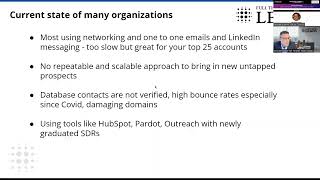
Thank you, Joe, I appreciate your time. So I'm going to go through a little, a quick agenda for everybody so people get an idea of what I'll be talking about. Can you already see my screen? Joe, can the screen be seen? I don't know if you can come back on, but I think it's working. So basically, I'll go a little bit like who I am, you know, why should you even listen to me, the state of a lot of startups, and especially in the SaaS space, you know, how much time is spent closing versus hunting. There's a lot of Wasted time doing that. Um, there's a lot of people that use their own email domains, their, their HubSpots of the world, their SalesPardot of the world, and think they're doing great and find out there's other issues. Um, so one of those things is how do you protect your domain? And then are you measuring your analytics? Are you doing A/B testing? Are you— do you have KPIs against what you're doing? And I guess the other thing I want to cover is like, what tool sets are you using and why? Um, and then if anybody wants to stay on after that, I kind of go into like more about how I pitch my company and what it does. Um, I basically help with companies that want to get more leads. I basically help companies that want to hit more investors on LinkedIn or email. I also help, um, do recruiting as well, um, using my lead gen generation platform. So just a little bit about me. 25 years in the biz, as Joe said. I worked at startup out of New Zealand called TechStation that sold to the NFL all their SMS alerts on broadcast, same thing with UFC, USTA, worked at Warner Brothers, have a big background in SaaS, HR tech, social, all those different things. I have over 950 million context for between LinkedIn and email and over 25 years of selling. So that's kind of my background. I started full throttle maybe 14 months ago and I've grown it to more than a million dollars in revenue. No seed money, no angel money. I didn't have to build any type of MVP or anything like that. So I have a repeatable, scalable process that either you can do yourself or you can hire a company like myself. So what is the current stage? Well, the current stage is basically you see a lot of people do account-based marketing and they're going very slow at it, but there's all these other accounts around that ideal customer profile that you can go after to help build that momentum so that when you're working on those larger deals, you also have small and medium-sized deals that can close. So really, just going after those 25 major accounts are important. But it's also for your closers to do, to do things like look at their LinkedIn, look at 10-Qs, look at all their different information to be able to figure out what is the strategy, what is the challenger approach to get into those leads. It's not a very repeatable and scalable approach. Um, the databases that people are using are not very quantified or qualified because what happens is if you don't— if you have a database especially during COVID 20 to 30% of that, of that database is bad. So you got to have a company that is doing things like ZoomInfo or Apollo or, or these other ones that really have data that's always continuing to update. And then a lot of folks are using, uh, Pardot, HubSpot, Outreach, and they're hiring newly graduated SDRs. Um, SDRs turn over a lot because they're kids, they don't want to do lead gen their whole life. So you're better off finding someone like myself or someone that does expertise of understanding how to use these, these, uh, tools. Now if you use HubSpot Pardot or Outreach, you're kind of getting into the right approach, but a lot of folks are using that with their own Gmail or Office 365 email. And what happens is you'll start seeing your domain reputation diminish, your emails go into garbage or trash. And then people going, why, uh, why is every email that you're sending doing that? So you want to make sure that you maintain, um, email health, email deliverability, and domain health. Um, if you have any questions, um, I'm going to be taking Q&A at the end, um, at venturesummit.tv, and then Joe's going to basically send them to me. So please feel free to ask questions even while I'm talking, then we'll answer them at the end. So, um, are your closers— are they focusing on hunting or are they focusing on closing? If you look at, um, you know, how Salesforce did this about 15, 20 years ago, they realized that their salespeople are spending way too much time going like this with their, their pipe. They're closing and then hunting's going down, and then now they have to rebuild their quarter. So they kind of developed this whole idea of like, let's have Legion folks do lead gen for us, for our AEs. And that has taken off like, like, like crazy, especially in the software space. So definitely have your sellers doing discovery and also doing things like closing and working on understanding who are the decision makers. Um, you got to make sure that your fluctuation of your pipe is, is limited so that when you are trying to raise money, they're not seeing like this, this graph of your, your revenue going up and down. You also, you definitely want to have a repeatable, scalable process and a repeatable, scalable, um, product or, or SaaS to sell. So that's on the closing versus hunting. A lot of folks don't understand this as well. I actually didn't understand this until I started doing this full-time for myself, is that, you know, there's subdomains Like I use mail.fullthrottle.com and basically protect my fullthrottlefulautoleads.com by doing a subdomain or alternative domain. You never wanna send marketing, transactional, or sales emails from your main domain. There's companies that I know that had to change their domain because they sent so many emails out of their HubSpot. All their SDRs were doing it, marketing was using it. And they're using HubSpot and using their main domain. So HubSpot's a great tool, but if you don't use it the right way, you can damage— you could damage your domain. Um, you gotta have an engineer, email engineer, not just an IT person, understanding what your DKIM, your DMARC, SPF, MX, um, SPF records, all those different records that need to be able to align to that new domain or subdomain. You can't just turn on Gmail or Office 365. I was trying to do this beginning and had like Enfilada 1, Enfilada 2, Enfilada 3. I did all these different email variations at the main domain, and Gmail was shutting down those emails. Emails are going into spam, and then I was affecting the domain. So learn, learn from me how to not do things. And you basically, you, you, if you do something wrong, you learn how to do it right. And that's kind of the, uh the logistics of working with an expert like myself. Make sure you verify your domain health. There's different tools for that. Make sure that your, that your email addresses are verified, that you have an email engineer that sets it up, and use drip marketing. And that's— automation is key, not just sending out an email with maybe 1 or 2 emails. Send out 3 to 4 emails over the course of 2 weeks. Always do a breakup email. You know, here's, hey, I've been trying to reach you, Tom. I'm not for sure if you're even the right contact. I'm going to give you one more try. If I don't hear back from you, key thing is I'm going to contact you in 30 days. So that will get someone to say, sorry, um, let's do, let's do a call, or hey, please stop. And that's what you want, yes or no. I'd also recommend highly to get, uh, Calendly uh, TidyCal or any other scheduling software. HubSpot includes it, so you don't have to go back and forth 5 times to figure out what time works. And, uh, you know, LinkedIn, same thing you're doing— what I do with email, what I can do with LinkedIn. I can automate the invites, automate the emails, automate the in-mails, and basically do drip marketing on LinkedIn as well. I do about 150 a day, so it doesn't basically notify LinkedIn that there's some sort of automation attached. But you want to be concerned that you do things right on email and LinkedIn, that you're not abusing it, and that you're also not doing it one by one by one, which is very time-consuming, not a scalable approach. The other thing is how you measure. If you don't measure it, how do you know if you're doing well or not? There's a lot of folks that just send out emails and kind of throw stuff at the wall. You want to have different email cadences for different personas, different email cadences for different industries, different email cadences if they already open the email. I'm getting 20-30% open rates on regular emails that I send out because I'm doing very personalized approach. I'm even saying, I hope you're enjoying your Tuesday afternoon, because it picks what time of day it went out. And, and, uh, puts it in the email when it goes out. So that looks like a really, um, real-time email. So that's important to do. Um, are you doing A/B testing? Like, you're using subject lines that are very similar? Are you asking questions like, have you tried this? What have you done with this? Have you— get— tie in some emotion, you know, to the emails. Have someone look at your content. Too many emails I get when I start work with a client are, this is what we do, this is how we do it, we'd love to talk with you. That's all about them. Every email should be, here's what I can do for you, this is how I can help your business, this is how I've helped other business. If you don't do this, this is what's gonna happen. You know, use the challenge approach, use, you know, fear of missing out. Those are the types of things you gotta look at. You really gotta make sure that you understand how automated it could look if you don't do it the right way. Um, so what are your tool sets? I mean, a lot of— I mentioned this earlier— are you using HubSpot? Are you using Pardot? Are you using Zoom? Are you using Apollo? Um, you got to make sure that that CRM, that database that you're working with, or a partner like myself, that it connects to your Salesforce or your HubSpot so you can track results, track analytics. You got to make sure that you have a biweekly or bi— I mean, sorry, bimonthly or weekly cadence with that partner, um, to make sure that you do it the right way and that the content's going the right way. I always like making sure that you filter— let's set up the filters on LinkedIn and email together. So there's— it's, it's kind of a partner approach. Um, Sales Navigator, not, not enough people use it, and they're not using it as, as much as they should. Like, if you use that with automation and really dial in your filtering, you're going to get meetings out of LinkedIn. But again, on LinkedIn, don't just send a message and then, and then as soon as they accept, have that cadence go out and say, thanks for connecting, could we meet? That's not— that's too aggressive. You want to make— basically get to know them, um, see if there's a good fit. Tell them you might, you might not even be a good fit, like the whole thing of kind of want what you can't have. So You definitely want to kind of go that route. You know, do you have a team that just focuses on lead gen? I've met a lot of people that I help where it's the VP of sales, VP of marketing, and I'm helping them. You know, then there's teams where there's a whole team of SDRs who are just spending $500,000 a month and they're getting 2 or 3 leads a month from their SDRs. When I was doing this for HR tech and all these other companies, I was getting 5, 6 meetings a week and my SDRs were getting 2, and I wasn't even an SDR. So they brought me on stage at the sales kickoff, say, Michael, can you tell us what you're doing that could help our SDR team? And that's kind of when the light bulb came up and go, you know what, maybe I should start my own company. And that was 14 months ago, um, after doing 25 years of full, full cycle sales. And now I focus in on just getting you and your clients meetings either with investors or with brands, um, whether it be small, medium, or large across the world. So that's kind of a little bit about the approach, how to do it, why to do it. Um, what I'm going to do now is more of a commercial just about what I do. So, um, hopefully you stay on and tune in. I can definitely go through this one-on-one with you, but I just kind of want to give you a little more in depth about Full Throttle and what I do. So we talked about this earlier, if you could hire an SDR, SDRs are usually 25 years old, first job, and he or she are very green and they turn over. They want to, they want to sell, they don't just want to do leads all day. So it's kind of expensive to do it that way, and the, the price tag for SDRs are $5,000, $6,000, $7,000 a month, at least in Canada and US and UK. Um, there's an external approach where they hire the same kids, but they're either in the US or across the world. And again, high turnover and sometimes language barriers. So I don't recommend necessarily building a huge SDR team instead of hiring maybe someone like myself that I'm your main point contact. You're hiring me and my repeatable skillful approach. We went over this already. Um, just wanted to kind of repeat my background, what I've done. If you want to see who I am and what I've done, whether it's just benefit from the first part of the slides or now, I have 120 references on LinkedIn. So if you want to check out what I've done and who I am, you know, a lot of background there. I've actually been in military for 12 years as well in the reserves and Air Force. The Full Throttle name was given to me by a Marine and I'm Air Force. So if anybody knows, any of my veterans out there, Marines give nice names to Air Force guys. They don't, but I got one because I know what I'm doing in Legion. I also trained Brazilian jiu-jitsu and that's kind of where I got that name from a Marine that's actually a cop in Orlando. So, real fun! There's actually 15 references on Full Throttle as well. So that's something you could see. Anybody that wants to stack, you could click on any of these names and see who they are and what they do. I've been featured on Daily App Brief, Venture Summit, even Australian TV. And as you can tell, I did the last one over here for Venture Summit. This is kind of the database that I use. It's a platform that has over 240 million people in their database. There is about 15 to 30% open rates, about 2 to 6 meetings a week on average. I send about 20,000 emails a month, which is very hard to do if you're if you're not doing it safely, you don't have an email engineer, and you're not doing A/B testing. So it's very important to kind of do that right. There's tons of ways to slice up the filtering, whether you're using me or someone else. Do not do it on your domain and definitely get a database that's constantly updating their data. Data waste happens about 20% every quarter, especially now with COVID and COVID changing. Um, there's a lot of bad data out there, so you want to make sure you do that. Make sure it connects to Salesforce, HubSpot. There's— you don't want to do CSV files where it just basically gets put into a CSV file and then ingested into your CRM. LinkedIn— there's some tools out there that do LinkedIn automation, but you got to be careful. A lot of them are Chrome extensions. I basically use one that has, um, it looks like you're actually operating the LinkedIn profile. And if you do it right with a proxy server, you can actually invite people right here via email, um, using the platform. If you know the email address and the personal LinkedIn profile, you can actually do a cadence on LinkedIn with the tools that I use. You can also look at everybody that's on LinkedIn and go, who has their open profile? Who can I send an email to? That's very important. InMails cost money, but if I can look at 2,000 people in my ideal customer profile and find 400 that have their, their, um, profile open for in-mails. I didn't pay for those, and now I'm able to send out 400 in-mails to exact targets of who I want to go after. So it's important to be able to do that type of stuff. You know, Sales Navigator, again, just like my email platform, has tons of ways to filter. I mean, the last, the last thing you want to do is send messages to people that don't want to hear from you or waste the capacity that you have with email and LinkedIn to, you know, people that you don't want to talk to. So I look at this as a kind of a cost justification for me, at least, and maybe other companies. Like, you got to look at SDRs, SDR managers, employment tax, Social Security, commissions, bonuses. It's a lot of money that you'd have to spend to kind of build this yourself. You definitely want to have some SDRs or AEs, but building this huge team of SDRs that underperform, which is most of them that I've seen— I'm not saying all, I'm saying most of them— um, I'm, I'm doing basically about 300,000 touches, and maybe they can do maybe 100,000 touches a year with one person and an SDR manager. So I look at it, it's the third more output and a third of the cost of what you'd spend for an SDR. So there's basically, for me, 5 things that I, you know, pushed out. I do email protection, email automation, can send out 20,000 emails a month and have an email engineer that sets us all up. I have automation on LinkedIn. I recommend not doing more than 150 activities a day, so does the platform that I use. And I also do recruiting as well. That's kind of something I added. I have a background in HR tech and was a recruiter before. So basically what I do is I offer that because I get folks that say, you know what, you need to hire a VP of Sales, you need to hire a VP of Marketing, you need to hire more SDRs. I just placed a VP of Sales in Southern California for a SaaS company that's like Expedia for health, for childcare. So definitely like nice one-two punch, you know, as far as doing recruiting and also lead generation. And also, you know, I just try to figure out what's going to work for our clients and make sure that I'm doing what's in the best interest of them. Um, things are going well. I'm very happy with, with starting my own company about 14 months ago. So that's about it, folks. Um, I'd love to kind of, uh, understand if you have any questions. And, uh, also on my— I have a Calendly link on my profile. You can book a time with me, or you can use scheduling software built in. Um, would love to chat with you, but, uh, Joe, is there any questions so far? It's at venturesummit.tv. Looks like I got one here. How would you warm up an email address for outreach? I used G Suite before but had to do 50 a day, then 75, then 100, or else it would get banned. Are all your emails self-hosted? If, if that is how you send how many emails? Per month, or do you still need to gradually send over chat? Okay, so you— one thing I did not go into is I also use a separate email server, which I forgot to mention. So I use a thing called SendGrid, and I use SendGrid along with my automation platform. So you definitely still have to warm up your domain, but I had the same problem when I started a new domain and was using Gmail or Office 365. But Gmail or Office 365 would actually shut your email down. Um, and then you're having also domain reputation issues as well, and deliverability as well. So you never want to use, like I said earlier, Office or, or Gmail directly with some sort of HubSpot outreach or any of that stuff, because you'll ruin your domain and they will shut your emails down. And you have to ask your IT guy, like I had to, I'm at my last company, to turn it back on. And, um, not— it's not all the time you could turn it back on. You're gonna do damage that is, um, you know, you can't reverse. Playing the game of opening up different domains every 3 months is a whole— a whole nother risky way of doing it as well. So find an expert like myself, do it the right way. I have an email engineer that's been doing this for 20 years. He actually works at Coke as well, and, uh, he's— he keeps people out of Coke. From emailing them. So, do you think this tool can help with— another question— do you think this tool can help with primary research, talking to potential customers while still forming the product definition? That's a great question. I've actually helped companies define their ideal customer profile. What's— what is the market seeing by using this amount of emails going out. You could say like, we think that this market is good for finance, fintech, um, government, whatever industry. And then we actually send it out and you see that you're only getting 2% open rates, which is very low. I'm getting 15 to 20, or 15 to 30, I'm sorry. You could actually use this to define what your ICP is and use this analytics and data to show investors Um, what type of— what is your ideal customer profile? What is your total addressable market? What is resonating? So you're taking your— I, I call this moneyball for, for, um, for sales, you know. The same thing with, with doing this on a flip side. I can outtake this, take, take this technology and reach out to every investor that you want to go after. There's plenty of these folks on, on the video today, but Um, if you have a database and you have LinkedIn, these people want to be found. They want to invest in good companies. If you're going to sit there and do one by one by one and take a very formulated approach, do that for like your top 10. But there should be ways to automate this. We're too much in the 2022 where you could automate things. Um, let's see, is there any new ones here? I think that was— I think that's it. Any more, Joe? I don't know how I'm going to see.
That seems to be the questions that we received from the VentureSummit.tv website. If anyone else has additional questions for Michael, you can make sure to reach out to him and connect with him at the partnering platform. His profile is there. And Michael, what's your contact details for them to contact as well? Oh, there it is.
Okay. Yeah, share that. Yeah. Is the screen— is my screen still up, Joe?
Yeah. Yeah.
Yeah. So definitely book, book a time on my calendar. Give me a ring. Um, I would love to hear other from other veterans as well. Um, but I love everybody. So, you know, God bless America, God bless the world and peace and love.
Amen.
Amen.
Okay. Thank you very much, Michael. Everyone, I'm going to ask you all to head on over to VentureSummit.tv's next session where it's going to be on Startup Boards. That's going to be starting in 10 minutes. In the meantime, make sure to head on to the partnering platform and connect with other attendees. Request meetings if there's a meeting slot that you're not available for, for whatever reason. Make sure to recommend or suggest another, uh, another time to meet with, uh, with others. And, um, also check out the startups. The rest of the website, venturesummit.tv, has the schedule, sponsors, the way to reach out to our sponsors, speakers profiles, as well as, um, presenters. Thank you so much everyone for joining, joining us for this session. We'll see you over at the next one in a couple of minutes. Take care.
Thank you, Michael. Thank you, Joe.
More from Michael

Full Throttle Leaders Podcast- Laura Fu is a (GTM) leader, author, and revenue systems operator




Full Throttle Leaders Podcast- with Gwen Lafage, VP Marketing at Sinch, on GTM

Full Throttle Leaders Podcast- with Spencer Ricks, Head of Marketing at BoxHouse




