Michael Bernstein proposes using algorithms to improve team collaboration by nudging norms and hierarchy through Slack feedback, rotating people between teams for diverse perspectives, and assembling experts on-demand. His system outperformed traditional approaches by about 40% in experiments. He frames collaboration as a computational problem rather than a fixed organizational structure.
Chapters
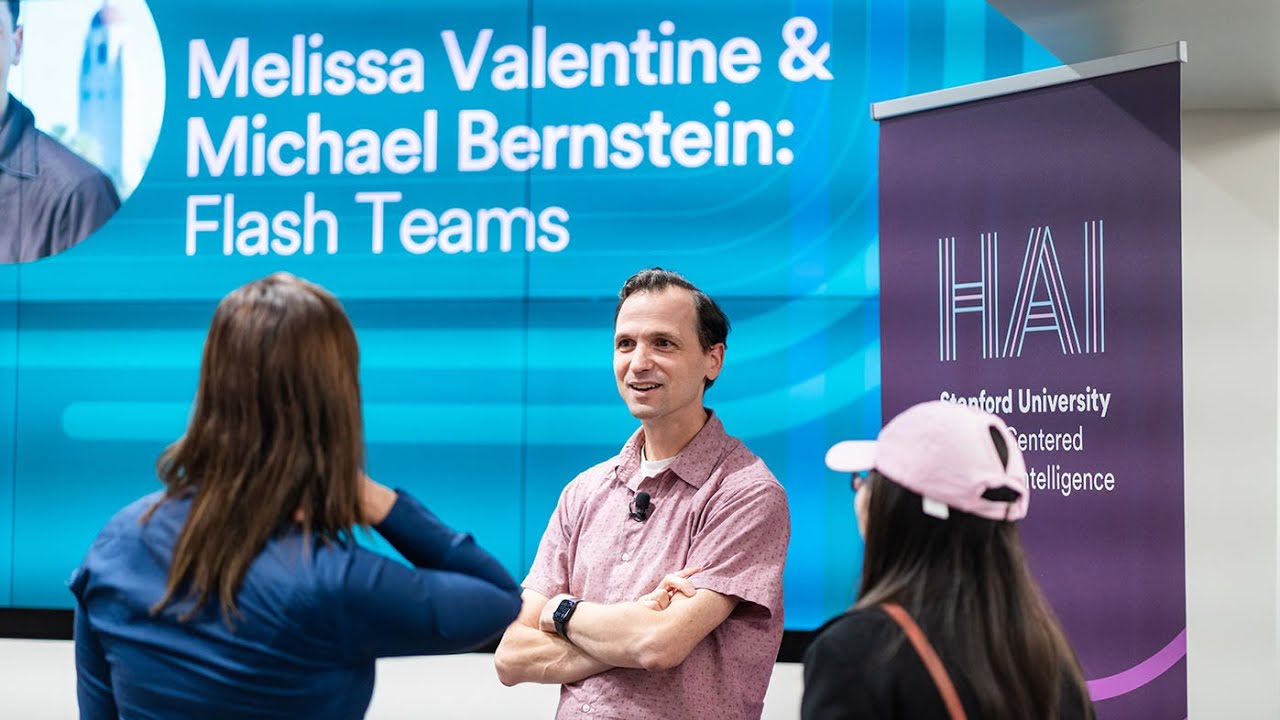
Good morning. I'm James Landay. I'm a professor here in computer science and also one of HAI's associate directors. We're now moving on to our final topic area for the day, augmenting human capabilities, which is really close to my heart because I'm doing a lot of research here myself. And so I'd like to introduce our first lightning talk speaker, Michael Bernstein, who's an assistant professor in computer science and also a close colleague of mine. Michael.
So the question that animates me is how we are going to work together to address the most significant societal challenges in front of us. And I think it's no lie to say that increasingly more and more of these kinds of challenges need to be addressed in groups, in teams, in civil society, in organizations, Doesn't matter how you're doing it, we're going to need to work together to get it done. And I would hazard a guess, off of a lot of social scientific evidence, that increasingly when we struggle to get this to work, it's not because the people who are here don't have the raw skills and abilities to do it, but because we are not so great at working together to get it done. And that's where I see an opportunity as a computer scientist, as a designer. Because computation is increasingly mediating our interactions, our social and our collaborative interactions, we can ask, how might computing help us overcome the kinds of heuristics and biases that might lead us astray in how we design our collaborations and do so more effectively and for a better society? Let me give a simple example. Let's say you're working together on a team, say research organization, whatever it would be. What's the best way to work together to get that thing done? Should we be really flat? Should we be very strongly hierarchical? Should we be really nice to each other? shoot it as it is. What's the right way to do it? Unfortunately, social science says that is not the right way to ask the question. There is no universal best way to do this. And in fact, it's going to depend on the people and the kind of thing that they're trying to achieve. So this is a hugely contingent space. We've decided to actually tackle that as a search problem, to say, well, let's say we brought together a team in any sort of collaborative software. Here's Slack. They start working towards some sort of goal. And after a bit, they give some feedback to our system on how it's going. Our system takes that feedback, turns it around, and does a little bit of a nudge. Says, you know, I know this sounds a little bit silly, but try being a little extra positive in your feedback this time. Just shift that feedback norm a little bit. And what you might imagine is that there are hundreds and hundreds of possible combinations of these team structures that might impact how the team works. And initially, you might start out with a very neutral way of doing this. But based on the feedback, our system might nudge something like the hierarchy, over time, take that feedback, and essentially help that team achieve the kinds of structures that help it have a good time and be effective at what they're trying to achieve. Now, why don't we just do this ourselves? Why don't we train MBAs to do this? It's a really complex decision space, and it turns out that Prospect Theory says that we're pretty risk-averse. We're not gonna explore enough. On the other hand, you could try these really advanced AI algorithms, your most modern version of something like a multi-armed bandit, that's gonna try to optimally explore. And it turns out that this actually tends to get ignored because it's inducing so much change that the teams just sort of leave it behind. But we can take this notion of how people interact with the algorithmic system and design the AI system more effectively by trying to smooth out that rate of change so that the team can actually pay attention to it. And when we do so, these kinds of teams using our systems in our experiments are outperforming teams led by managers, democratically, traditional algorithmic setups by something on the order of 40%. Second example. We'd like to believe that we can look around at each other, draw on each other's ideas, and ping them together to create new ideas that no one else has ever had. Again, it turns out this doesn't work. When I'm seeing other people's ideas, I just charge ahead with mine, cuz thank you, mine is great. But what we see is actually possible is when we're interacting with each other, influence can be carried over by collaborating with people who carry those different kinds of perspectives. So you might imagine, could we create a sort of network rotation that that would move people between teams to help us get access to other perspectives. And if we do this, we need to balance against familiarity, having strong tie strength with people who I know how to work with on one hand, and network efficiency, or essentially information diffusion, the ability to bridge structural holes on the other side. To find something in the middle, what we call again network rotation, to try and create a collective that's effective at bringing ideas around. Finally, what's going to happen when the internet changes our ability to draw together on-demand experts from around the world in a series of just, say, minutes? Here's an example of a series of animators, scriptwriters, and others who've come together using an online system that colleagues and I have built to basically create a short animated video in 48 hours from the moment that they came together, coordinated again by our system. And imagine this is just one team that our system has seen. Over time, you can imagine seeing tens, hundreds, many, many more of these. And if you tell me what you're trying to do, our system can start to identify essentially segments of all these previous teams that might be stitched together to create a new team for what you are trying to achieve. And that you can use as a template to bounce off of. As a final thought, when organizations first came about with the rise of the railroad in the 1800s, they were basically designed from this, from this point of view of interlocking gears. They wanted people to be as coordinated as effectively as really complex mechanical systems. And in that same time, computation has gone from a dream of Charles Babbage to something I wear on my watch. Now imagine what could happen if we actually started thinking about collaboration, organization, and society from a more computational metaphor, something that can take bottom-up feedback, that can be reactive and data-driven. I think many of our collaborative metaphors would change. I'd like to thank my colleague Melissa Valentine for this, the students who helped drive it, and your enthusiasm.