Abarth 124 Spider vs. Alfa Romeo 4C Spider Comparison Review | An Italian Sibling Rivalry
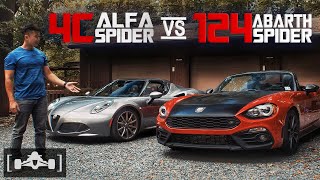
Michael Chuang compares the Abarth 124 Spider and Alfa Romeo 4C Spider, two Italian roadsters with very different engines and prices. The 4C is faster and more exotic, but costs roughly twice as much. For most drivers, the modified Abarth delivers similar handling and better daily usability for half the money.
Questions this video answers
237 brake horsepower; 258 foot‑pounds of torque.
1.75 liter turbocharged inline‑4; 0–60 mph in 4.2 seconds.
164 brake horsepower; 184 foot‑pounds of torque; curb weight stated as 2,477 (units implied pounds).
1.4 liter turbocharged inline‑4.
About $6,000–$7,000 in modifications.
Chapters
Foreign. The Alfa Romeo 4C in the Abarth 124 Spyder, they're very much like siblings in a way. Both cars are Italian, have turbocharged inline fours, rear wheel drive and are convertible.
But that's pretty much where the similarities end.
Because if you buy these cars brand new, the Alpha will cost you more than double the price.
And that's not to mention that the.
4C is mid engine and the 124 is front engine.
So you might think this comparison makes no sense, but to me it does. Because not too long ago I was.
Actually in the market for a 4C myself.
And then somehow I ended up buying one of these guys instead. So let's talk about why. But first, the basics.
Alfa Romeo 4C Spider. 237 brake horsepower, 258 foot pounds of torque and a curb weight of 2487. Powered by a 1.75 liter turbocharged inline four in a six speed dual clutch gearbox, it can do 0:60 in 4.2 seconds. Completely irrelevant because nobody actually races from 0:60 anymore unless you're from the 1950s. Plus the channel is all about 40, 160 to 130. Anyway, let's take a look at that Fiat.
Abarth 124 Spyder.
164 brake horsepower, 184 foot pounds of torque, and a curb weight of $2,477. It's got the tried and true 1.4 liter turbocharged inline four that's in practically.
Every car that Fiat Chrysler builds in this price range. The difference between this and the 4C is that you can get it in six speed manual, or in our case a six speed I Aston automatic. And before you ask me why I buy this car in auto, it's actually for my wife who I've been trying to get into some casual track days.
Plus it makes a little bit more.
Sense for this comparison.
To even things out. I put about 6, 7 grand worth.
Of mods in the 124. So it's pretty much full bolt on.
Minus a downpipe, which is a pain.
In the ass to install. So I didn't do that. It should make around 190, 195 wheel horsepower, or about 230 crank if you do a drivetrain loss conversion. So it's pretty close to the 4C.
In terms of suspension.
I'll try to level out the playing field by adding stiffer springs and sway bars.
But even with all this stuff, the.
4C is still twice the price. So let's see if it's twice the car.
As I watched the 124 from the driver's seat of the 4C, it became apparent to me that I really liked the way it looked. It's arguably more masculine than the Alfa, which has soft lines and bubbly curves. The long hood line, the headlights, the true soft top, the Abarth is a classically handsome car. On the other hand, even though they're about the same length, the 124 doesn't have the same exotic presence as the 4C. That's because the 4C is 5 inches wider, 2 inches shorter, and coupled with the mid engine layout, it just makes it look more purposeful than its front engine sibling. But looks aside, what are they like to drive?
Well, right off the bat, both cars.
Handle like go karts, and it's hard to truly compare the two on the street. But you'll be hard pressed to find anything that handles better. However, because of the familiar front engine layout, the 124 will feel more predictable to most people. But the 4C will make you feel like you're driving a race car. Not only because the lack of power steering and brakes connect you to the road, but because the suspension is both harsh and unfiltered on top of riding on a fully exposed carbon tub. But a harsh and stiff ride doesn't necessarily mean better handling. I truly believe that with the suspension Mods in my 124. It handles almost as good as the 4C, but with a significantly more compliant ride. And you can easily daily drive the 124 without the need for physical therapy. In terms of exhaust note, it becomes more subjective here. The Abarth has a full catback system, and in my opinion, that gives it the sound it really deserves. It has a more burbly not, and I personally think it sounds better, but the 4C again sounds more raw and visceral because you hear everything working right behind your head. I'd be willing to bet that with the right aftermarket system, the 4C could actually sound as great as it performs. Speaking of performance, even though these cars have a similar power to weight ratio, the 4C simply feels faster. Both cars have noticeable lag before they get into the meat of their power band, which is around 4,500 rpm. The lag is slightly less apparent in the tuned 124, but with the dual clutch gearbox, the Alpha puts more power to the ground, moves through the rev range quicker, and changes gears faster. Unfortunately, I don't think there's much of a comparison here. And I think the results from the acceleration test will back that theory up. The 4C is undoubtedly faster, and if you modded, we wouldn't even be having this conversation. In street driving situations, the 124's conventional automatic is smoother on takeoff and coming to a stop, but the 4C feels much better during gear changes. It's more aggressive, brisk and responsive on acceleration, but it's still not that great for a dual clutch system. On top of that, the Abarth 124 gives you a much more traditional convertible experience. The 4C soft top situation is more of a faux target top, and it doesn't give you that open air feeling that you normally would associate with true convertibles. But normal driving is not what we like to do here, so let's see how they drive on the track instead. As I mentioned before, the124 is predictable. The front engine layout is much more forgiving, and honestly, it doesn't have enough power to get you into these sort of real trouble. Regardless, you can still have pretty impressive entry and exit speeds. The lightweight Miata chassis really lets you carry a tremendous amount of velocity through a corner. It's an unfair advantage, but the 215 wide, square Toyota R888Rs do provide the proper amount of mechanical grip, especially when you pair it with a limited slip differential. But the gearbox and the brakes are the weakest items here. And the standard brakes are not the optional factory Brembo, so they feel mushy and uninspiring. When push comes to shove. You either have to brake slightly earlier than you normally would, or really step on the brakes to make things happen. The gearbox works as you expect on upshift, but when downshifting, there's too much delay and it won't execute unless you're well below where you actually want to be. The biggest problem is that for the amount of G forces this car can pull, the seats have a lot of catching up to do. If you truly drive this car the way it's meant to be driven, you'll find that you slide around quite a bit and it's really not pleasant at all. We'll do a quick acceleration pull now for the 40100 time. Now let's move on to the alpha 4C. This place should feel like home for the 4C. And in a way it does. But because the suspension is so stiff and this particular track is so notoriously under kept, the car doesn't feel like it's driving to its full potential. If you couple that with a 205 front and 235 rear Pirelli P0s. You can't help but feel like the limited mechanical grip is lacking with what this car should theoretically be capable of.
I would say that it's not as.
Easy to drive fast as the 124, but I ultimately believe that it has more potential even with this underwhelming factory setup, especially once you get used to that lack of power steering, firmness of the brake pedal and the dynamics of the mid engine layout. The transmission responds quickly enough in this environment and you can really appreciate over the lackluster planetary gearbox of the 124. Surprisingly, even though it's quicker than the Fiat in a straight line, I still feel like it needs more punch on that back straight away. See how the acceleration numbers compare. We'll do full auto because that's what gave the fastest time in the Abarth 124. My hypothesis was correct. The Alpha 4C ran our 40100 test in 8.81 seconds, which is a full three seconds fast in my stage two Abarth, which ran a modest 11.81. So it wasn't really even worth putting them head to head in a straight line race. See, I started this video wanting to love the 4C so much that I strip my 124 back to stock and sell it immediately. But after driving them back to back, I'm not so sure anymore. With the simple modifications I did to my Barth, it makes the 124 every bit as good of a car as the alpha fit 4C in the handling department and the sound department. It falls short in a straight line and in driver engagement, but makes up for an impractical drivability and that's invaluable to many people who can only have one sports car. So to answer the original question, no, the Alpha 4C is not worth twice the price. If I had to do it all over again, I'd still save 30 grand and buy the Abarth 124. If this is your first time on the channel, be sure to watch some of my other stuff. I'm dedicated to producing cinematic car content.
And doing real world performance tests for all sorts of fast cars.
So if that's your jam, be sure.
To hit that subscribe button and ring.
That bell icon for new episodes every Thursday. Thanks for watching.
More from Michael


Straight out the box subscription product, everything is listed already on our website! Check it out