Easy Way to Make Your Car Faster | Testing E85, Sunoco 100, and Octane Boosters
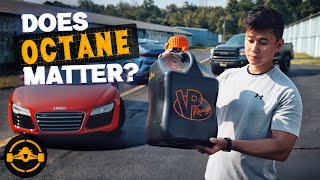
Michael Chuang tests whether premium fuels and octane boosters actually make cars faster. E85 and Sunoco 100 showed measurable gains in trap speeds for some vehicles, but cars already tuned for their fuel saw no improvement. Higher octane costs more and may not work for every engine.
Chapters
In this growing age of hybrid power and electrifying sports cars, it seems kind of bizarre to talk about race fuel or octane enhancements because it feels like gasoline cars are on their way out. And while I'm sure that's gonna happen at some point in time, eventually, I think we're still a long ways away. And even if I do convert to an EV someday, I'll still be a petrol head at heart. Today I want to talk about a topic that I think is widely discussed, somewhat controversial and and commonly dismissed by third party theoretical information. It's actually a subject that I spent a lot of time obsessing over when I was younger. And that topic is basically, does race fuel or increased octane do anything to.
Make your car faster?
A lot of times on forums and Internet discussions, the general consensus is no. But as I've been testing more and more cars on the channel, I started to question that hypothesis. As you know, here on track day, I'm all about the real world data and running the tests in the most controlled environment that we can possibly attain. We use racelogic vboxes to verify the metrics along with doing da correction to standardize the results. Basically, I'm obsessed with the numbers. Anyway, the counter argument is that the modern ECU will adapt, adjust and pull timing accordingly to the fuel grade no matter what. And if your car is in tune to take advantage of that increased octane, then you're basically just burning away money, which you know, that's a pretty fair theory. And to clarify, I don't know too much, nor do I care too much.
About the technical science behind it.
Like I said, I'm a results kind of guy. So today I want to test a bunch of different types of gas powered vehicles to see if increasing octane will make a noticeable difference in a straight.
Line in terms of performance.
But before we get started, let's go.
Over our testing parameters.
It's important to preface that in the United States we have a different system than Europe for rating octane. When we say 93 octane here, we mean 93 aki or the European equivalent of 98 ron. Anyway, we'll be running each car a few times on their recommended fuel grade pump, 93 in most cases from either Shell, Sunoco or BP. And once empty, we'll refill with 100 octane from my local Sunoco station. Then we'll drive the car around a little to let the computer adapt and then re run the tests. Every car will be run on the same road as the baseline and every Result that you see here will also be da corrected to sea level. Let's get started. Here's going to be our first example. A high revving, naturally aspirated, performance oriented sports car. In this case, it's a bone stock first generation Audi R8 V10 Spider. This particular car is ideal for testing because it has all wheel drive and it's an automatic gearbox, so that'll help us maintain consistency. We ended up doing a bunch of runs with this platform because we felt like it would have the least to gain from increased octane and we just wanted to be sure. But actually you might be surprised. Quick sidebar I also forgot to mention that for almost every one of these tests we will omit the quarter mile ET because it's a variable that relies very heavily on the launch and the trap speed is actually a better indicator for power. Alright, so the RA put down some pretty decent baseline runs and it took us some time to let the car learn the new fuel after giving it about 6 gallons of 100. But here are the numbers for the quarter mile trap speed. Overall, the Audi ended up gaining about a whole mile per hour on average, and it was 1.1 miles per hour faster between its quickest respective runs. Don't quote me, but I'm guessing that's the equivalent to maybe a 20 horsepower gain. So let's take a look at the 60 130, which is all about the car's raw power and has nothing to do with the launch. This test still showed a little over a tenth of a second average gain and two tenths of max gain. Very surprising indeed. Anyway, let's move on to the other side of the spectrum. Our former work truck, the Toyota Tundra, has absolutely no supercar pedigree or performance tuning weaved into its detail. It carries a modest 5.7 liter naturally aspirated V8 that has a very average compression ratio and a common fuel cutoff range that you'd probably expect to find in a majority of budget cars and trucks in the market right now. We started out the baseline runs with the recommended 87 octane here and then filled her up with 93 to preserve the drivetrain. We only launched in 2wd, so take the 0 60mph with a grain of salt, as there might be varying levels of tire spin, but it still seemed to achieve a faster overall aperture by about half a second. 4100 is the range that we use for slower cars like this, and even here it gained almost 6/10. When I analyzed the data, most of the gain was towards the top end of the rev range at higher speeds. Interestingly, in a separate towing test that I did in my own time, I found that filling up with 93 octane afforded me better overall mpg, but the gain in fuel range was basically offset by the increased cost of the more expensive gas. Next up is our BMW X6 M50, which represents a modern performance oriented daily driver, something that is turbocharged, premium branded and has the intention of providing a sporty driving experience, but also has a ton of electronics helping it out. This could mean Mercedes, Audi, Infiniti, or potentially even Kia. These days we did most of our testing at Atco Dragway where we ran the quarter mile and 41 hundred times. We only got the mixture up to about 98 octane, but I think that's good enough because it was already almost a full mile per hour faster than 93 overall. The same story applies for the 40100 time where it improved around a quarter of a second. Oddly enough though, on a separate day I tested the car with an E30 mixture, hoping that I would be able to use this as a cheaper alternative, but I ended up losing about half a second in performance. It's possible that the ethanol messed with the factory tune, or that perhaps the ratio of ethanol was just too high, which results in not enough actual gasoline being delivered, but either way I won't call this E30 test conclusive yet because I only got to do one set of runs with it. At some point here I wanted to throw a modified car into the mix, so we'll use our phase two Abarth 124 Spider. Euro Compulsion has graciously supplied me with a dedicated 93 octane tune in the car, so we did a few runs on Pump 93 and then a few more on Sunoco 100. Ultimately I found that there was no significant gain here and the car was actually marginally slower with the 100 octane. This example solidifies the theory that if you are tuned for a specific fuel grade, you won't see any noticeable gains from dumping race fuel in it unless you retune for that. Last summer I did a few videos with the TTRS and RS3 platform that really confounded me. Both cars are supposed to be able to drop around 116 and 117 miles per hour in the quarter, but in every situation and through multiple runs, we barely managed 111 to 112. After some research we ended up retesting with an E20 mix on the TTRS to find that it gained almost 6 mph in the trap speed. I did the same thing with the Audi RS3 and it also gained about 4 mph in the quarter mile trap. What that means is that some manufacturers might be tuning their cars to very stringent parameters to achieve performance metrics that are very appealing for press purposes, but unfortunately might not be able to be replicated under normal conditions. A little disheartening, but good to know because this is actually the case on my former C7Z06. We know that there are a lot of reports on the forums about overheating on the C7Zs, but a little known fact is that it's actually also a princess when it comes to fuel. You can see here that the car was pulling timing intensely in third gear during this race against an AMG GT.
R.
In no realistic scenario should a C7Z run a 7 second 4100 time and then lose that badly to a 3 stock Mercedes. What I think happened is that I had a bad blend of 93 in the Corvette because when I went to refuel the following week, I could not replicate the situation. Ultimately that means that even 93 octane won't be enough to achieve the advertised performance in some conditions. While we're on the topic of Z06s, I also did a few octane booster tests with that car. I used two of the most popular offerings at the time, Torco and Boostain. In my findings I used the same ratios of octane booster to pump 93 from each bottle and I achieved a 98 octane equivalent from Torco and a 100 octane equivalent from boost boosting. I then did a third gear pull from 40 to redline, which in the manual Z06 is a little over 123. Now you can see that the performance in the 4100 range was a little all over the place, but the average of the increased octane was definitely an improvement over stock. The most interesting thing that I can't seem to explain is the dramatically increased fuel cutoff when using boostain. Anyway, I'll leave you all to make your own conclusions, but it seems like the effects of increasing octane are pretty obvious.
Okay, I know there's quite a bit of data that's spread out here over an entire video, so if you want to see all the numbers kind of in one place, I'm going to include a link in the description below to a spreadsheet that I use to kind of keep the numbers averaged out really cohesively. Basically, it seems like contrary to popular Belief increasing the octane can indeed make a noticeable difference in a straight line performance arena, even when used on a factory stock vehicle. On the OEM tune, of course. As mentioned, the 124 was tuned specifically for 93 octane, so in that scenario it wouldn't see any benefit.
But if it was tuned for 100.
It would definitely see a performance spike over the 93 tune. That's a given though. On the other hand, it's possible that the 93 and all the tests were not perfect blends at these top tier pumps. But then that poses a whole nother problem because we're just filling up with shitty fuel at that point, so I'm just going to assume it's real 93. Anyway, now that we've answered the big question of race fuel and octane, it creates another dilemma. Is it worth it? Because 100 octane is expensive currently from Sunoco, it's about three times as expensive as Pump 93. But you know what, ED5 is actually pretty cheap and its effective theoretical octane is somewhere around 110. But you gotta be careful though, because you want to find a station that has a high ethanol content in their E5 so you can create a good blend. On top of that, not all cars can take ethanol safely from the factory, because most can't. And you can only really get away with an E30 mix without weird things happening. So just keep that in mind. Octane boosters are also a good cheap alternative, but they have the potential side effect of culling your spark plugs and other internal bits.
If you want to be safe in Jeep, you can theoretically also just increase your overall octane rating by 1 or 2 points over 93 to unlock the full potential of your car if you feel like it's acting a little slower than it should be, because as seen in a test with The Audis and Z06, even 93 octane doesn't seem to be enough to achieve the advertised performance times. But I've been talking so much about straight line stuff that I almost forgot to mention that I believe it's intensely beneficial to put a little bit of extra octane in your race car on track days or HPD events where you'll be running your car extra hot and pushing it to its limits repeatedly. It's just an extra blanket of security for those kind of situations, in my opinion.
At the end of the day.
Does octane make a difference in a stock car? Yeah, I think it absolutely does.
Is the performance gain noticeable?
Now that's debatable in some cases it can be very dramatic.
Should you go out right now and.
Fuel a car with a high octane mix? That depends. If it can take corn, then I.
Don'T see any problems on an E20.
Or E30 mix once in a while. And if you want to play it safe and run pure 100, then I would say only do it when, you know, get that big paycheck or if you're gonna race somebody for real. And on the topic of actual octane boosters such as Boostain or Torco, you know that's kind of controversial because they certainly do work, but I would just be worried about the longevity of your engine because of all that gunk that they leave behind. But hey, it's your car, do what you need to do, right?
Speaking of which, every car is different, even if it's from the same manufacturer. I tried to cover as much of the spectrum as I could here, but obviously it would take me months or years to test every viable performance car on the market. And I know that I might have overlooked some categories or topics, but I wanted to make this information as digestible as possible.
I'm sure there's going to be some questions and debate about this, so do leave those in the comments below. Anyway, hope you all found this video helpful or informative and as always, catch.
You on the next one. I hope you guys enjoyed this video as much as I did making it. If so, it'd be awesome if you can hit that like button and share the video with your friends. I can't cover everything I want to in the short amount of time that I have, so if I missed something, let me know in the comments below. As you probably know, it's mainly just me and my wife doing this channel in our spare time, so if you want to show your support, I'd really appreciate it if you took a look at our merch store or maybe bought something through our Amazon affiliate links in the description below. And if this is your first time here, don't forget to check out some more videos on the channel. I produce all sorts of cinematic car content, so if you like what you see, smash that subscribe button for new episodes whenever they come out. Thanks for watching.
More from Michael


Straight out the box subscription product, everything is listed already on our website! Check it out