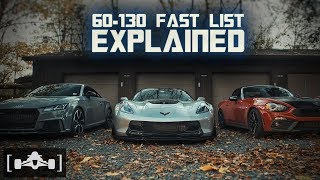
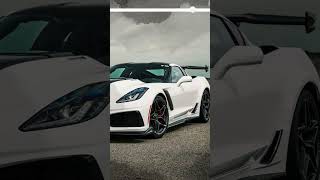
Michael Chuang explains his "fast list," a leaderboard ranking cars by 60-130 mph acceleration instead of quarter-mile times. He uses dual GPS loggers and a VBOX to measure rolling-speed performance, corrects for density altitude, and plans to release a phone app to share the data.
Chapters
So what is the fast list? Well, if you've been watching this channel, you might have an idea of what that is. It's our internal leaderboard of acceleration times. But if you're new to all of this, go watch some of my acceleration reviews and you understand what I'm talking about. But to me, it's the core concept of what this channel revolves around. It's sort of like the reason why I've been testing all these different cars. You see, ever since I was young, I used to have this weird obsession with just gathering all the data. You know, like lap times, straight line stuff, just anything I can find. And I just wanted to put it all into this performance number database. And you might be saying to yourself, well, quarter mile times and zero to 60 datas out there, it's everywhere. But to me, it's not really a good metric of real world acceleration. There's just way too many variables involved. The launch, the driver, the shift points. I could go on. So I started doing a rolling 60, 130 and 40100 tests. Yes, you still have the gear change variable on manual cars, but other than that, it's really just down to density altitude, which I record at the beginning of each run. And then I do a correction factor down to sea level before I post on the fast list. Some of y' all might actually know what the 6130 is because it's a really popular metric between tuners and fast cars out there. But what about the 40 to 100? Well, see, I ran into this problem pretty early on where what if your car just isn't fast enough to hit 130 in a reasonable amount of time? So I had to create a range that was suitable for slower cars. Hence the 40100 was born. Ultimately, I still try to get a 60, 130 for every car that I test. But I sometimes that's not possible because of where I live. In a best case scenario, I'll start the run from a dead stop and make sure I run all the way past 130. But if that's not possible, I start to run at least 10 miles before the speed range. But you want to make sure you're still past 130 or 100, whatever your test may be. That way the car is full throttle through the entire speed range. I use two 10 Hz GPS data loggers, a VBOX to gather the actual times, and a draggy to cross verify and validate the slope of the road on the spot. I'll usually do at least two or Three runs, just to make sure the time is not a fluke. Then I'll gather the local DA and correct the time to sea level later on. That way, a car that I test in Colorado will be as close as possible to a car that I test, say, at Atco Dragway, which is right at sea level. Something else I wanted to clarify is that the car's computer isn't always right. People often put too much faith in technology and sometimes ask me why I shift using the paddles. See, I usually test the car in both full auto and manual paddle shifting modes to find out which one is faster. Obviously, in full auto, we let the computer do its thing, but when I manually shift, I always try to do so right before the fuel cutoff or the rev limiter. So in some cases the difference is negligible. And then there are situations where the disparity is night and day. You'd be surprised. Lastly, let's talk about the practicality of the 60 130. In my personal experience, I found the metric to be pretty indicative of the outcome in a roll race. There's still a margin for error though, and what I mean by that is in a real world situation, somebody's gonna get the jump. A naturally aspirated car is gonna respond faster than a turbocharged one. And some cars just have better power bands than others. So my theory is that there's about a half a second radius where a car is competitive to one another on the list. Take for example, it's a Hellcat. It runs at 61:30 in 8.11. And then there's the C7Z06, which runs it in 7.66. That's about half a second there. And honestly, it can go either way because of whoever gets the jump or whoever gets into the power band faster. And then there's also something like the Lamborghini Gallardo versus the Audi RS6. The Lambo has the advantage of instant power because of the naturally aspirated V10, but the RS6 has a better power band because of the turbos. So in a real world situation, it could go either way. Because of these variables, of course, there's no substitute for a straight up race. But sometimes when you don't have both cars in the same place, one can only speculate the results. One of my viewers, madhat researcher, he suggested that I start categorizing the fastest once it becomes too crowded. So when the time comes, I think I'm gonna look into that as well. Anyway, I covered just about everything I could think of, but let me know what you think. 61, 30 or quarter mile 060 or 40? 100 or does straight line stuff bore you? Let me know in the comments below. Oh, and before I forget, I'm gonna start working on this phone app where I have all my lap times and acceleration data bundled into one database. But that's still kind of like a whiles away. So anyway, I'll let you guys know when it's ready to go. Thanks for watching. These bugs are pissing me off. No, I do see that one still alive. If this is your first time on the channel, be sure to watch some of my other stuff. I produce cinematic content for all sorts of performance cars, so if that's your jam, consider subscribing and ringing that bell icon for new episodes every Thursday. Thanks for watching.