Michael Chuang tests lighter wheels on a C7 Z06 and Abarth 124 Spider. Dropping 39 pounds with race wheels cuts 60-100 mph acceleration from 3.51 seconds to 3.35 seconds. Lighter unsprung weight improves lap times and straight-line speed, but watch your tire diameter to avoid triggering ABS issues.
Questions this video answers
27 pounds total (all around).
39 pounds total (all around).
Stock: 3.51 s; Race set (18" slicks): 3.35 s; Taller lighter (19"): 3.44 s.
Stock topped at 100.83 mph due to fuel cutoff; slicks topped at 101.19 mph; the taller 19" set topped at 101.95 mph.
Chapters
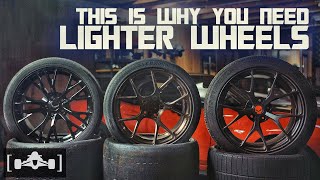
Let's talk about reducing unsprung weight. It's probably one of the best ways to improve your car's overall performance because it doesn't just make your car quicker in a straight line, it makes the corner better and brake faster as well. Plus it won't void your warranty. And one of the easiest ways to reduce unstrung weight is is by swapping out your wheel and tire setup to something lighter. So today we're going to see how much of a difference it makes. On my C7Z06, I have three sets of wheels with me today. The factory set with stock Michelin Pilot Super Sports, a 19 inch forged set, also with Michelin Pilot Super Sports. In an 18 inch forged track set with some Hoosier R7s. The 19 inch setup shaves 27 pounds all around. And the 18 inch track set is a whopping 39 pounds lighter because of the slicks. Now broscience tells us to multiply that number by 5 or 10 or whatever to get the sprung weight equivalent. I don't know what it really equates to, but we've got our trusty little V box here today to tell us the actual gain. But here's a little plot twist. The 19 inch set is a little bit taller than the stock set by half an inch. So that's going to affect the gearing. I'm curious how this is going to play out in the acceleration. Anyway, I'm here at Raceway Park's road course in Old Bridge, New Jersey. It's shown in a reverse configuration for the drift event. But what I'll do is slowly come out of turn 10 here at about 30 miles per hour in third gear and just go flat out on the straightaway until the top of third, which should put me right around 100 miles per hour. That way the only variable is the wheel and tire setup. I'm going to start with the factory setup and then go to the super light race set. And then we'll end with the taller 19 inch wheels. Here we go. And we'll do that again. I do this at least 10 more times throughout the course of the day, but I don't want to bore you, so let's move on.
Alright, so there's really no way to tell just by looking at the footage. So here's some numbers based on the data that I pulled. And I might look Asian, but I'm.
Actually pretty terrible at maths, so bear with me here.
We're going to start with the 60100 because that puts the car smack dab.
In the power band for this gear.
The stock setup put down a pretty respectable time at 3.51.
And as expected, the race set was the fastest at 3.35. The taller but also lighter set ran a happy medium at 3.44. So it looks like being half an.
Inch taller didn't really adversely affect acceleration too much. Now let's expand that range a little bit to our usual 40 100.
Not bad. Looks like the race set stayed just under 2/10 of a second faster here. And the taller set is still the middleman. 4.92, 4.76 and 4.84, respectively.
For shits and giggles. I pulled the numbers for when the car had peak acceleration, which is 35-101 mph. It's pretty interesting because the gap really widens out here simply because the stock set will hit the fuel cutoff right before 101 miles per hour, specifically at 100.83.
The other two sets are progressively taller, which in turn makes the gearing longer. So the slicks being about 2 inches taller, topped out at 101.19 mph and the other set, which was half an inch taller and an acceleration of 101.95.
I saw this coming, but I just really wanted to know by how much. So, out of curiosity, I also did the same test on my Abarth124 Spyder.
Which is a significantly slower car. Adding lightweight wheels saved 26.8 pounds total. They're about 4 inches taller. And I also performed a one gear pull to redline. I did four runs per each setup, and the results came back as expected, with the lighter wheels being faster. The greatest delta was 0.38 seconds, with the average delta being 0.16 seconds.
So, to answer the question, yes, if you reduce unsprung weight, you're going to make your car fast in a straight line, presumably around a track as well. I kind of knew this going into it, but the goal here was to find out exactly how much.
In the case of my Z06, at 124, it's almost 2/10 of a second in just one gear. And if you spread that range out to, say, a quarter mile or something like 40 to 130, you could potentially make your car up to 3/10 of a second faster.
That's just a guesstimate, though. Anyway, the next time you're out there shopping for a new set of rims, consider the combined weight of the tire and the wheels. Saving a few pounds in this department.
Could go a long way. Before we end this video, I wanted to say that you can also reduce unsprung weight with lighter rotors as well, although technically it wouldn't make as much of a difference because the reduction is closer to the hub. Based on that notion, lighter tires would be the most effective change. And if you do swap your wheel setup, you want to be careful not to change the overall diameter too much. The last thing you want is your ABS and traction going crazy and sending you into a wall. Happy racing. If this is your first time on the channel, be sure to watch some of my other stuff. I'm dedicated to producing cinematic car content and doing real world performance tests for all sorts of fast cars. So if that's your jam, be sure to hit that subscribe button and ring that bell icon for new episodes every Thursday. Thanks for watching.