Van Life and Truck Camper Comparison | 2021 Winnebago Solis vs 2021 Lance 650
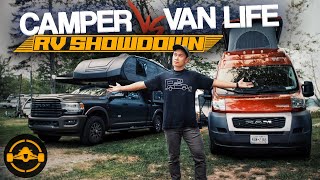
Michael Chuang compares a 2021 Winnebago Solis van on a Ram ProMaster to a 2021 Lance 650 truck camper on a Ram 3500, weighing specs, interior layouts, boondocking systems, and drivability. The van gets better fuel economy and fits under low clearances. The truck camper offers more living space and easier bathroom access.
Chapters
Normally here on this channel we do fast cars, slow cars, cars that may not even be cars. But never before have I done something like this. And don't be alarmed, we're not turning into an RV Travel channel or anything like that. But this is a topic that I have personally become pretty heavily invested into because ever since I retired from the movie business a few years ago, I've been wanting to travel and spend more time with my family. Traditionally, though, I've always felt like campers and RVs were for old boring folks who just like to sit in lawn chairs all day and get mauled by mosquitoes. But with the recent pandemic and all, a new search for this kind of lifestyle took place. And I've been seeing a lot more younger families and urban professionals who can work remotely take up to the road in these things. The majority of the time they go out in these smaller situations like class B vans or sometimes even a slide in pickup truck camper. And I think this is because these things are more manageable, easier to drive, and overall less intimidating for beginners. Obviously, we personally went with the truck camper route, but there are so many times that we felt like, you know, the van life situation would have been a little bit better suited for our needs. Anyway, I'm making this video because this is something that I wish we would have been able to see when we were making our shopping decisions or doing our research. For my normal viewers, this obviously isn't going to be your typical performance episode, but hey, hopefully it's going to be entertaining for you to see a little bit more personal side of my life. Or maybe if you're just into camping at the racetrack. And for those here, actually, for this RV comparison, I hope that this video helps you make your decision. Anyway, let's get started.
This is the 2021 Winnebago Solis 59P. It sits on the Ram Promaster 2500 chassis that has a 159 inch wheelbase, which makes it relatively easy to maneuver if you're coming from driving a normal car. At just under 20ft long, you'll be able to fit into most parking spots. It's also only nine feet tall. So if you live in the Northeast, you can ride on parkways and not have to worry about low clearance bridges. Powered by a 3.6 liter naturally aspirated V6, it makes a modest 280 brake horsepower and 260 pounds of torque. Not terrible by car standards, but remember, this thing weighs a little over 7,000 pounds unloaded. Add luggage, passengers and cargo, and you're pushing four tons easily. Anyway, it's front wheel drive and can only tow up to 3,500 pounds. It costs around 110 grand, which is a little more than a new Porsche Taycan. And this is one of the cheaper pre built ones that you can buy. But remember, this is only one species of van and there are a myriad of options out there. Over here we have our lovely new Ram 3504x4 mega cab carrying the 2021 Land 650, which is designed for a short bed half ton, three quarter ton, or in our case, a big boy one ton truck. The Ram itself is also around 160 inches long in terms of wheelbase, and the overall length with the camper on top is a touch under 22ft. But keep in mind that you can pair this on a much shorter truck and be around the same size as the Solis, or potentially even shorter. However, you might notice right away that the biggest downside of truck campers is the height. This setup is around 11ft tall. And though that's still shorter than many commercial trucks, other camper builds might push you into the 12 or even 13 foot range. And that's just too much for us northeasterners who like to build irrationally short.
Bridges on things called parkways.
Powered by the legendary 6.7 Cummins turbo diesel, it makes a decent 370 horsepower, but a massive 850 foot pounds of torque. So even though the truck and fully loaded camper combo almost tips the scales at £10,000, I have no problem overtaking on the highway or going up steep hills. Now, for reference, the land 650 itself is listed at £1700 and it's 1900 pounds with fluids and propane. And then, go figure, probably another 600 or so with humans and cargo. Anyway, the good thing about most trucks is that they are four wheel drive and can tow a decent amount, generally at least 5 tons. The Land 650 itself costs around $35,000 depending on options. And the 3500 Longhorn Ram is a touch over 85, so it's about the same price as the Solis all in. But this is on the higher end of the spectrum. You can pair a cheaper trimmed truck with a camper that's around 20k and be out of pocket at half the price or even less if you already own the truck.
Right off the bat, the biggest convenience of a van camper's gotta be the ability to pass through from the cabin into the coach without ever leaving the vehicle. This is extremely helpful with families with kids because, you know, you can just easily get up, go to the back here to the kitchenette, get some milk or snacks, or do a diaper change. And if you even need to use the bathroom, you could theoretically do that without ever stopping the car. Another thing is that you have multiple entrances and exits in a van if you need them. The front doors, the side doors here you've got rear cargo doors if they aren't blocked by stuff on top of that. A factory van build is usually a little bit more integrated in terms of a package than a truck camper because all the cameras and driving functions are already set up for you from the factory from the get go. No need to wire an additional backup camera or have an ugly screen sitting on your windshield. And in our case, some of our blind spot assists are basically gone. In most truck camper builds you have to remove the tailgate and also install a tie down system that mounts either to your frame or your bed to safely haul the situation. It's, it's quite ugly looking and depending on which one you go with, it's also going to be annoying to get put on. But that's also a double edged sword because even though it's a hassle to do, it affords you the ability to have two separate items on their own. You can have a truck to do truck stuff when you need it, and a living space off to the side, you know, when you're not camping. That also makes life easier for servicing because you can just simply access more of the guts of a camper when it's off the truck. And if you need to service either your camper or truck at a shop.
You can just bring one of them.
In without, you know, losing the function of the other. Whereas in a van you're basically out.
Of the vehicle completely when it needs.
To get some professional work done. A truck camper is also way more convenient if you already own a compatible pickup truck, because you can just go out and find a camper that fits you and, you know, make it work at the same time. It's also a little bit annoying because while we were shopping, we realized that every combination required a little bit of DIY love. And no camper or tie down system fit the truck perfectly. So it's not a one size fits all situation. You really need to tailor one to match your own needs in terms of livability. I wanted to show you that in a van camper with swivel seats like this one, it really opens up the Space and makes it feel larger and longer than it would normally appear on paper. But you'll also notice that the walking space over there is a little bit more tight because, you know, you're kind of confined to the narrow box that's already on the chassis.
Because in a typical truck camper, there's.
Going to be more width since it.
Actually overhangs beyond the sides of the pickup bed. So inherently there's going to be more floor space as well for you to squeeze around either your dogs, your kids, or other human companions that you're traveling with. But that also means that your pet will theoretically have more living space in a truck camper too, if they're big and, you know, need to hang out on the floor like our Doberman here. In terms of cargo and cubby storage, it really comes down to the specific camper build, because in both a van and truck, they can have similar amounts of shelving and storage options built in. However, I will add that in a truck camper, it has the potential to have more storage in the cab itself if you have something like a crew.
Cab or mega cab, and you don't.
Need to carry more than three or four people at once. But a van has something that's usually.
Called a gear garage that sits underneath.
The sleeping area for larger and longer items. Now, a good bathroom situation is generally a luxury in this type of lifestyle, and both will offer you the ability or the option of having a wet bath. But I feel like the One in.
This land, 650, is a little bit.
Better in terms of size, height and water retention than something like the one in the Soless. It actually gives you a sink and vanity storage. Both of them can double as additional storage space for tall items or drying racks for clothes as well. In this specific camper, we also have an exhaust vent for the bathroom, so it doesn't smell as bad when you go. When you compare it to something like the one in the Solis. And here's the big thing. In most vans, the bathroom is smack dab in the middle here of the coach, which is actually more annoying than you'd expect. We learned that the ideal situation is have the bathroom as far away on the opposite end of where you sleep as possible. Like we have it here in this Lance. But that brings me to the next topic. How many people can you actually sleep? Generally, three to four is the maximum realistic amount. In both styles of campers. A queen size bed is pretty standard in either scenario. But in the Soless, it gives you the added option of a Pop up tent to sleep two more adult sized humans. In most truck campers, the dinette here will also transform into a sleeping area as well. We found that we could comfortably sleep with one kid in the main bed, while a friend or a second child could sleep in in this smaller sleeping area. But keep in mind, sleeping in a van is usually an east west situation, whereas in a truck camper it's mostly north to south, which can feel a little bit more roomy and be better for your headroom when you get up and stuff like that. Amenities wise, both will usually have a kitchen stovetop, a fridge, a main exhaust fan, and tons of 12 volt or USB ports for power. But air conditioning and heat is sometimes a little harder to come by in a van situation.
Although many more expensive builds will have.
Ac, the Solis only has heat because a roof AC is not an option because you can't do it with a pop up sleeping area. Truck campers of this size sometimes can be outfitted with microwaves and ovens, but that again is a double edged sword because you need to have some sort of shore power or generator hookup to be able to run these more powerful appliances. In a van you can run the cabin AC with a separate fan circulating the air and maybe make it through like an 85 degree day without dying. But regardless, it's not ideal. And really you'd be limited camping in cool or cold weather conditions in those kind of situations. Since this is a channel that focuses on performance cars and the actual driving.
Of them, who would I be if.
I didn't inject my 2 cents into a drivability category? Obviously our Ram 3500 is diesel powered and I don't want to turn this to a gas versus diesel debate, but it's pretty relevant because both vans and trucks can come in both fuel options. Now, naked and unloaded, our truck got I think 19 or 20 miles to the gallon pre camper at 65 miles per hour. But when we threw the camper on, it dropped down to about 15 or 16 at the same speed. Now that's pretty significant, but it's not actually as bad as we thought it would be.
Now if you've got a gas powered V8 truck, I think you need to anticipate a bigger drop. You'll probably be in the 10 to 12 mpg range and that's frankly pretty bad. The Solis on the other hand, probably because of the smaller displacement and better aerodynamics, got around 18 miles to the gallon at 65. And I can only expect this to improve with a diesel powered Mercedes Sprinter or even an EcoBoost 4 Transit. So ultimately, in terms of fuel range, a van is the better way to go. But what if you need 4wd and want to do cool off roading stuff? Well, then your only options are a 4x4 sprinter or transit, which means you have to bump the price range up significantly. And even then, ground clearance is only good in the Mercedes, Whereas in a pickup truck camper, you're pretty much guaranteed at least 10 inches of ground clearance in stock form. Whereas the Mercedes Cities is maxed out at 8.5 with a short wheelbase model. That means that although snow, gravel and dirt roads are no problem, truly conquering the wilderness can only be done in a pickup truck camper. But like I said earlier, a big disadvantage of truck campers is the height clearance. Unless you have a soft side pop up camper, any hard side truck camper like ours is going to start at around 11ft high. And in the northeast where we live, that's a big problem because there are a lot of low bridges, on parkways and even trees that we have to worry about when we go off road. The Solis and most other vans will max out at about 9 or 10ft tall. And that is a significant amount that makes city driving a lot more convenient. You can even make it through some drive thrus in the Solis.
Yes, we talked earlier about how a van camper is inherently going to get better fuel economy than a truck camper. But that's like saying a Prius is a better car than a Ferrari because it can travel further on a tank of fuel, which we all know is an absolutely false statement. But in this comparison, the American truck or any domestic truck is going to be the Ferrari because it's going to.
Have more horsepower, more torque than even.
An EcoBoost powered transit van.
And that means it's going to be.
Able to overtake on the highway, you know, travel up hills, tow heavy loads. Infinitely better when you have an appropriately sized truck camper setup.
When we were driving up to Watkins Glennon's thing, we would basically floor the pedal up a steep hill and still lose a few miles per hour. And if we were towing something, floor, forget about it. Our Ram, on the other hand, handles the weight like there was nothing there. And actually, because it's a heavy duty truck, the suspension is smoother with the camper on than when the truck is unloaded. So, moving on, then, what about towing capacities? Well, that to me is the biggest performance difference between the two. Even with the modified hitch and fully upgraded build, a van camper is only capable of towing up to 7,500 pounds. But as you know, with a maxed out heavy duty truck, the sky's the limit, or at least your registered weight capacity, whichever comes first. Anyway, in this instance, the solids can only tow up to 3500 pounds max. Whereas with the camper loaded, our truck can still tow just under 10 tons. That's more than I'll ever need from a bumpable trailer. But ultimately, although driving the Ram is more comfortable and easier, with all the technology we have in it, it's going to be less maneuverable than a short wheelbase van like the Solis. In a van, the risk of rollover is also much lower. You don't really need to stress out when you're doing a tight turn. And the visibility out the front is usually much better because of the shorter hood line.
Now here's an interesting topic that I never really considered, but stealth and safety is crucial. When you're just out and traveling by yourself in unfamiliar places. You don't know what kind of people or animals or situations you might face. With a van, it's pretty inconspicuous because it just looks like a normal cargo van or work van. But truck camper here, well, you know what's happening. It's definitely an RV of some sort. So that means it'll probably be easier to get kicked out of a parking lot or even targeted in a class B van. But that brings me to another point. When we boondocked in the Solis, it was pretty sketchy because we would normally be in parking lots and rest areas. It's not very tall, so a person can easily just peep their head through a window and see us, or even just break the window and do some harm if that was their intention. In the truck camper, though, everything is elevated. The first set of windows is a good seven feet off the ground, and the cab over bed is at least 8, 9ft high. So it's a lot harder to break into or feel threatened by any human sized problems. Same goes for privacy too. Obviously both have shades and stuff, but with the truck camper, we don't have to also worry about covering this massive front windshield when, you know, we go to sleep or change. Now, boondocking capabilities is something that's really important for those who choose a smaller camper over something bigger like a travel trailer or even a class A. And for those who don't know what boondocking is, it's basically the ability to, you Know, be off grid and operate without water, sewage or electric like you would normally find at a campsite or your neighbor's house. In terms of self sustaining capacities, the solis has a 21 gallon freshwater tank, 20 gallon gray tank and a 5 gallon black tank. The Lan 650 has 22 gallons fresh, 15 gallons gray and 16 gallons black. Most truck campers will have a dedicated black tank for your poop and stuff stuff. But van campers often go the route of cassette toilets for, you know, ease of portability and whatnot. That's important because even though you can go longer without having to dump your black tank in a truck camper, a cassette toilet can be pretty much dumped basically anywhere, you know, like a toilet, porta potty, etc. You just have to do it every few days instead of, you know, once a week. Now, in terms of talking about freshwater fills, it's a little harder than a van camper because they usually use the Nautilus system or whatever it's called, and that requires a pressurized Source. In our Lance 650.
It's gravity fed, so you can just.
Funnel water in from any clean source. Capacity varies from camper to camper, but 20 to 25 gallons is pretty much the norm for this size of rv and it's usually enough to last four to five days and two or three showers if you're conservative. What's equally as important as water is the electricity. And although solar panels are becoming more and more common these days, truck campers are still a little bit behind at times with, you know, self contained power and keeping it with technology. Because almost every single van that I've seen so far has at least 200 watts of solar on the roof. In a double battery situation, our land 650 only has 100 watts of solar and a single group 27 battery. Although that's enough to power necessities like lights, water pump fans and 12 volt ports for about a night after a full charge, you really need to be aware of the battery levels afterwards. We often find ourselves running into the 20% range by morning, and that's with us being conservative running the fridge strictly off propane. In the Solis, you can run everything off of the battery and solar indefinitely.
If you know what you're doing.
Obviously you can modify with lithium and add more solar in both scenarios, but I'm talking stock for stock in this case. Either way, if you're going to need to run bigger appliances like the AC or the 110 outlets, you're going to need to add a generator to the.
Hitch carrier like we did.
But that also means carrying more fuel and whatnot. For reference, the generator that we have takes a gallon of fuel and it can run our AC and laptops for roughly six hours max, which I guess that's pretty decent for a night of boondocking. One of the last things I want to talk about is overall popularity. The different types of truck campers and the different brand options for both types of RVs. Now, no doubt Van Life has been infinitely more popular than the truck camper route. And there's definitely merit to that. For a single traveler or even a couple trying to live off the grid, it's an easy and fantastic way to do that lifestyle without having to think too much about it all. Everything is in one simple to drive package. Plus it's sort of hip and trending right now. Now truck camping on the other hand, is more associated with an overland style of camping and living. And people generally say our rig kind of gives off some budget earth roamer vibes. It's definitely a little bit more intimidating looking. There's a little more thought involved when you're trying to pair a truck and camper together because you need to have the appropriate size truck, a tie down system, and then you need to think about if you want to have slide outs or a hard side camper or a soft side camper. So there's a lot to kind of, you know, digest. But I can go more in depth about that in a future video. So let's talk about brands then. Now yes, like a van, you can DIY your own truck camper, but you have to be much more mechanically inclined or be able to find a shell that fits your needs. But in terms of vans, you have Winnebago, Thor, Airstream, Pleasure Way, and a whole bunch of other options. In my experience, van builders have more consistently better build quality and more up to date technology in their builds. Truck camper brands, except for maybe some small niche builders, are mostly still stuck in the 80s and they don't understand the needs of the modern traveler. I mean, they seem to think that having 100 watts of solar on your.
Roof is a revolution.
And I hope that all changes in the future. But I guess innovation really depends on supply and demand. For me, I'm obviously going to stick with the truck camper for now, but my next rig might either be a custom built on a chassis or a 170 sprinter, but that's at least a few years away. Anyway, I think I covered everything I could think of for now, on my next trip out, I think I'm gonna make a dedicated video on our land 650 and show you guys around that specifically. And you know, I might make another.
Channel for this kind of stuff, but we'll see.
That's gonna do it for me on this episode and as always, catch you.
On the next one.
I hope you guys enjoyed this video as much as I did making it. If so, it'd be awesome if you can hit that like button and share the video with your friends. I can't cover everything I want to in the short amount of time that I have, so if I missed something.
Let me know in the comments below.
As you probably know, it's mainly just me and my wife doing this channel in our spare time, so if you.
Want to show your support, I'd really.
Appreciate it if you took a look at our merch store or maybe bought something through our Amazon affiliate links in the description below. And if this is your first time here, don't forget to check out some more videos on the channel. I produce all sorts of cinematic car content, so if you like what you see, smash that subscribe button for new episodes whenever they come out. Thanks for watching.
Subscribe.
More from Michael


Straight out the box subscription product, everything is listed already on our website! Check it out