VBOX vs. Dragy vs. AIM Solo 2 DL | Which is the Best Performance Timer For You?
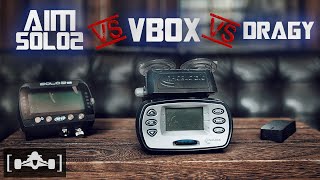
Michael Chuang tests three performance timers: the Racelogic VBOX, Dragy, and AIM Solo 2 DL. VBOX wins for completeness, Dragy offers the best value for straight-line runs, and the AIM Solo 2 DL has the chops but suffers from quirky software, short battery life, and limited customization.
Chapters
I don't do these tabletop reviews very often, but on this episode I wanted to talk about the tools that we use to gather our information and go over their strengths and weaknesses. So today I have the Draggy, the racelogic VBox performance box, and our newest edition, the AIM Solo 2 DL. I will be honest with you though, right off the bat I was pretty disappointed with the AIM Solo two and there's a good chance I'm going to return it after this review is over, but that doesn't mean it won't work out for you. But first, a little bit of history. The V Box. Probably the pioneer of the 6130 obsession. I've had this bad boy for about 10 years now and it's still going strong. They make several different models, but this performance box has been everybody's go to, from magazines to journalists to factory testers, etc. It cost about 500 bucks, which is not exactly cheap, but considering it lasted me this long, I'd say it was an investment well spent. Enter the Drag E. I feel like they kind of rode on the coattails of the 6130 craze that VBox started, but they did something that the VBOX couldn't. They made an affordable and easy to use product that the casual racer could just pick up and use. And that's not to say that the V Box is hard to use, it's just that the Draggy modernized it and brought it up to speed by letting you see all the data clearly on your phone and shared into their little leaderboard database. At 150 bucks, that's hard to beat. And then there's the Aim Solo, which has been around for a little while and this is the second generation, but their focus is more on lap timing and track analysis than straight line stuff. This is a DL version which allows you to log and see data from your ECU via OBD2 cable or hardwired connections. And it costs $700, which is a little pricey. How about getting it going? The VBOX is pretty straightforward. You put in an SD card here. I recommend nothing bigger than 4gb because the bigger the card, the longer the boot time. And honestly, I've probably tested hundreds of cars and done dozens of track days and I still have about a gigabyte left over. Ok, so you mount it up with the included suction cups in the back, then you plug in your power cable. It came with a 12 volt cigarette plug, but it's simply a USB type M barrel and you can get them on Amazon and just plug it into a power bank. This is how mine is usually mounted, so the wires are as out of the way as possible for filming purposes. After that, it's pretty simple. You have a few screens you can do lap timing, predictive stuff, but most people just use the performance mode, which tells you all the pertinent acceleration and deceleration information. The cool thing is that you can set custom ranges so you can do anything you want, whether it's 5 to 60, 35 to 90, 2000 or whatever. I obviously have mine set to our usual 40, 160, 130 ranges. And then once your satellites are locked on, you're ready to go. You can drive and not have to worry. It's all being logged on to the SD card for analysis later. But if this process is a little bit too complex for you, consider looking at the Dragy. It has a magnetic back and it comes with two plates that have adhesive on the bottom and can mount to any flat surface on the dashboard. For me, I have to test a lot of different cars, so I just fold over some gaffer's tape and stick it to the center of a dash where I would normally do it, which lets me move it from car to car pretty easily. After you mount it up, you pair it to your phone with the Draggy app. It's pretty straightforward, and as long as your phone doesn't fall asleep, it'll continuously collect data. Nifty, huh? Okay, so by the Amsolo 2DL, and I'm not gonna lie, it's the coolest looking of the three. And that's why I bought it, because I wanted to actually display it in some of the shots when we film, there is a magnetic back, but the easiest and most secure way to mount it is a Rambo suction cup mount that you have to buy separately. So that's an additional 35 bucks. It's got 4GB of memory built in, and it's also an internal battery, so no messy cables or anything, which is nice. You mount it up, turn it on, choose your mode, and start driving. It's a little finicky in the fact that you need to set the appropriate mode beforehand, whether it's lap timing or straight line stuff before it'll record data. So it's not as plug and play as it might seem. But if you set it to lap timing mode, it will pick up whatever track you're closest to, automatically log data, and set the finish line. Because it has a database of over 3000 tracks in its system. The battery life is also not that great, but if you do run out of battery, you can supply power with one of these, which is the OBD2 cable that you plug into your car's ECU port. And if you do plug it in, you can basically turn the Aim Solo 2 into a pretty nifty little Shift light, which is nice on top of receiving all that information. That's all fine and dandy, but how accurate are these things? This is extremely important because otherwise what's the point of spending all that money? All three units can be more accurate than your phone because all three units use a 10Hz GPS receiver, which in theory updates 10 times a second versus your phone's GPS, which updates once a second because it's a 1Hz receiver. Now, not all 10Hz GPS receivers are created equal, and the AIM Solo uses the Glenass system as well, which should theoretically provide more accurate results. Let's start with straight line stuff. For this test we'll do a quarter mile run in my wife's Mazda. To my surprise, the Draggy had the most accurate time as well as automatically accounting for the one foot rollout. The VBox and the AIM Solo were both pretty close to each other, but had a slightly larger delta from the physical time as well as trapping higher. So from a dig, I think the Drag E is the clear winner, but from a roll I always find the VBox to be just a hair more accurate. I can't attest to the AIM Solo from a roll because we didn't get a chance to test it at Slipstream. How about around a real track? The Drag E is automatically disqualified from this because, well, it doesn't record lap times, it only does straight line stuff. And they say there will be a firmware update where it can start doing that sort of data logging, but at the time of this review it hasn't happened yet. Anyway, we went to NJMP Thunderbolt to test the units out and it was pretty clear that both the VBOX and the AIM Solo provided extremely accurate readings down to hundredths of a second. So this is really a tie here, although I am surprised that the VBox, even in its old age, produced ever so slightly more accurate results. How about some unique features? Each unit has a sort of unique strength or feature that sets it apart from the others. In the case of the Racelogic VBox, it's the sheer customizability of the interface. You can literally create any sort of performance test directly off the screen and see the results in real time. I can configure this thing to do half mile timing as well as braking from 100 to zero at the same time. Yes, you can set custom ranges on the Dragy, but it's a little bit more difficult to set up and view. However, the Draggy is great in the sense that it provides all the crucial data to the user almost instantaneously via their phone. On top of that, it's tiny. It's like the size of a flash drive, and although it's not as detailed as the VBox, it provides me with the slope of the road on the spot and that's important to let me know if the run was valid or not. It also provides density, altitude, elevation and temperature during your run, but I found that the DA reading is actually pretty inaccurate when compared to my Kestrel 5100 or cross referencing it with online weather records. The AIM Solo is awesome because it can connect to your car, collect data and act as a secondary dash. The built in track database is really cool too, so you don't need to manually set a start stop. On top of that, the readings are displayed down to 1000th of a second. The other two only do 100ths of a second. And I also like that it's all in one. No need to connect to your phone or power it externally, no SD card. Just boot it up, set your mode and go. Now here's what I don't like. The biggest pitfall of the VBOX is that it requires external power, and although the setup that I have is pretty efficient, it's still cumbersome to rig and set up when you compare it to the other two units. I wish the screen was brighter and perhaps bigger. The Design is over 10 years old and they're rumored to have a replacement in 2020. That solves all this though. One more thing, the suction cups are a bit weak. I've had situations where I had to tape the suction to the windshield to make it hold. The Draggy's biggest weakness is it doesn't record lap times, and that'll automatically disqualify for most of the track guys out there. The other downside is that you can't take the data off your phone and analyze it further in a software like you can with the Aim Solo 2 or VBox, and that's a pretty big con as well. Now for the AIM Solo. I'll tell you why I'm returning this thing because for 700 bucks you can't create custom ranges in the interface and you can't even program them in Ray Studio and aside from lap timing, it's a lot harder to use in the V box or Dragy. They got all these cool functions in the AIM Solo, but they couldn't integrate anything besides quarter mile, eighth mile 060 or 60 0. Come on guys. Also, AIM's Race Studio 3 software has a much steeper learning curve than Racelogic Test Suite. Not necessarily a bad thing, but I wish there were more tutorials online and technical support to walk you through your first time. Here's another bad thing. The battery life. Yes, it's nice to have an onboard battery, but in practice I would drain the batteries in about two hours or so every time. If you think about that, we're talking about 5 to 620 minute track sessions max if you shut it off after every session. Some people might find that adequate, but people who spend this kind of money on a data logger are probably here all day doing the full eight sessions plus on site analysis. And frankly, two hours is simply not enough. So which one is the best? I really wanted to like the aim solo 2 DL. I watched all the videos, read every review, contacted AIM Solo, I even read the entire manual if I bought this thing. And you know, honestly, even though it's technically superior to the VBOX and the Draggy, it just has way too many quirks and variables to make it practical for me. Plus the lack of having custom ranges on the screen is the biggest downside. Even if I can pull this data later in Ray Studio sometimes I test multiple cars at the same time and I need to see the data on the spot. That said, if all you do is lap timing and track analysis then this is probably the best product for you. And if you don't need a data log from your car's ECU, then just save the 300 bucks and get the non DL version now. If you only do straight line stuff, don't want to mess with any software or just casual about it all and just want to compare times with your friends. Get the Dragy. It offers tremendous value for $150, has great accuracy and provides all the key information in an easy to understand package. And you and who knows, maybe one day they'll be able to add that lap timing function. But in my opinion the winner here is still the vbox. Not the prettiest or easiest to use, but it is the most complete package. It can do pretty much everything you need and more. There's no margin for error as long as you have a powered on with an SD card in there. It's perpetually recording data, unlike the Dragy, which stops recording if your phone goes to sleep, or the AIM solo if you forget to put into the appropriate test mode, in which case it doesn't even record at all. All the VBOX needs now is a nice little facelift, and I'm sure the folks at Race Logic are cooking something up. Anyway, I hope you found this video helpful and let me know which one works the best for you. Me, personally, I like to run both the VBOX and the DRAG at the same time for my acceleration test because that gives me the peace of mind just in case one of the units fail. Plus, I hate doing math, so I like to have the slope on the spot. Thanks for watching. Good boy. Good boy. All right, you ready? You can see him. Yeah. Down. That's enough. Go to sleep. Good boy. All right, if this is your first time on the channel, be sure to watch some of my other stuff. I'm dedicated to producing cinematic car content and doing real world performance tests for all sorts of fast cars. So if that's your jam, be sure to hit that subscribe button and ring that bell icon for new episodes every Thursday. Thanks for watching.
More from Michael


Straight out the box subscription product, everything is listed already on our website! Check it out