Michael Dell, Founder of Dell — How to Play Nice But Win | The Tim Ferriss Show
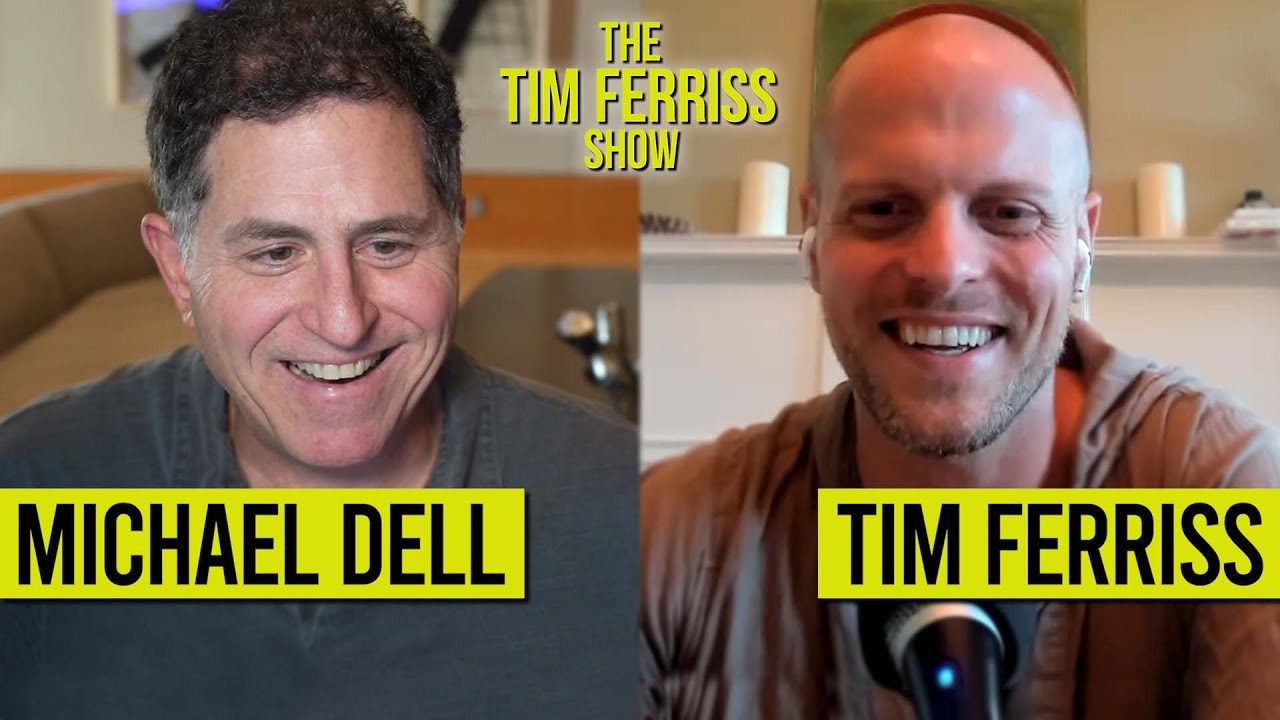
In this episode of The Tim Ferriss Show, Michael Dell, chairman and CEO of Dell Technologies, discusses the origins and meaning of his new book Play Nice But Win, recounts his early entrepreneurial ventures selling newspaper subscriptions, and explains how data‑driven sales tactics helped him earn $18,000 at age 17. He describes confronting corporate raider Carl Icahn during the 2012–2013 go‑private transaction, detailing the strategic rationale for taking Dell private, the challenges of financing the deal, and the role of allies such as Jamie Dimon and Silver Lake. Dell reflects on two major failures from the late 1980s—a over‑ambitious “Olympics” product line and a memory‑chip supply‑chain misstep—that taught him pragmatism and the value of just‑in‑time inventory. He narrates the hyper‑growth period in the early 1990s when revenue jumped from $890 M to $2.1 B in a year, the operational strain it caused, and the lessons about balancing growth with liquidity. The conversation moves to Dell’s transformation from a PC‑centric company to a cloud‑IT leader through the $67 B acquisition of EMC and VMware, the creation of a tracking stock, and the decision to go public again in 2018 to simplify the capital structure. Dell shares personal insights about introversion, vulnerability, and self‑care (sleep, walks, exercise), and how his early speech‑coach investment helped overcome a stutter. He discusses the strategic advantage of direct‑to‑consumer models, the information edge they provide, and common pitfalls for newcomers. Finally, Dell explains why he wrote the book—to be authentic, to share failures, and to encourage risk‑taking and curiosity—hoping readers will play nice while still winning.
Chapters
Just a quick note, at the very beginning of this conversation, we dive into a little bit of inside baseball, but not to worry, we come right back around later in the conversation and explain everything. So Stick around and thanks for listening. Hello, boys and girls, ladies and germs. This is Tim Ferriss and welcome to another episode of The Tim Ferriss Show. My guest today is none other than Michael Dell. You can find him on Twitter @MichaelDell. Michael is chairman and chief executive officer of Dell Technologies, an innovator and technology leader providing the essential infrastructure for organizations to build their digital future, transform IT, and protect their most important information. He's also the author of Play Nice But Win.
Yeah.
A CEO's Journey from Founder to Leader. Michael is an honorary member of the Foundation Board of the World Economic Forum and is an executive committee member of the International Business Council. In 1999, he and his wife, Susan Dell, established the Michael and Susan Dell Foundation. You can find Dell online at dell.com. You can find Michael on all social, and I'll link to those at tim.blog/podcast. But for instance, as we mentioned, on Twitter, @MichaelDell.
Yeah.
Michael, welcome to the show. So nice to see you.
Great to be with you, Tim. Thanks for having me.
And I thought we would just dive right into the action and begin with a story to pull people into your life and the many adventures that you've had. You open the new book with some mention of meatloaf, and I'm a huge fan of meatloaf, so that got my attention. But there are other aspects that got my attention. Could you please elaborate and tell us the story of eating meatloaf and why it made it into the story of your life.
Yeah. Well, it wasn't Meatloaf, the band or the musician. It was about halfway through the go-private. And I confront Carl Icahn directly, face-to-face, eye-to-eye in his home, and go over there to have dinner. And I kind of suspected that he basically didn't have any plan for the company. And that was my objective, was to understand, did he really have any cards or was he just trying to get me to raise the price a little bit? And I described this very dramatic moment and I'm at his house and it's very clear to me that he didn't have any plan for the company, but it was a fun and exciting moment about halfway through the go-private.
Now, for people who don't have any context, who is Carl Icahn? Let's just start with defining some of the players here, and then we're going to bounce around chronologically. But for those who have no idea who that is, who is Carl Icahn? What does he do?
So he's a pretty famous financier, corporate raider, greenmailer, and general troublemaker who kind of finds his way into transactions where he can try to cause trouble and get people to buy him out. And, you know, sometimes it works pretty well, sometimes it doesn't. To him, it's all a big poker game. He showed up in the middle of our go-private. He'd never owned any of our stock and found a kind of weasel way into the deal to try to make a little bit of money. Okay.
So if we freeze-frame that in time, there's media coverage with headlines, for instance, from Fortune, The Gamblers Behind Tech's Biggest Deal Ever. But things didn't start there. And I want to go back to childhood and the beginnings, and then we're going to jump around chronologically. But where does the title of the book come from?
So Play Nice But Win is something that my parents used to tell My 2 brothers and I, whenever we would go out in the street to play ball, you know, they, they would tell us, play nice but win. And it kind of stuck with me as a pretty good life philosophy, you know, to be fair, to be ethical, to be forthright in, in what you're doing, you know, in your dealings with others, but also don't forget to win, right? And so some people just just remember the play nice part, but there's also that win part, which is also important. But yeah, that's one of my earliest memories is our parents telling us, play nice, but win. And so it's something that stuck with me. It's something we talk a lot about at Dell.
And just for people who are wondering or people who might be saying to themselves, yeah, yeah, sure. Okay, that sounds nice. Of course, I must say that as a backdrop to this, When we were first introduced a few years ago, the mutual acquaintance who introduced us said to me, he said, he really is just the nicest guy imaginable and his whole family is nice. And that has been my experience. And it's always fascinated me because I imagine many people listening will immediately conjure counterexamples in the sense that there are many ruthless, win-at-all-cost players. And one would imagine that being nice could be a handicap if you're constrained, if you're taking certain options off the table because you view them as unethical or otherwise, that you would be in a way tying one hand behind the back when competing against these other people. How do you think about that?
I think life is a long journey and your reputation and your integrity matter. And I've seen time and time again that when you do the right thing and you treat people fairly and nicely, it comes back around to you in very positive ways. And it's just a, it's certainly what I feel comfortable with, but it's also a lot simpler way to live your life, from my perspective.
If we go Back again to, I guess, your adolescence. Now, this is from just doing homework for this conversation, which I always enjoy doing with people I've met just because it would seem really creepy otherwise to do all this internet sleuthing, but I have a context and a pretext for doing it when I have these interviews. And what I'm looking at here from an interview is what the journalist wrote, and that is, he made a reported $18,000 selling newspaper subscriptions at age 17. The secrets to his success: trial subscriptions for new residents at apartment complexes and condo communities, as well as recruiting friends to research public records of new marriage licenses at the county courthouse. So the first thing I have to ask, because you can't believe everything you read, are those statements accurate? Was that part of what happened in terms of the secrets to the success with the newspaper subscriptions?
Yeah, yeah, that's very accurate. Yeah.
And how did you arrive at, if you remember, recruiting friends to look at the public records? I suppose that's just not something that would immediately occur to a lot of 17-year-olds.
I remember exactly what happened. I got this job and I was a telephone solicitor and I worked at the Houston Post in Houston. It's now defunct. It was merged with the Chronicle and they had a bunch of us kind of in this big open bullpen and we were given sheets of paper that had just random phone numbers on them. And you would call the phone numbers and try to convince people to buy a subscription to the Houston Post newspaper. And my first full month I was there, I was the top salesperson. I remember that because I got an award. I thought that was pretty cool. But what I figured out was that there were a couple things you could do to sell newspapers better than anybody else, right? And one of the easiest things was You just sounded like the people you were talking to. So, you know, you just sort of picked up whatever accent they had. I won't do any of those for you today, but I think I got reasonably good at that. I also noticed that there were some trends of people, because you talk to these people and you're like, you know, striking up a conversation with them, trends about people that were tending to buy the newspaper. One was that they were often getting married and moving to a new house or apartment or something like that. Sometimes they were just relocating to a new place, they were getting a mortgage, something like that. And I figured out that in Texas, as in many states, when you want to get married, you have to get a marriage license. And through the Freedom of Information Act, you can go to any county In Texas, and you can literally go up to the counter and say, I want to see all the marriage license applications for, you know, this period to that period. And on the application, it says where you want the marriage license to be sent to. It gives you an actual address, which is like the perfect address to send this offer to, you know, get 2 weeks free for the Houston Post. And then if you want to continue it— Here's the deal. And so I started in Harris County, which is where Houston is centered, but then there's like 16 surrounding counties. And so I hired a bunch of my buddies, we had Apple II computers back then, and we'd go to these counties, type in all the names and addresses. I did this massive direct mail campaign. And yeah, that's when I was 16, 17 years old. A lot of fun.
It sounds like a lot of fun. I mean, you've deconstructed the system. And was anyone else doing this, or were you doing this by yourself? Were you sort of a Lone Ranger in this approach?
I was kind of a Lone Ranger, but I hired some of my high school friends to go to some of these counties because there were 16 of them and I couldn't really do it all myself. The other thing that was happening in Houston was It was kind of a boomtown at the time and sort of like in Austin now, there's like all these condo complexes and apartment complexes going up and you just go up to the person sort of running the thing and say, hey, I've got this great offer for all your new residents. Can you please put this in the welcome kit? And they say, sure. And so that worked really well. So Yeah, I was just trying to figure out how to sell a lot of newspaper subscriptions.
And around that time, or in your, let's just say, early, mid-20s, were there any particular entrepreneurial heroes or figures you looked up to or tracked closely, read about, anything like that?
I think it actually started before that. When I was a kid, I mean, I saw Charles Schwab, who started this Charles Schwab business, which was pretty cool. Ted Turner, Fred Smith from Federal Express, William McGowan, who had created MCI. And then of course, Bill Gates and Steve Jobs, right? Who are about 10 years older than I am. And all of that was super interesting to me. My mom was a stockbroker. You know, in our family, we didn't talk about the football game or things like that. We talked about the economy and oil prices and which stocks were interesting. And I was really intrigued by all that. And so those entrepreneurs were definitely inspirations.
You wrote your first book in 1998. So you've taken a 20-plus-year break on the books. And I've read that at the time that you published that first book, you didn't feel comfortable disclosing perhaps as much as you feel comfortable disclosing now. You're comfortable sharing more. And I'm curious if you would be willing to share a story or share something that you weren't comfortable talking about then that you are comfortable talking about now.
Well, there's so many things. I mean, I was not really comfortable with vulnerability in my 30s when I wrote the first book in the way I am now. So, One of the stories I talk about how I got arrested, probably not a story I would've told 20 years ago, but I was sort of an irresponsible young guy running around in fast cars and got way too many traffic tickets. And one time I got one too many and got pulled over and Literally, you know, I was taken downtown in the back of an Austin Police Department, you know, cruiser, fingerprinted and everything. Fortunately, they let me go. Felt really bad about it because I always had a lot of respect for the police and any member of the public service. But yeah, there's a bunch of stories in there about, you know, things that went wrong and mistakes made and I wanted to kind of tell the raw and authentic story about how the company really got going. And there were plenty of lessons along the way. I mean, we had people that were doing things they weren't supposed to be doing, and I was kind of surprised by it, but maybe I shouldn't have been surprised.
I'd love to dig into some of the specifics and talk about the things that haven't worked, or perhaps some of the mistakes or failures that stick out to you? Are there any particular formative experiences that fit into either of those categories that come to mind?
Yeah, I'll give you 2 that happened both in the late '80s, right about the time, kind of in the year after we went public and we did a pretty public Faceplant, as it were. The first one was we were ramping up our technical capability and sort of getting bolder and bolder in engineering. And we, you know, it was around the time of the '88 Olympics and we had this big program that we codenamed Olympics, right? And it had multiple microprocessors and all kinds of new inventions and turned out to be way too aggressive and bold, and it failed. Now, I think the lesson from that was to be a lot more pragmatic and focused in our innovation. And actually, the engineering muscle that we built allowed us to, in quick succession, create a broad array of products that were hugely successful and led us to a lot of growth. One of the other big mistakes we made around the time, you know, now a lot of people talk about Dell's supply chain and just-in-time inventory and all that great stuff. Well, it turns out, you know, the root of that was a horrible mistake we made in managing our supply chain because There was one of these transitions from one type of memory chip to another, and we had designed our products with the older type and got caught in a real mess, which caused our fledgling company to almost go out of business and stock to go down. It was really embarrassing, but painful lesson that we learned. And That became the basis of an enormous muscle that we built around just-in-time inventory and supply chain excellence that served us incredibly well and went on to fuel all sorts of successes for us.
It makes me think there's so many examples that come to mind, like James Cameron and The Abyss, where The Abyss didn't do very well at the box office, but helped develop the technology that led to the newer Terminator and Terminator 2. So from the ashes of that so-called failure, there were all of these technological innovations that then came to bear on future projects. How do you think about failure in the sense that, do you view these various initiatives, product launches, et cetera, all as experiments, especially in the early days? Were you ever emotionally— deeply affected by some of these events, or did you maintain a certain degree of stoicism through it all?
No, I was super bummed about it and unhappy, but it just made me want to go at it harder. And I probably didn't internalize the lesson in the moment as much, But there's no such thing as success by itself, right? Failure is always an ingredient of success. And in a business, when you're doing new things, it's always experiment, try, fail, learn, do it again. And then finally, hopefully, maybe you get some success, right? But failure is a key ingredient in any success.
When you mentioned this, this might seem off topic, but I'm curious, being more vulnerable now or more comfortable with vulnerability now, is that just a function of age or have you done certain things? Have certain other things changed that have enabled you to feel comfortable being more vulnerable?
Yeah, I think it's a function of age somewhat and just maturity. And also I would say when I started, I got off to an early start in life. And I found myself in the position where people were always asking me for things. It was pretty uncomfortable because—
Yeah.
And so I kind of developed a little bit of a Teflon coating to distract or deflect those requests. And at the same time, I'm pretty introverted, maybe deeply introverted. And so all of that combined, sort of left me in the situation where I wasn't very disclosing, wouldn't really explain failures or what was going on. So I think some people sort of looked at the origin story or the first decade or so, maybe we didn't really explain all the difficulty that went into starting a business like this. And I wanted to talk about all that.
What were the toughest periods for you personally with respect to the business and the trajectory that it has had? Were there any particularly dark days that come to mind? And specifically, I just want to talk about what got you through that period, what happened, and how you coped with it. Because certainly with the success ingredient, You have the failure component, and I would love to explore that a bit just to humanize the entire journey that you've been on.
I would say I'm pretty high on the determination and grit scale, and so was always looking through to the other side no matter how dark it was. I mean, there were periods certainly in the early '90s where we had grown really fast, And everything started to fall apart. We kind of went from half a billion to $2 billion in revenues in a very short period of time. You know, a lot of people talk about you hit the wall at a billion. We went right from $890 million to $2.1 billion in one year.
Wow.
And everything started to fall apart. You know, we didn't have the systems, the processes, the people, Capital, everything was just not ready. And there was a period there during that time where it seemed like every day, every month, the news just kept getting worse and worse. And yeah, I mean, it's a problem you have to solve, but certainly when you're in that time, you go home and as you try to go to sleep, it's hard to not think about All the people you're responsible for, their lives, their families, the commitments that they've made, and they're counting on you to make this work. They moved their whole family to Austin to help this company grow. And if I screw it up, it's going to be not only really bad, but embarrassing and a great tragedy. Certainly during the go-private, there were some very dark moments. There was one point where the board asked me not to talk to any members of the management team, which—
Makes things hard. Yeah.
And I'm the CEO of the company. It was just a short period of time, but it was pretty weird. And if you go back and look at the press, I mean, there were times when it was totally unclear what was going to happen. And yeah, those were some pretty dark moments. I mean, fortunately, my wife was there supporting me and I had lots of friends that were encouraging me on. But yeah, what is it, Winston Churchill? If you're going through hell, keep going.
Yeah.
So that's what we were doing.
Well, love to tie that into the introvert piece. So I also play the extrovert on occasion, but am deeply introverted. My girlfriend's the opposite. She's very charged and recharged by being around, in some cases, large numbers of people. I get very depleted. I'm curious through those experiences, or just really in general with the I imagine the high volume of communication and the numbers of people you must interact with, particularly during those crunch times. What type of self-care did you have for yourself, or what did you do to recharge, or how did being an introvert play into that? You can tackle that. I know it's a number of questions combined into one, but I'm just curious about how you factor that in, if at all.
Well, to recharge, it's sleep. Now, I'm a big fan of sleep. We've had some separate conversations about that.
Yeah.
And exercise, going on a long walk in the woods, sometimes with my wife, sometimes by myself or with a friend. But the onstage stuff, it's all an act, right? I mean, it's not my natural state of being. But of course you have to do it and it's important to do it, to be able to tell the stories of the company and describe what you're doing, communicate the value of what we're bringing to all these people and get them motivated and inspired. Yeah, you have to do that, but it's not something I would naturally do left to my own devices.
Yeah. I want to ask you 2 questions. I'll keep them a little simpler. The first is about that hypergrowth that you were describing, going from, I think it was $890 million to $2.1 billion in a year, something along those lines. In retrospect, do you think you should have constrained that in some way, or was it necessary to just completely blow things up in order to rebuild? Would you give advice to someone in your similar position to add constraints of some type or do something differently?
I think on the one hand, we needed to balance our growth with also liquidity and profitability just because we were running out of capital and our new CFO that joined us helped me understand that and figure it out. On the other hand, if we hadn't gotten larger and scaled, we probably would've gone out of business anyway, right?
Yeah.
So it was a bit of a, a difficult choice that we had to make. And fortunately, we're still here to tell the story. But I think to answer your question, if we'd only grown from $890 million to $1.3 billion, I think we might have been too small and on a trajectory just to be eliminated in the industry. And of course, we went on to become much, much larger, like over $100 billion this year. But yeah, we had to kind of go for it. And it's always hard to rerun the simulation. There are definitely things you would've done differently, but it's worked out pretty well for the most part.
Yeah, it seems to have worked out quite well. And like you said, you're here to tell the tale. I would like to next just ask you to walk us through your thought process and the process overall for taking the company private and then public again, because most people listening will be, and some will be very familiar with this kind of stuff, but a lot of folks will have a passing familiarity of at least the term going public and they'll know what an IPO is. But I suspect a very small percentage will know anything about then taking a company private and why someone would want to do that. So could you just walk us through what happened and how you thought about it?
So the company had gotten quite large and the growth started to stall out and we knew we needed some new horizons of growth. And we started investing in new areas like software and services and security and started acquiring new companies. And the more we did that, the more the Financial investors kind of didn't like it.
Mm-hmm.
And they kind of just kept associating us with the original product of the company, the PC. Okay? And this was at a time when the smartphone and the tablet were really on the ascendancy. And even to the point where there was kind of this narrative out there that, oh, well, you know, you're really not gonna need a PC anymore 'cause you'll do everything on your phone or you do everything on your tablet. And We kind of had the view that, well, those devices are great, but it's going to be an and, not an or when it comes to these devices. And, you know, when you're making all these investments and doing all these things, but your stock price is going down, it's kind of depressing, right?
Yeah.
But at some point it goes down low enough where the capitalist in me, I can't can't get that out of me, says, wow, there's like a silver lining here that's incredible. And that is we can buy back our stock at this really low price and we can accelerate the transformation and go faster. In fact, we're going to buy back all the stock from the public shareholders. You basically pay a premium that is, you know, you pay a price that's higher than the then current price. So the Public investors get some of the benefit of the transformation strategy if it's successful without taking on any of the risk. And then we as the owners of the company, myself and Silver Lake who joined me in the go-private, can really go much faster on the transformation. We can make investments without having to think about the the quarterly earnings, you know, shot clock that is there, you know, when you report every single quarter. And so I thought it was a relatively straightforward thing to do. It turns out, you know, it's a lot harder to buy your own company back. And we had the Joker showed up, Carl Icahn, to sort of make it much more interesting and difficult. And yeah, it started in August of 2012 and we finally completed it in October of 2013. And then, you know, we just started investing super aggressively in research and development, hiring more salespeople, and it was working. We were generating tons of cash flow. And we decided to sort of quadruple down. And after we'd done the biggest take private ever in technology, we said, let's do the biggest merger acquisition ever in technology. We bought EMC and VMware and created the largest cloud IT infrastructure company on the planet. And ultimately, through a complex series of transactions, we had a tracking stock. We wanted to simplify the capital structure, and we had transformed the company in a material way. And so it was kind of time to go public again in late 2018.
Okay. I have some follow-up questions. This is extremely interesting to me because I remember watching from the sidelines I remember when this happened, but I was only getting the headlines, but also getting the interpretation of commentators, not the people actually on the field. First thing I have to ask, and I'm embarrassed that I need to ask this, but in this context, what is a tracking stock? You mentioned a tracking stock.
When we acquired EMC and VMware combined with them, it was like $67 billion. But we didn't have $67 billion. We had the equity in Dell. We took on substantial more debt. And to compensate the shareholders, we gave them a combination of cash and a tracking stock, which tracked— see, EMC owned an 81% interest in VMware. And so the tracking stock was created for a portion of that EMC ownership to compensate the EMC shareholders. Tracking stocks are kind of arcane. You don't really see them very often. And the tracking stock appreciated well, but it still traded at a substantial discount to the underlying VMware shares. And, you know, a better way to do this was to align all the interests of shareholders, which is why we ultimately combined with The Tracking Stock in late 2018.
So when you were thinking about taking the company private, and as you went through the process, how did you think about risk and mitigating risk? What were the risks in terms of downside scenarios or worst-case scenarios, and how did you sort of mitigate the likelihood of ending up in those?
Well, when you take a company private, basically you're putting it up for sale, right? And anybody can buy it. I wanted to be the person who was going to buy it and thought that I knew more about it than anybody else. And I thought it was worth a lot more than the market thought it was worth. Otherwise, I wouldn't be buying it, right?
Yeah.
But a lot of things could have gone wrong. I mean, somebody else could have stepped in and said, well, I'm willing to pay a little bit more. And then I would've either had to top that offer or, you know, at some point get priced out. And of course, you know, the process can cause a lot of disruption. It can, you know, be used by competitors who can create Fear and uncertainty and doubt in the market about your business. Imagine the family members inside the company reading about this or hearing about it on TV and wondering what's going on with this company. And during the process, a lot of the downside scenarios played out. I mean, we had multiple bidders. There were times when people were speculating about who was going to run the company and it wasn't going to be me. It was a pretty messy, ugly process.
With respect to ultimately going public, and I suppose I should just add as context, so I know a fair number of public company CEOs and more than a few just hate the shot clock, as you put it. They're like, hey guys, we're trying to make investments for long-term growth and innovation. This is ridiculous. And it bothers them a lot. And then I know the CEOs of very large privately held companies. Ultimately, was the decision to go public again necessary because shareholders needed liquidity? Is that how the decision was made?
I wouldn't say it was necessary because shareholders needed liquidity. None of the shareholders have really accessed liquidity in any material way.
Yeah.
But it certainly allowed us to clean up the capital structure, simplify things, pay down debt faster, We just got an upgrade to investment grade by one of the rating agencies, which we kind of expected was going to happen, which is great to see it in print. But I would say one of the things we did during the go-private was we reignited the entrepreneurial spirit of the company, which was its origin. And I actually believe we've kept that going even as we're public. And so We're very clear with our investors that our horizon is not just the next 90 days, right? We're thinking about, you know, the medium term and the long term, and we've reoriented the business and, you know, it's, it's working. We had 15% growth this last quarter, and at our size, that's substantial growth rate.
Yeah, it's a huge growth rate. Was there anyone who stands out Could be more than one person who was particularly helpful that you're comfortable sharing during the take-private chapter of your experience? Yeah.
Jamie Dimon from JPMorgan Chase was particularly helpful. And there's one story about the combination with EMC and VMware where he comes with Egon Durban from Silver Lake and I to the EMC board meeting where we're basically trying to convince them to let us buy their company. And they're asking us all these various questions. And at one point they ask, well, do you have the money? It's like $67 billion. And Jamie just says, yeah, yeah, they have the money.
So that was it.
That was it. He said it. And he has stepped in and helped our company many, many times and super helpful, thoughtful, and been a great friend.
I'd love to ask about investments, but maybe not in the traditional sense. I'd love to ask you what are one or some of the most worthwhile, valuable investments you've made? That could be an investment of money, time, energy, anything at all. And just to give an example, I think Warren Buffett, when he's asked this question, your best investment, he talks about a public speaking course.
Yeah.
I believe it was with the Dale Carnegie Institute or something along those lines, because it multiplied so many other skills. It was complementary to so many other things that he was focused on. So it could be really anything at all. Does anything come to mind that would fit that question?
Yeah. Well, certainly for me, my best investment by far would be the $1,000 that I invested in starting our company.
Right.
So that one has turned out to be certainly one of my all-time best investments. But my mother, may she rest in peace, she recognized when I was in about the 2nd or 3rd grade that I was stuttering. I had a pretty bad stuttering problem and she got me a speech coach. And it seemed like every day, I don't, I probably wasn't every day, but it seemed like every day after school I would go there and the speech coach would work with me. And after about 6 months, I kind of stopped stuttering.
Huh.
So that wasn't an investment I made, but my mother kind of knew what I needed at that particular point in my life. And that was clearly a great thing because it could have held me back otherwise.
How do you think about competition? And I'm leaving that very broad, or could you tell us a story about competition? Either will do. I'm just curious. And this kind of comes back to one of my original questions of whether or not you have to change your playbook or opt out of certain competitions, given you have this North Star of playing nice.
Well, there are certain kinds of things that you just opt out of because you're not willing to play dirty.
Yeah.
And I'd say you see some of that in certain countries around the world. I won't name any in particular, but you know who I'm talking about. And so we kind of avoid those things. And for me, competition is interesting and often Motivating. I think also it can be limiting if you're comparing yourself to competition. The competition might not be very good, right? You could totally be setting the wrong benchmarks, right? If you're measuring yourself against, you know, a competition that's, that's not really that great. And you can also learn a lot about what not to do from competition. Right. But I actually think it sounds kind of trite or quaint. You learn a lot more from your customers than you do from competition. And we always talk about having big ears and designing the company from the customer back and solving the unsolved problems of customers. You're not going to get those things from the competition. As much as you will from a real understanding of what the customer is trying to do.
You have been a true pioneer in, I suppose, what all the kids would call DTC these days, direct-to-consumer. I mean, you have tested and tested and refined and refined, and in the beginning certainly pioneered a lot of approaches. I would be curious to hear, since the direct-to-consumer model is much more prevalent now than it was when you started, what are some of the common mistakes or things that people miss when they're novices engaged or trying to engage with a direct-to-consumer business model?
I think there are many, many flavors to it. I think some of the advanced moves are understanding the information advantage that you have with the direct relationship and connection with the customer. And a way to think about this is in the simple sort of retail versus direct-to-consumer or direct-to-customer online context. If you have 10,000 retail stores and you're trying to predict what people are going to go in those stores and buy. Yeah, you can have like really sophisticated AI and try to guess that, but ultimately it's just a guess and you're having to stage and prepare all sorts of things and anticipate, and ultimately it's going to be wrong and to some degree, right? And demand's going to change and unexpected Stuff is going to happen. Whereas if you have perfect information and the quality of your demand signal is actually perfect because you're in direct contact with that customer, you don't need any inventory to prepare for that. You can use that signal to feed your supply chain in real time, and that creates an enormous capital efficiency. But the information advantage coupled with the capital efficiency, coupled with the customer intimacy and the ability to improve the product either with telemetry data or feedback in one form or another, the compounding effect of that is quite valuable versus delegating that to a series of other parties.
Why don't more people do that? Why do people delegate it out to third parties? What makes it difficult?
Well, I think you're seeing more and more direct-to-consumer, but supply chains were traditionally long. People had multiple levels of distributors and dealers and that sort of thing. But now with digital channels and everything going online, you see much more of that. So now it's becoming more the norm. But you think about, you know, a product or service today is continually improving even once you have it, right? It's being upgraded with software and with data and with AI all the time. And that's obviously far better than just a static product. So I think more companies are figuring out, even the ones that had those traditional channels are trying to figure out Gee, how do we create this persistent connection with our customer so we can be more in touch with their actual needs? And look, I believe fundamentally that organizations like ours and others will be successful if they solve the future problems that customers have. If they don't, they'll just go out of business, right? So you have to be in touch with those problems. And you have to have the capabilities to innovate around addressing those unmet needs. Now, customers aren't always going to tell you exactly what the problem is. They might articulate some difficulty they're having. A company has to understand all the ingredients and all the sort of molecular components that go into creating the solution. And that's often where the magic occurs in product or service creation, is this understanding of all the ingredients and all the unsolved problems.
So I have to ask you about this book as a project. There are a million and one things you can spend your time on. You're a busy guy. You are a fully engaged human being with the world. Why dedicate the time and energy to a book project, to this book project?
A lot has happened in the last decade, from the go-private to the biggest merger acquisition in history in technology, going public again, transforming the company. Again, the first book I wrote back in the '90s, I really didn't disclose very much. And I wanted to tell the kind of real authentic story. A number of friends encouraged me to write a book about everything that occurred. And it was fun to go back and tell some of the stories about the origin that I had never talked about before, as well as kind of explain the real story of the struggle to you know, keep the company and transform it.
And is, is there anything you really hope people will come away with after reading the book, or a particular impact you'd like it to have on readers?
You know, I, I hope people will take more risk. I mean, I, I have this belief that a lot of human potential is sort of left unrealized because people are afraid to fail, seeking perfection and unwilling to experiment and make mistakes. And if you read the story, you'll see that at the root cause of what is ultimately a very large, successful company were all kinds of learnings and mistakes that went into it. And I think you have to be a little bit, willing to break some rules. And if you're always following instructions and doing what you're told, you're not going to drop out of college and start a company, right?
Michael, I always enjoy our conversations. I am very excited about the book, and the title could not be more accurate as far as I'm concerned. Play Nice But Win is the title of the book. Subtitle, A CEO's Journey from Founder to Leader. People can find, of course, Dell Online, dell.com, at Twitter @MichaelDell. You're also @MichaelDell at Instagram, Facebook, Michael S. Dell, LinkedIn, MDell. Is there anything else that you would like to say? Any request of the audience? Any closing comments you'd like to add before we wrap up this conversation?
No, I think you got it. I mean, the other things I talk about in the book are curiosity, and I think Curiosity has been a driver for me. I was interested in math and electronics and computers from an early age, and that has led me to the path I've been on. So I think being curious, learning, experimenting, failing, taking risks, there you go.
That the combination of the stories sort of allude to principles and playbooks that people can borrow and apply, and moreover, that it's possible to win and be nice while doing it. So I really appreciate you taking time to have this conversation, and hopefully we'll be back in Austin before very long. But thank you for making the time to— Thank you.
Awesome, Tim. Great to be with you. Thank you.
And to everybody listening, we'll have links to everything in the show notes, all resources, as well as links to Play Nice But Win and everything else at tim.blog/podcast. And until next time, thanks for tuning in.
More from Michael

Michael Dell's 40-Year Tech Journey: AI Supercomputers & Innovations | WSJ CEO Council