Michael Dell | Podcast | In Good Company | Norges Bank Investment Management
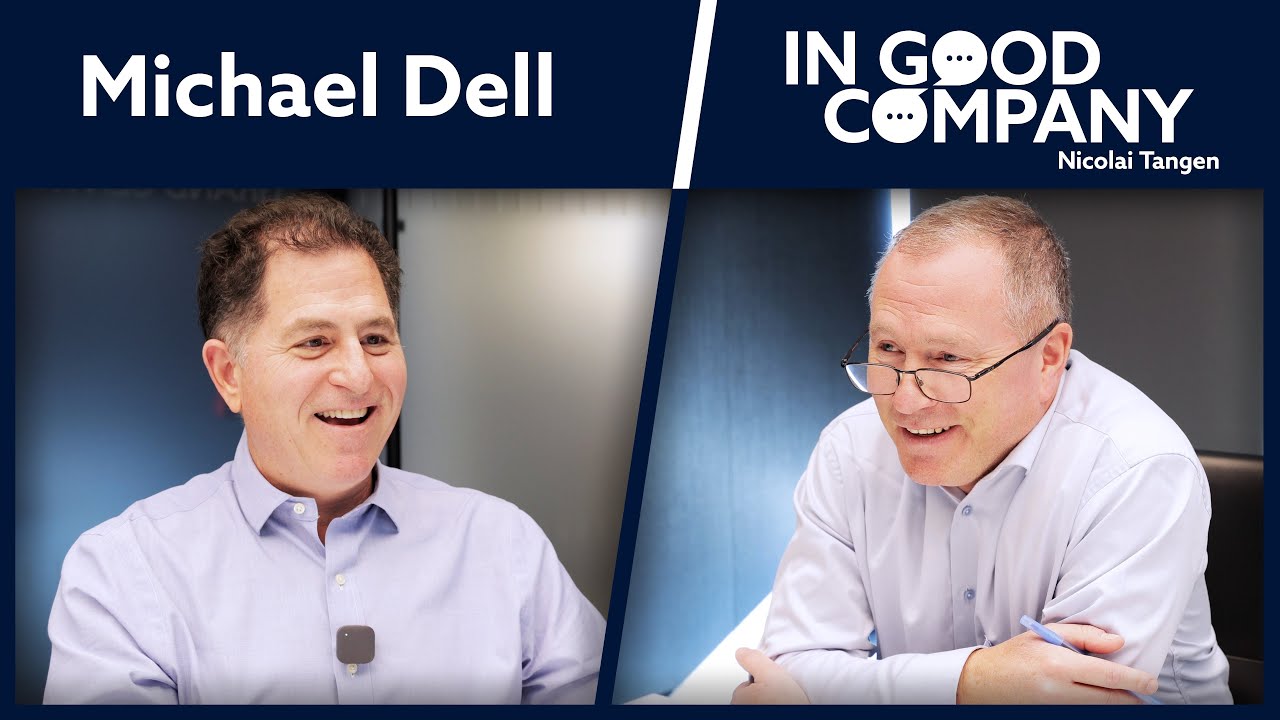
Michael Dell tells how he disassembled an IBM PC at 16, found components cost far less than retail price, and built a $33 million company in year two by selling directly to customers. He discusses going private in 2013 to escape short-term pressure, the $67 billion EMC acquisition, and his view that AI is only 10% through its growth curve.
Chapters
Hi everybody, I'm Nikola Tangen, and today I'm here with one of the most incredible tech entrepreneurs of all times, who started off in his freshman dorm room and built his company to one of the largest technology companies in the world. Now, one-third of you will have a PC with his name on. Michael Dell, welcome.
Thank you so much, great to be with you.
Normally, Michael, I would kind of start with the present, but I think when it comes to you, we have to go all the way back, you know, Let's start at the beginning. You were very young, and you bought an IBM computer. And most people would kind of start to do computer things, but you took it apart instead. What did you— how did that happen? What did you see inside that computer?
Well, you can't actually understand things unless you take them apart and know how they work. And yeah, I was very interested in electronics and kind of what was inside, right? And microprocessors, memory chips. Disk drives and power supplies. And I kind of wanted to understand all of this. And so I was curious and I was interested. And one of the things that I found was that the parts that were in this IBM PC, it was introduced in August of 1981, none of the parts were made by IBM. And I was upgrading computers.
But you were— what were you, like 15 years old or something?
I was 16 years old.
16. And how did you buy it? I mean, did you get some money from your parents, or you've made your own money, or—
Well, I had— when I was 12, I worked in a Chinese restaurant and had a bunch of different jobs. I was like trading stocks and currency when I was 14. I got a job at a newspaper, not delivering the newspapers, selling newspapers. And it just kind of had all these little businesses to make money. And it was fun.
When you took it apart, the IBM, where were you? Were you in your room or living room?
I was in my parents' house where I lived, in my room. Yeah.
You get a screwdriver and you just screw it apart.
Sure, yeah.
And what did you see inside? What did you learn when you opened it?
Well, back then, you could actually learn a lot because you didn't have these large chips that we have today that are an amalgamation of lots of small chips. And so you could literally get a book that would explain what each chip did. And you could understand the circuits. And as I said, I was upgrading computers to make them do more. More memory, more storage, make them go faster. And so what I found in this IBM personal computer was that none of the parts were made by IBM. And then I sort of discovered that the cost that they were— the price they were charging for the computer was roughly 6 times the cost of the parts. And so it didn't really seem like it was fair to me that it was that expensive.
IBM was the most valuable company in the world at that stage. And you were a 16-year-old.
They were the most valuable company in the world. And they were about 80% of the value of the sector called technology at the time. So they were more dominant in their sector than any company, maybe any time in history. I mean, are there any companies today that are 80% of one sector of the S&P 500? No, not even close. So yeah, they were an incredibly successful company.
What did you think at the time? Did you have any longer-term plans? So what did you think?
Well, when you're 16 years old, you don't have long-term plans, right? And I didn't. I was just having fun with computers and upgrading them. And went through high school sort of doing that. And I was programming computers. And I was tutoring other kids on how to use computers. And very interested in the idea that the personal computer was very empowering. You could program it to do things. And some of the parents of the kids I was tutoring said, well, I'd like a computer. Can you help me get one? Like, sure, I'll get you one. I'll set it up for you. And I'll upgrade it for you. And I'll do all that. And so it kind of became a little bit of a business while I was going to high school, upgrading these computers. And then I went off to college. I was—
At Texas?
University of Texas. I was a biology major. I was supposed to be a doctor.
Because your parents wanted you to study pre-med.
My parents wanted me to be a doctor. My father's a doctor. My brother's a doctor. Many of my cousins are doctors. And so it was sort of the family business, be a doctor. And strong encouragement from the parents. So I'm not in my parents' house anymore. I'm in the dorm room. I've got a lot of time. University of Texas is a big school. Some of the classes are enormous. If you've If you show up or you don't show up, they don't really notice all the time.
So you didn't always show up?
So I'm kind of doing this computer thing and it's getting bigger and bigger. And my parents found out about it. They got very upset. They kind of made me stop. I stopped for 10 days. And that's when I decided that actually this was something So how did it scale?
How quickly did you scale it? Because growth rates in the beginning were tremendous, right?
So in early May of 1984, the company was incorporated. Dell Computer Corporation became a corporation. And it was about a week or two before my final exams of my freshman year. And so the first year, we had $6 million in revenue. And the second year was about $33 million. And we grew about 80% per year for the first 8 years compounded.
Wow.
And then for the 6 years after that, we grew about 60% per year. So if you put any number in there and you do that kind of compounding, all of a sudden, you've got tens of billions of dollars. That's what happened. We started originally making upgrade kits for the IBM computers, then designing our own computers, and then expanding geographically. We expanded from desktop computers into notebook computers, then into servers and storage and services. And here we are today, 40 years later.
How much did you work? What does it take?
All the time. I mean, what else is there to do? I mean, if you're starting, I mean, yeah, when you start a company and you're 19 years old, that's all you do is you work. It's fun.
It's your life, right?
Yeah.
So what is the entrepreneurial mindset? What is it? What is it that makes some people do these kind of things? There are not many of them. There are not many of you. What do you think it is?
For me, it was curiosity and just interest in technology and the possibility that these machines could enable people to do things. I was interested in business and also I saw that, wow, when people get these machines, they can do amazing things with them. The technology is improving so much and always looking to find a better way to do it. Can we beat the other guys? Can we build a machine that has more performance than our competitors? Can we offer better value to our customers and grow the business and ultimately grow the impact of what we're able to do?
Why do you think there are more entrepreneurs in America than elsewhere?
I think there's something in the culture that is accepting risk, even embracing risk in a good way, that says, well, OK, if you try something and it doesn't quite work and you fail, it's OK. Try something else. And maybe that is not as accepted Everywhere, I think there's you know a combination of factors, right? It's this risk acceptance. It's capital that will invest behind that. There's a history of other entrepreneurs that you can look to, that I look to and others look to, and said, "Well, yeah, they did it, so maybe I could do it." Did you think it would risk at the time?
Did you did you ever have fear?
No. So if you have nothing, nothing to lose, right? So it didn't seem like a big risk. I mean, the risk for me was. If it didn't work, I'd go back to college. So not that big of a risk. Now, obviously, as the business grows, you're like, wow, now I've got hundreds of people working for me. I'm responsible for them. Some of them have families. And they have kids. And so every night when you sort of put your head down on the pillow, you're thinking, I've got a big responsibility now. I better not screw this up. All these people are depending on me. But I think there's also a lot of opportunity that is unrealized because people aren't maybe as willing to take risks. But I never really thought about it as, oh, I'm taking this massive risk.
You also changed the way people thought about supply chain. How was your thinking differently than what was normal at the time?
started the business as selling directly to the customer. And when I say that, there's generally a perception that the customer is an individual consumer. And it's true, we sell to consumers. But actually, the vast majority of our business has always been, even from the beginning, businesses. Governments, institutions, Of all sizes, large and small. And so we had this direct model. That's how the company started. And if you contrast that to others where you had, let's say, retail stores and a series of people that were kind of in the middle between the manufacturer and the ultimate customer, you have this classical system of guessing what the demand is going to be and then putting inventory in these various locations. And so something very interesting occurred with the personal computer. And it's still very much the case in this industry and many others. There's always new technology. And the cost of the material is generally coming down.
Yeah.
And so if one company has, let's say, 90 days of collective inventory in its various stages going from the manufacturer to the ultimate customer, and another company has, let's say, 5 days of inventory between the manufacturer and the customer, and the material costs are coming down like this, there's only one company that's going to win.
Yeah.
Because it has a structural cost advantage. So that's what we had. It also had a way better return on capital. Because we didn't have to have all the capital employed there. So how did we come about this? Well, one way we came about it is we didn't have any capital. So we had to invent something that was way more efficient. And we had this direct to the customer model, which also gave us incredible fidelity in the signal of the demand.
Yeah.
Right? Because if somebody walks into a store, well, you have to have guessed before what it is they're going to buy. But if somebody calls us on the phone, or now we have internet, right? They go online, they buy something, we know exactly what they want, right? Because they're telling us. And that signal can go back to our supplier, in a nanosecond. And so you get this very efficient supply chain that is also very efficient in capital return.
You mentioned it was important to have role models. And of course, some people have football players and baseball players as their role models. I believe you more had people like Bill Gates and Steve Jobs and so on. How important is that?
Yeah, well—
And you met Steve Jobs when you were very young.
I did. And you had people like Fred Smith, who started FedEx, and Charles Schwab and others. You could see entrepreneurs that were out there starting businesses. You're like, that's pretty cool, right? What they're doing. And it was never like, I want to be exactly like that. It's like, well, what can I learn from that? They did something really cool and interesting. And yeah, I think it's important to have those examples.
It's interesting because when I prepared for this, I spoke to a lot of people who know you. And they will say, you know what, Michael Dell, he's like a real businessman. He loves business. I mean, there are few like diehard businessmen. And if it hadn't been computers, it would've been something else. Just why do you love business?
I think it's fun because, you know, it's an interesting puzzle, right, to solve, right? It's like, why do certain businesses grow and succeed? Why do others fail? How do you position? How do you create the right products? How do you align the people and the teams to drive success? And ultimately, progress in the world, my view, is generally not from the government. It's from the private sector. It's from individuals and businesses that are propelling innovations and driving forward. And so, you know, to be a part of that in the technology sector in the most exciting time in the world, I don't know anything that would be more fun and interesting than that.
Just after the year 2000, you became the biggest brand in the world. Did you celebrate that? I mean, are you a believer in celebration?
You know, we kind of have this phrase, you know, celebrate for a nanosecond. So we do some celebrations, but not too big into that. We mostly, You think about where are we going in the future? How do we continue to grow and expand and provide more to our customers? And, you know, we're in a business where it's always changing. There's always something new coming.
What's been the biggest surprise for you in terms of technology development? So when you go back, what has been like, wow, this is, I never expected this to happen?
It kind of happens in a bit of slow motion. So it's not all that surprising. I think certainly in the last 2 or 3 years, the tremendous progress in AI and particularly large language models and the speed at which that's happened and how it's been diffused into open source and is I think really a revolution in a lot of areas. I was surprised by it in the instant that it started to happen, as I think a lot of people were.
What is your take on the current state of AI development?
I think we're in the first 10% of the S-curve. And most of the world has not really figured out how to use all these tools, although we have access very broadly. The tools that we have are pretty amazing, but they're the worst they'll ever be. They're going to get way, way better in 5 years. And most of the data that exists in the world hasn't even been touched as it relates to these kinds of tools. And there will also be compounding improvements that layer on top of the existing improvements. And yeah, I think it's a revolution in terms of the productivity and efficiency that it unlocks inside existing businesses. More than that, I think it's an opportunity for growth and for reimagining how a lot of things are done in the world that ultimately will propel humanity forward.
So when you look at— because you have insights into a lot of the enterprises— and what are the most exciting changes and developments you're seeing there?
I think we're still very much at the beginning of this. And what's happening is businesses, enterprises are realizing that they can fundamentally rethink a number of their processes and ultimately become much better at the things that are important to them and automate a lot of things that are rote or not as interesting for humans to do. And we've had this sort of Schumpeter's creative destruction for a long time, where some new technology or model comes along and It replaces old ones. This is just that, but turbocharged to an extreme.
But is it slower than you had expected? Is the uptake from normal companies slower?
It doesn't feel very slow from where I see it.
Because people are slow when it comes to changing the way they work, right?
There's definitely a cultural element there, right? Want to change and you have to have a culture that embraces change. That's not always the case in all organizations. I think what's generally happening is you have, again, a kind of S-curve adoption where you have some early leaders in just about every industry that kind of say, wow, we can have 10% or 20% productivity improvement. it's not very hard to get that. And there have been sightings of 30% or 40%. We better go do that. And if one firm does that, and another firm in the same industry hears about that, like, well, maybe we better do that too. And if they don't, you'll see firms more quickly separating themselves, succeeding faster or failing faster, which has generally been a trend for a long time. The pace of business cycles has been speeding up. And so, I think we're starting to see that. And there are tons of use cases that are obvious from software development, enhancing the productivity of software developers, making the code actually better.
Sam Altman told us that we should improve our productivity by 20%. So, that's the target we have.
Well, there you go. I think that is a completely reasonable target. That's not a crazy target at all, given the tools that are out there. Now, I think it's easier for larger firms than smaller firms, because there are way more people involved in the processes that go on inside larger firms.
Yeah.
Right? But they also have cultural inertia. things that can get in the way. But this is why leaders differentiate. They're able to make changes that propel organizations forward.
Yeah. Talking about tools, who do you think will win the hardware race, the chip race?
Clearly, we have one company, NVIDIA, that has got an incredible early lead. And they're in a great position. Lots of companies have entered the space. I don't think of it as one company wins everything. So first of all, AI itself will occur anywhere where there is data.
Right.
So on your PC, on your phone, in your car. everything in the world is becoming more intelligent and more connected and is generating data. And so the AI is going to go to where the data is. And some of it will occur in big training data centers like the kind we're building and talking about. But most of it will actually occur in the real physical world. So I think there'll be many companies that succeed in that space. Certainly, we have been probably the leading company in the world now building these large AI server farms for training and inference to fuel these AI engines.
Some people think that eventually compute will be free. Do you think computer power will be free eventually?
Sure, you can have a free computer. It just doesn't do very much. If you want the latest one, that costs a little more than free. But I mean, the cost of a given unit of computing certainly is asymptotically approaching zero for sure. It's just that what you want to do that's interesting and valuable uses more computing power.
Moving into consumer PCs. So a third of your income is from commercial PCs. Like the one I have at my desk. What are the important innovations taking place here now? They look a bit like— they don't change that much, right? I mean, they look a bit like the one I had last year and the last year.
Yeah, this is kind of the deceptive thing, right? Because if I said, here's a PC, right? Well, you could have a PC from 40 years ago or 30 years ago, you know, 10 years ago, still a PC, right? Well, actually what the PC does is very, very different than it used to do. And so we keep asking it to do more and more things. Right now, the big thing that's going in the PC is AI. And we used to have the CPU, right? Then we had the GPU. Now we have something called the NPU, a neural processing unit. And it is a part of the processor that speeds up the AI activities that occur on the PC. To an incredible degree. And pretty much all the software that you're using is being rewritten so that anytime there's a prompt or some user interaction, that experience is enhanced and made better using AI. And most of that AI, maybe 85 or 90% of it, will run locally on your PC. And so we talk about the AI PC, and there are 1.5 billion PCs in the world, roughly, and about 750 million of them are more than 4 years old. Obviously, they're not going to be able to do this. Even the ones from last year don't really do it. So all the new ones have these NPU, this ability to enhance AI software on them. And that's probably the biggest thing that's going on in addition to longer battery life. We have more than 24-hour battery life, super bright displays, super thin, super light, very secure, all the things that you'd want in a new machine to replace the one that's several years old.
And we will continue to buy new ones, basically. Yeah.
I mean, if you want to be in the future, right? We sell a product in the PC which is actually not our main business by profits. That would be the cloud and the data center. We sell a product that is a defined life appliance. What that means is that when we create a new one that is significantly better than the old one, you'll want to replace it. Now, if we don't create one that's that much better, then you won't want to replace it. So that's our job. make it so compelling that you don't want your old one anymore.
Now moving on to the company. So you were listed on the stock exchange for 25 years, and then in 2013, you took Dell private, you took it off the stock exchange.
Correct.
Why did you do that?
So, you know, around 2010, we started, evolving the company into new areas. And we were making acquisitions and we were building cloud, data center, networking, storage capability. And kind of the more we did that, the less the market liked it. At the same time, something else was going on. You had the smartphone and the tablet were sort of on the rise. And so a lot of people looked at the smartphone and the tablet. They said, well, that's the new thing. We don't need the PC anymore because we have these other things. And Dell, even though it has all these other businesses, it's kind of a PC company. So the PC is dead. So therefore, Dell's dead, right? So the stock kept going down. We're buying back the stock. At one point, the stock is like really low. And I'm thinking, this is kind of crazy. I mean, this company is generating Lots of free cash flow, billions of dollars of free cash flow every year. It had generated $150 billion of cash flow in its lifetime. Let's just do a huge buyback. Let's buy back all the shares. And we'll accelerate the transformation of the company faster because we won't be thinking about the quarterly gyrations. We'll be thinking more about the 5-year and the 10-year outcome. So that's what we did.
But you also bought— so when it was private, you also bought EMC. Very big deal.
Yeah. So when we took Dell private—
I think it was like $67 billion, right? So biggest technology acquisition the world had ever seen, right?
Correct. So when we took Dell private, it was the largest take private ever in technology. And then a private company bought a $67 billion public company and took it private too, which was kind of fun. And that significantly accelerated our transformation. Now, we kind of became like a public company then because we had a tracking stock associated with EMC's ownership in VMware. And then ultimately, we became a fully public company again at the end of 2018.
So it's the most profitable private equity deal ever, I think.
That's what I'm told. It's worked out well. Could have been a lot worse, but it worked out well.
So you characterize it as fun still? Did you have any fear when you were doing that, or not really?
A little bit. A little bit. There were certainly periods where there was uncertainty, right? Like, OK, how's all this going to work, right? This is a fairly big company. We're buying and combining with our company.
And you had some activist investors who didn't make life easier for you.
We did.
We did.
There were definitely some moments, but we worked through all that. Had a lot of great people helping me. And we had a theory about how it would work.
Hmm.
And it actually turned out better than we thought in almost all areas, not every one. And we were able to create a much broader set of capabilities for customers that customers thought, What was the one thing that went particularly much better than you had expected? Well, we believed that if we went to our large enterprise customers and we said, well, in the past, you would buy the servers from Dell and you would buy the storage from EMC and you would buy some software here and you'd put all this stuff together. And that if we said, well, hey, we're number one in all these areas, including commercial PCs, would you rather have fewer suppliers than more? That they would like that. And we didn't really need heroic assumptions for the combination with EMC to work. And so we didn't really have heroic assumptions. But it turned out that it worked even better than we thought. And so there was $20 billion in organic revenue growth in the first several years. And customers really liked what we were doing. So we cranked up the innovation engine. We kept applying new capabilities. And customers liked it.
Well, congratulations. It's incredible.
It was a lot of fun. Still is.
Yeah, no, I can see that. What are the positives and negatives of being a public company? Are you having a stock market listing?
I think you could do it either way, honestly. Back in 2012, 2013, we had gotten ourselves into a bad situation, really, where we were overly short-term focused. And so going private was a great reset for us. And it allowed us to reignite the entrepreneurial culture. And reset the time horizon to a longer one. And we've been able to maintain that even as we've come public again. And so, yeah, I mean, everybody understands the kind of pluses and minuses. But for us, those were the main things. And how do you maintain a longer-term orientation You know, even as you're a public company.
And you mentioned resetting corporate culture. What is the corporate culture at Dell? How would you describe it?
It's winning. It's delivering value for our customers. It is understanding their requirements and solving them. It is a results orientation. It is play nice, but win.
Yeah, so it kind of brings us to the book you wrote there.
Yes.
Play Nice, But Win. What does it mean?
It means that we can be fair and ethical and honest in our approach and also win. And it's just something I learned from my parents, from my mother specifically, that she taught me and my 2 brothers when we were little kids. And it kind of stuck with me. And it's kind of— in the book, I talk a lot more about the lessons.
It's a great book. I love the book.
Thank you. I had a lot of fun writing the book too.
I did that during COVID But what's the key to winning? I mean, how do you win in this industry?
That's a complicated mixture of things, right? It's part strategy. It's part engaging and understanding new customer requirements. I mean, at one level, what we do is we solve problems that customers have that are valuable and important to them now and in the future. And if we do that successfully, they give us more business and we grow and we thrive as a business. And if we don't, we're gone, right? It's just the way it works. And so our job is to listen with big ears and understand the customer requirements, what those challenges are. Now, there's more to it than that. We have to also understand what are the molecular ingredients of technology that are coming around the corner and all the innovations in science that are going to enable the new capabilities that can be built in software, hardware, and everything else.
How do you have the biggest impact on the company now?
I spend my time on strategy, on products, on customers, on developing our team and our leaders. Certainly, a big part of strategy is, where are we going to focus our resources and what is our path to continuing to win?
When you speak to other CEOs, do you see a difference between the founders, the people who founded and still are CEOs, and other CEOs?
Not always. But certainly, it is personal, right? When you found a company and it's been your life's work, right? And you've been doing it for all of your adult conscious life. Yeah, I think there's something different there. But I've seen plenty of non-founders who are also incredibly passionate about what they're doing. So I don't think there's a hard and fast rule about that.
Do people dare to disagree with you?
Well, if they don't disagree with me, then I get very worried. And so we try to create an environment that we make sure that we have active debate and discussion. First of all, I don't try to make all the decisions myself. That would be disastrous. It would slow the company down. To your point, you need a team that's able to have a rigorous debate. I'm often very unsure about a lot of things because things are moving around all the time. Things are changing. And so we often have this notion of, OK, we've got an idea and a belief, but it could change, right? New information, new data, new facts, something different happened, we change our mind.
So this friend of mine, he went to a conference at a hotel in Texas. And there was this notepad on the table. And there's a quote from you at the bottom of the notepad. And it says, try never to be the smartest person in the room. And if you are, I suggest you invite smarter people or find a different room.
Yeah, I mean, you want to surround yourself with really smart people that can help propel whatever it is you're doing forward. And I believe that.
And what is it that keeps you hungry now? I mean, you have this incredibly successful company. You're one of the richest people in the world. Just what makes you excited?
Last week was the Supercomputing '24 show. We showed off this rack where we can put 50 trillion transistors in one rack. And if you step back and you think about that amount of computing power and what can be done in drug discovery as it relates to cancer or in solving all the unsolved problems in the world. That is what excites me. What excites me is the impact that technology has on the world in a very positive way. And that's what we do.
Any particular areas you're excited about? I mean, I know your philanthropy, for instance, goes into health, education.
Yeah, definitely. Definitely, I think health is an area where technology has yet to make the impact that it could. And we're starting to see some signs that it can have an enormous impact in the next decade or so. And that's incredibly exciting. I think education, this idea of an infinitely patient tutor, that can help a student learn exactly the thing that they need to learn to advance. Ultimately, technology has always been about enabling human potential. The last 40 years have been incredibly exciting, but I think it's just a pregame show. I think we're just getting to the the more interesting part where technology is going to have a much bigger role in progressing the world forward. And so, you know, we're not doing everything. There's a lot of— we have to work with a lot of other companies to make all this happen. But to be a part of that is incredibly exciting, fascinating, interesting, and fun.
At the same time as you have built the technology company, you also have built MSD Capital, which is Well, which was in a way a family office, but has become much bigger, right? And one of the most successful investment boutiques on Wall Street. You hired Greg Lemkow from Goldman's. He's an extremely accomplished investment banker. You merged it with BDT, another very strong firm. How do you see this going forward? MSD BDT. Right.
So it really started out as investing for our foundation and for our family. And then I had a bunch of friends that said, well, hey, looks like you're doing this pretty well. Can we come and take a look? Sure. Yeah, come and take a look. And then they said, we want to build the same thing. OK, fine.
Great.
Go build the same thing. And they came back a couple of years later and said, well, we tried. It's hard. Can we invest with you? I said, no, no. We don't want to do that. They came back a few times. And a couple of years later, we said, OK, fine. So we sort of set up a firm to help other founders, usually, and some families. And then merging with BDT, now we have something much greater, which essentially provides aligned advice and aligned capital and aligned investment solutions, not just for our family, but for lots of families.
Right.
As I said, I love business. I love investing. It's all very interesting and fun.
What is your role in this?
I am mostly still running Dell Technologies as chairman and CEO. But I'm chairman of the advisory board of the firm. And I help the firm in areas where I maybe know a little bit more than some other areas. Greg and Byron Trott are doing a great job leading the firm. They don't really need my help that much. But, you know, I'll pitch in from time to time when I, when I can help.
You mentioned fun a few times, and clearly you are more fun than most CEOs. That's, that's very clear. What place does humor play in your company?
I think humor is very important. Yeah. I mean, if you can't laugh, joke around, play tricks on people, you're doing it wrong. So you have to be able to laugh at yourself. And humor is incredibly important.
Do you look for it when you hire? Do you hire fun people? Are people in Dell more fun than anywhere else?
I don't know about that. Me personally, I have not spent a lot of time in recent years, hiring from the outside. Most of the work that I've done in the company has been developing and training the next generation of leaders inside the company. Yeah, I'm spending time developing our team, figuring out who speaks up, who has a different perspective, who can see around corners, And who has new interesting ideas and who's not afraid to challenge the way we did it before. Those are the people that I want to have more responsibility.
How do you relax?
Well, I learned a long time ago that there's a diminishing return to the number of hours worked in any given day. If you're going to do something for a long time, you better find the right Sort of balance is maybe not exactly the right word, but what's the right mixture of working and playing and relaxing? I go to sleep pretty early.
Like when? When do you go?
Like 8:30, 9 o'clock. I get up. I like to work out.
When do you get up?
4-something, maybe 5-something.
And you work out every day?
Yeah, pretty much. Yeah.
So you've got a gym at home?
Yeah. You won't find me at the Nightcap. I'll be asleep.
Do you barbecue? You're from Texas.
I eat barbecue.
You're from Texas. I would have expected you to be a big barbecue eater.
I eat barbecue. I believe in the theory of labor specialization. So I personally am not cooking a lot of barbecue, but I'm definitely eating barbecue.
And what's your favorite cut?
Well, in Austin, we have a great place called Terry Black's. And they have these incredible ribs that are just amazing. So I recommend that.
Now, we've got tens of thousands of young people listening to this. What is your advice to young people?
Experiment, take risks, fail, find difficult problems, do something valuable. Don't be afraid. And be bold.
And don't listen to your parents. Because if you had, you wouldn't have been here today.
Well, yeah, your parents aren't always right. But they're not always wrong either. So yeah, your mileage may vary on the parents.
Well, Michael, what an incredible journey. It's been wonderful to have you on the podcast. Big thanks.
Thank you.
Great to be with you.
More from Michael

Michael Dell's 40-Year Tech Journey: AI Supercomputers & Innovations | WSJ CEO Council
Michael Dell, Founder of Dell — How to Play Nice But Win | The Tim Ferriss Show