BayBrazil conference 2022, at Stanford: Michelle Zatlyn, Co-Founder, COO & President, Cloudflare
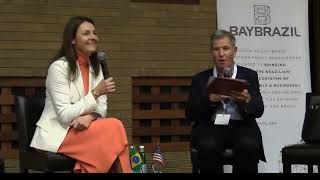
Recorded BayBrazil/Stanford conversation (moderated) with Michelle Zatlyn, Cloudflare co-founder and COO. Michelle recounts her path from Saskatchewan → McGill → Harvard (met co-founder Matthew Prince) and the founding of Cloudflare; explains Cloudflare’s mission to make Internet properties faster, safer, more private and reliable via a global network; describes technical/differentiation choices (anycast, caching, edge PoPs), scale and business model assumptions (capex and scale economics), product expansion into Zero Trust and developer/serverless platforms, and experiments with Web3/IPFS and Turnstile (captcha alternative). She also discusses policy engagement, executive coaching, and encouraging women entrepreneurs. The transcript includes audience questions on content moderation, identity/MFA, and product details.
Questions this video answers
Points of presence in 275 cities across 100 countries (including 36 across Latin America).
About 27 million Internet properties.
About 20% of the web.
18 of the Fortune 20 companies.
She said the first time they raised money was November 2009.
Chapters
Well, thanks very much, Magaritza. This is really a great, great group here that you have assembled. I certainly remember the first time around, and you've become really the model worldwide for how to run a diaspora from another country. I was just in Greece and in Poland, and they're asking me, how do we form something? And I said, you're the person to talk to, so you're going to get a lot of phone calls. Okay. Now, on my way over from Greece and Poland, you take the northern route. And I noted that I went over this territory called Saskatchewan. Who has ever heard of Saskatchewan? That's good. How many have actually been there physically? Not flown over, but been there really? Are you from Saskatchewan? Did you get lost and somehow follow a bear into Saskatchewan? So the person on my right, your left, is from there. I'm going to ask her in a minute to describe her journey, but she's had really a spectacular career. I was doing some research on you. I'm a faculty member at Stanford's business school, as Margarita said, and I do an awful lot of courses on developing economies. So half of the business schools from places like Brazil and Chile and Turkey and other places throughout the world and come to our classes because they want to learn a little bit about the challenges they'll have outside of the Valley and, and go back to their home country and start something up. We've had a lot of successes over the years, been a lot of fun. Now, venture, in the last 10 years you started, a company has grown from a $60 billion industry worldwide to $630 billion. That's a tenfold increase. Used to be a little part of private equity, now it's its own category. Everybody wants to get into venture money managers and so forth because they've seen the growth has been personified by Cloudflare. So, Michelle, maybe you could talk before we talk about your company, talk about your journey from Saskatchewan to McGill to some really great companies I think here, and then Harvard Business School and then your very first startup that has turned out to be spectacular.
And now sitting here at the back of the club at Stanford.
There you are.
There you go. Right. You know, it's interesting. So I, I, I'm not from Brazil, but I hope when I come visit your beautiful country, you'll all welcome me. I'd love to come visit all your companies and, and, and in your beautiful country, but I am from Canada. Saskatchewan's a province in Canada, a very unlikely place to be a tech entrepreneur. And it's interesting, this conversation is, I had to leave my home country to make this dream come true. And it's been amazing and can talk a lot about that at the Bay Area has been very good to me. But I'm a big believer in countries need to find a way to have entrepreneurs be able to build big companies at home. Otherwise it's going to be only the successor in the US and China. It's going to be really, really difficult going forward. And so we need lots of unicorn companies built in Brazil. We need lots built in Canada, uk, Germany and. And that will really help in a geopolitical landscape. So I'm a really big believer of this. So my pursuit is one of. Actually it's kind of a made for Disney TV show. I like happy endings. I have a really happy ending.
Entrepreneurship, certainly not R rated. That's fair.
It's definitely not. It's very, very made for TV feel good story. I grew up in farmland of Saskatchewan. My parents kind of made us get good. Very big believer of getting good grades. I did went to public school. I got good grades. I got a lot of scholarships to leave the province. And I ended up in Montreal at a great university called McGill, sometimes referred to as the Harvard of the North. I remember when I was telling my friend's parents that I was gonna go to McGill. They're like, what are you gonna study there? And I said, I'm gonna study science. They said, doesn't the University of Saskatchewan have a science program? Like, they didn't understand why I was leaving the province. And so I was lucky to have parents who said, hey, you can go leave the province. You can always come home. You gotta go see what else is done in the world. And I guess when I saw what else is going on in the world, it made me chase my dream even more and more. And so I'll skip a couple steps. I wanted to go to medical school. I really wanted to be a doctor because I wanted to help people. And some way around along the way, I realized actually I might not want to be a doctor. And that's why I fell in love with technology. I love technology at scale and Internet scale. Like talk about before, because you can help people at scale in huge ways. And I think that's the power of technology and the Internet and like what gets me going as an entrepreneur and why I show up every day to do that. And so I was living in Canada. I had really progressed a lot. I was working at Toshiba as a product manager and I was at a cocktail party down in Boston. My sister lived down there. And there was somebody in finance who was kind of grilling me. He was like, so, what are you up to? Very direct American. And I was from Canada. Very direct, very competitive. I didn't know him very well. I said, oh, I work as a product manager, Toshiba, and I'm applying to do my mba. So in between bites of his hors d', oeuvre, he's like, where are you applying to? So I named all the Canadian schools. It's like Rotman at U of T and all the Canadian schools. Western, yeah, good schools. And I said, Stanford, because my older sister had gone to the gsb and I thought, okay, she was an alumni. Maybe I had a leg up to get in. And then he. After. But he was listening to me. And then he said, why aren't you applying to Harvard? And in the back of my mind, I thought, because there's no way a girl from Saskatchewan will get into Harvard Business School. I didn't say that. I said something like, oh, it's competitive. I don't know if it's a good use of time and resources. And he looked at me, and again, I didn't know this person. So think about it. How many of you would have just been polite and nod your head, yeah, yeah, yeah. He said to me, he if you never put your name in the hat, it for sure will never get pulled. So I give him big credit. His name's Greg, for saying that kind of bluntly to me. And some people might say that was rude to me. It changed my life. I went home that night. I researched the application. I applied to Harvard Business School. Long story short, I got into Harvard, I moved down to Harvard. I went to Harvard Business School, and I met my business partner, Matthew Prince, in section on campus at HBS. And we started Clapflare in School project. And now 12 years later, it's a publicly traded company on the New York Stock Exchange. We have about 20% of the web that uses Cloudflare, and we help make the Internet faster, safer, and more reliable. So it's a really good made for Disney TV story.
Fantastic. Well, that is quite a story. I hope you all wrote that down. You have to apply to Stanford. I mean, to apply to Stanford, too.
Stanford, too. I think there's probably a phrase like that.
It's not so bad. So talk a little bit more about your company. You just kind of just gave us a glimpse of that. You described the company's described as a global network designed to make everything you connect to the Internet. As you said, Secure, private, fast and reliable, right? Websites, APIs, people, employees, corporate networks, you got it. You name it. Talk a little bit more about that. In the early days of the company, did you imagine, what did you imagine the company would be okay, so let.
Me tell you a little bit what Cloudflare does today. And there are many of you in the room that are customers, so thank you. And if you're not, you know, we have a free plan and would love to talk to you, but it's businesses, startups, nonprofits, all have some sort of presence online. And it turns out that making sure that, that stays online and protected from cyber attacks, making sure it's fast is really hard. And that's what Cloudflare does. We do that as a service. We do that as a service and we have everyone from developers with, or students with hobby projects. Up to 18 of the Fortune 20 companies are Cloudflare customers. So we have about 27 million Internet properties that use our service to be faster, more secure, more private and more reliable online. So it's super, super cool sometimes. I like to describe it as like a digital bouncer. We, we keep off all the malicious traffic and for legitimate visitors coming, we are like a personal trainer. We make it really spiffy and it's super easy to use. It's less than five minutes to sign up. So that's what we do today. And when we started Cloudflare, it's interesting. I still have the business plan that we wrote when we were students at hbs and the service was defined as. Cloudflare is a service that makes, it speeds up websites, protects them from malicious behavior online, and makes it easy to add third party services. So we do a lot of that today. We do a lot more. But a lot of the original idea kind of has expanded over time and I think that you never really know that you're. We had some assumptions early on. So the way that we make the Internet faster and safer is we build a global network. So my company has points of presence in 275 cities and 100 countries around the world, including 36 across Latin America. And that costs money. So we buy router switches and servers and we ship them to 100 countries around the world and manage all of that. And that's how we make everybody's websites and apps and APIs faster. You know, if you, if you're in Sao Paulo and you go to the Sao Paulo popular pop instead of back to some, some other point of presence, just it's, it's just faster as well as we stop a tax really locally. And so one of the things is we knew that cost capex to buy those servers, switches, routers would cost money. We were not going to fund that on our credit card. And so one of the assumptions we had early on was because we have to, we have a real capex cost to our business, we were either going to be a big company because you would depreciate that capex cost across a lot of customers or not exist as a company. Being a medium sized company didn't really make sense with what we were trying to go. So we knew that up front. We knew that really early on. And now did I know what that meant? No, I had no idea. You know, I've had so many experiences and we'll never quite go back to the same shape anymore. But it's, it's. We had this assumption early on it's either going to be a huge success or not exist as a business.
Fantastic. So I was reading a little bit about the stories I mentioned, I did some research and this issue of latency came up. And you know, it seems illogical what you just said, that by inserting something you're actually making it faster rather than slower. You would think that it would slow it down. So could you maybe. I know you're not the CTO of the company.
No, no, that's fine. But you can talk, you know, I definitely can. It's so funny, Steve. That's what. When we started our. Okay, so this is for the entrepreneurs. So Matthew and I were business classmates and we were students when we started to work on our idea and we went around and we told a lot of people, including smart faculty members at Harvard. So just like you, Steve, at Stanford telling them our idea. And that's exactly what they said.
Huh.
This is really clever. You're going to deliver security as a service. That's interesting. Provide this layer of protection from small businesses and over time you'll go up market. And they gave this exact enter. But you're going to add steps in the lookup like request and you're going to add latency. And no real business will ever tolerate latency for security. That was exactly the objection we got. So what did you do? What did we do? We heard it like four or five times in a row. So then all of a sudden our business plan went from we're going to be a service that secures websites to we are one that secures and speeds them up. We weren't sure how, but we were like, we're going to have to figure out how to cache and get back to just even or better to get over this objection. And it was interesting, once we started to use that, the objection went away and it was less about how you were going to do it. They kind of like assumed that we were going to figure that out, but it was just that we were thinking about it. And so I think that as a founder, early on, getting that early feedback, you know, it's interesting. You get so much feedback. Some of it's not good, so you just put it aside, you nod your head. But some of it's really helpful and it shapes how you get ahead. And then we started to explain it that way and all of a sudden it got people more and more excited.
That is so true. I wish I could just capture those words right now from you as a founder and bring them into my classroom. Because we have a lot of would be entrepreneurs in my classroom. And first thing we talk about is go out. You have one opportunity in your life where you're not going to be very distracted. You're going to be talking to a lot of prospects and customers and so on, get some feedback, write it all down, come back, think about it, talk about it with your mates and so on. So what makes your technology so special? You basically, you know, I've been involved with three companies that have actually not just been successful, so I'm super happy about that. But we built industries. Not just a company, but an industry. That's the proudest thing that I feel like I'm part of. So that's what you're doing too. You have competition, obviously. It seems in the research that I did that customers really rank your company very highly, which is good news, of course for you. But you do have competition. What makes your technology the best? Here's your chance. They all want to buy.
You're all welcome to be customers, but really I want to inspire you and help you in your companies and hopefully go pursue your dreams and build bigger companies, bigger outcomes so that you help build more exciting businesses in Brazil or be planet Brazil. Your diaspora all over. I think that that's amazing. We need lots and lots of winners. So a couple things that I've learned over time. So you start with an idea and you get venture funding. And we raised just a little bit of money. The first time we raised money was November of 2009. It was a really hard economic time. We were actually the only tech investment Venrock made all year. They were our first investor. So it was not a frothy venture.
Capital Great investor, by the way.
Yeah, Ray, exactly. Really, really great investor. And so it was not a frothy time. And so we had raised some money and the idea was, okay, how are we going to differentiate ourselves? And what was interesting is, as we were telling people what we were doing, most people didn't believe us, which was interesting. Really smart people who knew a lot about the industry said, that's impossible. And I think what's interesting about having some of that pushback is, okay, are we crazy or do we have something differentiated? So that's kind of point one. Point two was Ray made this point. Ray Rothrock, as a cyber security investor. And it was a couple years in, I think what he said has always stuck with me, which is helpful. He said, the best investments in my career that I've made over all my life are ones that where the opportunity expands over time. What normally happens is you make an investment in a company and the opportunity narrows over time. It becomes more narrow or more limited in what you thought. And I think that makes sense. You're like, oh, it's going to be huge, and it only sells for a little bit, or they only have a little exit or kind of goes out of business or whatnot. But the truly great companies are ones that start and over time, they keep adding total addressable market or expanding what they can do. Because at the end of the day, you need to grow revenue for a really, really, really long time to build something special. And I think that's, at the end of the day, what Cloudflare's built. So we built a global network. I can tell you why it's different. And at day one, when we started, everyone asked us about a company called Akamai. So many people, every time we went anywhere, they're like, oh, you're just a cheaper, faster version or better version of Akamai. It was interesting. Matthew and Lee and I, who started Cloudflare, would always prep them and say, I promise you, we don't get up every day thinking about Akamai. Who we really think about is Cisco. We want to be Cisco as a service. Cisco is a hardware box that everyone that runs the Internet, basically, it's going to turn into a service on a globally distributed platform. We're going to run the network that does that. So that's what we've basically done. A lot of people thought we were crazy at day one, but that's what we've done. And at first, we started by making websites faster and safer. Then we added, way down the weeds, something called Layer three and layer four on the Internet. And I won't talk about that, but it's like another whole new market that matters. And then we've gone into something called protecting users, called Zero Trust. We also don't need to go into that, but protecting employees who are trying to access information in corporations. And then we have a developer service where people can write code on this global network. So in the future, instead of spinning up an AWS instance or Microsoft Azure instance, you can just build right in the network in 100 countries and it'd be everywhere. That's what the future is coming. That's a way bigger vision, way bigger tam, way bigger total addressable market than our original business plan. And I think that that's what you want. And often again, I'm 12 years into the Cloudflare. I know so many entrepreneurs. I know all the SaaS, B2B companies, and the ones who run out of steam are the ones who aren't sure what to build next. And they aren't thinking about it. They try, they go really deep on their first idea, their first act, and then they just run out of Runway, and that's just not a good place to be. And so I think what's really interesting is, you know, we had a really big opportunity. We have differentiated technology, how we built it, but it was over time, the opportunity expanded. And so I think for you sitting in this room, like thinking about that and you don't have all the answers, we didn't know exactly all of this on, you know, one, two, three years in, but we were constantly obsessing and trying to think about how are we going to expand this, how are we going to expand it? And that really paid off. Just the last point on the differentiation piece early on, and I'm sharing this because many of you go through this is so we went to Google, we really admired them. Like back in 09, like we just real 2010, we really admired them. They were so technical. When you're building infrastructure for the Internet, we're so geeky at Cloudfront. So geeky. Oh, like big nerds. And so we went to meet them. They were talking about investing in us. We were like, so excited because Google has built like an amazing service that works around the world. Technical, geeky. And their lead architect was like, this will never work. You can't use something called anycast to make Cloudflare work. And they're like, that will never work. And that was a bummer. You're just like, okay, well it is working. And what he. He Was like it might be working now, but at scale it won't work.
So you got dismissed almost out of hand.
It was, I guess the point was just because people you admire don't always see what you see. Actually sometimes that can be a good thing. It can also be a bad thing. In our case, it was a good thing. And what's interesting is just last point about this is we had competitors, we had a lot of startup competitors, Ankle biters, what we used to describe them, but they called us a lot of pain. One day a couple years in, Google launched a competing service and it was interesting. They're all now all out of business. And so I think it is because we have really differentiated strategy and technology that was ended up being like a long term competitive advantage that served us really well, but it was hard for people to see. We saw it, but others didn't.
Well, you know, it is a good example for everybody here in the room. When we talk in our classes, we talk about everyone's really interested in the romanticism of Start, but startups need to become scale ups and then scale ups need to become making money and looking for opportunities so that they can build new products and continue to sort of reinvent themselves. If you take a look at the Fortune 500 over various decades, you'll see an awful lot of big companies that have gone out of business. And the reason is they just have stopped innovating. They're just trying to do things for themselves inside the company and it ends up being all incremental. So I want to get into a topic and then I want to turn it over for a few questions with our audience here. One of my favorite topics is perfectly for this. I've been a coo, chief operating officer of three companies before I became CEO of a couple of companies. And I always felt like the COO was always blamed when things went wrong. And of course everything goes wrong. Something goes wrong in any given day and never gets any credit when things go right. So I noticed you're smiling and you seem to be happy and I was never that way. I was always cranky and you know, what else is going to go wrong and one of those kinds of things. So, so talk about your day as coo, because you've got to keep all the trains running on time and things that happen with big customers. And do you talk to analysts as well? I'm sure. Okay, so talk a little bit about your life.
Okay, sure. Well, if I met you, if we'd been doing this maybe seven, eight years ago when we were three, four years in. I mean, I went to a dinner, so not quite a room this big, but it was a dinner. And my exact words then where I don't understand why anyone starts a company. Like, it's just so hard. The first two, three, four, five years were just really hard. It's hard to hire, it's hard to build the product. You know, 10, 10 highs in a day, followed by 15 lows. Like, just the roller coaster in a day. No one understands anything you're going through. You can't bring all your problems home to your home. I was making my boyfriend o husband because, ignore us. Put your monkeys on their back. And so she was, like, super lonely. It was hard, but. And I remember that dinner someone said to me, and we were successful. So I could just imagine, like, you know, someone on the earlier panel said, you're either successful, I can't help you, or you're failure. And that's it. And kind of the messy middle. We were definitely the success story. I was just like, this is so not that fun. And at that dinner, people were like, michelle, you cannot say that. Like your success. Anyway, so it's interesting. Part of staying in the game, like, I'm still on the field, running a big company is. And I think part of it is also as a woman, I feel I don't want to not like my job. I want to. I want to like what I'm doing. And so I like. It's just like a choice that I make. And so even now, when there are hard things that work at the. Lots of hard things. In fact, all the hard things come to me because we have great people now. We hire awesome people, and they deal with all the other things. So it's just the hard things that come to me, and it's all hard and messy, and you're just like, okay. But now I just have a very different point of view of, like, all right, good that we know it's a problem. What are we going to do about it? We have the right people at Cloudflare here. I work with great, amazing people. How do we get the right people assembled? And now we know it's bad. Once we focus that we know on something that's broken, it will get better. The worst thing is, like, not admitting that there's something broken, which a lot of companies do. They just admit and they hope it goes away. Well, that's, like, not a good idea. It's like, no, this is broken. Let's just own it and let's figure out how we're going to make it better and once you do, you feel a lot better and then people win. So it's actually been a huge mental shift for me. And so I feel like I've gotten a lot better at dealing with the problems and refiguring it as this is an opportunity and a learning experience and I feel lucky that I get to go through it.
Good for you. Do you folks at Cloudflare. Not on my list here. Do you use coaches?
We do. I do have an executive coach. She's amazing. I actually had a session earlier today. Yeah, there we go. Right. So Candice, my colleague is here. She saw me yesterday too. I'm constantly in a good mood. So you can all say, is that true?
Okay.
Yeah. I think that there is research that shows that some people have a positive disposition. Like 50% of your happiness is genetic, the other is environmental. And so I definitely am disposed to classes half full person. And so I do have an executive coach. And we didn't early on. I didn't early on. And in retrospect, it's something I would have gotten earlier.
Great. So I have a ton more questions, but I want to see what this great audience would like to ask. Michelle, back here. Yeah, go ahead. Do you have a.
Gus? I've been living here for maybe 10 years.
So let's talk a little bit about.
The solution, social responsibility of Call to Air. Because there are many cases where you expel kind of companies that are kind of, I don't know, whatever. So I think this is a good opportunity for the Brazilian companies to understand.
That because I don't see that in Brazil that much.
So of course. So when you have. So the Internet, I am pro Internet. I'm pro digital revolution. Like, it's amazing. And there's, I think Benjamin said in the panel before, there's so many problems left to be solved and again, I hope all of you go solve them and make it better for all of us. So that's great. The Internet's not going away. In fact, if you just look just like one data point, I'll answer your question about the policy side. So just when the pandemic hit and everyone stopped, like in what was it, March of 2020. And we couldn't see one person in two week period. And basically like a month in over, over the course of four weeks, the amount of traffic on the Internet around the world doubled. Okay, Pretty amazing. Makes sense. You couldn't see people in person. We're going to do everything online. You're all spending a lot of time online, maybe on Zoom or you're watching Netflix, I don't know, whatever the video streaming services in Brazil, or you're just doing spending a lot of time online. So you couldn't really see people in person. So it's interesting, there was a theory of post pandemic, will it fall back to February 2020 levels? And what's super interesting, I'd say, you know, the world isn't 100% back, but it's pretty back. I've been doing a ton of stuff. People are much more in person. The Internet traffic is up 40% year to date, which doubled two years ago. So it's definitely not receded. Like it's way more. And if you just think about it, so many companies had to innovate. They all said, okay, this project on the back burner now we're going to get the direct to consumer restaurant food service going because people can't come into restaurants. Or there's a lot of telehealth where you used to go see a therapist in person all the time, but now maybe go to the first session in person, but the rest are all online. And so Internet traffic is really up in the last less than three years. And businesses have a lot more digital first initiatives. So what this all means, the reason why I bring this up to your question about politics is, oh my goodness, the Internet's only 30 years old. The policy side of this and the regulating side of this and laws around the world are catching up. It's so important. Ten years ago, there were eight tech companies that had market caps of $100 billion. Eight. That's it. They were considered the geeks from Silicon Valley that no one understood. Now, I mean, this year the market's way down. But let's call it, last year there were over 26 in less than a decade. $100 billion is a huge market cap. That's bigger than a lot of banks, financial institutions that have been around for hundreds of years. And in 10 years, all of these massive companies got built, all tech related. That is really unnerving to policymakers. And so what's happening right now is people who run large services, including Cloudflare, you know, you have 20% of the web sitting behind you. We are part of these conversations and the policymakers are leaning and saying, okay, what policies do we need to make to make the online world more functioning? Because there's so much greatness to it. Anyone with an idea can put anything up. You can, you know, you protest rights. You know, all this stuff. It's great, but there's also a shadow side. There's bullying online, there's meanness online, and things like if you put copyright online, that's illegal, it gets taken down really quickly. There's a very well defined law around that, that people follow you bullying someone online. There is no law around it. There's no law. And so you can be mean to somebody online and there is no law there saying that's not allowed. And so then what happens when someone's bullying you online? Who do you go? There is no such thing as an Internet police. So what do you do? Who do you report it to? So you go report it to wherever they're being memed, probably, you know, Reddit or Facebook. But those people will say, well, I don't really want to deal with that because they're just of kind to be mean. You know, that's rude, but I don't know if I'm going to kick them off. And so those are the sorts of things that these policymakers are leaning into. And at the end of the day, the Internet's an ecosystem. There's so many tiers. We're not going to go through a full history lesson right here. Cloudflare, there's kind of the users who are like accessing the Internet. So you should be responsible for what you're doing online. There's the platforms of where you're doing it, maybe an app that you're building or where you're spending time. There's. There's the infrastructure providers. That's where I put cloudflare into the Canva infrastructure. We provide infrastructure to all of you. We build, like the roads and the bridges of the Internet and there's the access providers. So earlier they were talking about the ISPs, you know, and the telcos and the ISPs. And depending where you sit in the ecosystem of the Internet, you have a different set of rules and responsibilities for the policy making. But everyone has to come together to have that. And so the end of the story is, if you're into policy, you should lean into this. The laws are getting made now that are going to shape the Internet from the next 10 years. If you're a tech company, pay attention, because if you don't, it will cause you great pain. And I know a lot. We've been a company that invested a lot in this. And so we're part of the conversations and I think generally seen as a good actor usually. And there's some companies who just didn't take it seriously. And They've had to pay, catch up after and it's really, really painful.
Absolutely true. And you can see that Europe is sort of leading the way on that. US is following. Great question. Thank you. Anybody else? Yes.
My name is Johnny Ferrari. I'm a Brazilian entrepreneur in the US for a while. I'm about to probably get your service. But one of the things that I've been amazed and hope you have an answer is even today with all the technology we still have to push prove that we are we, right? I'm not this document show my id. This is not me. I am myself. And every time there's a new technology like fingerprints, whatever, thinking finally technology will see who I am without improving, I'm me. Do you see anything happening in the near future where we don't have to use MFA single sign on if we don't have to prove we are Ask ourselves.
I do. I think there's a world where that's the case and there's a lot of people working on this in different ways. Actually I was just. This came up in a conversation the other day where it's where imagine a world, you don't have to prove who you are. There are no passwords and it just is and that it's all baked into all the services. So I think that is, I think it's a few more years out of the way. We have a lot of things to do between here and there, but absolutely. And 10 years from now, I think how our digital footprint and how we interact online, I think it's gonna look a lot different than using the other panelists conversation. Kind of the messy middle right now again, the Internet's 30 years old. Kind of going from like the 30, 35 years. When you're 40, you kind of got like a confidence to you. You can start, you know, like, I think that, I think it's gonna age well.
Why don't you, why don't you pick up on what efforts at all you're doing that you can talk about for web3 and metaverse and so on.
Well, it's interesting. So, okay, so at Cloudflare, it's hard to predict the future. And again, it's crazy. As a founder, you're trying to predict the future. You're trying to find something that's going to become big. And you know what's amazing about venture capitalists is they see the future, right? They're investing in things that become like known 10 years later. So it's super cool, but it's, but it's really Hard to predict the future. Things often change in ebb and flow. And so for us, we're big believers in the Internet's going to be around and Web three and all these sorts of things. Quantum computing, there's lots of different trend lines. Serverless computing, we see ourselves as building the pixels in the axles, like the bridges and the roads, pixels in the roads to make all of that happen. And so we actually today have a Web3 Gateway. We have an IPFS gateway, where if you're building on Web three, you need to connect to the regular Internet. Cloudflare connects you, which is great because it's not and whatnot. And so it's a funny story about this, just to give you a sense is if Matthew was sitting here, my business partner, he's like, I don't understand Web3. Maybe I'm old, I don't know. But there was a product manager at Cloudflare who was super excited and he said, okay, I'm not gonna veto this because if that ends up being the next big thing and I veto it, I'm going to get disrupted. And so, so he let Wesley, her partner, go build it and we'll see. And he's kind of like, let's let the world vote, not us. We build axles. And so I think that's super interesting.
To experiment and try some different things. And as Google has, they bail it off a lot, but they keep pushing.
And it's what, again, I think the worst thing, again, you're early. So you know when you're early, you've got to get going, you got to get traction. You have to understand that your business, you gotta become a business. Like, those are all great. But at some point, if you stop innovating internally, it will become your Achilles heel. And so you want to be a place where you can keep innovating and expanding and it'd be okay that not everything works. When you do innovation, you're not going to have 100% hit rate.
Another question. Yes.
We're standing between everyone and cocktails, which is this tough place. Species.
On the edges of their seat. This is all good stuff. Hope you're all taking notes. Go ahead. Okay, right here again. So I want to get your feedback on how's the testing of your ride style? What is the substitute product platform that you have? Is the AI behind and trying to get consumers out of trying to do.
The captcha thing, which is super difficult.
And sometimes very annoying, and I don't like it. As a matter of fact, I think I have Come across some of the businesses that might be on your beta or your testing process right now that's been using it. And I find that super cool, really easy, because that way I don't have to deal with the captchas because I get it wrong.
I have to type three, four times.
And that's very annoying.
You are all so well informed. These are very advanced questions. I just like Turnstile. We just launched three weeks ago. So you are like super current, you know, so like broadly how we think about or what we're like. And this has not changed for 11 years. And again, so I'm just trying to hopefully, for some of the founders in the room, help inspire you. So the way that I used to describe couplers, we're taking anything that used to be hard and we're making it easier. So before, if you wanted to be fast, safe and reliable, kind of on average took six weeks to do that anyway. So that was part one. We made it five minutes. So six weeks to five minutes is like a huge delta. Okay, so that was one. So something used to be hard, made it easier and it just worked. You didn't have to configure anything. Just like we kind of like, again, we're a digital balancer and a personal trainer that just worked. You didn't have to configure anything. We want to take things that were expensive and make them inexpensive. And so before it would take six weeks and, and cost at least $100,000, but more like hundreds of thousands of dollars. And we all of a sudden were five minutes and our prices started at free. We had a $20 a month, a $200 a month. And now, sure, we have customers paying us millions and millions of dollars a year, but we started at free and we still start at free today. That's like a huge delta. So something was hard, easier, something was expensive and something that required a lot of technical people before you'd have to hire a lot of network engineers and it. And be pretty well trained. We said, anybody? You don't have to be technical to use Cloudflare. That was like our point of view. And so we use that a lot in everything we do. So we look at problems at scale. We work at intranet. Scale. Scale. Super interesting. It's so fun. It's also really hard. And captchas is something that nobody likes. And we use a lot of CAPTCHAs to help be the digital bouncer for our customers. Right. You come and it's like, I think you're bad. You can block it. Entirely, which is. That's pretty severe. But if you capture it, it captured it. It gives people a chance to prove who they are. But the problem is when you're, like, legitimate, it's a really a bad user experience. And so we kept saying, can we do something better than captcha and innovate in this premise of can we make things that are hard, easier and inexpensive and stuff like the genesis of that? And just nobody likes the cap Captcha and we think we can do it better. And back to the Internet's 30 years old. That was kind of developed years ago to solve that problem. We know a lot more. And that's not what the world should look like the next 10 years. And if not Koffler, who's in a better position to solve it?
All right, I'm going to ask a final question. You weigh off a little bit some of the more technical topics. You're a very successful woman. You're excellent executive. You get great marks. You know, to be a COO for as long as you have your people skills must be unbelievable. There aren't enough women, Margaret, sitting in this room. There's enough men. We should fill some of the seats with more women, right? To have more women entrepreneurs, do you feel a sense of obligation to give back? How do you. Your time is so precious to you because I'm sure you must have a really tough day and you have your personal life as well. How do you balance all of that? Or do you try to balance all of that?
When I was 30, I'm 42 now, I had a conversation with myself. It was actually one of those vision boards. Not really a vision board, but someone told me about a vision board. So I did my own, and I.
Said, what do I want?
I want a big career. I'm super ambitious. I want a big career. I want to be part of something. Love being part of teams. I love solving problems. Like, I just love that. So I have a big career doing something I cared about that I thought was important. I wanted to have a life partner. And my then boyfriend is now my husband. We've been together for a long time. He's been there from the very beginning, which is super cool. He's also an entrepreneur, which is super interesting. And I want to have kids. And it's interesting. I made choices along the way that tilted the risk reward in all of those favors. And so today I feel like I have a great career. I love my husband, and I have great kids. And I'm not saying there are days that aren't Hard or moments, there's lots of things, but that's what I wanted. And so I feel really lucky that I get to have that. And so I try not to take any of that for granted because it doesn't have to be that way. And it's interesting. At business school, again, I'm very impressionable, I'm very curious. I like to learn a lot. It's like actually a great trade. As a founder, if you were to ask me the most important trade is the rate at which you learn is the most important thing. And that's not my saying. With George Lee, who's run tech banking at Goldman Sachs, he's known every single amazing founder, like all of them. And I went to his conference like four or five years in. I said, George, you know everybody. What sets the amazing founders apart from the media, like the OK founders. He's like the rate at which the they were. Doesn't matter if they don't know everything. They listen to it once and the next time they're saying it. And I feel like I have that. And so anyway, back to. I just, I like, I feel really lucky what I get to do and I hope others see it. I have a lot of people come up to me saying like, wow, how do you do this? And I just hope that like people I don't know who want the same thing, not everyone wants that can see that it's possible and that I'm having fun while I'm doing it.
Well, you're very inspirational. Let's give her a big hand. 10 years when you have three times as many people here or whatever, we can have her back. And now her company is in top number, number one tech company in the world.
More from Michelle






SF Conference 2013 CASE STUDY: Michelle Zatlyn - Scaling a Company To A Billion Views A Day




