Cloudflare Co-Founders, Michelle Zatlyn and Matthew Prince, on building company culture
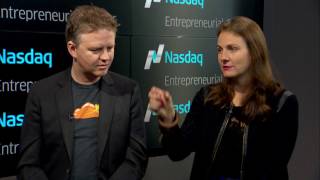
Interview (CNBC Disruptor series) with Cloudflare co-founders Matthew Prince and Michelle Zatlyn about Cloudflare's origin, mission to make web performance and security available to everyone, and their approach to entrepreneurship. They describe Project Honeypot as an antecedent, the complementary skills of the founding team (Matthew, Michelle, Lee), recruiting strategies and culture choices to attract diverse global talent (~320 employees at time of interview; average engineer moved ~1,200 miles), and a notable product decision to make encryption free for all customers. They cite serving both small sites and major organizations (NASDAQ, Central Bank of Brazil, Pakistan IRS) and express long-term ambitions to "rebuild the way the Internet works."
Questions this video answers
About 320 people.
About one in every ten Internet requests.
Project Honeypot.
Encryption (TLS/SSL).
About 1,200 miles (average move).
Chapters
Hi, I'm Bruce Ost. I'm vice chairman of Nasdaq as well as president of the NASDAQ Entrepreneurial Center. And we're here today with our CNBC Disruptor series. And it's great to have Matthew Prince and Michelle Zatlin. I knew I was going to mess it up.
That's right, Zatlin, you got it.
Zatlin from Cloudflare, co founders of Cloudflare, with us today.
Thanks for having us.
Joining us.
Thank you for having us.
So it's a great honor. You guys are one of the CNBC Disruptors. So in your own words, what does Disruptor mean? First, why don't we start with you?
I guess Michelle and I met at the Harvard Business School and Clay Christiansen, who really sort of coined the term disruption, I guess is what I still kind of come back to his definition, which is that over time, industries and companies that get large and stale are lose a lot of their edge and they can be disrupted by often companies that come along that are more nimble, that can offer their services at a lower price. And that's what we've done at Cloudflare is we've made services that in the past were only available for the biggest companies in the world, the biggest Internet companies in the world. We've made those available to literally anyone online. And as a result of that, now we're the market share leader, have millions of customers and have built a really great business, starting with that original principle.
Of disruption, which is a pretty great leap considering you're a lawyer by background, you're a chemist. So how did you guys decide to start this company together?
Well, so Matthew and Lee, our third co founder, had started something way back when called Project Honeypot, which tracked web spammers online as part of this open source community project. And so they knew a lot about how if you're a small business with Internet property, that the challenges you face protecting your content from a range of online attackers. Fast forward. Matthew and I met and we were talking about it and we kind of had a conversation, went like this. I was like, that's great that you have Project Honeypot. How do people hear about you because you had no budget? And what do they get for signing up? And through a series of conversations, finally Matthew said, michelle, one day they want us to create a service that actually stops the bad actors. And there we kind of went off to, to spend more time looking at the idea. And pretty soon we realized that if you were a large organization, there were services available to make sure that your Internet property was fast around the world and protected. But if you were the rest of the Internet properties, and there are 400 million, there were not good solutions. And so we set out to say, if we rethought the problem, how could you do it today? Solve this problem in an elegant way that would be accessible to anybody.
That's great. That's great. That's been a great journey, then. So we do like to talk about the journey. So you guys are founders, you're entrepreneurs. Tell us a little bit about what entrepreneurship means to you.
I think that we have the greatest job in the world, that we get to work with really smart people and build something from scratch. Cloudflare launched almost exactly six years ago. And. And in that, if you'd ask us, I think, six years ago, what would we be sitting being interviewed by you and the Nasdaq and have the breadth and reach that we do, where today almost one in every ten Internet requests flows through our network. I don't think we could have ever imagined that. And so I think that entrepreneurship is about taking problems that a lot of people feel and then coming up with solutions for those problems. And I feel very lucky that I get to work with Michelle and get to work with the entire team at Cloudflare. And every day we take on bigger and bigger and more audacious goals. And it's pretty amazing that we've also built a great business at time.
The same.
Same time.
So you guys were lucky. You met each other and decided to form this great company. And six years later, you're doing extremely well again, congratulations on being recognized by CNBC as Disruptor this year. But if you're an entrepreneur out there, you're talking to someone that's maybe taking a class here at the Entrepreneurial center, what would you tell them? How would you say to get started? Because you guys have obviously done it, and they'd love to hear how you got started.
I mean, so answering that question is always tricky because you asked 10 different people who have been very successful.
I've asked 10 different people, and you're.
Going to get 10 different answers. And so I'm happy to give my answer and Matthew's too, with the caveat that at the end of the day, you're in charge. If you have an idea that you really want to pursue or something you feel so passionate about, you have to follow your own gut, because people can give you different advice all the time, but ultimately, it's up to you. Having said that, I think too like a framework or Something to think about or ask yourself if you're an entrepreneur. The first is, what problem are you solving and is that a meaningful problem? And I think that's really important because sometimes if you solve a problem where it feels like you can really get your hands wrapped around all of it and you know exactly where the problems are and how you're going to solve, and you have the answer for everything. Sometimes that's not quite big enough or meaty enough or too easy for someone else to follow once you show what's possible. And so this idea of, like, are you solving a meaningful problem? And by meaningful, it's either like a large market size or something that that has some challenges to overcome that would create barriers for others. And then the second thing is, can you attract the right people, the right team? Because it really comes back down to the people you're working with. There's no way, no matter how good you are as an entrepreneur, you're going to require other people to work with you to make something happen. Can you attract other incredibly talented, passionate people to do all the things necessary to execute on solving that meaningful problem? And those are two questions that I feel like when we started Cloudflare, what we said our meaningful problem was, we want anybody with an Internet property to be fast and safe around the world. It was a very audacious goal, and it was so audacious, we get a lot of pushback. Be like, that's too big. That's too audacious. You have to pick a segment. Which segment are you going to go after first? And Matthew and I would be like, everybody. And it was a very kind of uncomfortable conversation. But because we had this very audacious goal and a very big surface area, we attracted a lot of great people who wanted to come. Be like, that sounds amazing. And I want to be there and I want to play a role in helping make that happen. And so as an entrepreneur, if you can think about those two things and really start to crystallize your story around that, that can be very powerful and helpful.
I love that. I love that idea. I think Big is great.
I think the other thing that, because this isn't the first company I've started, I started another company previously and we're not on. That company is still around, but it's not on the CNBC list. And again, it was a much smaller problem. But the thing that really, I think is important and that you can often tell almost from day one, not always that what teams are going to succeed, but you can see a lot of problems with teams that don't make it work is who's on that initial founding team. My last company, the three of us that started the company, basically started it and chose to work together because in junior high school we'd had lockers next to each other. That turns out not to be the best way to pick co founders. And we fought all the time about who did what and who was in charge and who was responsible for this and that. And the reason was that we came from very similar backgrounds, we had a very similar set of skills, and it wasn't clear why there needed to be three of us to be there. And so one of the things I feel very fortunate about is that the founding team that we had at Cloudflare was extremely diverse. The way Michelle often describes it is she said, when you're starting a company, there's a huge slate of problems that you have to solve. What you want to do with your initial team is almost build a Venn diagram where you cover as much of that surface area as possible. You have just enough overlap between the circles that you can actually communicate, but not so much that you're ever asking, like, how do we split up responsibilities? And so when I have entrepreneurs come to me now and they said, I'm having this problem, we can't figure out who does what within the company, I have this sort of sinking feeling in the back of my head that they've already made a pretty fundamental mistake in building that initial team. And I think one of the things that's been great for us is that Lee was sort of the technical genius, Michelle is sort of the operational genius, and I'm a good carnival barker. Turns out that those three roles, if you're building a company like ours, actually are pretty important roles. And I think a lot of what we've done that has worked has worked because we set a very good, solid foundation with the initial team from the beginning.
That's great. That's key, just getting the right people initially. But then you've also grown and you guys have gotten larger and you're in a very competitive place in the Bay Area. How do you compete for talent? And how do you get employees to want to work at Cloudflare and have that same passion that you both have?
I mean, we spend a lot of our time, Matthew and my time on a day to day basis, working to bring the great people to come work at Cloudflare, because without being able to hire really great people to come work at Cloudflare, I mean, that's number one job of everybody in the company. And so Matthew and I spend a lot of time, our entire management team spend a lot of time. The people who come and do the work at Cloudflare every day, they spend a lot of time interviewing, talking to their peer groups, because we're all really proud of our mission, we really proud of the company, and we know that we want other great people to be there because there's a lot of things left to do. And so I think on one side, we're really lucky. We do have this big mission. We have an amazing team who are smart and talented and curious. And so people spend time here and they're like, oh, my God. I also want to work on hard problems with smart people. And again, when you have this audacious goal of, hey, we want to build a service that anybody can use around the world and help make the Internet a better place place, a lot of people are like, lean in, tell me more. And we're still at a size where we have about 320 people, where we have a product market fit, but we're still small that you can have big ownership on, executing and feeling like you play a big role in moving the needle forward. So, in a way, we kind of are in the honeymoon phase where we've demonstrated success, but there's still so many things left to do. And again, so we're all spending time talking to people to come work at Cloudflare.
At some level, as the founder of a company, your job is to fire yourself from every other job. There's another entrepreneur who I admire who said that to me once, and I thought that really resonated. And so as the CEO of the company, I divide my time into three buckets. About a third of my time is what I'll call external affairs. Coming, talking to, to you, talking to investors, talking to customers. About a third of the time is sort of internal affairs, and about a third of my time, which is a big slice, is recruiting. And I still talk to every person that we hire, not so much to sort of veto people, but in part just to say, even as we're getting bigger, we want to be the sort of place where you've at least had one conversation with the CEO before you start so that you can call them up. And if you look at organizations that succeed over time, a lot of times the characteristic that they have is that they're able to draw from the greatest talent pool. And so we're looking for people all around the world, and we're trying to create an environment and A culture where no matter who you are, you can feel comfortable. So I remember really clearly six years ago when we were starting, there were about eight of us and one of the engineers and we were all some version of 20 or 30 something single people living in San Francisco. And one of the engineers said, let's make a tradition that every Friday after work we'll go get drinks and talk about the day and get to know each other outside of work. And everyone thought that was a great idea. And so it was not a popular decision when Michelle and I vetoed it. And part of the rationale was at that time, that makes sense when we're all 20 and 30 somethings, but when we're someday trying to hire the brilliant 50 year old single dad with a 15 year old daughter at home that he's got to run home and pick up from school after work. If we've created a place where in order to be part of the culture, you've got to come out drinking every Friday night, that's great for building a fraternity, but that's not necessarily great for building a company. And so while today we're large enough, I'm sure people go out drinking after work every night. We try to be a place where we can draw from the broadest possible pool of talent and that people who come here will be incredibly familiar. If you look at our engineering team, we measure this at some point. We haven't done it for a while, but at the time when we did, the average cloudflare Engineer moves 1,200 miles to work for Cloudflare. And so we're bringing people not just from the Bay Area, but from South Africa or New Zealand or Australia or Poland, and we're bringing them together to this place, assembling a really diverse team. And that diverse team with all those different perspectives is the only way that we've been able to build what a lot of people told us would be impossible.
That's amazing to hear. And one thing we really push here at the Entrepreneurial center is the diversity and trying to get more people involved in entrepreneurship through diversity. So, and we hear a lot about it at tech. There's not enough diversity in tech. So how have you done that? I mean, that's a unique trait that you guys have.
I think we don't think about it from a quota perspective. We're not sort of saying we need this, we want great people. But I think that it starts with creating an environment where people will be, will feel like they can be a part of it and feel like they can succeed. And so there has been conversation about how do you get more women in tech? And Michelle turns out to be a woman in tech. But it's never something that we've really. We've had people really try to push that story and tell that story. It's never been what we've never really. It's not been a marketing piece for us. But I think it really is important that if you're joining a company, you see that someone who's on the board, someone who's on the senior leadership team, someone who is in every critical meeting looks like you. And so I think as a result of that, we have a slightly easier time attracting women, but we also have a slightly easier time attracting Canadians because. Because Michelle's Canadian. Right. And so I think what you want is to just make sure that people are. That people can see a path to success and that they don't see that they're blocked simply by what chromosomes they have.
And I get asked this question all the time, and as Matthew said, for a long time, I didn't want to talk about it just because I didn't want to be. I wanted to be the founder of cloudflare, where we were solving really hard problems and I happened to be a woman. I didn't want to be pigeonholed into this box. I am willing to talk about it more because back to what Matthew said is, I think more examples of what's possible means the next generation of both men and women can look up and be like, oh, my God, I want to do that. That's awesome. Right? And so we have started to talk about it more. And, you know, what I like to say is that there are more men than women in technology, but there are so many women working on amazing problems, and that it is such a great industry. You get to work on hard problems at scale. You can really touch the world and work with really smart, talented people. And it is an industry that's growing. And so I do want more women, I do want more foreigners, I do want more diverse groups to get into the industry, because it is one that's growing and it is a. Has a very bright future ahead.
So question then, as a woman in tech, what's the worst advice you've ever been given, most likely by a man?
Probably? You know, again, I guess the one that doesn't ring true for me is when it's like, you need to be more like this and that just, I'm not good at being something I'm not. And so, again, I'm really grateful that I have surrounded myself with people who are like, who are huge supporters, including Matthew. And it's more, no, be more like Michelle. And so I don't have to change who I am. It's more just be who I am. And ultimately, if you're doing a good job, the people around you be like, you're doing a great job. And so when people try and change you or say you need to speak up more, you need to do this, it's like, no, I don't. That doesn't feel authentic to me. And so I like, just be yourself. And if you're doing a good job and you surround yourself with the right people, people will take notice.
So, Matthew, what about you? What's for artists listening out there? What's the worst advice you've been given? Saying, don't listen to that.
Gosh, I don't know what the worst advice that I've been given is. I mean, I guess there are a lot of people that told us that we shouldn't do this. There were a lot of. Well, I guess one thing which maybe isn't a piece of advice, but it's certainly a. Certainly an attitude that I think a lot of entrepreneurs have that I think we've stayed away from, which was there's so much media attention around fundraising, around, what's your valuation? Are you a unicorn? And to me, I've always kind of felt like that was a little bit like bragging about how much money you raise is a lot like bragging about how big your mortgage is. And at some level, it's kind of if you have to raise money from either investors or markets or otherwise, at some level, that's a failure on your part, that you haven't built enough of a business that has sufficient cash flows to fund itself. And so I think that we've always tried to stay away from that and to the point that instead of maximizing what valuation we could get, we'll maximize who we get to work with. And as a result, we've got to work with some just incredible people over the years, to the point that there was one particular time we were raising money that we took evaluation that was 50% of what we were offered because there was one particular individual that we really wanted to. To work with, and that's paid off in spades over time. And what I hope is that as we continue through our path, and I think we're on the path to being a public company and maybe someday listed with nasdaq, that I hope that we can Continue to focus on how are we building a business, how are we doing things that we admire, how are we proud to come to work every day and that we measure our success based on the value that we're delivering to our customers, not necessarily what our market cap is on any particular moment of any day.
And if you deliver those results that you guys continue to deliver year after year, that will happen.
Yeah. And it turns out one of the luxuries of us now is that because we've picked to work with great people, people that are very long term oriented, we can take big bets and make big risks. Thinking about the future and I think about the companies that we admire, the Facebooks or Amazons or Google's and they've really set themselves up in such a way that they are thinking about how to build a real business, but they're thinking about making building something that is going to be a team, 10, 50, 100 year business. And I hope that again that we can continue to have that outlook even as we become a bigger company, even as we sort of go through the next steps in our evolution. And I think that's important. So stop the kind of almost relentless focus on how much money you raised and how much you're worth. I think just sets you up for a lot of unhappiness and a lot of bad decisions over the long term.
You said get the right team, get the right investors, get the right partners so that you can solve the right problem. I love to solve the problem. That's great. So you are coming up on your six year anniversary as a company. Just give us an idea of what would you like people to say about Cloudflare, you're disruptor this year. What would you like to be said six years from now about Cloudflare?
Meet the company who's rebuilt the way the Internet works.
And I hope that we don't lose the. I think people think people. I think people think we're smart and that again we're willing to throw ourselves in front of these big, thorny, hard, audacious problems. And sometimes people don't quite understand. We at some point we made encryption free for all of our customers. One of the top reasons why people would upgrade to a higher level plan was because it used to be something that we charged for, we made it free. Why? Because it was the right thing to do. And it's inspired because we did it and we showed that we could do it at scale. It's inspired a whole bunch of other companies, Amazon, Google and others to follow that lead. And that has paid off for us many times over, even though again, it seemed like this somewhat crazy decision at the time. And so I hope we never lose kind of the spirit of we're going to try and do the right thing for our customers no matter what, and that that will get valued over time and that people will look at us and sometimes scratch their head. But again, that hopefully we're still thinking about what's really over the horizon and how do we push the bounds of what's possible and how do we take things that used to be reserved just for the Googles and Facebooks of the world and make them available to everyone else?
That's amazing. That gets back to the definition of disruptor. Definitely pushing the other guys to do what they should be doing anyway for the customers. So that's pretty amazing.
Well, that's great. NASDAQ is a customer of ours. We have, we started servicing the little guys. But today a significant number of the Fortune 50 companies, a lot of large financial institutions, national governments, the Central bank of Brazil, the Internal Revenue Service of Pakistan. I mean, these incredible organizations come to us because again, they have that same need of how do we stay safe online in an increasingly kind of hostile, hostile environment. And then how do we make sure that we're always going to be fast, we're always going to be available and that we have an insight on who's actually using either our website or our mobile application or whatever it is that you're putting online. And we've effectively built what is the next generation network. We're not dumb pipes, we're smart pipes. And that's again, I hope we can continue to push the boundaries of that.
That's great. Very exciting. Congratulations on the success today. We always like to end these with some. Something a little personal. So, Michelle, you are from Canada. Is there anything you particularly miss about Saskatchewan?
Oh, the amazing northern lights. The license plates in Canada say land of the living skies. And they really are living skies. These northern lights dance. And so I absolutely miss those because you definitely never see those in Northern California. But, but you know, it's. I've traded it for the bay lights. And so those are pretty spectacular too.
They are very spectacular. And Matthew, I heard a rumor that your mom snuck you into university computer courses when you were seven. Is that true?
Yeah, yeah, it was 1980. Yeah, I grew up in Park City, Utah and she used to take me down to the University of Utah, which had a great computer science department, and pretend to enroll. And then I would actually take the courses that's crazy.
Did you ever get caught?
No. I mean, I was just the kid she'd bring along and who'd sit next to her, but then I'd go home and do the homework. But it was. I learned a lot and have had just a great, great experience as a result. Getting to know how technology works, but then also studying law and business and. And all of those things. And it's really remarkable how all of those different experiences combine to allow us to build what we're building.
Wow. That's great. Seven years old, Very impressive.
Six.
Six. Even more impressive.
Six. Six. Six as of September.
So you were seven when you were.
Oh, when I was sneaking into the glass, I was seven, yeah.
All right, so we've been talking here at the NASDAQ Entrepreneurial center with Matthew Prince, who's the co founder and CEO, and Michelle Zatlin is the co founder and head of user experience at cloudflare. Thank you so much for sharing your experiences. I know the entrepreneurs out there will love hearing your stories and great success and wish you the best as you go on for the next six years. Congratulations.
Thanks, Bruce. Thanks for being a customer.
Thank you.
Thank you, Bruce. This was great. Thank you.
More from Michelle






SF Conference 2013 CASE STUDY: Michelle Zatlyn - Scaling a Company To A Billion Views A Day




