June 2021 NY & London Enterprise Tech Meetup with Michelle Zatlyn, Co-Founder of Cloudflare
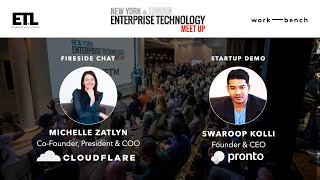
This recording is a June meetup co-hosted by Workbench (NY) and London’s Enterprise Tech Meetup. It opens with a demo of Pronto (presented by CEO Swaroop Kali), an ecosystem/partner-management platform positioned as a collaborative "system of engagement" that integrates bidirectionally with CRMs, marketing automation and file systems, provides role-based access, dashboards (direct vs. influenced revenue, solutions and pipeline), and ecosystem-level analytics. Pronto was founded in October 2018, released its first GA ~a year before the talk, has ~35 employees and >100 customer companies, and its largest customer manages roughly 3,000–3,500 partners. The demo emphasizes multi-tenant, multi-cloud architecture, fast onboarding (no onboarding call >90 minutes) and that partners receive a free, customizable edition to collaborate. The second half is a fireside chat with Michelle Zatlyn (Cloudflare co‑founder/COO) covering career advice (“life is a collection of experiences”), the early, uncertain pre‑traction days of Cloudflare, decision-making about swinging for the fences versus building a profitable business, the need to pair differentiated technology with strong business metrics (revenue, gross margin), and leadership lessons after going public. Michelle describes Cloudflare’s long-term, capital‑intensive strategy (global network), starting with a low‑price/free offering for developers/small sites and working up to large enterprise customers over time; she notes Cloudflare has over 100 patents in its portfolio, went public in 2019, and described the IPO as a milestone rather than an endpoint. The talk also stresses founder/co‑founder choice, mental health/self‑care, pacing, and realistic board/investor engagement.
Questions this video answers
October 2018.
A little over 100 companies.
About 35 people (projected to ~50 by year-end).
Roughly 3,000 to 3,500 partners.
No onboarding call has gone beyond 90 minutes (including customization and bidirectional integrations).
Chapters
Awesome. Thank you Kira. And hello enterprise techies. Welcome to our June Enterprise Tech Meetup. For anyone who doesn't know me, I'm Jessica Lin, a co founder and general partner at workbench along with Jonathan Lehrer. We're an enterprise tech focused VC fund based here in New York and we invest in early stage startups throughout the country in three to six million dollar rounds. And we are obsessed with all things enterprise sales and go to market. Now today's meetup is extra special and jam packed for three reasons. First and foremost, we bring you not one, but two cities. We are so thrilled to join our New York City forces with London's Enterprise Tech Meetup today for the first time ever who are longtime friends of ours as a sister meetup. Ian Ellis, who runs a London meetup and John used to work together at Morgan Stanley and both meetups are almost a decade old and we've been saying how we've gone global with Zoom and now we really are today co hosting this meetup together. The second reason I am so, so pumped is because our keynote speaker today is none other than Michelle Zatlin, co founder, president and COO of cloudflare. Many of you know our efforts here at workbench in supporting women enterprise founders and Michelle has been at the top of my dream list of women to meet and speak here at our meetup. And and today is finally that day, so don't mind me fangirling over here. And last but not least, pronto, one of our latest investments here at workbench will be presenting their demo for the first time ever on our meetup stage. So you are all in for a very special treat.
Awesome. Thanks so much Jess. Before we begin, a few reminders for the tweeters in the room. You hear this all the time. Our hashtag is nyetm and for our London peeps it's lnetm.
So.
So feel free to use both today Tweet away and tweet often. You can view all the videos of the past meetups. We also do a ton of write ups recapping some of our great speakers. You can find that on the Workbench YouTube page as well as the Workbench blog. And we will leave time for audience Q and A as we always do so throughout the conversation. Be sure to leave your questions in the chat as they pop into your head and then our speakers will get to them when they can. And with that, it's my pleasure to introduce our startup demo today. Swaroop Kali. He is CEO and founder of Pronto. We met Swaroop last year and we're blown away by his vision for the future of partnerships and channel teams and how Pronto can help you measure and track the value of your partnerships. Most of which is a black box. Today I will let you take it away. Swaroop, thanks so much for joining us.
Thanks Jess and John, you know, wonderful opportunity for. I'm sure there are a lot of people from Pronto over here, but for a lot of startups who are probably thinking about rising funding, especially in the early stage, I can't tell you how happy I am that Workbench decided to invest and we are now partners on this journey. So if you're thinking of raising a round of funding, definitely hit John and Jess up. So having said that, let me share my screen. Hopefully all you guys can see my screen. So we'll get started with just a couple of slides, just to set the context and from there we'll quickly dive into a brief demo and if there are any questions, please feel to put up in chat and I'll get to them as soon as possible. Now, some of you might have heard about us, probably some not so much. Um, so the story of Pronto actually began a lot because of my past experiences. I've been a management consultant, worked in BDN partnerships a little bit in corporate venture capital. And one of the challenges that I faced was, you know, alliances looked like really good on paper, but when it came to making the rubber meet the road, it was super, super hard. Right. That was sort of the spark which led us to start on this journey. So we started the company around late 2018, like October 2018. You know, Manoj, my co founder, who's probably in the audience here, you know, we were sitting in this dingy little office corner and now a little over two and a half years later, you know we are a little over 35 people company. A lot of background of who work with us either comes from BDN partnerships, they come from deep cybersecurity background, especially my co founder and a lot of people have worked or built large scale cloud native applications. The first version of the platform actually released a little over a year ago. That was our first general availability and today we actually power some of the largest technology ecosystems in the market, whether it's Red Hat, Juniper, Sisense, Better Cloud and a couple more logos. The logos that you see here are just a representative sample. We have a little over 100 companies who utilize our platform today on a day to day basis. Now you probably have started Hearing about ecosystems, the word ecosystem is not new, it's pretty old. It's derived from ecology on how all living beings build symbiotic relationships and coexist. Right. We here at Pronto fundamentally believe that business ecosystems are very similar, right? Where organizations which have a soul which is driven by culture, they collaborate and they partner with other organizations either to build new products, solutions or offerings, and market to end customers, either sometimes together or probably by themselves, but also selling, right? And those selling motions could become more of a resell motions or you know, sort of a co sell motion. Right. Now there are sort of two big key drivers. One is a technology enabler, the other one is customer buying patterns. Customer buying patterns have changed. Where they're saying, hey, don't sell us point products or solutions sell as the end to end solutions tax, right? And vendors can't build everything in house, so they always have to partner, right? So that is what is driving sort of the growth of these ecosystems where every company is trying to build like a big ecosystem by themselves. Right? Now the meaning of an ecosystem essentially means you bundle all the different types of partner relationships into one holistic bucket and try to operate them and look at what is the value that they're delivering. And sometimes it's just working one on one with a partner and sometimes it's working with more than one partner where there is a strategic alliance partner in that relationship, plus the system integrated relationship. So that is what defines what an ecosystem means. Now there might be some people in this audience who are directly from BD partnerships, channels, alliances, but most of us in one way or the other would have touched a partnership or an alliance. And someone who ever sort of try to peek under the hood, they will understand that a lot of pain points exist, right? It's very manual. The current traditional tool sets don't work because they were not built for collaboration. They were built for transactional relationships like only channel partners or resellers. And what people have tried doing was they went to the 8,000 pound gorilla of Salesforce, tried to customize it. But Salesforce was never built with collaboration in mind. It was always supposed to be within the four walls of the organization and not necessarily working between two companies, more so like three companies. But one of the sort of the fundamental hypothesis that a lot of their current tool sets were built was that sort of partners are second class citizens, right? They are smaller, they're order takers, we just give them some sales enablement material and they'll just go and sell. But that is not necessarily the world that we are living in. Sometimes these partners are much bigger than you, or even if they are smaller, they probably have much more deeper intelligence on where customers are going. Right? So all of these result in a big failure rate of these partnerships or relationships where there are metrics out there which say that over 60% of these relationships fail and they're leaving money on the table. Right? So that's sort of where pronto starts coming into place. So what is pronto? So pronto, essentially we call it a collaborative system of engagement. It's not a system of record. And the distinction is that a system of engagement helps two or more parties to engage with each other on a platform. Right? That's fundamentally what a system of engagement means right now. How does pronto work? Right, so think of pronto as the bridge that connects you and your partner and you can manage the entire lifecycle of the relationship, but it's completely automated, right? You connect, whether it's your CRM, your marketing automation, your customer success, and you can pull and push data into pronto. But more importantly, pronto works on network effects, right? So when you invite a partner to collaborate with you, your partners are actually getting a complete full blown enterprise suite for free edition of pronto that they can customize themselves and manage that entire relationship from their end as well. Right? So it helps you build that transparency and visibility that is much needed for a partnership or a relationship to thrive. Right? And we do this for both go to market and non go to market relationships. And what we mean by non go to market is, you know, the industry calls them the breadth programs or the technology partners, whereas the go to markets are more of the co sell and the resell which are strategic alliances and channel partners. Now a lot of people look at this graphic and they think, hey, are you like a zapier which is connecting systems between enterprises? The answer is no. We actually have very amazing user experience thanks to our design team, if they're here. And we always say that we are a design first company. Anything that we do, it first goes onto the design board where we think about the user journey, the user experience, because this is a very complex process. How do we manage that complex process underneath the hood? But whereas on the surface it seems seamless for the end user, all the way from building your programs to building solutions, where you track all the solutions, the steps that are needed to build a solution to co marketing, which includes launching marketing campaigns either jointly or just one sided or tracking MDF utilization to all the way to sales, enabling your partners, right? So we manage the entire lifecycle end to end. But the biggest value proposition that I always say is a lot of VP of Partnerships or VP of Business Development, corporate development today have no clue in terms of how big the ecosystem is, what is the performance of the ecosystem, who is performing better, who is not performing better, and where can there be a repeatability. All of that is surfaced through our dashboards and metrics. We'll show that in a quick demo. Finally, where are we today? A little over 100 companies use pronto on a day to day basis and we continue to grow. Customer acquisition is obviously the topmost priority for us so that we continue to scale and grow and acquire more logos, but more importantly, deliver on the vision and the value proposition that we promise to our customers. Finally, the team is scaling rapidly. Like we are a little over 35 people. But if my prediction is true, then we'll probably get to about 50 people by the end of the year. So some of the roles that we are immediately hiring for are Director of Product Marketing, there's a leader, demand gen marketing manager, an account executive and a lead product designer as well. There's some more open roles on our website. So if there is anyone in your network who would love to have a conversation with us around ecosystem management or who is probably interested in taking up a role in a fast growing startup, then definitely hit us up. I leave my email address in the chat. Let me quickly switch gears to a quick demo. Hopefully you can see my screen. This is our landing page. Think of my Persona as being that of a partner manager who is managing a bunch of relationships. What you're seeing here are different relationships in the ecosystem, right? Some of these are one to one relationships and some of these are one to many relationships. So here in this case, this is a multiparty relationships between Huli Akamai and one other partner. Right? Now let me dive into one of these relationships to showcase how Pronto is built. Right? So the way Pronto is built, number one, we had a multi tenant, multi cloud architecture. And think of a high rise condo building where the entire building can be customized to the way you need it, the way you look, the way it feels, what sort of structure does it need to have? Workflows, business rules, all of that, right? But then each condo unit, you might want it to be a little bit different. One is contemporary, one is traditional. I want my walls to be blue, someone wants my walls to be teal. So if you go into one of these relationships here, here, you would still be able to customize this relationship as well. The moment I go into the relationship, I can actually see the performance of my entire relationship from what has been targeted to what has been generated. The direct versus influenced revenue, where direct revenues are something that I'm closing, whereas influenced revenue is something that my partner is closing for me. How many solutions have I built with the partner, what stages they are in? And there are much more metrics down there. Right. But the way each relationship is structured is it's extremely methodical and easy for people to understand and get started with Pronto, two and a half years of the company, I've never had a single onboarding call which has gone beyond 90 minutes, which includes a complete customization and also bidirectional integration with a CRM or a marketing automation system.
Right.
So if I go into something like sales over here, I can track all the contacts from my sales opportunities, but I can also track the deal pipeline that I am pursuing with my partner. Right now you'll see that some of these are actually coming in from Salesforce with the bidirectional integration, some of these are actually coming in from Google Drive because the partner is probably managing some pipeline in a Google sheet. And some of these could actually be manually added into as well. Right. Now if you look at the data sources here, there are connectors where some of these are coming from Huli, whereas some of these are coming from Dropbox. Right? So you'll see that what Pronto enables you is two companies, disparate systems across two different organizations, but you're still able to share and collaborate on data and further your go to market mission. Right. And that was never. That didn't exist before. Everything was driven by spreadsheets and emails and notebooks and all of that. Now one of the other crown jewels of Pronto, which is what we usually lead with, is the measuring the performance of your entire ecosystem. Now as your ecosystem grows, it becomes very hard to manage it. Right? So now when you have the ecosystem dashboard, you can actually look at the entire performance of your entire ecosystem. How many relations do we have and based on what stage they are actually at, how many solutions and which stages are the solutions in. But I can actually quickly look at what are the top five performing relationships and which ones are not performing all of these. I can go into drill down reports. But one of the biggest challenges that partner managers or BD people have is building reports and they spend a ton of time trying to build these reports. So we make it easily accessible to download all of this content whether you want one of These graphs or whether you want to do further due diligence on scratch.
So Arup, I'm going to jump in because I see a few questions coming in too. So who manages the relationships as seen in this view? Who is a user using this particular dashboard?
Yeah, so like I said, the user Persona that I am logged in is that of a partner manager. So the ecosystem dashboard is actually targeted towards BD and BP of partnerships because they are the ones who are responsible for managing the ecosystem. I just, for the purpose of the demo, have access to this, but there's a very robust role based access built into the platform and you can define who wants to see what and where do I give access.
Awesome. We have time for one more question because we're squeezed on time today, but this is a great one. How big is your biggest partner ecosystem currently? I'm guessing of a customer.
The biggest ecosystem that we have is that of an enterprise customer. They have about, roughly about 3,000 to 3,500 partners in their ecosystem.
Which is.
Incredible to think that they had no platform at all to manage those thousands of partners.
Exactly.
They were literally using spreadsheets. Well, thank you so much, Swaruu, for this awesome, awesome demo. Like I said, we're so pumped to welcome you to the Workbench family and if you could actually drop your email in chat, that'd be awesome. I know there are probably lots of people here in our community who works with channels or partners, teams for them to get in touch with you. Thank you so much, Farooq.
Thanks, Jess.
Awesome. With that, we're going to switch gears and turn it over to our Fireside chat. We are so, so amped to have Jeff Elder from Business Insider with us to lead today's Fireside chat with Michelle. Jeff covers cybersecurity and AI at Business Insider and and was previously at Salesforce, McAfee, Wall Street Journal and more. And with both Jeff and Michelle's deep security backgrounds, we know this is going to be a terrific chat. So I'll let you take it away. Jeff.
Great.
Thanks so much, Jess. Michelle, it's great to see you again.
Likewise. Thanks for having me. Nice to see you too, Jeff.
Yeah, I wanted to ask you about sort of a personal approach, something I've heard you say in interviews before. You've said it in an interview with me before. And that is life is a collection of experiences. Collect a lot of them. What do you mean by that?
Okay, sometimes I say things and then a few years later I'm like, oh, by the way, I've learned some things since then, but this one I stand by. I do think life is a collection of experiences. And I'm in my early 40s and I think about my friends in life who are happiest or most successful, and they've collected a lot of experiences throughout their careers. And, you know, I like to say that. And maybe it's more of a reminder for myself that earlier in my life, I kind of used to envy everyone who had their life figured out. Like I remember at college or university where people knew exactly what they wanted to do and they set everything up to do that exact thing. And I thought that just seemed so much easier because it's a lot of work to go collecting experiences and being open to new ideas and trying something new. But now I guess I say because I wish someone had told me early in my career that you don't have to have everything figured out in university or college. You can collect a lot of experiences and they all add up to something really interesting. And so what does that mean? Tangibly? It means go take that new project or job within the company that you're like, I never thought I was going to work in sales. Well, go do a stint there. You'll learn something. You'll be expanded in ways that you never thought were possible. Or maybe there's an opportunity that you, that you, that pushes out of your comfort zone, maybe a public speaking opportunity. But it's like, well, just put yourself out there and try it and even if it doesn't go well, you'll, you'll learn something from it and grow as a person. Maybe take a trip to somewhere that's not on your top 10 list. Just to say, I thought I knew what my top 10 list is, but this is a good check and balance. Maybe there's the world, there's a lot of amazing places in the world. And maybe I don't know what my top 10 list is. And so that's what I mean by going to collect a lot of experiences.
That's a great segue into the early days of Cloudflare. And when I've heard you talk about this before, things weren't always immediately clear. You had other opportunities. Big offer at LinkedIn. This guy in Harvard Business School with you won't shut up about this open source project. And you're like, what even is that? So it wasn't just a straight shot to super success and growth from Cloudflare. It sounds like it was really a journey. Can you talk a little bit about those early days?
Yeah, definitely. And this was before Cloudflare was a company. So I like to tell it because the story. Cause there's some of you on the call that are further along and that's great and I'm sure gonna talk about that too. But kind of once you have traction, how to scale. But there's the pre traction phase where you're kind of searching and it's almost like you're surfing a wave or in an ocean kind of bobbing up and down and one moment you feel really good, another moment you're like, but there's this whole other ocean for me to explore. Is this it? And it's hard. It's hard to make a commitment to something. And so we were early at Cloudflare and it wasn't even named Cloudflare yet. We kind of had this. There was something lurking there. And I did have other options. I had a really good job offer from LinkedIn which would have been great. And that was their pre public. The person I was supposed to work for, he still works there. My roommate actually did go take that job and his career has turned out just wonderfully. So I think there's lots of ways to be successful on your career and saying, hey, I'm not going to do any of that. I'm going to pack up my stuff, move to California and see if we can take this idea that we couldn't even verbalize very well, by the way, and make it a reality. Reality seemed a little crazy, but we just had to see where it went. And it wasn't obvious. It wasn't like you lined, you signed up a spreadsheet and you did all the analysis and the spreadsheet. See, option A was go take the job at LinkedIn. Option B was move back to Canada and do whatever. My other option was option three, start Cloudflare with Matthew Prince and Lee Holloway. If I had done kind of the analysis in a spreadsheet, I don't actually think the spreadsheet would have said do option three. But there was just something. There is almost part gut feeling of have to see where this goes and even if it doesn't work out, at least we can say we tried. And that to me was a bit of me taking my own advice of life is a collection of experiences, let's go collect it. And it was scary and it was hard and it wasn't uncertain. And there's some people who start companies where they're very certain. They're like, I'm going to will this into being successful. And that's amazing. I Admire those people. But there's lots of other people that are in my camp where they're like, there's something there. It might be big. Should I spend time on it? And then what happens is a lot of people say no. And I think that if you can have some of those people say more yeses, I actually think a lot of really great companies will get built.
Let's talk about that middle period that you were talking about. You guys swung from the fence for the fences early on and it was kind of hard. You were looking to be a growth company all along. Can you talk about the strategy there and sort of the tactics you used?
Yes. Yeah. Okay. So this is something where I used to be super dogmatic about how I said this and I soften the way I describe it because actually my husband's an entrepreneur and he has a great company that's profitable. He's taken $0 of venture funding and it's growing really nicely. And so I've kind of seen another way to build a company. And so my preface to this answer, Jeff, is exactly what you said. We were swinging for the fences. And so we still are. And that's. That's wonderful. I love it. There are a lot of ways to build companies. You don't have to do that. And so if you're the entrepreneur listening or you work at or you are part of one of these early stage teams, I think the step one is understanding which camp are you in? Like, are you swinging for the fences? Great. You might make a different series set of decisions then if you're like, actually no, I want to just build a really good, profitable business. That. And that's wonderful too. There's lots of those as well, I think where there are sometimes issues. And again, I have a lot of scar tissue built up building clout for over 11 years. I know so many entrepreneurs, a lot of successes, a lot of not successes. And I think one of the mistakes I see is when people get that mixed up, they say they want to swing for the fences, but maybe the opportunity actually doesn't justify that because you need a big opportunity to be able to swing for the fences. You can't will your way into the market size. It either exist or doesn't versus or other people who think, I don't want to swing for the fences, I'm just going to do this. But then somebody else comes and swings for the fences and takes all their business. And so you kind of need to figure out which one you're doing. I think. I do think that's important. But for us, we were very ambitious and we kind of knew we were going to be a one or a zero or, or how we described it as. Cloudflare is a very intensive business, capital intensive business. So we run a global network. Our customers are anybody with a website, app, API, anything connected to the Internet is our customer. So that's a huge market. There's a lot of things that connect to the Internet and we help make all those things connect to the Internet faster, safer and more reliable. The way we do that is we run a global network and so we actually spend millions and millions of dollars on capital capex every year. So we actually, for a technology company, we have a huge capex bill every year. And so we knew this early on. And so for us we're like, well, it makes sense to make those huge investments if we can share it over a lot of people over time and there's a lot of people using it. And so it was this idea of we knew we were going to be a huge company or not exist as a company. That was our thesis and I think a lot of that has proved out. And so a lot of the decisions we made early on were very long term focused. We want to build a long term business, a business that's here for the next decades after decade after decade. We weren't trying to build a business to be sold. And when you do that, there are decisions along the way that weren't obvious when I started or wrote our business plan, but where you have to decide, are we really going for it or are we going to build this to be acquired? And you would make different decisions at those points along the way. And we always kind of said, no, we want to be a standalone business. And so now, 11 years later, from when we started our company, we're public, we're traded on the New York Stock Exchange. Our market cap is somewhere between 20 and 30 billion dollars, depending on how the stock trades. And that's pretty amazing. And what's interesting is all these startup founders say, wow, that's amazing, you're such a huge success. And it's true, we are a successful startup. Like we are no longer startup. We've gotten out of escape velocity of startup. We are a company, we have real revenue, we employ 2,000 people around the world. We have a lot of customers that depend on our Service. You know, 4 million businesses around the world use our service. We're very proud of that. But in our grand plan of swinging for the fences, we're nowhere near where we want to be right. We, we, we have so many innings left ahead of us to build this iconic company where we want to be a much larger company with much larger, like many more customers and many more employees. Employees. And so while we're both successful, we're still very early. And so I think that what I say internally, which people tease me about sometimes, is we're just getting started because it just feels like there's so many things ahead of us and that's exciting. I meet founders sometimes who say that sounds terrible. I would never want to run a public company. And so again, you would make different decisions along the way. And I think all are good. The being honest with yourself as a founder is probably the message I want to get across the most because again, I just see a lot of boards getting sideways, investors and founders getting sideways, founders getting sideways with each other when you're not aligned on what you're actually trying to do. If one founder, if you have a co founder, and we had three of us that started Cloudflare, we always were aligned of swinging for the fences. You could imagine if Matthew wanted to do one thing and I wanted to another, or Lee wanted to do another, how much discourse or friction that would cause. And so I just think being honest with yourself is really important.
You've talked some about how the tech has to be there, but that the business also has to be there. And for folks who are tuning in a little bit and they're focused on the engineering, is it sort of like you have to have a double major sometimes in order to really get where you want to go? Are they twin paths that have to coexist really strongly?
Yeah. I think this is a good question and I like to make this point because I used to come to so many talks like this. I still do. I get a lot of mentorship from just hearing people ahead of me and hearing how they're building their companies, because we're all kind of making it up as we go along. And this is something that I feel like no one told me along the way. And so now I'm like, why didn't anyone tell me this? Which is why I like to tell people this. So I, again, I'm a founder. I started Cloudflare then at some point. And when you're finding a company, it's so awesome. It's about the technology, it's about finding product, market fit. And you're like a group of people and you're just like the founding team and everyone's kind of in it together. It is so Fun. It is. It's also really hard, don't get me wrong, but it's just like, it's kind of like being on this team playing for something or you know, a school project that you're about to ship. I don't know, everyone's got a different jam. But like, so I like, I loved that. But at some points, the technology and we built infrastructure for the Internet, we are such a geeky, nerdy company. We have filed over 150 patents or over 100 patents in our portfolio. We've invented a lot of technology, which we love. That's our happy place. But at some point it dawned on me of, okay, the technology is cool and we're tech founders and that's amazing. But actually what's really cool is building a good business attached to it. And you know why that's important is that it is super hard to compare technologies. Like I was, we were a cloud based security, performance and reliability service. And how we have architected our solution, it is different than other how other companies have made decisions. And we like love that. But at the end of the day, being able to compare that technology is very difficult. It's even difficult for technologists to compare because it turns out comparing the future is hard. What is much easier to compare is your business metrics. And there are a very set of kind of business metrics that you get measured on as you get further along. Revenue turns out that's like the great equalizer. Doesn't matter how cool your tech is. At the end of the day, can you capture, are people paying? Are you making money from it? Somehow it turns out revenue matters a lot. Gross margin. Gross margin is okay. You're selling this service, how much does it cost you to actually deliver that service? And if, you know, if you have a mug, a coffee mug, you sell the coffee mug for $5. How much does it cost you to make the mug? Maybe it's a dollar. That's called gross margin. You have $4 left over to spend on everything else. In software, it's different. You know, we run the service. What's our gross margin? How much money do we have left over to go back and invest in sales and marketing or more engineers to go build new awesome technology and then all the other things you need to make a business run. And when we start cloud, for the first five years we kind of thought the business metrics were uncool. And we were mba, we came from Harvard Business School, so we knew that it wasn't, that we didn't get it. It just wasn't a cool thing to talk about in the valley where we built our company. And again, very quickly I realized having the founder hat is awesome. Adding the business hat is super cool because all of a sudden you start your business, metrics look really good and more people pay attention, and then if you can explain why the tech is so cool, that's great. And so I think both are the best. If you look at all the best companies in the world that have swung for the fences, which again, I am trying to do, they have both. And again, you might not be trying to do that, and that's okay too. But if you are, I do think you need to have great differentiated technology that sustain it, that, that sustains plus a really, really good business. And it's having both is. Is a good place to be.
I wanted to talk to you about the more recent leg of your journey because you've said some interesting stuff about going public is not the end, it's not happy ever after. It's when things really get interesting. So I want to get into that. But a couple of questions from the audience about this middle part. Was there a tipping point where you said we're a growth company? The second one is how did you get going on products and customers?
Okay, yeah, so, okay, so let me practice. And I started to say this and I didn't say it. And I'm going to say it because I think it's really important. Again, this is something also that I don't think gets said in this way. So you all have opportunities. You are all pursuing an opportunity. And you know way more about that opportunity than I do or even Jeff does, although you all want Jeff to eventually write about it one day. So that's so. Because that helps. Helps to keep the machine going. So. And when I say we were swinging for the fences, we kind of knew Cloudflare was either going to be like there was something huge there where if we could help make anything connect to the Internet faster, safer and more reliable, that seemed like a big market. And we didn't even really do the market sizing exercise. We have since done that many times because that's what happens when you become a business. You do the market sizing exercise a lot. Maybe on day one it's not important, but like, at some point it kind of back is to this business. You start to make different decisions. And it just was like, this is a huge opportunity. And so the visual that I now use is, look, there are a lot of opportunities in life and I've Met.
A lot of entrepreneurs, which is why.
I've kind of had this realization there are tons of opportunities. The thing that was not obvious to me, and I'm just going to, maybe it's obvious to all of you, is those opportunities look different. Some are bigger and some are shinier. And I think that that is. Now, it doesn't mean you can't take a rough, a smaller, kind of rough opportunity and polish it up and make it a good one. You can, but it inherently might just always be smaller than someone else's bigger opportunity. And so they are different sizes. And I, you know, there's a lot of companies that I look at and they have bigger opportunities than Cloudflare. I think our opportunity is huge. But there are others where I'm like, wow, their opportunity is even bigger and shinier than mine. But I'm still very content doing what I'm doing because I'm proud and I think we're delivering a lot of value and we're on this mission and we're on this path. And so, so I think lots of opportunities, like they're different sizes and different shininess. And so what I've always taken great pride in, and same with Matthew, is, hey, we want to make sure our opportunity reaches its full potential. Because what would be really bad is you take a big shiny opportunity and you only get to like a third of the way. Like I would feel to me as an entrepreneur that's kind of a failure. On the vice versa, if you have a medium sized opportunity that's really rough and you polish it up and you reach that's full potential, I actually think that's like a huge metric of successes entrepreneur, because you've really been able to make that reach its full potential, whatever that is, and maybe now it's time to go find a new opportunity to pursue. And so that's like something that I kind of like to use as an illustration because I think that gets people thinking. And sometimes what happens is people say, oh, wow, yeah, my shine, my opportunity is not that shiny. I'm going to do all the work to brush it off. And that's great, good for you. And then maybe they said, but actually I'm going to go meld my opportunity with someone else's and together we're going to be even bigger. I think that's really interesting. You can start to do other sort of things like that. So that's a little bit of a play how we think about it. So when we go back to what did we do when it came from product, we had to start somewhere. So we started by building making the Internet faster, safe and more reliable for small businesses, developers, entrepreneurs. That was where we started. We started with a free service, a $20 a month service. And it turns out when you sell something for $20 a month, expectations are different than when today we sell things for a million dollars a month. They're just different. They have different expectations. Sure. That when someone's paying you $10 million a year, they have a much higher level of scrutiny than when someone's paying you $240 a year. And so we started by building a product, helping solve problems for what sometimes gets described in business books as the long tail or the underserved market. So Clay Christiansen is a professor from Harvard Business School. He talks a lot about business strategy. He's since passed on since we started Cloudflare. But we were really inspired by there were a lot of solutions if you were a big organization to be fast, safe and reliable. We didn't think they were going to be future proof. But at the time, when we started Cloudflare 10 years ago, there were a lot of choices for there. But if you were anybody else, there was nothing like no alternative, zero. And we said we want to build a service that is the best for this market, that has no solutions. And that's where we started at knowing, because again we were streaming for the fences. We said knowing that over time we are going to work our way up to go win that large Enterprise, that Global 2000 company. But we're long term focused, we don't need them on day one. Let's earn our stripes. And we kind of just kept marching along the path and in our Q3 earnings call, so now we're a public company, Q3 earnings call of last year, so not that many months ago, six months ago, I guess nine months ago, we announced our first $10 million customer. And so that took us 10 years in the making. And so it was just this idea of we're going to solve anybody putting anything online. We called it like an application. So your apps that you're building, your websites, you need a digital armor. You need that to be fast, safe and reliable. We built, we do that for startups, small businesses, entrepreneurs. Like that's where we started. Developers, hobby sites, that's where we started. And then over time we've layered in all these Global 2000 who now, you know, we have many $10 million plus customers and million dollar plus customers and we, we were very long term focused on that. So and then we've also expanded what we do, but that's, that's a little bit of where we started and that worked really well for us. And I. There's a whole reason why that works. Well, your story is going to be different and that's okay, but just being purposeful and having a point of view on it actually will set you apart that from. From most other founders who aren't thinking about that business. Because again, it's back to the technology and the business. Hat.
I talked to you at the beginning of the pandemic and I asked you about your employees and where they were going to be working and that kind of thing, you're not going to remember this, but I do. You said, hey, this isn't an experiment. This is our employees lives. It was clear to me that leadership for you went far past the ipo. And we have some other questions here. And I know that as young entrepreneurs, folks think, I get the ipo. It doesn't matter what happens after that. I get that big funding round, everything's done. But you've spoken before about ringing the bell at the New York Stock Exchange, having your kids there in the movies, that's the final scene. But it's not. Cybersecurity changes all the time. You folks have to make tough calls about stuff like free speech and who you protect and who you don't. Can you talk a little bit about after that great success, leadership, self care and how it's not the end of everything, it's the start of stuff.
Yeah, no, that's a good point. I feel like going public gets such a bad rap. There's so many. I say this specifically with founders, for so many founders on this call. And part of this, the workbench community. And it's amazing. It's been like, so fun. And I think there's a lot of people who take themselves out and they're like, I don't never want to be a CEO of a public company. And it's a little bit like, are you sure? Like, why do you say that? Maybe someone else didn't like it, but maybe you'll surprise yourself. And so, no, don't get me wrong, it's a big responsibility and it is different. And maybe you don't enjoy it and that's okay. You shouldn't force yourself into it. But I feel like sometimes people just say it gets a bad rap. And for us, I would say it's been a very positive experience. And, you know, this idea of going public was a huge deal and I didn't really appreciate it. I kind of dawned on me before you go public, you do a roadshow. And we were in New York and it's before a road. Sorry, not, not the roadshow. You do something called Testing the Waters. And what it basically is.
And.
There'S elements of the US law that are super elegant and this is one. So the SEC is the organization, the regulatory body that oversees public companies and they kind of say, hey, before you actually decide to tell the world you're going public, that's a very, it's like almost like posting your grades for the world to see. We you're allowed to go meet with institutional investors to kind of test the waters to get feedback, to see if there's an appetite for you to be public. So I kept thinking, I mean school was a big part of my life. I always got really good grades. I cared a lot about my grades. That might resonate with some of you, Some of you probably you're like, I got bad grades again, lots of ways to be successful in life. But for me that was my, I was always, I always measured myself against how I was doing at school. And so I always like in going public like I was. We've been working on a project for 10 years and we were about to post it for the world to see and then evaluate. And so Testing the Waters is this experience where you kind of. We went and talked to experts and we were telling them and so no one knew. Like you didn't know Jeff, A business insider. We didn't. The world tells you to be really careful. You can't even tell your friends or family. So you've got this big secret in your life and you're going to meet these investors in New York and Chicago and talk to them in the London investors, San Francisco, all these hedge funds and pension funds and they're really smart and they're trying to understand your business and they're trying to decide should we invest our money. If you went public, is this a good investment, will you drive ROI for us? This is kind of what the conversation is. And it was during those conversations where I kind of realized how big of a deal going public was. I didn't really understand. We were just so heads down, building Cloudflare, helping our customers, thinking about our team. And it was just, it dawned on me at some point where we were in New York City, we were at this, this, this, this fund, hedge fund and I just met the people and the guy, he's the partner there, he almost got teary eyed, he's like you have no idea how often we talk in this room about how most entrepreneurs never even get to this room. And now not only are you here, we love what you're doing and we want, if you go public, we will be huge investors in you. And I kind of left and I thought, I've seen glimpse of that with my venture investors where they really are invested in cloudform, they really believe in what we're doing, they really think we're helping to make the Internet a better place and they're so proud to be a part of it. And I kind of never thought that that was going to be part of the public investing. I and the fact that this person I didn't know very well had just met us, he's like, we love your business. We love what you're doing. We want to be a part of. You guys should be so, so, so, so proud. And I just kind of thought that's when it resonated and I went and so then I started to ask the exchanges how many people go public. I had no idea. And since then, the number's gone up a lot. But when we went public in 2019, we were the 210th tech company to go public on the New York Stock Exchange in a decade. So it's just not that many. I was just like, what? That's it. And again, that's taking out healthcare and all these other things. But in tech, we were the 210th company to go public on the New York Stock Exchange. I couldn't believe it. And so it was those. So it was a big deal. So we celebrated it. It was fun. We celebrated as a team. But then it was a Friday, Friday. It was Friday the 13th that we went public. We had a great celebration. We like, it was a whole team effort. Everyone was really proud. But on Monday, we were back at our desks because it was like, not the end. It was like, let's go. And since then, we've grown our business a ton. We've shipped a lot of new product. We've made the opportunity bigger and shinier and kind of on this, filling it up to it reach its full potential, which we still think is many innings ahead. And so it's been a huge privilege to be part of that and then to be part of the leader helping lead that and almost changing some of this narrative you hear about. It's the end, that's the end. And oh, now I'm going to just go party all the time. And again, that's fine if you need to take a break. Go celebrate. But I don't know, it's being productive, being useful, having groups of people roaming the same direction, building something of value for your customers and for, in our case, the Internet is incredibly rewarding. And I think about the people who left saying, oh, this is done. I've kind of checked the box and I think about what they've missed the last two years. It'll be two years in September. There's a bunch of experiences that they missed out on that you just don't get early. Right. And I think that those, some of those things, just back to my point of life, is a collection of experiences and you justify why you take yourself out of the Games along the way. But it's like if you stay in, sometimes you go and get new experiences that you didn't even think that you cared about or knew were possible.
So you were an athlete growing up. You like to win. But you have talked about pacing yourself self care. That young entrepreneurs who work and go by the old Valley mantra of I'll sleep when I'm dead are setting themselves up to not do their best work, to not restore themselves and be able to get that inspiration and discover those opportunities. Can you talk about that a little bit? That taking care of yourself is not a reward after you found success, that it's part of the journey.
Yeah. So here I really want more research on this, writings on it. Like, I would love someone to write a series of blog posts because it's. There's not a lot of good content on this, in my opinion, which is another reason why I bring it up, because it's just like, I wish someone had said this to me. No one did. So, look, building companies are intense. This idea of building a company is an intense experience. And I just. I just think that it is what it is. And so. Okay, great. It's an intense experience and that's both exciting and exhilarating and super rewarding. And you get to do amazing things that other people don't get to do. But it's also incredibly hard and lonely and hard on your psyche and especially early on. Like, I just remember early on in Cloudflare, you know, the highs and lows, you have 10 in a day. Like, you go from a high to a low to a high to a low, and you kind of go home in a day. You're like, I feel like I've been through a washing machine and nobody understands. Understands. Like you can't even tell your friends, don't understand. I had a. I had a. I had a boyfriend. Who's now my husband. So I was in a really serious relationship. Even like he didn't really understand. The only person that really understood were my co founders because we were like going through the washing machine together all the time. And so but you can only talk. You can only. But you need a break from them too. So it's a little bit, it's very intense. And when I early on at Cloudflare, there was a lot of talk about founders who were depressed and depression and there's a lot of terrible things that have happened and for some whatever reason there's less of that. So maybe, maybe the narrative, maybe things have gotten better, which is good. So anyway, so that's a little bit of it. It's hard. So you do have to take care of yourself because no one's telling you to take care of yourself. And even if your loved one says, hey, you really, like, I'm worried about you, or your co founder says, it looks like you need a vacation, it's just at the end of the day you got to find it. And so that's why this idea of self care, care and you can, you can be successful and take care of yourself. And I just wish maybe I, if I had heard that earlier on, I would have done more, made different decisions. And I'm trying to get better at it. And it's something I like, I keep working at. And so what does that mean? Just like making sure you're sleeping enough. I mean, all the research shows that like a good night's sleep is actually the world's most powerful drug. Like, you're refreshed, you make better decisions. It's almost more important than a replying to those five emails. They'll be there tomorrow, right? Like, so there's things like that, what we used to be really bad at, which I've gotten so much better at. This is back from a founder hat to a, to an executive hat. I mean, I talked about founder to business owner hat and then add executive hat on and then add executive of a public company hat on. Like those are two other different identities that you have to learn to get good at. After being a founder, it's different. And I remember like this idea of especially as you grow, you got to get better at delegating and empowering your team to do the things that used to be really good at. And as a founder, I had a hard time with that because it's just like, we're in this together, we're all equal. I don't, I don't want to give away that. But you got to learn to like, people are going to take it and make it even better or maybe they'll make it worse, but. But then you can coach them to making it better or maybe it just will turn out looking different than what you ever thought was possible. And so you have to learn to prioritize. You got to learn taking care of yourself. And the big wake up call for me is that I basically ended up wasting a year of my life. And I really like, say, say this is. I like, I had a back injury and I used to go to board meetings. This was when everything was in person. Like I couldn't sit. Like, I took meetings lying down. It sucked. And I ended up with back surgery and I'm fine now, but it just accumulated. And I didn't take prioritize taking care of myself in my 30s as I was on this huge rise and we were a huge success story. And so I just think, take care of yourself. And you know, the good news is I went through my, my low point and I've come out the other side. So that's, that's good. And I feel a lot better. My back's healed and I'm a lot healthier and now I make time the day to exercise and it's on my calendar. And no, I'm not going to move it because I'm not going through that again. I can tell you I wasted a year of my life lying on a floor and it was pretty miserable.
So I want to stay with this just for a second because you don't get a chance to hear super successful people like you talk about those low points all the time. And somebody in the, in the audience just said, how did you handle those low points early on, before you have that approbation from the world, before you have the huge funding rounds? How did you get that resilience?
Yeah, this is a good. So I, So there's two things that I feel really lucky about and two decisions that I made that were really good that helped me get to those little points. So I think it's. I have a, I've said this before, I haven't said it for a long time is like, choose your co founders wisely and choose your life partners wisely. I mean, so I'm, I'm in a relationship. My husband and I, we have two kids. All happened during Cloudflare. And then there's three of us started Cloudflare and two of us are still running the business and we're very close and we have Gotten very close to going through this. And I just remember there were points where there was a lot of low points and Matthew, who's my business partner, like was high, like didn't experience the same way and he helped get me through and there's points where he was low that I helped get him low. And so it was almost like if you could match somebody where he's known to panic early and I'm a bit more of an optimist so there's something. He'd be panic early. But I'm like, yeah, but look at all these, all these other rose colors, roses out there that are blooming. And then the days where I'm like, oh my God, all those roses are dead. She'd be like, but Michelle, you know, it's, you know, this is an opportunity. And so that works good really well. If there's somebody where when you're low, they're high, like, I feel like that helps. I mean that and I just being willing to even say, oh man, this is hard, what are we going to do about it? Some people can't do that. They just internalize all of it. And so I think we are lucky to be able to have that. And you know, if you go back like early on we used to message all the time because you're just. It's kind of that. So, so that. And then same with my life partner where, you know, at home there's lots of good things that clobber and then some days where are tough but you kind of have someone at home be like, yeah, but you should be so proud or this. And so now you can't bring all your problems home. But like that, that. So I think having people that were good rocks good and I've been a good partner to them. I think that does set you up in a better place than if you feel you can't say anything to your co founder or your life partner. Like then you're really. I mean that's. Then you feel really isolated. So you got to find your community in some other way. So that's that. I also just think that we got advice early on and yeah, be careful with advice. But this advice is stuck and I'll share it. Here is there is a CEO of Venrock, of Venrock Portfolio company who met with us and said, look, building a company is like flying a plane. There are two ways to crash a plane. The one is everything goes wrong. You literally crash it into the ground. So that's bad. The other way is if you are flying so high, so vertical that you defy gravity and you end up crashing. And what he was saying is that in startups there's so many highs and lows. If you only talk about the good things, you're going to go straight up. And we've seen some spectacular failures of companies like that. And whatever you think about WeWork, I put WeWork in that case where they were flying so high and it was a spectacular that we all got to watch and learn from, from. And then there's others who just, like, make a series of bad decisions and like don't have a business and they run out of steam. The really great business hats. So again, put your business hat on or executive hat is the best pilots fly 10 degrees over the horizon. And so when things were going bad, we tried to find the good things to focus on. And when things were going well, we tried to find all the reasons why something bad would happen. And I'll just tell this funny story, last story, and then I know we're out of time. It was really early. We were pre Series C, so it was early Cloudflare. And we kind of had nothing to talk about at our board meeting because everything was going well. So we said, okay, let's talk about all the things that could go wrong. And so it was like called the five, I can't remember boulders in Cloudflare's business. And it was really early. And we talked about the five things that could kill our business. And we came out of that board meeting, the board said, this is the best board meeting we've ever had because it was just idea of the metrics all look good. And we were trying to bring down the. And again, it was so early. We didn't want people saying, oh, oh my God, you're the next big thing. We just didn't want that. So we talked about all the. So this is an example where the plane was going like this. Matthew and I corrected it to be 10 degrees by talking about all the things that could kill the business at the time. And then of course, the board discussion was, what are we doing to mitigate against all of these? And so that's that. That is a glimpse into what you all have to look forward to, from going from a founder hat to a business owner, to executives, to hopefully public company executives. And. And a little bit of insight of how we got from one side to the other side.
So good. I love talking to you. Michelle, thanks so much.
Thanks so much, Jeff. You make it very easy.
It's over to you, Ian.
Great, thanks.
So much, Jeff, and huge thank you Michelle. Really, really insightful and really the best way to describe it is a breath of fresh air, I think, especially after the pandemic. Just hear such a positive story and.
Such a great story.
So huge thank yous for taking the time to come speak with us today. And Jeff, as always, very thoughtful and profound. So that was super, super great. Thank you to Swaroop Prop Pronto for, for doing a great demo earlier on. A quick shout out to the London sponsors. Thank you to ARIC, to the FinTech Innovation Lab and to Tailored Brands and onto our next event. So we are very, very excited to be working with the guys with John, Jess and Kira at the New York Enterprise Tech Meetup to do a series of these summer events. So our next event is the 15th of July and we'll have Daniel Deans from UiPath coming to join us and speak. And now the most important thing at the end of the evening is the after party, so if you would like to join. We use a lovely event platform called Toucan, which is great for networking. It feels a bit like a pub, which is always good. So if you're around, do come by and join us. The link to the Toucan event is in the chat and hopefully see some of you guys in July. And thanks again, Michelle. It was a super insightful event.
Thank you.
Have fun at the happy hour.
No worries, it's always an adventure. It's somewhat famous at this stage.
Oh, good. Well, that sounds like fun. Thanks everyone. Bye.
More from Michelle






SF Conference 2013 CASE STUDY: Michelle Zatlyn - Scaling a Company To A Billion Views A Day




