Michelle Zatlyn, CloudFlare Girls in Tech, Amplify Women s Pitch Night #AMPLIFY #theCUBE
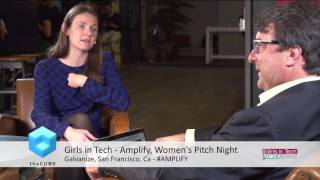
This content was created by Michelle Zatlyn. This content was uploaded by Michelle Zatlyn. This is a YouTube interview titled "Michelle Zatlyn, CloudFlare Girls in Tech, Amplify Women s Pitch Night #AMPLIFY #theCUBE" (created 2026-01-28) — a live on-location conversation recorded at Galvanize San Francisco during the Girls in Tech Amplify Women’s Pitch Night. Host John Furrier (theCUBE / SiliconANGLE) interviews Michelle Zatlyn (co‑founder of Cloudflare, head of UX) about Cloudflare’s origin story, early fundraising and team-building, product/roadmap thinking, advice for entrepreneurs (especially founders deciding whether to go full-time), hiring and culture, women in tech and diversity, and how large organizations should approach digital transformation.
Chapters
Live on the ground from Galvanize San Francisco.
It's the cue covering Amplified Women's Pitch Night.
Now here's John Furrier. Okay, hello, everyone. We are on the ground here in San Francisco at the Galvanize Incubator. I'm John Furrier, the founder of Silicon Angle Media. It's the cube on the ground. And we're here with Michelle Zaplin, who's the co founder of Cloudflare and also head of User Experience, giving a Fireside chat here at the Girls in Tech Amplify event about women in entrepreneurship. Co founder, entrepreneur, yourself. Welcome to our on the ground. Thanks for joining me.
Thanks for having me. I'm excited to be here, John.
So obviously we've been. We love the women in tech. We just spent an amazing time at Grace Hopper, which 16,000 people. I was one of 1,000 men, so I felt. I loved it, actually. So I love any women in tech. But here, more importantly, in the Bay Area, we're in San Francisco Silicon Valley. Entrepreneurship is in the blood.
Yes. Yeah. No. We're so lucky where we, where we live. I feel like, you know so many people when you spend time in the Valley, you realize, you know, everyone's talking about the next great idea. It's, you know, you go to a party, everyone's talking about what they're working on or an idea they have. It's not like that everywhere. And so we're really lucky where we get to live and have the resources to fail to execute on these different, sometimes crazy ideas.
So you're giving a Fireside chat. You just came off the stage here with all these women entrepreneurs. Pitch night tonight. So it's all about getting the pitch out there, talking about your experience. Obviously, Cloudflare, your company you co founded and head of user Experience, you're doing a great job, great success.
Thank you.
Great customer base, great growth. What did you talk about?
Well, what did I talk about? So we launched at an event like that six years ago. And so what I talked about with the audience was I was in your seat six years ago and now six years later, we have a great business. We have real customers that are using Cloudflare. We help make the Internet faster, safer, better for more than 4 million Internet properties. 15,000 new sites sign up every single day. Whether you're a small business, a large business, a blog, an API, an app, you can use Cloudflare to be fast and safe. And what I shared was I was in your seat six years ago. And here are some lessons or aha's. I'VE had along the way that I wish I had known.
How did you guys get started? Take a minute to explain the story. You guys rubbing nickels together? Did you have the master idea? Was it heavily funded on the front end? Take us through the journey at the beginning.
So. So we started to work on this idea of if you are a small business or somebody with content online, how can you be as fast and safe as somebody like a google.com. google.com is the fastest and most secure Internet property on the Internet. How can you make that available to anybody with an Internet property? And there are over 350 million. And we said, feels like there's an opportunity. And that's how we started. And so we started with, could we execute on this? And we started to make progress. We were students when we started.
And that helps in the overhead.
It did help us. The overhead. And whether you're a student or whether you're doing it as part of Y Combinator or moonlighting. Or moonlighting. There's lots of different ways that people do it. But we were students. It's a great time to start working on a business idea because you're right, your overhead is very low. And when we graduated, we felt so much passion around the idea, we moved out to California to give it a go full time. And when I think back now, I think, what was I thinking? I mean, it was just.
Was it blind faith? Just, let's go out there.
It wasn't blind faith. We had, we had, we had done some initial validation, but we didn't have a working product. And so it was early and we came out here to build it. But we, but we believed so strongly in it that we wanted to give it a go. We kind of said, feels like we're onto something.
You felt it?
I felt like that. And so I moved. We packed our things in a U haul. We were living in Boston. My, my, my co founder and I, we packed our things in U Haul. Him and his mother drove the U haul from Boston to San Francisco.
That's a good mom.
A very good mom.
She gets the Mom Award.
Yes, Mom Award. And, and we showed up and, and, you know, for the next year and a half.
Did MOM become a user? Because, you know, the MOM test is always key for product validation, especially head of user experience.
Right, right, Exactly. We. She is not. But we have a lot of small businesses, bloggers, large businesses, lots of different types of customers, nonprofits that now use cloudflare to be fast, safe, and available around the world. But it was really this conviction around. We felt like we could democratize the web. We felt like if you were a business with something to say, we want to give you the same resources as Google's technical operations team.
One of the things I'm observing, I've been out here now 18 years. I moved from Boston as well in 1999, and when I sold my company out here, it's like, okay, I have to be here. It's so much different, different culture and picked up and moved. Right, so what's your advice now? Because now the world's different, there's so much more entrepreneurship because the democratization of obviously mobile and cloud have really created a low bar to get into the game. And so you're seeing a lot more diversity. Certainly not enough, but a lot more. What's your advice to folks? Even my youngest daughter who's a sophomore in college, they talk, dad, I got a nap. I'm going to do this. That I'm like, okay, hold down, settle down. What's your advice? Because this is now kind of breathing and people are trying to find out when do they know the gut is the gut feeling. Do you trust your gut? What is that feeling? It's like falling in love for the first time. You don't you really know until you do it. But you know what I'm saying, it's one of those things.
Well, one thing I've learned is don't give relationship advice. So, you know, I guess the same kind of goes up to the entrepreneurs. But there are also things that I've learned. You know, again, we've, we started Cloudflare six years ago and things are going very well. We're really proud. I get up every day and I think, wow, I'm so proud of the work we're doing. And so, you know, I think it's. I love the idea that people are dabbling and that it is much easier to pursue these ideas. And I think that's amazing. And we should, we should, you know, hold on to that dearly. But doing things as a side project versus full time are two different things. Right. And I. So the questions that entrepreneurs or some founding teams, good questions, litmus tests that they can ask themselves are, do I believe so passionately about this idea that I want to commit the next eight to ten years to it? Because that's how long it is. It's eight to 10 years. This is not take a one, it doesn't take two years. It is average time to exit if you take all the startups is 8 to 10 years. And so it's like, do I want to work on this for the next eight to 10 years? And when we started Cloudflare six years ago, you know, we would go around say, hey, we want to help make this a better place. And people would laugh at us. They said, that's an audacious goal. Why you never.
But I love that. Means you're out of something.
Exactly.
Your contrarians are the ones who do it. I mean, remember Nutanix D Rog? I remember he just went public. He was laughed at. Lightspeed funded him. And look at. No one got that until four years in, like, whoa. He thought differently. So trust your gut and you got to have a belief.
Well, it's just this idea of like, do I want to do this? Like, is there something big here that I want to work? Is this a, like a media enough problem? An idea that I want to work on it for the next eight to 10 years? And if the answer is yes, then it's a great then, then yes, you should keep doing it. And then the second thing is, can I attract all the right people to make it happen?
Talk about the team dynamic. Because I know, you know, I've done a bunch of ventures myself and I always, again, I agree with you. I do give relationship advice. I just say, but that's me. I always say, be careful in the team. You can't dial a team. You can't like just dial up and say, I need a co founder. I need this person. It really is a unique selection process. Your thoughts on that? Because it also depends in the dynamic funding cycle, if you're self funding or you're bootstrapping to revenue. Certainly if you're a contrarian, no one's gonna get funding. Maybe some seed will come your way, but that won't last long.
Yeah.
So the team really is gonna be the make or break. Your thoughts on team selection? Team process.
The most important thing I do every day is the team we work with. It's. Can you attract the right people to come work at Cloudflare? Can they. Can you set them up for success so they can do their best work? And I spend 99% of my time thinking about that. And it's never enough.
Like in the early days when you guys were moving out here, did you.
Have funding when we moved out here? We didn't. We, we did it. We, we. So we didn't have funding when we moved out here. There's three co founders working on it, making progress, and then it.
Did you make revenue first or get funding? Seed Funding.
We. So we worked on it. We kind of felt like we had a lot of conviction. We. There's a small team, the three of us, we ended up raising money and then we hired folks and then we built the product. So we definitely had funding before revenue, but we, the founders worked on it before, before anyone else because we just couldn't.
Who are the investors?
Venrock, Pelion, nea, Union Square Ventures out of New York and then some.
Several sizable and tier one VCs. NEA certainly great VC. Yeah, we have Wilson, great history.
Yes, we have. Excellent. I'm very biased, but yeah, Fred's contrarian, which is good.
The contrarians usually get the big hits.
Well, the Union Square Ventures out of New York, they really understand how the Internet works. I mean that's their whole thesis.
Yeah.
And I mean they're a very technical venture capitalist. I mean Fred, Brad, Albert, I mean Andy, they all really understand how the Internet works. And when you're building a company like Cloud Soft Floor, where we're helping make the Internet a better place, that's very useful that they understand how the Internet works.
So I got to ask you, we have a minute left, but I want to get the women perspective because I was just talking at World of Watts and certainly and then at Kubecon with some of the red hat folks and talking about diversity and I said, look at 50% of the population is women. Those are the users now. So like why are male going to be developing the product? We need to have a perspective. So because we're on this whole mansplaining thing and I'm like, well, mansplaining is also software too. If men are developing the software. So there is an aspect of user experience that has to take into account the target audience.
Absolutely.
Easy answer is get more women to design product. But how do you. How do you guys. How do you think about that and what's your thoughts on the current state of the.
The. So there are more men than women in technology. Absolutely. There are a lot of women and it's not like I know every single one of them. There are a lot of us and they're working on. So there are so many amazing women working on interesting problems in tech and I think that's great. And so showing more of those stories to inspire the next generation women is awesome. I think that there are a lot of women who are trying to figure out what they want to do with their career. Might making a career switch. If you're at all interested in technology, it's a great industry you get to work on very hard problems at scale. People are very smart and talented. It's a growing industry, which means financially there's often like a good outcome. And so I hope that more women will get into this surface area.
The surface area of opportunities are expanding too. Big data has attracted a whole nother realm of visualization. Where are the geeky data geek artists? Where are not just, not just software anymore, it's an increased surface area.
Health tech. How do you do? I mean, there's so many different, I mean technology is a, it touches so many different facets of our lives. So for folks who are like, well, I don't know anything about it, but I'm kind of interested. I encourage again women and men to say this is a great industry that you should really take seriously. And we need more and more smart, passionate people who are really willing to roll up their sleeves and work hard to come and execute because there's so much opportunity ahead. There's more opportunity ahead of us than behind us. It's a great industry to pursue.
Michelle, final question. What's the coolest thing you're working on right now?
The coolest thing I'm working on right now? Well, the fair part of my job is people. So I get to hire lots of great folks all the time. So that's what I love the most. And so it's hiring, recruiting, building out the different teams, both here in San Francisco as well as around the world. We have a London office, a Singapore office. That's what I love the best. So that's the coolest thing. Always people, people, people. The second coolest is we're thinking about our 2017 plan, right? We're at the end of 2016. It's what's the product roadmap look like for next year? What is that? How does the budget stack up against that? And I think that's pretty opportunity because I think we've done a very good job as a business executing to date. But as you go through that exercise of saying, hey, what does 2017 look like? And having to like write it down, you realize we have so many things left to do ahead of us. And I think that's a good place.
To be in final, final question. Since I always get these questions after my final question, which is becoming par for the course with great guests like yourself. What is your advice for folks out there, whether it's small, medium sized business or enterprise to a large scale enterprise customer who says, you know what, we are on this digital transformation, we are going to be cloud Native. We're implementing more DevOps. Our developers now on the front lines of the business value. How should they be thinking about how to craft their apps, their experiences and their teams?
So we work with a lot of large organizations who are saying, hey, how do we make sure we have all our security aligned? Or how do we make sure we have a good global audience? How do we make sure it's fast around the world? And these are hard problems that they have to deal with. And I would say that large organizations respond in two ways. And I think some that are very, very good. This is a lesson that I think other large organizations don't necessarily. No one's telling them is we have the days of sending out RFPs are kind of don't do that, don't send an RFP. What is it?
Agile.
Right. Well, or. And RFPs, they serve a purpose. It's five. But what's better, we have a lot of large organizations that say here are the problems we need to solve. We think that your team is smarter, technical. We'd like to get to know your team. Could you help us solve these problems and how. And it becomes a much more collaborative process and you basically, large organizations get the power of our engineering team to help solve their problems, to help educate their engineering team about ways to approach it. And the really smart large organizations are doing that. And so it's not an rfp, it's saying, hey, these are the problems they come to. Companies like Cloudflare or others saying, hey, you guys seem like you're going to be around for a while. How could you help us solve these problems? And the good companies will say, well, we can help you with these, we can help you with those. Go talk to these people for those.
The lock in one year licenses are like. And it's not even you do budgeting differently.
Right? And it might not even be, you know, necessarily like, hey, let's sign a contract. It's more like have a conversation and you start to develop a relationship, okay, now we're ready to buy and you know each other and it's a partnership. And some large organizations approach kind of the digital transformation that way. And I feel like that's a very smart way versus oh, this is our problem. Here's a list of companies we're going to ask solutions to and get you to bid on it. Which is fine once you know what the problem is. But there's a whole step before during these digital transformations. If you're a large business of I don't even know how to characterize the exact problems I'm solving. And the corporate great organizations are saying, let's go get some of this, this tech talent from these small organizations to help us think through how to solve.
It and work together.
Hold hands together.
Hold hands across the bridge to the future.
And so that's something where I think that that can be a great leverage point.
Michelle Zadlin, co founder of Cloudflare, congratulations on your success. Go get Cloudflare. Great product. We're going to do that I've been convinced to do. We should be using it@silicone, angle.com and thecube. Thanks so much for joining me. I'm John Furry here on the ground at Galvanized in San Francisco for the Girls in Tech Startup pitch competition. We'll be right back with more. Thanks for watching.
More from Michelle






SF Conference 2013 CASE STUDY: Michelle Zatlyn - Scaling a Company To A Billion Views A Day




