#WIN2020 - MEET MICHELLE ZATLYN AND MATHILDE COLLIN, BILLION-DOLLAR TECH COMPANY BUILDERS
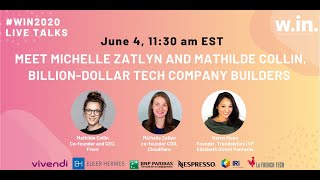
Transcript of a Wind Forum 2020 YouTube panel (moderated by Karen Moon) featuring Michelle Zatlyn (Cloudflare co‑founder/executive) and Mathilde Collin (Front co‑founder/CEO). The conversation covers leadership transitions during scaling, hiring executives, maintaining culture through hypergrowth, storytelling and communications, social responsibility and platform use, fundraising choices and an IPO perspective, and practical work–life balance advice; Mathilde recommends the book 'Doing Good Better'.
Chapters
Everyone. Hello Wind family. Welcome to the Wind Forum 2020. Today I am very excited because we are going to have a fascinating conversation with incredible women in tech. Three women in tech. And so I will leave the floor to Karen Moon, our moderator. But before anything, I want to thank our sponsors who are making this possible, namely IRI Worldwide, bnp, Paribas, Nespresso, Vivendi, Cuhler, Hermes and La Frensteg. Thank you. So, Mathilde, Colin and Michelle Zatlin, Karen Moon, the floor is yours. Thank you for being here. I'm so excited.
Thank you so much. So I'm gonna keep the introduction short. First of all, I'm honored to be here. But we're here with two tech leaders who had moonshot ambitions when they co founded their startups. But the really cool thing is they're actually making it happen. They're both scaling market leading companies and redefining their market. So first I'd like to introduce Mathilde, who's on Forbes next billion dollar startup list. She co founded Front in 2013. Front is a platform for customer communication. And as CEO she scaled Front to nearly 200 employees, over 6,000 customers, and has raised $130 million from top VCs like Sequoia, as well as executives from Zune, Oka and Qualtrics.
Thank you.
Michelle has co founded Cloudflare in 2019. Today Cloudflare is a $9 billion company and it provides infrastructure for the Internet through cloud based performance, security and reliability from SEO from inception all the way to ipo. She's helped take Cloudflare public last September and scaled to over 2 million customers in over 13 employees.
Thank you. Very honored to be here.
So you know, I think this is a question for both of you. You know, there is an adage in startups that you have to rehire yourself at every stage of the business. Was there a pivotal point where you had to transition your leadership style and focus? And you know, what are the leadership traits that you think made you successful through these transitions?
Well, I can start if you want. So I was thinking about this. I think in terms of traits, I think there are two that at least led me to evolve over time. The first one is curiosity and the willingness to learn. Like I'm someone that's eager to learn and if you don't have that, it's going to be very hard because the pace at which you need to learn is insane. And number two is self awareness. Like if it doesn't start with you acknowledging that you're good at this and bad at this, there is no way you'll be able to learn what you need to learn. Now, if I think about pivotal moments, the reality is it's not like you wake up one day and you need to completely change your skills or your goals. They just evolve over time. For example, one of the things that right now I need to do really well is I need to hire executives. And if I don't do a good job, then the company can die. Now, if you think about six years ago, when I started the company, what I had to do really well was making sure that we were building something people wanted and making sure we had product market fit and hiring executives didn't matter. And I think an exercise that everyone, like every CEO or exec can do is this exercise of writing the primordium of your company. So thinking, well, if in a year from now my company is really in trouble, why would that be? Like, what's the highest likelihood of an event happening? And so for me now I can think, well, if one year from now the company is not successful, it's because I failed at hiring executives. And so now I know that this is the new skill I need to learn. So I would just encourage founders to do this exercise so that they know what skill they need to work on next. But I don't think it is as strict as, well, six months from now, I will have to do that. And there is this moment where I had to reinvent myself.
Yeah, you're right. It's much more gradual. Sometimes it comes and hits you in the face, though, pretty quickly. I couldn't agree more about curiosity. I often tell our team, or I even think about myself as like, if you can be a sponge, that is just like one of your greatest assets as a founder. The rate at which you learn. And the faster you can learn, the more you can get up to speed. And this is not my quote, it's actually Evan Williams quote that I have heard through other founders. And it goes along something like, we're all just making it up as we go along. So if you have a really high rate of learning, you're more likely to stay in the game, which is part of the battle. The other piece, I would add, and I think that this is, we have 1300 people across the world. We have built out an executive team. And one of the things that I've really been thinking about recently, about how my job has changed or a skill that I've had to learn that was different than 10 years ago is storytelling. And it's amazing how Powerful. You need to be a really good storyteller. And I just think about for when I started Cloudflare to today I've become such a better storyteller. And it's really powerful. It's because you got to bring a lot of people along. You just can't do it one by one. You can't even just do your executive team. You got to bring the whole company together, you got to bring your shareholders, you got to bring your customers, you got to bring your community. And you know, you can't do it on one by one pieces or webinars one by one. You got to do it through written word analogies, anecdotes, stories. And so I think that that is one thing that I've gotten a lot better about over the years. And you know, it's always been important, but it's really important right now as we've gotten a larger presence, right.
And so if we think about like something that's stayed the same, you know, from the from inception, whether it's your visions or company cultures, when you started, what was like one thing that was important to maintain and then how did you maintain that through hyper growth?
Well, a lot of things remain the same and specifically a lot of the foundations usually remain the same. But the way. So I'll give you some examples, our values have remained pretty unchanged. I think one thing that's unique about France is this combination of being a very caring company. We care about our customers, ourselves, our employees, because they're human beings. And at the same time we're also a very result oriented company. So we make sure that we hit our goals. We make sure that we have, you know, no excuse to not hit them. And this balance is really hard to strike. And it's hard to strike when you are five people. It's hard to strike when you're 100 people. And you know, I cannot imagine how hard it is when you are thousands of people. Now, you know, initially why we had this was because, well, I think it's a balance that I personally am able to strike. And so it's easy to then when you're a team of five to have that because you have so much influence and then the company grows and your influence diminishes. And so the two things that I found useful to scale that has been of course when hiring and you need to make sure that from the individual contributors you hire to the leaders you hire, they can strike the same balance because they will influence their team in a more meaningful way than you will. But two is processes. And what can you do to make sure that in processes can be tools that you will be using? So we have values and we have a tool that allows us to have a virtual currency. When someone is doing something great, we give them a bonus, but it has to be attached to a value. So then people think, well, this value means that thing. So every day you have example of what the value means. So this is example of a tool. But then another thing could be a process around all hands that you have. And you make sure that every week, 9:00am, we have an all hands. We've always had this and we have part of it that's giving awards where we reward people for the values that they show. But at the same time, we show our revenue metrics every single Monday morning so they know how much we're pacing towards our goals. We actually have a daily reminder of how much, you know how well we're pacing towards our revenue goal. So I think the best answer I could have is processes and tools, and they mean so many different things as you scale and then hiring.
Yeah. And just like a tip for everyone, actually, you shared this and you're very transparent about your email templates that you've shared from day one, you know, funding decks. So these are all things people can find online. Michelle, what about you?
Yeah, that's a great one. We always say, Mathilde, what you said about how, you know, early on the culture is really defined by what the founders are doing. And we had three founders, so it was really, you know, it's. You see all the best and the worst in your culture based on your personalities, but when you are 500 people, thousand people, it really actually does not. I mean, it matters a little bit about the founders, but it's much more a democracy. It's probably the only thing in a company that's a truly democracy is the culture. And so I agree that you have to have these processes and tools to reinforce the behaviors you want so that you see that on a daily basis. The, you know, one thing that's been. The one thing that I thought I would share with the audience in case it was helpful, is, you know, Cloudflare's mission is to help build a better Internet. But we never started with that. I mean, we started with. We used lots of different words. We didn't know what our mission was. And it was something that emerged after a couple years. And we actually tried a lot of iterations before, and a lot of them was like, democratizing tools previously reserved for the Internet giants. We had lots of other fighting for the free and open Web. We had a lot of other iterations that we had used before, but I remember the moment where, hey, how about helping to build a better Internet? And actually, the first version of that culture, of that mission statement was cloudflare is building a better Internet. And I remember we went and showed some of our investors, and this was a few years in, three years in, and one of those investors was Union Square Ventures. And I remember Brad Burnham, who's a partner there, he invested in Cloudflare, had said, I don't like it. And we were surprised. We were so proud of it. We were like, this is it. And he's like. And he's like, I don't like it. We're like, why don't you like it? He's like, because the Internet is much bigger than one company. It's a collective. And he was exactly right. As soon as he pointed it out, we were like, oh, wow, this is totally tone deaf. And so it very quickly switched to help build a better Internet. And that was like, as soon as we heard that, it really clicked. And we've since adopted it, and we adopted it quite strongly, but that was three, four years into the company's history. And so a lot of the. What Cloudflare stood for was the same, but crystallizing it into the right word. We were patient about finding them, and because of that, it felt very authentic when we found it, and it just felt right. We'd already been kind of acting, doing the actions to reinforce it versus picking something and then having to prove that we had earned it. And so that was something that I remember very distinctly back in 2013 that might resonate with some of the founders on this call.
So, I mean, if we stay on that for a second, you know, Cloudflare is in a really unique position to kind of set industry standard. And you guys have demonstrated this outside the company. Like, tell me more about what you feel, you know, the social responsibility is and the challenges, you know, related to that, especially in this, like, super hypersensitive time.
Yeah, this has been. This is interesting. This is something that I've personally struggled with because I'm a founder. I'm now an operator of a publicly traded company that's growing really quickly. And I'm a director on that board. I have two young kids, I'm married, I'm a sister, a friend. I'm all these other things. And so then to add in, hey, how can I be doing more with my platform to push things that I care about? Forward, it's a hard balance where I'm like, I want to do more, but, like, I really. It's hard to find the second in the day to put that in, because it's not. It's really important, but I don't know, is it more important than my kids or our company? Like, it's. It's hard. And so I've, I've. This is something that I've continually thought about and try and push, trying and find a good balance. So what I've done so far, and I always ask myself, what can I be doing more? Is. I've been really. My first priority has been to make Cloudflare a success, because that's what gives me a platform to be able to push other topics forward. And if I don't make Cloudflare success, it's a lot harder to move other topics or conversations forward. So that's what I've been really focused on the last 10 years. Like, really focused on the last 10 years. And again, it's going well, so it's working, but it hasn't left a lot of time for things outside of that. And then at Clauffer, we do a lot of things, so I support those things. But now, especially since we've gone public, I've actually asked my. I've asked our head of communications kind of say, hey, I really want to start to think about how I can use what I would call as a more. A larger platform to move other conversations forward. And I'm having those conversations right now. It's hard to find examples. You can't. There's not like a book you can read to say, how to do this really well, because it's kind of a new thing.
Twitter, Snapchat. I know you guys turned off 8chan. You know, there's no perfect answer to some of these, right? Yeah, yeah.
And those are thoughtful things. Like, those are Cloudflare decisions, which I'm an executive of and the founder of. But like, I think of your question of, hey, now that you're. Now that you have some visibility, how can you use it to put it towards conversations that matter to you? So more women in technology or women in business or underrepresented minorities, how can you use that? Or, you know, I'm an immigrant, I'm Canadian, so is Mathilde. And it's like, hey, how can we help? How can I help there? Like, there's lots of things I could get involved with. And it's, hey, which, how do you pick and how do you move it forward? And And I'm constantly looking for advisors or resources to try and help me frame that and pick that it. And it's hard to find those people. So if there's anyone listening today, please email me and let me know because I'm really. This is something that's been top of mind. It's different than two years ago. Two years ago I just did not. It was very focused on building my company and I had really young kids. But now I'm like, I feel like, okay, I should be doing more. I want to be doing more. But where do you even start, like as a person? Like, where do you even start, really? That's smart and strategic and you can amplify things. So it's a good question. And I'm looking for, I guess, help from the right people to help me figure out a better answer to that because it's top of mind.
There is a book I would encourage you to read and I would encourage everyone who's listening to read that has helped me a lot on this. It's called doing good better. I'm happy to send it to you afterwards. And you know, the idea is a lot of people think about what's the most. There is another book called the most good you can do and they're very similar and the idea is what's the most good you can do? Because every, like most human beings really care about doing that and the tldr and it's not spoiler you should still read the book is you should do something you're uniquely good at and that will create wealth. And then you can redistribute the wealth to the missions you care about. And then they explain a framework to pick, like what you want to give to and give is money or your time or whatever you care about. And I think it's a very interesting way to think about it, which is instead of thinking, you know, what's the cause I care most about? How can I dedicate my life to it? Well, first start thinking, what am I uniquely good at? And obviously, you know, to be where you are today. You're an amazing executive and you're an amazing founder, operational leader. And the fact that you've been able to create so much wealth through cloudsplayer and that's true for the company, for you, but that's true for a lot of your employees as well. And then hopefully customers also got better through the product that you use then allows you to think, well, now that I've created this wealth that would have not created without me, then how Can I give back? And what framework can I use?
So.
So I would. This book is amazing.
I'm going to my bookstore to buy it, My local bookstore. Doing good. Better. Thank you, Mathilde. See, that's why you gotta throw things out there sometimes. Actually, as a founder, there's a lot of times you just don't know. And I found if you throw things out into the universe, often the amazing thing about technology is people say, hey, what about this? Or introduce you to somebody, and all of a sudden you're like, wow, I solved that thing. I didn't know even how to approach. So thank you.
So, you know, one thing everyone wants to know about, especially in this environment with, you know, the funding gap and underrepresented founders, we'd love to hear both from your experience and maybe starting with Mathilde, you know, you raised a $59 Series C this Jan. I think it was probably pretty competitive. A lot of people wanted in, but you also did something different. You know, you opened it up to other executives. Can you tell us a little bit more about that? And then afterwards, obviously, we want to hear about your IPO experience and what made that successful.
Well, at the end of the day, I think that, you know, the number one skill that I used for ever fundraising was storytelling. So, you know, I really go with Mijal said about storytelling being so incredibly powerful. But, you know, putting that aside, I think one thing that I've always felt when raising money is sometimes founders, you know, think that they need to work for their investors, which is partly true. You also need to work for your employees, for your customers, etc. But the way I've always thought about it is I've always thought that investors in our journey had the easy job, in a sense, that they put money. And then you're working so hard, and everyone in your company is working so hard every single day, and you hope that they'll make money out of the investment they made. And because the way I've thought about our investors is I truly want them to be helpful because we will work insanely hard, and we want them to also help us. And so along the way, I've been thinking, well, what are the things that I need the most right now at a company level to bring us to the next level? And two and a half years ago, maybe, where is our Series B with Sequoia, who's been tremendously helpful, and that was great. And they joined our board. And then I was like, okay, well, now that we have a firm that's very powerful and that's helping me through their partners and their resources. Like, what do I need? Do I need another firm? And I was like, well, like, I don't think that's what I need right now. There are so many operational questions I have all the time that I wish I had a group of leaders that they could, you know, that could help me and would be invested in France enough that they would be incentivized to help me. And so we, you know, we decided to do this because the founders and CEOs and executives that we chose from Atlassian and Zoom and other Qualtrics, there are companies that have faced the same challenges as we face, and we're facing, and we will face thinking about who can be most helpful. I just felt like this group of people were the ones that would be most helpful. So that's how we made that decision.
Amazing. And, Michelle, tell us about. First of all, congrats on the IPO last year. What were the key learnings and what do you advise is critical for success, for growth, stage founders or everyone who just eventually wants to get there? And also, I remember from our call, you were saying, you know, it's not about just being a unicorn yet, like, much bigger ambitions. Right. How are you going to take it to $100 billion?
Yeah, I mean, I. I will say, from starting a company to taking it public, Taking a company public on the New York Stock Exchange was very fun, and it was a very joyous experience. And I would say that one that I was personally proud of, but not just me. We had 1200 people at the time at Cloudflare, and I think almost every single person at Cloudflare was really proud to do that because it was one of those moments where you realized all of the blood, sweat and tears that every single person, like, every single person who shows up every day that puts their heart into, like, it kind of like, was like a crystallizing moment of, like, wow, we did this together. Like, everybody wasn't. It wasn't one person doing a good job. It was a collective group of amazing people who come to work aligned with this mission to do great work for your customers and the Internet. And so that was. That was really special and something I did not realize. I feel like going public has such a bad rap, but it was a really positive, amazing experience. So I hope other founders, including Mathilde, follow and build amazing companies. It was just incredible. Yeah, I mean, I. You know, I think that if you. If you want to build a company that wants to do that, like, that's amazing. Go for it. You can. And there's so many other SaaS companies or B2B companies or consumer companies ahead of you that you can learn from. And I really encourage people to do that because it's, you know, there's some things in companies are very unique, but there's a lot that you can just learn from others. As you just heard from Mathilde, like, hey, people have done this before, so reach out and ask. So that's great. But then I also, I'm always careful to balance this with a huge asterisk of there's a lot of entrepreneurs out there where they just don't want to take a company public. And that's totally okay too. Like it's not, it's not the only outcome. I think it's a great, like again, I, that was Cloudflare. We've always been building to build a large independent company and everything we've done has been on that path. But I know so many entrepreneurs have great businesses. Some have take ventured, some have taken no doll ventures and then built very profitable great businesses. And that's really cool too. I think what's really important as a founder is deciding which one you are, like which, which type of company you building right now. Because if you stay true to that, then lots of great things will happen. I think that I've heard a lot of heartbreaking stories when founders think they're one thing, but try to do it the other way and they get themselves into trouble. And maybe there should have been a company that shouldn't have taken venture or shouldn't have shot for the moon, but they did that because they felt like it was a cool thing to do. And then they're like, I just don't know. Our market's not big enough, I'm running out of growth rate. And you kind of get stock or some people who don't want to take venture, they're like, we're going to do it my own way, which is again, totally viable. But then somebody else does it and out competes them. And so you got to kind of decide what the opportunity is and align it. And I think that's really important. If you do that, there'll be lots of success. And I wish everyone on this call a ton of success. But it's when you get that wrong that it's really painful to undo. And I know a lot of founders who've gotten stuck in their businesses. I mean, I've been doing Cloudflare for 10 years where, where they got a mismatch and they couldn't find anyone to take them out. Like they couldn't find anyone to replace them as CEO and you can't. It's really hard to. And it wasn't. The company was failing. It just was kind of like doing okay. And they, and they became like a zombie company. We don't talk enough about the zombie companies. I wish someone would talk more about the zombie companies and the lessons learned so that others could learn from that. So that's the next panel. It's hard to find people who are willing to say that it's true. I don't want to say it quietly. Yeah, like a masked, like the masked singer.
Like an anonymous. I don't know. There needs to be something.
You know.
A lot of people say you can't have it all, but I found that both of you have really figured out how to achieve work life balance. Like, can you tell me a little bit more about that just to show an example of how you did it for yourselves or how you're doing it now?
I mean, first of all, I think it's not because you're doing it well today that you will do it well, you know, three days from now or three years from now. So I think it's a. You need to reinvent yourself constantly on this topic. But my, like, for me what has worked is discipline. And I've not always had this discipline. But I'll give you very concrete things I do. So, you know, I woke up this morning and the first thing I always do is meditation. And I do 10 minutes of meditation, you know, every single day and I never skip it. And then now that I'm working from home and I think it's harder to have this work life balance. You know, I have a one hour lunch break where, you know, I don't, I don't have my computer. I'm just doing something else. And then I'm very deliberate about when work ends. And so like tonight it's 6:30. And I know that at 6:30, although I will have a million things to do still, like I will, you know, shut my computer and I don't have any apps on my phone. So it's like there is no way work can invade me in that sense. And there are many, you know, many other things I do. But ultimately the discipline I have around, you know, I'm working, I'm not working. When I'm not working, I'm fully not working. And I have all the tools I need to not be notified of things happening. That's really what has allowed me to Keep that work life balance. But again, like, you know, like, I would have given an answer pre Covid, and then Covid happens. And I think that brings like, new challenges, new opportunities as well, with new challenges. And so you need to, you know, be dedicated to it all the time and constantly think about what will help you.
I love this. I love this topic. I wish there was a lot more content on this topic. I feel like a lot of people don't want to talk about it. And so I hope that.
More podcast, by the way, after this. I want more from you guys. You have so much knowledge.
I mean, others. Because I just think it's like people have jobs and then they have their lives. And I'm like, curious of like, how do people set this all up? Because I think that people take really different approaches and I just, like, I just want to learn. And you can kind of pick and choose what you're like, oh, that's actually a good idea. When, when people start to talk about it. I mean, I, I mean, I, I don't think about it as work life balance, but I do think that it is the following is. I really wanted to have a great career. I've always been really ambitious. I've always been running towards the opportunity. I wanted to have a relationship and I wanted to have kids. Like, and I just really wanted all those things. And so I made decisions along the way that allowed me to do that. And like, that's the, like, they're really purposeful. And it's, you know, again, it's, it's almost like a roadmap. If you're building a product roadmap, if you know what you want the product to build is, it's a lot easier to build it than if. Let's just see how you feel today. And there's a lot of things in my life where I'm not so black and white. But this was something, you know, I don't know, 10, 12 years ago. Like, I just like, yeah, I wanted to be with some. Like, I wanted to have a relationship, I wanted to have kids, and I want to have a career. And so over the last 10 years, I've kind of really focused on making all of those things happen. And, and, you know, I was talking to my husband and again, as Mathilde said, I feel like Covid creates a lot of self reflection time. And, you know, sometimes I'm like, wow, I'm really proud we have done this. You know, 10 years ago I had a boyfriend and now he's my husband. I had no Kids. I have two kids. And now I have a company that's publicly traded. And 10 years ago, I literally, like, my grandmother referred to it as, oh, your side project. You know, like it's something like, was like a side project or my school project that turned into now a publicly traded company. And so it's been a really amazing decade to do that. And again, I was just really purposeful about wanting that. And so that doesn't mean that it was always easy. So again, I have it. It's been great, but it's not like there weren't trade offs along the way. So I'll just give you a couple. And they sound silly, but like, they matter when you're like, if you just put yourself in those situations. So we were building Cloudflare. We were a really small company and I was just working all the time, and I had my first child and we had like 50 people at Cloudflare at the time. And so I lived really close to my office. Like, by really close, I mean across the street. So I had no commute. So I was either at home with my newborn and my husband, or I was at work. And I literally spent 90 seconds commuting because it was across the street. It was down an alley and across the street. And I didn't live in the best neighborhood. I certainly didn't have the best. Like, I lived in a. You know, it was just more convenient. And that worked because I kind of wanted to. I wanted to figure out, okay, I had a lot to do at work. It was just, there was a lot going on. But then I was also had this young child, you know, years later, we've moved to a house, to another neighborhood where I have a commute to work. But like, it took years. Like, I lived really close to the office for a long time in a less desirable neighborhood. Just. Cause it was like I was like, I don't. I can't add some more time into my day. I'm trying to take time out. And so it sounds silly, but. But it's. It was like a decision and it was a conscious decision. And I guess these are the sorts of things that you can do if. When you know what you're trying to achieve. And so I'm really lucky. The other thing is, you know, the person I married has been a huge champion of mine. And so my parents, my sisters, and I realize how lucky I am. Like, a lot of people have partners that aren't supportive or have family members who kind of like, what are you doing? You should be doing this instead. And you know, my parents, my sisters, like, they've always been like, we're so proud of you. Go for it. And same with my husband. And you know, when you're dealing with an emergency at work at 5am on a Saturday morning, never gave me a hard time once. You know what I mean? He's like, okay, go deal with it. Like when you're done, we'll hang out. And like that is really, I'm really lucky. And so find people in your life that are champions for you not making you feel bad because of the decisions you're making in the micro.
Well, thank you both so much. I promise to keep you guys on time. I am going to ask a final question, but I am going to get it from you guys later and we'll share on social media and that's going to be as it relates to confidence if you have a final thought for our audience. So we'll share that later. But we are right on time and thank you so, so much for sharing your.
It was amazing. I was listening to you behind my screen and it's such an immense pleasure to be with you. You know, sky is the limit and it looks so easy when we listen to you. But I keep in mind my takeaway from all this is that you have to be very, very focused and very disciplined. Be a good storyteller. Read this book. What's the name again? Mathilde? The name of the book.
Doing Good Better.
Doing Good Better. And surround yourself with people who make you better. Thank you so much.
Thank you.
I hope you will continue the conversation and thank you for the inspiration.
Thank you for having us. Good luck, everyone.
Bye bye. Bye everyone. Thank you.
More from Michelle






SF Conference 2013 CASE STUDY: Michelle Zatlyn - Scaling a Company To A Billion Views A Day




