Building Coalitions for Change: Inside the Baton of Black Excellence and Racial Equity
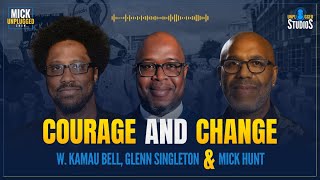
Glenn Singleton and W. Kamau Bell discuss racial equity, intergenerational responsibility, and building coalitions. Singleton's Beyond Diversity framework argues equity means proportional representation across institutions. Bell frames his work as handing a lighter 'Black Baton' to his children through media and comedy.
Chapters
We have to do the first work of looking inward, right? And we have to ask that simple question of, you know, what impact does race have on my life? And what impact does my race have on my life? And as I look around my community, how is race playing out there?
Ladies and gentlemen, welcome back to another exciting episode of Mick Unplugged. And today I've got a special moment. I've got two guests and we're gonna talk about it all. One is an Emmy and Peabody winning storyteller who uses comedy to confront culture. And the other is an education equity architect redefining how we talk about race in America. Together, they're pushing past comfort to spark the real change that we need today. Please join me in welcoming the brave, the brilliant, the uncompromising, two guys that I look up to the most, W. Kamau Bell and Glenn Singleton. Gentlemen, how you both doing today?
I mean, I know Glenn's used to those kind of intros, but I'm still getting used to him. So I know Glenn is like, that's exactly as it is.
Glenn actually sent me everything to say about him ahead of time. He was like, it has to be these. Do not sway from the text.
Exactly. Read it. Just like, this is not a suggestion.
Right.
If it doesn't go down this way.
It'S not going down at all.
Yeah.
So, Glenn, I'm actually going to start with you. I like talking about your because that thing that's deeper than your why, Right? Like, Simon Sinek wrote a book, start with why. And I think everybody got stuck there, right? You start with why, but it's your because that really keeps you going. So again, Glenn, I'll start with you, man. If I were to say what's your because today? What's that purpose, that passion behind what you do? What is that?
You know, what is so clear to me is that everybody who's looked like me has had this journey before me. And when I think about, you know, coming all the way across, you know, the grounds of West Africa, through this, through the, through the transatlantic slave trade, up through slavery, Jim Crow, you know, all of these moments of oppression for people like us when we get to my generation and we have more than we've ever had, and so I just feel like it can't fall apart with me.
Wow.
Wow. I love that. I love. I'm taking some notes because I have a follow up question on something you said. But Kamal, man, I'm gonna give you the floor now. What is your because why do you continue to do what you do?
I mean, the, the flippant and probably truest answer is because me and my wife have three kids and I can't just be like, good luck. I feel a responsibility to, to make sure that the world is as easy a place to navigate for my three daughters as my three mixed race black daughters as possible. And, you know, and I sort of think of it as the Black Baton. Like, when my grandparents handed the black baton to my parents, it was lighter than when they got it because they had gotten it from people who hadn't been that disconnected from enslavement. And then when, when my mom passed it to me and my dad passed it to me, it was much lighter because they had gone through the civil rights movement and everything that entailed there and pushed the black people forward, black folks forward. And I got it. I'm like, it might be heavier than when I hand it to my daughters. And so my goal right now is to sort of make sure that I do everything I can to make sure that when I hand them the Black Baton that it's not heavier than it was when I got it, which is going to be a lot. But look like I got Glenn and you and other people working on that too. So. And then I think the other thing is, like, I grew up in a household where you sort of knew as a, you had two jobs. The job to put food on the table and the job to make it easier on all the people who look like you, who couldn't get what you got. And there wasn't really a choice there. It was no, it was just, it was just. It's what we do. So this is just. I think if I was a car mechanic, I'd be an anti racist car mechanic. I just think this is just a part of the deal.
I love that, man. I love that. And I'm going to tie that into the, the conversation I wanted to have with you, Glenn, and both you, Kamau, is this, like, Glenn, you said we have more now than we've ever had. Right. And I truly believe that. I also feel to that point, enough of us don't realize that. Right? Because those are the things that aren't talked about. Right. Like, and I'm not saying everyone and everything, but, you know, we'll talk about Lil Wayne's album that just dropped and how good or great that wasn't right, but we won't talk.
Nobody said it was good. Slow down, slow down, slow down. Nobody said it was good. Don't. Let's not, let's not put misinformation out there. Let's. Okay, continue.
He said it was good.
Okay.
Whoever was in the production booth said it was good. But, but Glenn, man, so how do we spark those conversations internally so that we can have them externally? Because you do a brilliant job of that, right? I mean, you, you're a consultant to Fortune 100, to Fortune 50 companies. Forget 100.
Right, right on.
How do you lead those conversations internally first so that we can have them outside?
Well, you know, when, when I talk about having so much, oftentimes we, we get hung up with the new shiny stuff, right? So absolutely. It takes less time for me to create the guidelines for conversation in these corporations now because I've got friendly AI. Okay, we never had that, right. I didn't even have cell phone when I was building this work at the beginning. Right. So this is, you know, this is three decades deep. And, and so, you know, with those two, there's a whole group of now flourished from these modern technologies and from, you know, the hard work that the entertainers, the athletes, the corporate people have done before. And they've got bank to prove it. Right? So when I think about what's in the community in terms of resources right now, and I think about the challenges facing our community, third grade reading level in every major city across the country for black children. I'm pushing right now on the multimillionaires and the billionaires to figure out what it is that you're doing with all that extra. Right? Because you only can live in one house, you only can drive one car and it can be a nice one and it can be a big one. But after that, that space that's sitting around those extra material things, that the ploy of capitalism have really hurt us there. And then the second thing, I'm going to the other side of the prism. And the other side of the prism is what requires our consciousness. Because you know, when I sit and talk with my 80 year old mother, I get the pearls, right? She tells me, no, don't go that way, don't go that way because. Because they're not going to like it, right? And so if I'm trying to get from A to Z and I know I'm already running into a roadblock, okay then, then why wouldn't I avoid that if my purpose as we've talked about is to not fail us right now? And so when I think of the trajectory from that elder and ancestral wisdom all the way up to the modern technology and the material, we've got a buttload of stuff that we can use right now to get this thing moving in a way that those elders and ancestors would be proud of us.
Amen. I love that. And I'm right there with you. So Kamau, for you, you talked about that baton, right? And how heavy it is, right? And just like you, I have three mixed race black kids, right? Black children, they don't like to be called kids anymore. So black children, there you go. How do you, how do you have that conversation about the baton internally with your children?
Let's see, my 7 year old hates the President and will say it out loud. So, and I'm in. And you know, and while we may, we can have a grown up discussion about hate. I think it's, it's very savvy of her to understand that this person is not on my side, you know, and so therefore I put that person into the hate camp along with like, you know, lima beans, whatever you want to say. So for me, the idea that my 7 year old is aware of the state of the world and aware and even in a sort of a seven year old way is really important to me because it means that like if, because some people grow up not being aware of the state of the world and then when they're full grown adults, you've had conversations with them and they're like, they say something like, well, you know how many senators are there? And you're like, oh no. And it's fine. And I will tell you, and we can have that conversation. But I think the more that in my house I grew up as an only child, I heard my mom having every conversation. And so with my kids, they seem, they're hearing me have a lot of conversations. They're also seeing my work, they're also seeing how people talk to me in the streets. So they're aware that like Data does things where he has to talk to people about the state of this country regularly. And they've heard me speak enough to know which sides we're on and that we, and they, that we want to be on the side of the people. And the people is not just people who look like us and we live in Oakland so they can see those people. And so then you have like my, my 14 year old who just graduated from 8th grade who as part of her graduation celebration, the, her advisor said, and Sammy Bell, who, thanks to her and our, and our, and the administrator who talked to her, now every kid in this school knows the words to lift every voice and sing because my daughter sang it at every like school, you know, function she was like at every. And. And there was a black woman who works in school who asked her to, and Sammy did it. And I said, sam, you got to learn the words. You got to like me. Like, you can't fump her through any of it. We're probably not going to do the second verse, but learned it anyway. And so that's a kid who is like, just through the power of her voice, because she has a good voice, is engaging in a little bit of activism by teaching some white kids in her school and some non black kids about the words of lift every voice and sing. And so for me, there's more than one way to do this, but I think it's important that my kids are aware of what's going on in the world. And my 10 year old, who's pretty shy like I was when I was her age, I go, look, you're never going to get in trouble with me if you're defending yourself or somebody else who needs to be defended, you think needs to be defended. And that's a very basic thing. But I think it's cool. You might hear the teacher said, I can do this and that. And I go, whatever the teacher says, you come home to me and we'll take care of it. And so for me, creating a sense of like, justice is not always in the hands of authority, that justice is sometimes a thing you see that authority will tell you not to see. And so we are engaged in those conversations regularly, you know, in our household. And we also celebrate Kwanzaa, which is the fourth final piece of raising a black family.
Man, that is deep. That is deep. But you're right, man, everything, again, I've been a big believer, I was raised that you can't have outside conversations if you don't have them inside first.
Right?
And so my grandparents instill that in me. My parents instill that in me. And that's what I do with my children as well too, is, hey, we got to talk about it. Because one, if you don't know your truth, if you don't, if you can't have your own voice in here, you'll never have it out there. And so, you know, and I know, Glenn, that's something that you're passionate about as well too. That's, that's the pillar that you have, man. And I want to applaud you and talk a little bit about beyond diversity and all the good things that's going on there. Talk to the, the viewers and listeners a little bit about that because to me, beyond diversity isn't just a conversation, man. It's, you know, in the 60s or 70s, we would call it a movement. Right. Like, like talk to us a little bit about that.
Right. Well, you hit on the first pillar, right. Of Beyond Diversity is a training framework that I wrote over 30 years ago. So we're celebrating the marker of 30 years at LBJ Library next week. Right. And I think it's fitting that that's where we're going, because before we even think about the Great Society and the civil rights movement and gaining insights from that past, we have to do the first work of looking inward, right? And we have to ask that simple question of, you know, what impact does race have on my life? And what impact does my race have on my life? And as I look around my community, how is race playing out there? So that when I come talk to you and Kamal, I'm already at that place of racial introspection and my consciousness is moving me beyond the first trappings of defensiveness and fear and all of those things that we've been given about this topic to, whoa, there's some power here. And so 30 years ago, I was looking at all of these disparities in education. I had worked in corporate and advertising. And so I'm seeing that, that we are just not reflected in the goodies of society at the same proportion that we live in this society. And so for me, the equitable future, the mark of racial equity, is when we start to see ourselves proportionately represented in all the good stuff, right? All the good stuff. And so if you can walk around society and say, hey, that's good, right? To be on a board, hey, that's good to be CEO. Hey, that's good to be at the top of the class when I graduate or to go off to the college of my choice, hey, that's good to get that record deal, you know, Then. Then you know that we've reached racial equity. And Beyond Diversity was designed so that we could have the conversation to move a society, the movement of society, to that place of the elusive yet tangible, sometimes equality, man.
So I'm going to tell you this. You don't know this, Glenn, man, I'm going to try not to get emotional. I don't get emotional, but I'm going to hold it in, man. So, you know, been a huge fan of yours for a long time before the Internet and all that. Like, I knew who you were, and I was one of those kids, I can call myself a kid then that you were talking to, man. Like, I had to Be the best at everything I did, right? Like my graduating high school, if I didn't have a scholarship, Mike could have gone to college, but I couldn't have gone to the college I wanted to go to, right? And so I genuinely had to be the best so that I could get either an academic or athletic scholarship. But then when I got to college, University of North Carolina, by the way. Go Hills. When I got to college, that same mentality was there because I knew that I had a purpose and to show everybody that look like me that we can be excellent, right? That. That we don't have a ceiling, and the ceilings that we have are the ones we put on ourselves now. Not saying the world is fair, never gonna say that there are things we're gonna have to fight for that other people don't have to fight for. But dammit, I'm gonna fight, right? Right? And so, Glenn, I wanted to tell you thank you for. For being that for me when you never knew that you were man, brother.
Thank you.
Thank you for that. And those skills that all three of us have developed, you know, and Kamala and I carry this special pressure of being the only one of the next generation and our families, right? This only child syndrome. But we learn to be excellent, and the world would be a great place if. If people had that skill of a desire to be excellent, right? So it's nothing wrong with that. It's just that when you have to be excellent and you might not be noticed as that now, right? As you look around and we think about the conditions which we're living in right now, the irony, right, of the challenge to DEI where, you know, we have just installed an entire government of people who are not experts. Excellent. Yeah, right.
That's the nicest way to say it. There's an entire government of people who are not excellent. That is not excellent, Right? Not.
Not excellent, Nick, in the way that you needed to be at Chapel Hill. Right? And I'm working over in the high school district right beside you, where this is a community of excellence and a resource community. But we couldn't get the black children and the brown children to the top of the class so that they could continue to walk right on to that university.
Right?
And so that's, that's why we came together to make sure that your excellence was marked as. As excellent and to make sure that those who were not feeling excellent were given the resources. So at least they could. Could be that if they put in the effort.
Yes, sir. Yes, sir. Now, Kamau, I get to. To give you Some praise that you don't know about, man. So in my household, you know, we watch a lot of the things that you've written, that you've produced, we've seen specials. I want to talk about who's with me, man. Like, like seeing the title of this tour. And I know you're. You're going towards the. The back leg of the tour. I'm a little upset you're not going to be in Greenville, South Carolina.
Oh, no, no. First of all, I. We're still adding dates, so. And I will be in Durham, I don't know, and Charleston. So I don't know.
Literally, that's what I was going to say. I know you go back to. Back in Charleston and Durham, so I'm gonna have to come see you in one of those too, man. But something else about the framework.
Kennedy center was killer, by the way.
That was a special night.
Imagine where you are right now, Kamal.
Oh, thank you. Yeah. So talk to us about the framework of this tour, man. Like, everything from the name. Because the name of the tour is so compelling. Right. And me and my children talked about it. But the message that you're trying to. To send throughout the tour, like, talk to us a little bit about that development.
Well, I mean, so, you know, a lot of us who work in the. The sort of the showbiz. I was gonna try to figure out a nicer way to say it, but just in Hollywood had the one, two punch of. So post George Floyd's Murder by Minneapolis. Hollywood was like, we need to talk to more black creators and we need to give them a voice and let them. And so a lot of projects were greenlit in that moment. The project that I got was a thousand percent me growing up mixed. That was about my mixed kids and also other mixed kids in the Oakland Bay area, which was great. But a lot of projects got greenlit but never got made because by the time it was time to make them, we'd already had the backlash to the. To all the dei, and suddenly all the DEI people got fired. I had a lot of meetings with a lot of black women who were in charge of dei, of these. Some of these corporations who then weren't there. Months later, you'd send an email that said, does not work here anymore. And then I had a deal go through. So. And then the, then the strike happened. The writers and the actors strike. And although we won, I mean, both those unions, we won a lot of what we wanted. They. What they did was, we're just going to stop employing you like, we're just going to stop. So we're going to stop making content. Famously, Warner Brothers, who own cnn, where I used to work, stopped, stopped the post production on a, on the Batwoman movie in post production. So they were already $90 million in and then said, and it was going to be. It was like a black Batwoman. Which I don't know if that's why they stopped it, but didn't help it, I'm sure, but they were just like, we'd rather use this as a tax write off than release this as a film. Even though the directors were in the edit bay. Two Egyptian directors, I believe, again, who knows this is all connected, were in the edit bay editing the finishing the movie. And they're like, stop, stop your work. It's never coming out. And so not only. So there came a point where, like, there's people I know in Hollywood who haven't worked since the strikes and. But that's when I had this moment. And I, A lot of projects I thought I was going to do just sort of disappeared. And I'd stopped doing stand up comedy. And I had this moment of like, wait a minute. I was raised by Janet Cheatham Bell. I was raised by Walter Alfred Bell. And sometimes he would ask me, what did your parents do for a living when you were growing up? And I wanted to go, they're hustlers, but not in the way you think. And my mom's father, Smith Cheatham, was one of those guys who would walk onto a job site and just start working and they're like, you don't work here. But wait, you did better than everybody else. You work here now. He was just like, I'm going to get a job. And so I chose as an opportunity to start to really like, okay, what can I do? Well, I know I can write. Where can I take my writing? So I went to Substack, went to Substack and, and was able to go, okay, now that I can do whatever I want to do. What is the goal here? And the goal is to find out who's with me. Like, you know what I mean? Like, you know, literally, it's that simple. Who is, who believes 88% of the things I do and we can talk about the other 20% or who, who believes very little of what I believe, but seems like I'm making some good points and I want to, like, I want to at least work through this. And so for me, that's where the, you know, it's sort of, I always feel like it's like a flip on Kendrick Lamar's way of saying it is they not like us. My way of saying it is, who's with me? It's a kindler, gentler way of saying they not like us. And so, and I know that for my CNN train, like the work, working down cnn, I got a lot of people who are with me who don't look like me, a lot of older white conservative folks who just like the way I said stuff and came to realize some things they never thought about before. And then because I've done podcasting things, like a lot of younger folks with me, a lot of black and brown activists who have been inspired by my work. And I'm just trying to. I feel like this is just me trying to build the coalition as, as Martin Luther King Jr. Did towards the end of his life that he did that he, I guess, as you say, he didn't know. He knew where. It's like, it's got it. It's more than about black and white. It's about, it's about race. It's about class. It's about. It's about the entire, the United States effect on the entire world. And so for me, then it became time to, like, I got back into stand up and I very clearly was like, oh, I'm still asking who's with me? This is all connected. This is especially because I started the substack before Trump, but once Trump was in office, it was like, oh, it's still, it's definitely who's with me now? Because I think before we can figure out what we do, we got to figure out who's on our side. And right now in la, people are in the streets standing up to fascism, literally looking around and going, oh, these are all the people who are with me. And it's not just Latinos, it's not just poor folks, it's all sorts of types of people who, who are in your coalition. So that's where that comes from.
From.
I love that. And I want to go deeper with both of you on that too, because, you know, when, when you have people like yourselves and us, the work that we do can never be alone, Right? And so there are always people that don't look like Les, that maybe don't even have the same political views that we have, but also know good versus evil. Right? And so talk to us about that of how, you know, it's a coalition of people. It's a coalition of entities that actually help make the things that we do happen.
Well, so many. I mean, if people don't want to, you know, stroll the history so far back, if we just look at, you know, this first design of the Great Society, neither Kennedy nor LBJ were really interested in the cause, okay? Their purpose was something completely different. And oftentimes that same purpose that you see pervading those halls of Congress right now, they want to get reelected. They want to keep the gig going. And also, America has this interesting a part of its culture that we want to show the world that we're great, even though we're not acting great inside. And so these two forces were happening, right? And the Kennedys and then lbj, they came to understand that there is some goodness in this moral obligation for all folks to feel real citizenship and dignity. But they also recognize that. That it was in their best interest to calm the storms. And that's what I worry about today, Mick, because this particular government is not interested in harmony and peace and community in this country. They're interested in their own individual personal gains. And so I don't know how you talk to people who are only interested in themselves, right? Because there's nothing that we have here. So I think our coalition now is really important to come together as people who have a bigger interest than just ourselves. We're looking for what's going to happen for our children. We're thinking about the elderly and all of those things. And as we serve them, as we serve them, we actually serve ourselves better, too. And so that's the message when folks come in and they're sort of directed one way on immigration, and I'm directed over here on racial justice. Okay. I've got to help them to see that when we all win, we all win. Right? That's the key in here.
Totally agree. Totally agree. Kamau, your side on that one.
I mean, mostly, as you saw, I was dancing while he was talking. Like, I was like, yes, yes, yes. So the part that I really started excited about was when you talk about LBJ and Kennedy weren't just born into wanting to be on the right side of history. You know, like, it's. I mean, let's be clear. Especially the Kennedys. They were. They were a couple generations away from being bootleggers. You know what I mean? Like, they were. They were. You know, a lot of this is like these politicians putting their fingers in the air and saying which way the wind is blowing? And right now I'm in the middle of a lot of online back and forth with people because a lot of. There's a lot of excitement in some parts of California about Gavin Newsom basically standing up to Trump and putting out some videos saying, hey, if you want to treat California this way, we're going to stop paying our. We're going to stop paying into the. This American system. Since we're the fourth largest economy in the world. If we just stop paying into the system, the country falls, the country collapses. And a lot of people got excited, and I think that's great. But, you know, I'm also. Don't talk about it. Be about it. You know, and. And I just. And I was sort of seeing some Californians who I know be like, we got to be careful with Newsom because he's not always on our side. He's not always clearly on our side. He's not always. He just. He just started a podcast where he's interviewing right wing people. He also made gay marriage legal. He also wanted universal health care, but he didn't want $35 insulin. There's just a lot. There's just a lot.
Yeah.
There's just a lot.
Yeah.
He. He has many pictures of him, like, dismantling homeless encampments, but looking good looking. So it gets confusing. So I've just been here to say, hey, guys, like, let's not get, yes, he's saying the right thing, but let's also not forget who he is and the number of people who are like, this is why the left can't ever win. This is why Democrats can't ever. Da, da, da. This is why we're just basically, let him cook. Basically what they're saying, like, let him. And I brought up the example of, like, do you think LBJ signed or pushed the Civil Rights act of 1964 because he was excited about it? No, he pushed it because Martin Luther King Jr. Wouldn't stop showing up in his office. And he was like, I got a lot of people outside who are marching this way. Like, he was pushed into doing that and at some point realized, I want to be on the right side of history. Whether or not he had a moral thing or not, that's for him. That's for his biographers to talk about. But from the outside, it was clear, without mlk, it doesn't happen. It doesn't happen. And so it's because. So my feeling is like, we, you know, we have. Politicians only exist to be pushed into the right forms and functions. Even if you support them 99% of the time, there's gonna be 1% time you're like, hey, and look, my mayor's Barbara Lee. I don't know when she's been on the wrong side of history, but when she is eventually, like, I will be there to say, hey, Barbara, I need you to so. But I think that, like, we really, we so many of us, we're so scared that we're looking for a hero instead of looking at ourselves and going, what can I do? So you want Newsom to handle it and hope that he just handles it and takes care of it so you can get back to Pilates? And I'm saying like, hey, maybe you can have an anti racism Pilates session and figure out what that is. I'm not telling you not to do your Pilates instead of just hoping that Newsom is the hero that we've always wanted. When no politician is agree.
I talk to people all the time about when you understand the politics of politics, nothing actually surprises you because it's one of those things like, I'm going to do this. Everybody's going to be excited about it. But there's these other four bills that I'm going to push through with this one big one that the world sees. But I'm going to push these others that they're not going to realize for a couple of months, a couple of years, and then they're going to be like, oh, wait, what was this? Well, you wanted this big shiny thing over here. Well, to get this big shiny thing, I had to pass these other three or four things that go along with it.
As my mom used to say or says, the only thing you can trust less than a politician who doesn't want your vote is a politician who wants your vote. It's easier to deal with the politician who doesn't want your vote. You can, you can say like, because you kind of know what that guy's going to do. But the politician who wants your vote might say anything.
Absolutely. Absolutely. All right, you guys have been gracious with your time. I'm going to ask each of you, like, one closing question. And Glenn, I want to go with you because, you know, you pioneered the Courageous Conversations framework. And I think, you know, today more than ever, and I'm not even talking about politics here, I think today more than ever, courageous conversations need to happen, man. So, like, how does someone start that dialogue today? With your framework, right?
So the first thing that, that I'm going to suggest even before you, you go through the Internet buy, you know, take a seminar on courageous conversation, is you just get a sense of the paramount importance of racial justice in this society. Right? This cannot be what everybody understands America to be without racial justice. You just have to cross through that. And so establishing that personal relationship to race in your life and to this trajectory of showing up on the side of anti racism.
Right?
And that is the on ramp. Once you get into that on ramp and you get into these conversations across the board, you're going to find people who don't agree with you. And rather than a retreat from that, that's when you know that you're entering the next level.
Right?
Because we can all sit around and talk about people who pretty much share those, you know, those experiences and understandings of race. But it's when you get to people who don't live the same experience and their politics could be on the same side or shade of blue, okay? But they're just having a different experience. And so we've got to be open to really having the questions in that nuance. And then finally, finally we got to get to the place of understanding that race is a symbol of power. Right? It's metaphorical, Right. And so you gotta not see that, you know, we're all the same and, you know, all of those things, red, black, yellow, green and white. You know, all the stories that you're told. No, no, no. There is a hierarchy of power, right? And you've got to understand this principle of white power. You've got to see white supremacy and you've got to see anti black racism. These two parts of that continuum, right? And as you can step into those three levels, it's about me. Definitely. There are multiple understandings and experiences existing. And there is this system of power, race, that is about a hierarchy that holds power at white. When you get that we're ready to go, everything can change.
Yes, sir.
It's not that hard. Not that hard.
Absolutely, absolutely. So come out for you. Man 1. Congratulations on celebrity Jeopardy.
Absolutely.
I was. I jumped up when you won.
For all the. For all the smart Negroes who were bullied, I'm here for you.
I know DonorsChoose was happy about that, too. I'm a big supporter of school systems, so I know that was amazing. So my question for you that I want you to be able to give insight to the viewers and listeners. So for that person that's listening or watching right now that's afraid to say something wrong, right? What's some advice? What's some courage, some power you can give that person or those people today?
I would say if you're afraid to say something wrong, I would first say you need to do an audit of your friend group and see who you're surrounding yourself with that. You can't be honest with who you are with who you are sitting near and who you are regular in conversation with. So it doesn't mean that I don't think I'm going to say something wrong, but I feel like if I do, I am surrounded by people who want to go, hey, come on, come here for a second. And they're going to do it with love unless I keep doing it, unless I keep saying, you know what I mean? They're going to, they're going to, you know, it's age. Adrian R.E. brown taught me the difference between calling in and calling out. They're going, call me in. And if you haven't figured out a way to have a friend group that is, that is also smart enough in different areas and have enough different experiences, backgrounds that you don't feel like you can be lovingly called in and you don't have people who can do that, then you need to, then you need to look at yourself and go, who did I surround myself with? You know, this goes back to the Lil Wayne album. Like, like clearly Lil Wayne is not surrounded by people who can be, hey man, maybe not 19 tracks. Maybe Lin, man, one brand is not the right producer for you. You know, whatever. He's not, he doesn't have those people around him. So just so understand, be your don't, don't end up in that situation is what I'm saying. Like you have to. And then you have to know that you're going to say something wrong sometime if you're trying. And I know this is a stand up comedian, if we don't try to say the wrong thing, we're never going to say the funny thing right now. Sometimes the wrong thing is so wrong people write you up in an article about it. But I feel like that's just the nature of the business and you just gotta, as a standard comedian, you know, I'm never gonna go through what Lenny Bruce went through, like where or where he got arrested for saying the wrong thing. Although maybe I am now that we're going to a different era of America, maybe that's coming back again. But I just feel like, you know, I.
More from Mick


How My Supportive Parents Shaped My Life: Patric Young on Gratitude and Faith



Transform Your Leadership with Ken Coleman: Discover Your Sweet Spot | Mick Unplugged





The Power of Character: Building Stronger Relationships - Mick Unplugged | Bela Gandhi
