Coded Justice: How AI is Redefining Justice with Stacey Abrams
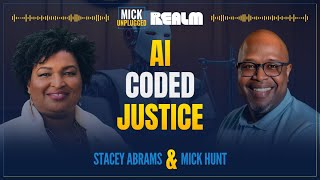
Stacey Abrams discusses her legal thriller Coded Justice and why she wrote it to make AI accessible to ordinary people. She argues that tax policy functions as a lever of power and warns that AI deployment needs regulation, citing recent court disputes over training data involving companies like Anthropic.
Chapters
If you don't think the AI Is playing a role in our legal systems, think again. In this episode you're about to listen to, I sit down with my shero, Stacey Abrams, and we talk about the role that AI has today and will have in the future of our legal systems. We're also going to break down Stacy's new book, Coded Justice. It is a thriller. It is AI Centered, and we're going to break the code on AI So buckle up and get ready. This episode is for you, Ms. Stacey Abrams. Stacey, how are you doing today, dear?
Well, I. I'd like to meet the woman you're talking about because she sounds kind of awesome. Thank you.
You see her in the mirror every day, I'm sure. Every single day. Stacy, again, just so honored what you mean to me, and I'm gonna say millions of other people, and I know you get a lot of praise and a lot of accolades, but a lot of times, sometimes we don't understand the gravity, the brevity of what we do. And I need you to understand, Stacey, just what you mean to a lot of people. The voice that you have, the voice that you've continued to rise, is second to none. And so for me, I'm not even gonna say a fan, just someone who has believed in Stacey Abrams for a long time. Someone. You know. I'm from South Carolina, so George is my neighbor, so seeing the things that people across the nation don't really get to see. Right. I just thank you. And I know you know what that means when I say I thank you. And I just. I truly thank you for being that beacon of light, that beacon of hope and just someone that I can follow in your footsteps. So thank you.
I truly do receive that. It is discomforting because, as you are, I'm a child of the south, so this is kind of awkward, but it. It. I don't take it lightly. And it matters to me that I matter to you and to others. I'm grateful for the work that I get to do. I'm deeply privileged to be in a space where what I do has of an effect. But I will never, ever take for granted the gratitude. And what I see is the camaraderie and the fact that we're in this together. So thank you.
No, I thank you. And it leads me to my first question, and it's usually the question I ask all of my guests up front is, what's your because? That thing that's deeper than your why. Right. Like I tell people all the time, your why is superficial. I can probably guess it. It's great to start with your why, but there's a purpose that's deeper than your why. And I like to call that your because. And I've always wanted to ask you that question, Stacy, because, no pun intended. You've been a voice for the voiceless. You've been a leader for those who couldn't lead themselves. What's your because? Like, why does Stacy continue to do that?
Because poverty is immoral. It is economically inefficient, and it is solvable. And we give ourselves too much permission because, you know, a passage of the Bible says, the poor will always be among us. And for many, it is an excuse. For me, it is a call to action. Wow.
And when did you know that that was your call to action?
I was probably in elementary school. My parents. My mom was a librarian. My dad was a shipyard worker. But they would take us to volunteer a lot. Like, I miss a lot of Super Friends because we would go volunteer on Saturdays. And you understand what that means?
Absolutely, absolutely.
And we were out one day, know, volunteering, and, you know, we were at either homeless shelter or something, and I'm like, mom and dad, you guys know we're poor, too, right? And, you know, they. The response was, look, you know, have. Having nothing's not an excuse for doing nothing. And what I thought was, it's inefficient for six. You know, for these six black kids and these two black parents trying to fix Mississippi. There's got to be a more efficient way. And I asked my parents, I said, shouldn't someone else be helping do this? And they said, well, that's what government is for. That's what these organizations are for. That's what churches are for. I'm like, well, they need to get. Get better at it. And from that moment, for me, it was always about, how do you not just have the instinct to help? How do you organize people? How do you organize institutions? How do you create infrastructure so that you're not just trying to solve a problem, you're actually building solutions that go beyond a single person or a single family trying to do right. That was it for me.
And what grade did you say that was in, Stacey?
That's probably like, fifth or sixth grade. I really like the Super Friends.
Fifth or sixth grade. I was trying to figure out how I could go play basketball or football and get some time to do all that. And you're over there solving the world's problem. But that makes you who you are. Just so many questions that I Want to ask, Going there, you've often said, and I talk to leaders about this a lot too, you. You've often said that the office that you have isn't about power, right? It's about impact and influence. Can you elaborate on that? Because I tell leaders the same thing I tell leaders. It's not about your title. It's about the influence and impact that you have. And in today's world that we're in, it actually holds more weight, more water than any other time that I personally think we've had.
So I'm going to pull those two pieces apart, because power is indeed what I'm interested in. But it's not power that's embedded in a political office, because anyone in politics, anyone with elected office, has borrowed power. You are borrowing power from people. And so the moment you start to think it's your power, you are very confused and likely will either end up in jail or you'll become a despot. So it's not your power, it's borrowed. But the second part is why the way I talk about it so often, I don't mistake position for power. Having a job, having a title, those are levers that you can use. It's easier to do this work if you have the power that is borrowed by a governor. It is easier to do this work if you have the title of mayor. But it is not impossible to do the work if you don't have those things. It's harder, but it's not impossible. But too often we mistake position for power, and we think the person with the title is the only person who can do the work, or vice versa, that because the work isn't getting done, that no one else can have that power or that title. And so for me, it's when I run for office and don't get it, or when I run for office and get it. Like not having the title doesn't excuse me from the work. And the power is what comes when the work gets done or when the work is thwarted. And that is the other dynamic about power. Because power is not just the ability to make, it is the ability to prohibit, the ability to stop. And we've got to start recognizing that it is our power that is borrowed by others, and when they misuse it, we take it back.
That I'm writing notes because that was deep. So how does one go to truly understand that? Right? How does one go to say, all right, it's borrowed, but I can be impactful with this borrowed power. Like, what's that mindset shift or that physical thing that has to happen, Well.
I think it's recognizing what it is we're asking for. So I appreciate how people have reacted to the work I've done registering voters and doing voter engagement, turning people out. But the reason I do that is because they had power that they didn't see, they didn't know. When you register unregistered people of color in the Deep south, it is because that is power that's lying fallow that someone is stealing, and it is their right to hold it. And so it's my job to get them registered. But when suppression interferes and they can't exercise that power, then my job is to figure out how do we stop those that interference. But the mindset shift has to be that again, you we mistake position for power. We think you have to have a title or a bank account or a certain look, I miss I don't have most of those things, but what I do have is a belief that right makes right and that if I'm doing what I'm supposed to, I can't guarantee outcome, but I can guarantee input and effort. And it's when you shift your mindset from I can do this once I have X to I can have X once I do this. That's when we start to see the shift in dynamic. I don't wait to win. I don't wait to be invited. I don't wait to be told this is the okay thing to do. I like to describe myself these days as a professional troublemaker because my belief is that you can't make things happen if you're waiting for permission for it to be so. But the other part of it is you can't ask other people to take steps or to fix things you aren't willing to fix yourself. And sometimes we've got to be the ones going out. I mean, you and I've heard in the church, you got to go, run, tell. And sometimes that's the job. Sometimes that's the power. It's the power to be the communicator. It's what you do with this podcast. We tell people what they're entitled to, and then we do the work of helping them understand how to get it. And then once they have it, we help them understand how to use it. And if they lose it, we tell them, we help them figure out how to get it back or to figure out, did you lose it for a reason? And so all of those are different facets of power, but there's no light bulb moment. It is the personal decision that I'm going to stand in my power and I'm going to use it until somebody either stops me or, no, that's about it. You have to stop me.
Yeah. Yeah. And again, of all the things I appreciate you, I think, is that resiliency, it's that I'm going to take risk. It's okay to, you know, to quote Our friend Mr. John Lewis, it's okay to be a good troublemaker.
Exactly.
Right. Because if we don't, then who.
Right?
If we don't cause good trouble, if we don't make good noise, then who is going to? And if you're waiting and waiting and waiting, you're gonna spend your lifetime trying to see that happen. And again, that's why I applaud you for taking those moments forward.
Thank you.
So many places. Again, I want to go, Stacy, but I want to go to, you know, you saying I'm going to law school, right? I'm going to make impact. I'm going to make change and justice. When. When was that? And if you tell me the fifth or sixth grade, I've got to stop the podcast because you've done way too much as a 10 or 11 year old.
This is actually the exact opposite. So my younger sister Leslie, she's a federal judge. She's the first black woman to be a federal judge in Georgia, and she has wanted to be a lawyer since she was 8. We were very precocious children. Our mother was a librarian, so we literally read books all the time. And, you know, the rule was if you could reach it, you could read it. So we were reading things that may have been above our grade level, but Leslie knew she wanted to be a judge. She read a kid's biography of Thurgood Marshall and wanted to be a judge. I had no interest in the law. I was not sure what I was going to do. But when I was in college, my. My last year or my junior year, I applied for this fellowship. And the only two students in the history of Spelman who'd gotten it, one went to law school, the other went to policy school. I decided if I said I'd do both, I'd double my chances of winning. And then when I got the scholarship, I was like, well, I don't have any other plans, so I'm going to go to law school and policy school. And it was in those places that I learned more about what I could do. But, no, I didn't wake up saying, I'm going to be a lawyer. For me, it was I'd always, during my time in school, during my time at Spelman, I was very involved in social justice issues. I made up a major. I did political science, economics, and sociology. And so for me, it was always, again, back to that. Because that because was my lodestar. And what I've been doing for most of my life is aggregating the tools that help me achieve my because. And so when I was a junior in college, a senior in college, the tools I discovered could be added to that box were law school and policy school. I didn't know exactly how it was going to play out. I did not go to law school planning to become a tax attorney. I did not go to policy school planning to focus on tax policy. But once I got there, I realized that tax policy is one of the most obscure ways that power is wielded over us. And so I wanted to understand it, and I wanted other people to understand. And so when I was a state legislator, if you came to my town hall meetings every single Saturday, when we had a town hall meeting, the first 15 minutes, we talked about tax policy, because it is one of those tools. It's why the first and only bill that this president pushed was a tax bill. Because when you can change tax policy, you change everything else. Where we get our money determines how we spend our money. And when they are willing to take it from the poor and take it from the middle class to give it to the wealthy, that is not a sign of economic theory. That is a sign of power shifting. And they want to take it from those who cannot afford to lose it, to give it to those who won't notice they have it. But that's because they want the power dynamic to remain as it is. And that has always been important to me. So I became a tax policy person because I wanted to understand that lever of power.
That deep. And you just enlightened me on something that totally makes sense, but I didn't think about it right. Like, tax law touches everything.
Everything, everything.
What's. What's something that the common person, like myself, wouldn't think to understand as it equates to tax law.
So when you are asked, you know, when we're complaining about our taxes, there are three types of taxes. There's progressive taxes, meaning you pay more the more you make. There's neutral taxes. You pay what you decide you can afford. And then there are regressive taxes. You pay the same amount no matter how much you have. The reason. There's a conversation about shifting away from income taxes to sales Taxes, there's a reason that if you own a business, they give you property tax breaks. But if you're an individual, you gotta fight tooth and nail and you're gonna lose. And that's because progressive taxes make the wealthy pay more and regressive taxes make the poor pay more. Neutral taxes are property taxes. Usually you buy the amount of property you can afford, so it's considered neutral. So they always come after regressive taxes first. They always lever use that lever first. And most of us don't think about it that way. But a loaf of bread costs the same amount whether you are rich or poor. That's why they go after the loaf of bread, because you can't make them pay you more at work. But we're all going to need the loaf of bread. And so we should focus on what are they charging us for and what are they spending it on. And the average person just kind of gets focused on the abstract number. They give us 10%, 30%. What's your marginal tax rate? Most people have no idea. But the reason they make it that obscure is because they don't want you to focus on the fact that as you lower the top number, they don't ever lower the bottom number. And that means that you're always paying more than you can afford, but the people who can afford more are never paying what they owe.
Stacy, you know what? I've again been a follower believer of you forever. What you just broke down is exactly why. Because you make everything that you say relatable, right? As much education as you have, one of the most educated, best minds that I know, you have this unique ability to make everything relatable. And I want to ask, where did that come from? But you're going to tell me. Fifth or sixth grade.
No, I'm going to tell you. I'm going to tell you. I'm going to tell you. Robert and Carolyn Abrams. That's where that comes from. Because my dad, I talk about my father, he was not able to read at probably more than the third or fourth grade level for most of his life because he's dyslexic. So my dad grew up in Jim Crow south dyslexic. So that meant they didn't diagnose him and they didn't offer him services. But my dad has this amazing oral memory. But what that meant for him was that he had to be able to tell people what he knew, but he also had to be able to hold information that he got. And he's also this just amazing storyteller like my dad. There's this quote from Mark Twain. Like my, you know, Mark Twain said, yeah, I remember everything from my youth, whether it happened or not. Like, my dad, like, he's got the ability to, like, tell you a story, and you're like, and that happened to you. You're like, wait, could that have happened? And then my mom is this extraordinary woman who, in her own right, had a very tough childhood and difficulty with education, but became the only person in her family to finish high school to go to college. She was a valedictorian of her high school, despite dropping out of school in fourth grade. They both have this ability to translate. They take these things they know, and they try to meet people where they are. And they raised us to believe that, yes, we should always aspire to more. You should never dumb down what you say, but you can always make certain that people can rise to where they deserve to be. And so you start with. I try to start with the big. Give you the access point and then have you travel with me when we go back. Because too often we expect people either get there on their own or we don't trust that they can get there at all. And my job is to make sure. I show you what's possible. I come and help get you. Get you there, and then we travel the rest of the way together.
Well, I totally know that's true. Because you know who else is an amazing storyteller? Stacey Abrams.
Well, thank you.
I need my editors to zoom in on this book. Stacey, you were gracious enough to have your team send me a copy.
Absolutely.
I told you, I haven't put it down. I have my markers in here. The book is so highlighted. So for those that are listening, the book is called Coded Justice. It's a thriller, and we're tackling AI in this book. And it made me pause because we don't know where AI is going. But I was sitting there like, are we ever going to get to a point where AI is a part of our judicial system? This book has me thinking. And this book is telling a very, very realistic story of. Of life. How life has looked, how life will look, how life could look. What brought this to your mindset? To say, I need to write a book about this or not even that I'm going to write a book, and it's going to be Coded Justice.
So I love. I'm very grateful for how you describe me. I love taking big topics, big ideas that people don't think they have either the right to or the ability to decipher on their own and then make it accessible. So my first legal thriller in this genre, my first one in the series, it was about the Supreme Court, but also about biogenetic warfare. The second one was about cryptocurrency, the FISA court, and the electric grid. This one was about AI. And each time I try to pick a topic that feels both familiar and completely foreign. And if you ask a person, do you understand this? Usually they'll say no. But I like ChatGPT or I like Alexa or like Siri, and I want to find a way for people to come in, understand it, because to your point, it's going to be a part of our lives going forward. There is no possibility of AI not being what we have to deal with. And therefore, if it's going to be so much a part of our life, from everything we do, from the judicial system to the economic system, to how we make our toast, if it's going to be so embedded in our lives, we need to at least feel comfortable asking questions about it and so forth. For me, it was, how do I write about AI in a way that feels accessible, feels thrilling, but also, when you finish reading it, you don't feel like you just read. You know, I don't want you to feel like you read a textbook. I want you to leave there. I want you to enter feeling curious and leave there feeling empowered and a little scared.
And that is the journey. That is totally the journey. You know, I. I had this question because you write about AI systems and you say that, you know, AI systems are showing less sentencing disparity, right? And then human judges. Do you think that's going to be the case?
No. Because our human nature is always going to lean towards punishment versus practicality. We will. And in part of the narrative behind Coded justice, the reason I use veterans, the reason I talk about diversity, is that there is no population that is organized in America that is more diverse than our military. And yet because of that, we owe it this highest responsibility, and we too often give it shortest shrift. Justice is another place where we let our prejudices, our fears, dictate our outcomes. And we don't consider the additional pieces. We scoff at judges who do, depending on how we think the story should tell itself. As I mentioned, my sister Leslie is a judge, and she said something to me recently. She said, my mission in that court is that no one leaves my court not feeling seen. She's like, even if I have to send you to jail, I want you to feel seen. AI could do that. But the problem is, when humans look, we don't always see the truth. And we are going to be. It's unlikely that we'll be willing to relinquish that much power, but we could use it to level the playing field. And that's what I try to do in this book. That AI is a tool. It's a tool that can be used to build or tool that can be used to destroy, but it's just a tool. It's up to the humans who are wielding it, who are programming it, who are regulating it to decide what it can and cannot do, what it should or should not be.
Love that. The title. How long did it take you to come up with the title Code of Justice?
I was in the middle of writing it, and I said, I think I was sending back the synopsis after the second time, when I really started to refine how I was going to tell the story. And I said to my editor, I'm like, I think I want to call this one Coded Justice. We try to use justice in each of the titles. So while justice leaps, rogue justice. But this one is about how. It's about Coded Justice. And yes, it's double and triple entendre. It's about the code and AI it's about the codes that we live by. It's about the codes we tell ourselves about who we are. But ultimately, justice isn't about just what's right and wrong. It's about how we get there. And to your point, it's about the why, and it's about the because.
Yeah, I love it. You know what I love about your book? And this is just a me quirk. I love the fact that chapter one just starts one and we got a date. Chapter two just says two. We got. Like, I love that because now it captures me. And I'm just going to throw this out there into the atmosphere because I believe it. Like, this is a great movie setup, too. I could see the movie, I could see the screenplay with this book, like. And I don't want to give it away because I'm reading it for the second time. Like, the first time I read it as a fan. Now I'm reading it from a leadership perspective because there are some leadership moments that you have in this book. There are some lessons that are learned in this book. So for the viewers and listeners, from your perspective, because you're the author, what are a few leadership lessons that you wanted people to get out of this book?
Well, one of your very first questions made me think of Avery. Avery is someone who has responsibility but no authority. And that's the constant theme through these books. Because I want people to understand you don't have to be given the authority to act, to have the responsibility of action. And that's leadership. Leadership is doing what you have to, not because you're told to, or not even because you're permitted to, but because it has to be done. The second is we've got to ask questions. And this whole book, her. Her. Her role in this is to ask questions. And I try to structure it so that you can take these questions with you. And I make certain that she's inquisitive, but that she's not always right. And that's the third one. She has this group of friends in the book that I just love writing about, and the fact that they challenge her and that she doesn't win the arguments, that's important to me. Because the other facet of leadership that we're not seeing right now is it's okay to be wrong as long as you learn from the mistake. It is okay to be wrong if it means you're going to be better the next time. And I want her to grapple with being wrong. I want her to grapple with not having all the answers, because the best leaders understand that they don't understand everything, that they are constantly learning. They are going to make mistakes. And it is not the fact that you made a mistake. It is, what did you do the next moment? Did you learn your lesson or did you learn your loss? I want her to learn her lessons.
Deep, deep, deep, deep, deep, deep, deep. Stacy, another question I have for you in regards to the book that to me translates to real world. How are we going to solve this? And with your background, both in the legal system, being the head of corporations, again, you are the right person to answer this question. When we talk about the code, right? Code of justice, but then we talk about the real world, who ultimately holds the responsibility for when there is something wrong? Is it the coder? Is it the company, or is it the code itself? Right, And I know you kind of know where I'm going with that, right? So, but. But ultimately, who's responsible?
So I have this podcast, assembly Required, and the whole point of the podcast is to grapple with that question, because most of the issues that we are perplexed by, it is a question of the code. But the questions that I want us to ask, who wrote it, the coder, who deployed it, the company, and what's the effect? And so code adjusted I mean, so Coded justice is my dealing that with AI assembly required, and then the substack I write because I can't talk as long on my podcast as I'd like called. It's called Assembly Notes. It's all about all three of those. Because we know there are different sets of responsibilities, but ultimately, ultimately it's the company, because the code is not sentient. The code does not write itself. The code is a reflection of the coder. The coder is a reflection of the environment, the learning, the experiences. They are going to bring that. And that's one of the things we grapple with in Coded Justice. Exactly which person made the mistake or did something intentionally and why. And then the ultimate responsibility rests with the decision maker who decides, I'm going to deploy it anyway or not, I'm going to take advantage or not. I'm going to give privilege to my belief systems over someone else's, and I'm going to risk consequences because my ambition is bigger than my sense of responsibility. And that's why I believe that AI should be regulated. There's this argument that regulatory constraint will stop innovation. That is absolutely untrue. Regulation means asking questions. It's about guardrails. And you cannot deploy technology as powerful as AI without guardrails and without questions. We did that once before in recent memory, and that was the Internet. And look what we're trying to fix. This is not about stopping innovation. This is about making certain that the people who will be impacted, who are not the coder, not the code and not the company, do not pay the consequences. And the price for our refusal to ask questions.
Absolutely. I'm going to come back to the book, but you just had my mind go to something. Have there been any documented court cases recently around AI that are powerful for us to know about?
Yeah. So there's a recent case brought against anthropology, and Anthropic essentially was accused of using information that they scraped, data that they scraped from lots and lots of sources. And I think it's anthropic and not OpenAI, but correct me if I'm wrong, but it's one of those two companies. But they were sued and the court said. The court kind of split the baby and said, you can train your models, you can train your AI tools on all of this public information. We should consider it all public domain. But when you start to monetize it, you're going to have to pay people for it. That matters, because when you are on Pinterest, when you are on TikTok, when you are on chat GPT and it's giving you advice on your love life, what you're going to eat on Thursday and what you should do with your job. It's scraping all of that data and it's not just putting it into this big pile where it can't discern who you are, it's also putting it into a file with your name on it. And there's a MIC file that someone's going to use that some coder is going to use either to directly target you or to do something that will be harmful to you. And right now there is absolutely no regulatory authority that gives you privacy for your data, that gives you authority to decide how much of your data it can or cannot use, and absolutely no way to get remuneration if they decide to take an AI model and train it on mic unplugged and do a nick plug sideways. Like they could do that. And there's nothing to say that that AI cannot mimic you down to the last syllable with just a little bit of difference. All of those things can happen today. This isn't a 10 year, 30 year, 50 year conversation, this is a September, January conversation. And so that's why it's so important for us to understand there's no legal case because there's no law and we need both.
I think I actually needed to hear that, right, because we talk about closed source, like I've built a closed source AI for the insurance industry and everything's good there. But you're right though, like those files that are being built, we don't know what people, what entities are going to do with them. And most of the time, you know, we have this thought of, well, you know, I'm just a nobody. Like nothing malicious could be done with me. Like those are the people that actually get targeted. Exactly, those are the ones that get targeted.
We built a closed source AI chatbot for dei. So I started a series of organizations protecting diversity, equity and inclusion, which sometimes gets dismissed as a sort of either boring HR thing or somehow problematic, but it's truly a value system. Do you believe in diversity means all people? Do you believe equity means fair access to opportunity? And do you believe inclusion is a good idea? If you don't, which one of those things do you disagree with? Because that's the question. Well, we have an entire architecture of law in this country and when you hear people say they are anti dei, let's come back to code of justice, the President's recent executive order making it unlawful for you to use AI if you want to get a federal contract. That means that if you want to build the very system that I have in this book so that veterans, who are the most diverse organized population in America, you need to know that black men have different PSA levels than white men when they have prostate cancer. And given that our military is predominantly men, when your veterans need your help. This law, this executive order is not a law. This executive order would preclude a company from intentionally training its model using dei. And if you look at what DEI is, that would be a part of it. Women have different reactions than men. Well, because we have, for now, a multi gender military, it would be problematic for an AI tool to be built to help women navigate being in the armed forces and when they come out being veterans. So I say all that to say we built this closed source chatbot because we want people to understand what DEI actually is. It's called a diva. You can find it aprnetwork.org but the reason I mention it is that in today's conversation, we have a leader of this country who is saying it should be unlawful for us to understand and build appropriately for the diversity of our country to serve our warriors. That should terrify anybody.
Mm. Mm. That's a whole another conversation right there, Stacey. We might have to come back and do part two.
I'm welcome. Ready when you are.
I have five questions just on that one. Just on that one. So coded justice. You know, I always tell a book because I just wrote my first book.
By the end of the Congratulations.
I didn't understand endorsements until, you know, I started writing mine and it happened. But you have some very cool endorsements from very cool entities, not just people, but the New York Times Book Review, the Washington Post, the Boston Globe, like, these are all entities that are endorsing this book. And I love the fact that in order for these entities to do something, they have to believe in it. Right? Like, you don't go pay somebody to do an endorsement like that. Right. How does it make you feel personally when the Boston Globe, the New York Times Book Review. And then we can get into some people too, right? But how does it make you feel when they think that highly of a book review you're in?
I, I, I am grateful. I, I truly am. And I, I'm being more muted in my response than I feel. But the thing is, you can't get more excited about praise than you do about the critique. And so I try to keep an even keel on both of them because, you know, I've heard once you, you don't want to take advice from anyone you wouldn't. You don't take criticism from anyone you don't want to take advice from. I think that's a bit dubious. But it's a good metric, which is we believe the good, and sometimes we over believe the bad or we discount the bad. And so I take all of it as it comes. I try to learn from what they say. If there's a compliment that they give me, I take it in and I think about, how do I make certain that that's something I can repeat? And if there's a criticism, what can I learn from it? And do I actually care? And that's the best way to keep writing, because if you start trying to respond to critics or respond to adulation, what you end up doing is writing their book and not your own.
Amen to that. Amen to that. Well, Stacey, you've been so gracious with your time. I know how busy you are. I know the fires that you're putting out. I know the voices that you're speaking on behalf. Of. So, again, I just wanted to thank you personally for. From my soul, for being on the show. I would love to come back and have you on again because you are one of my most favorite people on earth. You're very good, and you know that I mean that. So just. Just thank you for all that you do.
Meg, it has been a pleasure to be here. You were just up the road, so we're going to make this happen. And I just want to tell you I'm. I'm proud to be on the show because of the reach that you have and your willingness to. To engage in very authentic ways. You and I both know that is not thick on the ground, and particularly in this moment, it is not just appreciated, it is valued. So thank you.
I appreciate you more than you know. Stacey, where can people find and follow you? Like, I know, just Google Stacey Abrams.
So go to staceyabrams.com and you can find all of the different things I'm working on. You can find all the books I've written. There are actually 17 of them all together. I write children's books, legal thrillers, leadership books, business books. I mean, I'm no, like, I'm not Mick, but, you know, I've done some stuff. So if you go to safesavers.com, you can learn all about the work I'm working on, and we'd love to have your. Have you show up.
All right, so I'm going to put links to everything there in the show. Notes and description. I want to do something special. I want to purchase 20 copies of the book. And for. I get this a lot. But for the first 20 people that message me, Coded justice, and I don't care, email, LinkedIn, Instagram, whatever it is, coded justice. I'm buying 20. Stacy, don't let me end this call without me buying 20.
Not only you're going to buy 20, I'm going to sign them. So once they message you and you've picked your 20, we'll make arrangements and they will get a personally autographed copy of these 20 books.
Look at that. Coded Justice. That's the book. Go get it. Message me. You know what, Stacy? Because it matters that much to me. How about I buy 40?
Well, now you're just showing off.
I like real. I like weird number. Let's do 50, right? Like 40 might be a little odd. 50. Cop the first 50 people.
There we go.
Promise you you're gonna get a signed copy because this book is game changing for sure.
Mick, thank you so much. McCunt, you are amazing.
Thank you, Stacey. And for all the viewers and listeners, remember your because is your superpower. Go unleash it.
More from Mick


How My Supportive Parents Shaped My Life: Patric Young on Gratitude and Faith



Transform Your Leadership with Ken Coleman: Discover Your Sweet Spot | Mick Unplugged





The Power of Character: Building Stronger Relationships - Mick Unplugged | Bela Gandhi
