The Art of Never Giving Up and Inspiring a Generation
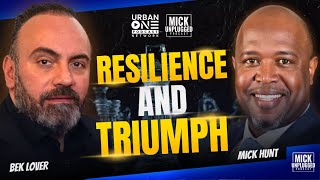
This is a recorded studio interview (McPlugged) between host Mick Hunt and guest Beck Lover. Beck recounts leaving a lucrative timeshare sales career to start the podcast "The Comeback Team," explains how sales skills translated to podcasting, and describes the intensity and incentives of timeshare work (high-pressure presentations, value-per-guest metrics). He also shares several major personal traumas that shaped him — the sudden car-accident death of his uncle/mentor (age 42) when Beck was 31, the loss of roughly 28 relatives in the 1998 Kosovo war, and being near the World Trade Center on 9/11 at age 19 — and how those experiences informed his message about resilience and inspiring others not to give up.
Questions this video answers
About 30 (he says he started the show five to almost six years ago; later states he was 37 minus seven → context indicates he was ~30 when he launched).
The Comeback Team.
Arthur Nascarella (Sopranos), Rachel Ray, Carole Baskin, Havoc of Mobb Deep.
Between $30,000 and $120,000.
Good: $3,000–$4,000 per guest; Beck averaged about $7,000–$12,000 per guest.
Chapters
What I regret the most about losing my brother, for example, wasn't just the loss of him. When I look back now, it's like, oh, my God. I lost three years. Three years of my life in sorrow.
Ladies and gentlemen, welcome to another exciting episode of McPlugged. And I'm excited to be in person, in studio with someone that I've looked up to forever. He doesn't know this. He's about to hear it for the first time. On how he inspired me to really go deep in my podcast. We're talking to the former head leader. He told me he did everything timeshare. He was the timeshare guru, the ethical ethnic timeshare.
We're talking very rare breed.
My man. Mr. Beck. Lover back. How you doing, brother?
Mick. Nice to see you, brother.
Good to see you.
Welcome to the Big Apple.
Long time coming.
What's left of it.
Long time coming.
A couple big bites got taken out of it the last four years, but we're trying to put it back together.
We're gonna put it back together. I believe in God. I believe in us, man. So, so much I want to talk to you about, but I wanted to tell you, man, face to face, brother to brother, you're one of the people that inspired me when I started the podcast to really be myself, because if there's anything about you, you're yourself unapologetically. And so I said, wait a second. This is my podcast. I can do what I want, talk about what I want with no repercussion. And it was after listening to, like, 10. I binge listened to, like, 10 of your episodes, and I said, I can be me. It's okay. No one controls me on what I do. This is my voice. And I want to thank you to your face forgiving me that.
You sure you didn't you listen to my episodes lately? You might turn it off and say, this guy's out of his mind.
But that's why I love you. That's why I love you. Sometimes we got to be out of.
Our mind about the comeback team.
Absolutely.
Nice interview.
Yeah.
We're going to launch season two soon, man. Yeah, I really miss that work.
Yeah.
You know, speaking of podcasting. Right. Yeah. It's what brought me and you here. And when I started that show five years ago, almost six years ago, at the age of 30. What am I? Minus seven? So 37 years old, I just walked away from a very lucrative career selling timeshare in New York City.
Yeah.
And I wasn't happy in life. I wasn't happy with the work I was doing. I was happy with the money, but I wasn't happy personally.
Yeah.
And when I started that show, I really, first of all, didn't have any experience as a podcaster. I had no experience in production. I knew I could talk because to succeed in sales for 20 years, you got to be able to talk. Right. If you can't talk, you're a starving salesperson.
Yeah.
Okay. So I knew I had the ability to talk. I knew I had the ability to connect with people. And I said, okay, I know I have the skill that's important for podcasting the rest of the stuff. I'm going to learn how to do it. And I launched the comeback team with. With nothing, man. Nothing. What gave me a little bit of morale in the beginning was I. You know, the first season, I went from. And this is where sales comes in, Right. Sales. I'm telling anyone, I'm looking at the camera, I don't care if you don't want a career in sales, it is a skill you must learn in life.
Absolutely.
You have to learn.
Yeah.
Because you're gonna have a very mediocre life if you don't. And what do I mean by that? It's not about trying to sell someone and do a hard sale, and it's just really learning how to listen, which I struggle with at times, Rick. And how to connect with people.
Yeah.
And that's really what sales is in essence. Right. Listening, understanding, looking for what they need might be on both sides. Like, what do I need from this person? What do they need from me? And is there a way we can connect? I mean, that's sales, in essence. Right. Yeah. To not learn this skill of how to ask the right questions, when to ask, when to speak. It's not like if me and you both got the same words in a word bank. Right. Let's say that we each got 100 words, and they're the same exact hundred words. It's like chess. We both get the same pieces, but how we play them can determine whether we're going to succeed or not, or if you're going to make the sale or not, or connect or not. Everybody's different. How they might react to words is different. Their humor is different. Right. So you could say one. One thing that 100 people find funny, but this one person takes offense to it. So, you know, when we're communicating, these are things that, you know, a salesperson. I think with time, through baptism and fathers, a lot of people have pissed off, brother.
Yeah.
And not Intentionally, you know, especially in timeshare. It's a very intimate meeting where you're going back and forth and back and forth and. And, you know, people can get angry, man. You know, and you're pushing them. It's high pressure. So you would be foolish not to learn how to know. At least learn about the process of sales.
Yeah.
It's life changing wholeheartedly. Really is.
Wholeheartedly.
So I started the show and I convinced. I went from begging him to, like, just come on the show to. He actually ended up co hosting for like the first season was Arthur Noscarella from the Sopranos. You've seen him in a lot of big movies. Cop Land with Stallone, and he was in Billions, which I love that show, but I don't like how it fizzled out. Yeah. You ever watch. I don't really watch a lot of tv.
Yeah.
But Billions was a show I love because it kind of brought in the whole New York dynamic. Politics, the corruption, the blurring of the lines. I thought it was very, very well put together show.
Yeah.
With Bobby Axwell and all that. He disappears with the plane. Right. So Arthur was on a lot of these big shows, and I met him smoking cigars and convinced him to come on. And then he's like, you know, I kind of like this. And then. And then, you know, then 2019, everything closed.
Yeah.
So nothing else was going on. So he stuck around for a while because they weren't shooting, so. So it was like, you know, I believe. I truly believe this. Your destiny. Yeah. There's free will, but some of it's written for you, too, meaning you got to take some steps, man. And then the rest, you know, God. God opens the doors for you.
There you go.
But to hear what you told me, man, I can even believe that you even. You got more followers than me, man. You know, how the hell did I inspire you, you know?
Hey, but it's the God's honest truth, man. And I. I meant that from my soul.
Were you on Clubhouse?
No, not at all.
I was a legend on there, so they threw me off.
But yeah, you know, with you. Right. Like, you get thrown out of everywhere.
Well, Clubhouse, you know, I think they got theirs, though, you know.
Yeah.
I got thrown off not because of what I was saying, because I was allowing people to speak correct and have open conversation and push back what was happening, you know, in 2019, which I did not agree with, the way they handled things. And I felt there was a lot of shady things going on, which I think time has proven if anyone has a half a brain can see that something just wasn't right about the last five years of our lives, whether it's New York, the fact that Governor Cuomo, no offense, I don't know, people support him. My best friend was just with him yesterday. Would even entertain bringing this guy back. And I'm not here to get into politics. I hate it. But I also talk about it, but not on your show. I can't believe this guy's even running. Did we forget why he stepped down? Like, right, Whatever. And do we forget about whatever, Leave that on the side? So for me, you know, to hear that come out of your mouth, man. And that. That's actually what kept me going. And what's weird, Mick, is I went from being a host of my own show that was kind of like, no one really knew.
Yeah.
To now I'm the guest that everybody wants on their show, man, which is crazy. And my. Even my followers were like, bro, we don't care about your guests. And I've had some big guests, man. I've had Rachel Ray. I've had Carole Baskin of Tiger King. I'm talking about when the show popped, I was like, one of the first interviews she ever did. Yeah. I've had Havoc of Mob Deep, Legend of Hip hop. I mean, I love the guy.
Yeah.
And I go from. From doing these interviews till everyone's like, man, we don't care about the guest. We don't. We just want to hear you, Ran. I mean, you want to hear me?
Yes.
They're like, yeah, we want to hear you, man. You, you, you. You inspire us. I'm like. And I start getting emails from people.
Yeah.
Because that. You know, my first podcast really was about trying to inspire people to never give up, no matter what you've been through. I've been through a lot of. You know, listen, this is not a competition of who's had a more tragic life. Right.
Right.
Eventually, I don't care who you are that's coming knocking. One day you're going to lose something that's irreplaceable, someone you love. That's only a matter of time. A mom, a dad, a brother, God forbid, you know, a friend, whatever it is. If you're going through a great time in your life, it's only a matter of time before the darkness comes, the sadness comes, and sometimes it catches us off guard, and a lot of people don't know how to handle it, and they don't know how to get back up. And what do they do? They Turn towards ways of numbing the pain. It carries over into their work life, you know? So speaking of timeshare, when I was doing it, it's a very intense job. You're doing two to three presentations a day. You got 90 minutes to convince some person who doesn't want to be there. Okay?
We got the free room. We go to the timeshare.
You have. The company has, in essence, bribed them.
Right.
To come and listen to you tell them why they need to spend between 30 and $120,000 in 90 minutes. Most people don't buy a car in that amount of time.
Right.
Okay. That they want and that they're willing to spend more money on to buy. And what's the mindset of the customer in timeshare billboards on the way there? Do you own a timeshare? Are you looking to get rid of it? They put on the radio, do you own a timeshare? You trying to get out your timeshare sucke? Okay, so. And they had to be bribed, literally. You know, made a really good offer to say, hey, you want to come spend two nights in New York City? We're only going to charge you 150 bucks when the room rates 700 or 500.
Right.
But you have to come and listen to Beckford. An hour and a half.
Yeah, okay.
And they're coming in very standoffish, close. Listen, I'm just going to tell you right now, whatever you say, whatever you do, we ain't buying. Those were the easiest ones. They were like shooting ducks in the barrel, okay? Those clients would come in. I'm telling you, no matter what you say, no matter what you do, we're not buying nothing. I'm like. And I swear to God, Mick Hunt, I swear to God, I would say, sir, in about 90 minutes when you're signing the paperwork. And he'd be like, damn, he was good. Right to their face, bro.
You told me that I was that person. For those that don't know, I came to see Beck. I was at timeshare. It's like, beck, man, I'm not buying a damn thing, bro. Like, I'm counting down 90 minutes. And Beck said, I'm going to leave this paper right here. Eventually you're going to come back 20 years later, I still have a timeshare.
Do you? You've seen it in action, huh?
Yes, sir.
So now there is a thin line, right? Pitching heat.
Yeah.
Sizzling too much. Flat out line. And I've seen in the industry, that's why the industry Is it's really not the product's fault. The reason timeshare has such a bad reputation out there is because of all the dishonest salespeople of misrepresenting what the product does just to get a sale. I'm happy in my entire crew. And I worked for the big three, brother. I worked for all. I worked for Marriott, Hilton. Okay. Very short time period with Wyndham. Okay. And I'm happy that in my career that I did there. It wasn't, you know, long. About seven years in that world. Never once did I have someone ever come back to me and say, you lied to us or you did this or a formal complaint. The only letter I ever got in my entire career in timeshare was the guy wanted a two bedroom. And in New York City, the units operated like two bedrooms. But they weren't.
They were. Yeah.
And I told them this, and they saw it and they still purchased it. But things like now, I changed my mind. It's not Beck's fault. That was the worst letter I ever got in my career. And one of the most high pressure environments you can be in.
Yeah.
And. And as a salesperson in that. In that world, they're stressed out. A timeshare. This is what breaks a lot of them, brother. You're on a wheel, right?
Mm.
And it's called value per guest. So I see X amount of presence, you know, customers a month. I get a rank.
Yeah.
And the higher my rank is, the more often I go out. The more often I go out, the more money I can make.
Yeah.
So if I'm not closing, eventually I fall off the wheel. I'm dead. I'm done. I'm not earning a living. There's no salary.
Yeah.
So it's a very intense process. So you were considered good if you had like a value per guess. It means every time you shuck a hand, the company was making three to $4,000. That was considered good.
Okay.
Okay. I was averaging like 7 to 10, 12. Wow. Thousand dollars every time I shook a hand. Wow. Okay. They didn't want me taking off.
Right.
But it came from being baptized out of fire also. Because what happened was I started with like 100 people, and within three months, there's only five of us left. Okay. That's how many people survive in that industry.
Yeah.
And there's a lot of corruption in that game. The managers that control the industry because they have their team in there, their friends, they look at the new guys as expendable. Yeah. So they would do a lot of feeding. So, like, let's say a tour came in from Beverly Hills, and then one came in from Bangladesh. It's not the stereotype, but just that the amount of money someone's going to have from Bangladesh or Albania, where my family comes from, compared to Beverly Hills is night and day.
Yeah.
So Beverly Hills comes off the elevator. They would give it to the people that were already there long before me. Didn't matter how good I was. They were all boys. They were all in on it.
Yeah.
Okay. And they were giving me tours that most people couldn't close. And I got angry. That's like the Albinian in me. I wanted revenge. I said, you think you're gonna. You think you guys are gonna eliminate me? No, I'm gonna outsell all of you.
Yeah.
And that's what I did.
Damn. Back.
I became unstoppable.
Yes, sir.
But the hardest part of my career wasn't that. It's that during that time period, I lost somebody.
So that's where I wanted to go. Right.
Sounds very close to.
Let's talk about devastating. Let's talk about tragedy and overcoming and what that's like, because you still have mouths to feed.
Right?
Like, you still got to go through it. And I think resiliency is one of the superpowers that you have. So let's talk about that, man.
Having kids makes you a super. A super person, I think, you know, if you're not putting your kids first as a parent, there's something wrong with you.
Yeah.
As down as I was, and I was down, man. So I lost what I call my brother. And there's sick people out there that tried to even attack me publicly, saying, he wasn't your brother. He's not your brother. He's your mom's brother. Stupid. This guy raised me right. My mom's brother was only 10 years older than me. He was like my older brother. He took me everywhere.
Yeah.
He was like my mentor. He paid for every. This guy took me everywhere. He gave me the name Beck Lover. I literally have this name because of him. May he rest in peace. He gave me this name making fun of me because I was into hip hop when I was younger and I was rocking the MC Hammer stuff, you know, the big pants, and sees me, he's like, yo, yo, Beck Lover. And I like. I'm like, damn. I like. I swear to God, I was like, fifth, sixth grade. I was like, I like the sound of that. So I was like, yeah, I saw some people call me back lover. He literally gave me that name and then became a nickname. Wow. And now the world knows me by it. But. So I was very close to this person, and I lost him suddenly in a car accident right at the age of. He was 42. I was only 31.
Okay.
And it was devastating. I had been through horrible things in my life. And I lost family in the kosovo war in 1998. I lost about 28 people.
Wow.
Okay. Cousins and their cousins, and I spent every summer with them. And it was in the Republic of Kosovo, which at that time was a part of the former Yugoslavia, which erupted into war in the 90s. And you had Bosnia and Croatia and then Kosovo. And I lost a lot of people, man. So I know what it's like to get a phone call and find out 28 people that you love and care for, your family that you see every summer is wiped out. And that's a devastating thing to go through.
Yeah.
I was underneath the World Trade center when I got hit Right. At the age of 19. I went to Pace University right here in downtown Manhattan. E train, last stop, World Trade Center. So I know what it's like to come out thinking the world's like, you know, going into the subway and the world's normal, and you come out 15 minutes later and you're like, did I just go through a portal?
Yeah.
Like, did I just go through a time warp? Like, where the hell am I?
Yeah.
Because it's snowing outside. But it's September. Yeah. And it's not snow. And I'm looking up and I see people start jumping off buildings. Right. So that's how my day started at the age of 19. So I've seen a few things in my life, but putting that all together. Losing Nikki, for me, was like atomic bomb one in my life. Wow. It was the most difficult thing I've had to deal with because of the. How close and how important he was to me. And I couldn't picture life without this guy anymore because he was so important to me. Yeah. And helped me shape a lot of my. Then he gave me a lot. He's the one that always told me, what are you doing, man? People love you. You're wasting your talent. Why are you working? Go. Go into Hollywood. I said, but I only want to be in that. He's like, dude, you belong in front of a camera.
Yeah.
What are you doing? People love you. You inspire people. You make them laugh. You make, like, people love you, man.
Yeah.
And then, you know, losing him in, it just. It was devastating, brother.
You know? So walk us through the steps of.
So I was at work. Yeah. Yeah. So, you know, I'm going to work in the morning. I take the ferry into the city. There's traffic in my town. There's never traffic like that. I'm like, what's going on? Somebody died on River Road. I'm like, who the hell dies on River Road? Make the story short. I'm going around my own brother, not even realizing it's him.
That's him.
I get to work, and at this time, I worked for Hilton and the. The biggest hotel in New York, the Hilton on 54th or whatever it is right here on 6th Avenue. That's what Trump, the first time he won, he held his.
Yeah.
Acceptance speech there. So I get up to the penthouse, because that's where they would sell the units. And I get up there, and then I see all my family call me at the same time. This is not good. Something bad's happening. The fact that my aunts are all calling me. They never even call me.
Right.
Something's wrong. So I pick up to, like, get to your uncle's house right now. I'm like, what do you mean? Like, just get to his house now. I'm like, can you tell me why? They're like, I don't want to tell you over the phone. I'm like, okay, so I already know someone's dead.
Yeah.
I'm praying at the time it's my grandmother, maybe. So you know.
Right.
But in my heart, I'm like, it's probably him, man. It can't be him. And make the story short, man. I'm, like, frenzied. I don't know where I'm going. I get downstairs, I'm trying to hail a cab. This is like, you know, before Uber really took. Took over.
Yeah.
And I make it back, and, you know, I'm in the cab, and then my other cousin calls me, hey, man, Nikki's gone. I said, dude, I just went crazy punching the roof nuts. The poor cab guy, man, he's like, brother, are you okay? I said, nah, man, I'm not. I'm sorry, man. Just get me to the ferry, man. And I went back home years, Mickey. You know, people go through a hard time in life.
More from Mick


How My Supportive Parents Shaped My Life: Patric Young on Gratitude and Faith



Transform Your Leadership with Ken Coleman: Discover Your Sweet Spot | Mick Unplugged





The Power of Character: Building Stronger Relationships - Mick Unplugged | Bela Gandhi
