Mike Austin, CEO & Founder, MetrixData 360, A DotCom Magazine Interview
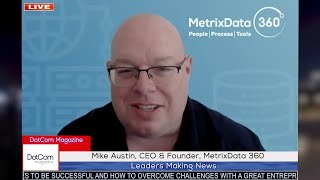
Mike Austin founded MetrixData360 to help companies manage software licenses and cloud costs. His approach combines proprietary tools like Slim360 for Azure with data-quality analysis and audit defense. Austin credits his success to what he calls the three Ps: promote, profit, and process.
Chapters
Foreign.
Hello everybody. Andy Jacob here with the Dot com magazine Entrepreneur Spotlight series. And I have a show I've been waiting for for a number of months now because you know, everybody in the software business, everybody in technology, one thing that's very, very top of mind for everybody is asset management. They call it software asset management. If you don't really know what it is, we're going to be learning a lot about it today from one of the leaders in the space. His name is Mike Austin. He's the CEO and founder of Metrics Data360. The 360 has a very important meaning to what he's able to do and what he's able to provide for his clients. But you know, a lot of clients really struggle to understand what's going on with their data and what's going on in their organization and what's going on with their digital software assets. And Mike is really a leader in the space. He and his entire team have done such a remarkable job building a great business to really provide assistance in so many different places, including software audits that we have to get into because it's so important to Mike. Welcome to the Dot com magazine Entrepreneur Spotlight series today.
Hey, Andy, great to be here. Happy, happy to join you. Looking forward to our conversation.
Yeah, it's great to have you. I mean, you really help your clients solve their biggest challenges by taking a data first approach and are really adopting best practices around, you know, around processes and tools. So let's talk about that. Let's pull the lens back to 30,000ft, tell us about metrics data 360, and then we're going to get into it.
Sure. You know what? I find the best way to start is to actually tell you a little bit about my background. I find this is usually a good way to kind of set the stage. Right. So, you know, it kind of. I actually have this memory when I was a kid and this is where it kind of started for me. I remember my mom coming home and I was probably about 11 or 12 at the time and I was sitting at the kitchen table. I vividly remember sitting there doing homework. And she came home and walked right by me and went straight to her bedroom and. And it was really strange because normally she'd stop and say, how was your day? But I could hear her sobbing in there when she went in. And I just had this pit filling in the pit of my stomach. And I knew that was the day because for months leading up to this, my mom was. We grew up in a small town and my mom was an IT manager at a small factory there. And for months they'd been threatening to close it down and move to Mexico. And she was trying to negotiate with her vendors to get savings to try and save the. Save the company. And they were just monsters to her. Like, she just couldn't get them to move anywhere. And, you know, this is, you know, pre Y2K and all that. And I just remember the devastating effect it had on my family when my mom lost her job. And I kind of thought at the time, like, that's never going to happen to me. And so, you know, fast forward. When I got a job at Microsoft, I thought I'd kind of made it because, you know, I was. I was brought in, into the licensing group and I was responsible for negotiating all these contracts. But I also worked with them on how they design licensing and with the program, like product teams, on how product licensing work. And, you know, I thought I made it. I was, you know, kind of going up the fast track. They were flying me into Redmond to build out all these programs. But in 2008, I found myself sitting up late at night watching all these infomercials and couldn't figure out what was wrong. And that's when my daughter came to me and said, dad, what's wrong? And I realized I'd become my mom's monster because all these companies were struggling to save money and they were asking me to go sell 20% more. And I knew all the games, I knew how to do it. I knew I could do it, but at the same time, it just didn't feel right. And so that's when I started to get the idea to start metrics data360 and kind of turn the tides and help organizations structure and negotiate smarter contracts with vendors like Microsoft and Oracle and IBM and the like. So, you know, it really goes back to that. That childhood memory of my mom losing her job and, you know, wanting to help, help my clients save money so that they can save jobs and, you know, do other other great things that, you know, with the money that we help them save. So.
Wow, I love the story, Mike. I mean, really, that's powerful. When you think about it. You think about your childhood and, you know, hearing your mother and. And leading you to sort of being a leader in this space right now. Let's talk about big challenges. Let's talk about the big problems. I mean, there's companies that reach out to you. I mean, you work with some of the, you know, most powerful companies in the world. What's the big, what's the big problem when they come and they say, hey, Mike, or they talk to a member of your team, what's the biggest problem that they're finding right now? What's the biggest challenge? And, you know, how are you able at metrics data360 to help them out?
It sort of boils down to we survey about 200 of our clients. And it kind of boils down to kind of three things. One is software licensing is very confusing. The software publishers love to build these bundles and sell you more than you need. And they keep changing the rules. Just very difficult to understand. It comes down to prices are constantly increasing. But the value that organizations are getting for the software doesn't necessarily pace that. Anything about the pace of change as you move from on premise to the cloud and all that sort of stuff. And the third thing is visibility into the data to make these decisions. And so I always try and describe things to people in a way that kind of makes sense. And it's sort of like if you think about as an organization, you decide, we're going to do a great thing, we're going to go out and negotiate a Netflix contract for all of our employees and get a great deal on it. And so you go to Netflix and you say, we want, you know, great price for all, you know, 200 of our employees, 200,000, it doesn't matter. We work with organizations of all those sizes and say, we want a great deal. But try and dissect that data where you're going to have families that have, you know, eight TVs and everybody's watching something different, whether it's a movie or documentary to kids shows. You're going to have some people that just have, you know, toddlers running around the house and all they want are kids shows and you can have like the outdoors people that don't even watch tv. And trying to figure out if Netflix would break that down into packages, trying to figure out how to put all that together would be next to impossible. Well, that's what these software vendors do is they create these great big bundles and trying to figure out how to dissect them and not over buy and cut deals for your organization where not everybody needs the same thing and you don't have the data to figure it out. And so we give our clients the visibility to make sure that you, they're buying what they need from the software vendors at a fair price. That's, that's kind of our core, core model now. We focus on price, but our Clients a lot of the time work with us because it's around peace of mind because we're giving them the data to make the right decisions and you know, those sorts of things.
Yeah, it's very interesting. I would imagine that you have different ways in which you're able to help your clients. For example, I would imagine there's some clients that want to work with you on a project basis. In other words, they come to you with a very specific problem, maybe around a very specific vendor. Let's talk about that. Those are software asset management problems that you can jump in and really, really help your clients on a project basis. Right?
Yeah, and that's where we typically start with our clients. They come and say we got a Microsoft Enterprise agreement that's up for renewal or a big Oracle renewal or pick the vendor. And we just, you know, we don't know that we have the, are buying the right thing. We don't know if we're getting a good deal. Can you help us? And that, so that's one area that they come in. The other is the opposite side of the coin where you know, they're in a contract and the vendor drops an audit on them to validate whether, you know, they have enough licenses for what they're using. And those things are typically not tilted, you know, or sorry, they are tilted in the vendor's favor as well. So they bring us in to sort of level the playing field and make sure that, you know, the, that that audit's being run correctly and you know, things are being calcul properly. So yeah, we do, we do tend to start with these projects. They could be big, it could be, let's look at an entire vendor's portfolio. So if you think about, you know, IBM and Microsoft and you know, they have thousands and hundreds of software titles so you could have us come in and look at everything or they may want us just to come in and look at, you know, a small portion of what they have installed or you know, we're moving from on premise to the cloud. What's the impact? And we'll just do an engagement to help them, you know, figure that out.
Yeah, it's very powerful. And looking at your trajectory, it would seem to us@.com magazine that once you bring them in for a project, oftentimes they say, you know what? They've done such a great job, let's just bring them in. You know, maybe we don't have the in house resources or maybe they don't recognize that the resources that they, you know, maybe they recognize that the resources that they have aren't really good enough to really give them what they really need. So they just say to your company, hey, come on in and take it over.
Yeah, I mean, absolutely, we can run a full program for people. But I mean I tell, if you think about these big companies, they have tons of IT vendors and you know, I'll pick on Microsoft. Microsoft makes about 500 licensing changes a year. So it's almost a full time job just to keep on top of those. And if you look at like an IT procurement or an IT manager that's responsible for contracts, they're dealing with Microsoft and IBM and VMware and Citrix and Adobe and you know, umpteen dozen others, you know, not to mention, you know, Salesforce's new S. And so it's very difficult so you know, getting expertise to really sort of make sure that you're supplementing your team. I kind of, I kind of describe it like a pro athlete, right? You know, you think about, I'm Canadian, so I always like to take the analogy to hockey. But you think about, you know, you think about a hockey player, right? You know, the Connor McDavid or the Wayne Gretzky's of the world, you know, depending on how old you are. They don't do it alone. You know, they have massage therapists and you know, choir practice and you know, mental coaches and skating coaches and shot coaches and coaches coaches. And you know, they have a team around them and that's what these organizations need, are strong teams that make their stars, you know, All Stars, right. And so I tend to think of it not so much that they don't have the skills, but we're going to make their stars into all Stars, right?
So I love it. Of course, being from Detroit, I'm a hockey town Detroit red wing fan. I'm pretty old and I remember Steve Yzerman, of course, you know, the captain and you know, he had his protector, Bob Probert of you know, on the ice protecting him and it's the same thing. Now let's talk about your Active Directory tool because you know, you've really developed proprietary tool sets and algorithms and, and I want to talk about this Active Directory tool because it seems like that's a great example of what you're able to do more effectively and efficient than really a lot of other companies, you.
Know, and that, you know, when we, when we started the company, data is in the name for a reason, right. And the Active Directory tool is a great example. A lot of organizations there's these tools in market these software asset management tools, these companies go out and buy and they spend hundreds of thousands or millions of dollars on licenses and implementation of these tools. But if your data quality is not good, you know, garbage in is garbage out. And so one of the things that we realized right away was that organizations needed to have way to measure whether the data that they have is good enough to make decisions on or defend themselves in audits. And so our active directory tool is something that we develop to take a look at sort of what do they have out there, what do they have inventory on? And you know, if you think about a Venn diagram, we want about 90 to 95%, you know, data accuracy. And there's a little bit more that goes into that, but it really is that first step in ensuring that you get good data to make decisions on when it comes to your licensing contracts.
Yeah, makes sense. Mike, of course, one thing that you mentioned is, you know, the group of people, the team. I want to talk about your team. I mean, you know, metrics data360 is known for having a great team, a great group of people that really work within these client engagements in a very collaborative way. So let's talk about that. Let's talk about your team. How important is it for you to have the right team members with the right not only mindset, but skill sets to solve the big problems of your clients?
Let me tell you another. I'll tell you another story. I love using stories to kind of illustrate what we do. Ironically enough, when I was at Microsoft, I had one president's club and it was a trip to Hawaii. And the one day they had an event, kind of different things that you could do. And my wife and I were looking at the events and there wasn't anything that particularly, particularly appealed to us. But one of the things was to go deep sea fishing. And so we thought, let's do that. At least we get out on the ocean. I wasn't into, you know, wasn't a big fisherman at all and immediately had this big sinking feeling in my stomach. I'm like, what the heck was I thinking? I get seasick, right? And so true to form, we get out there on the ocean and I'm literally lying. And it was a bad day. It was just, it was tail end of the season. We were out there for a couple hours. There was just no sights of anything. And true to form, I'm literally lying in the cabin passed out because I'm so sick from the seasickness. When I hear the skip, yell, fish on. And this is the biggest one I've ever seen. And so I actually jumped up because everybody else was up on top kind of having a few beverages and I jumped up and I saw this thing jump and go down. And he basically said there were four couples on there. He says can take all four of the men probably about four to eight hours to pull this thing in. And long story short, I pulled in a 500 pound blue marlin by myself in about 45 minutes. But I couldn't have done it without the team. I had to skip there that understood when to squat down and loosen the slack on the line and when to reel and when to kind of pull and get tension. I had the captain that understood the waves and when they were coming and sort of when to back up and go forward and guide and understand the ocean. I had my wife there pouring water on me because I was sweating. I got my colleagues there cheering me on, right? And the reality is I couldn't have pulled that thing in without that team, right? And so it's no different when you're negotiating with Microsoft or Oracle. You get that big, you know, kind of pit in your stomach and you don't know what's going on, right? Like, it's like, oh, I just don't feel great. But you know, if you get a good team, right, you get some really good strong licensing people, you get some really good strong inventory people that know how to do things, you get people that know how to build out a technical roadmap that aligns to licensing. You pull in your procurement, you pull in your legal, you pull in your finance and you can go out and beat that blue marlin, right? You know, you can beat the Microsoft and the Oracles of the world. And that's really what we do. We provide the pieces to supplement our clients teams where they need that strength or that bench strength, right? So you know, that's, that's really what it is and you know that's, it's so important, right? But you know, on the flip side as well, you know, they found that blue marlin using a tool, right? And so that's why we've developed, you know, some of the tooling that we have because you can take, take our slim 360 tool, we haven't really talked about that one, but we developed that to go and take a look at what's going on in Azure and where there's waste and where there's spend and identify that so that we can help people do that. So it's kind of like the fish finder in some way. Hey, where's the waste in your organization? Where are you spending money that you shouldn't be looking at? Your azure spend, your O365 spend, or Microsoft 365 and pulling that all together, together with the team. It kind of all comes, comes together like that.
So I love it. What a great story. You know, fish on and it's the biggest one I've ever seen. I mean that's a great story and storytelling is very important in business. One of the things you just mentioned that I did want to get into before, I unfortunately, you know, I've only have been allowed a certain amount of time with you. You're so busy helping so many companies. But I do want to talk about the Slim360 and I do want to talk a little bit about sort of how that that tool that you've developed really is a powerhouse.
It is, it's a game changer. Right? Because as these licensing rules change, they go from ownership of perpetual licenses to subscriptions. Microsoft has changed the game and you really need to understand. So if we go back to that Netflix story, what are we using, how are we using it, who's buying what, who's watching what, those sorts of things. With Slim, what we're able to do is in your Microsoft 365 or your Azure environments, identify areas where you're wasting money and they're plentiful. We don't have time to get into it today, but I can tell you this. Every customer I go into says, I got a pretty good handle on it. And we said, yep, we hear that from every client that we go into. The lowest amount that we've been able to save a client is 7% using the tools. The highest that we've been able to save somebody is over 47%. And we average somewhere about 21, 22%. And that is without negotiating, that is just right. Sizing and fixing what you're buying and dropping your costs. And I tell people all the time, no matter whether you're a 200 seat kind of mid market company starting out or you're Fortune 50 with a couple hundred thousand people putting anywhere, if you were able to put 22% of your Microsoft spend back into your IT budget, how impactful is that for you? I mean, we use this stuff on our Azure stand and on our O365 ourselves. And we're only, you know, little over a dozen people and you know, not spending hundreds of thousands on Azure. But we find 20% waste all the time just because things get out. You know, we put a system up and then we think we're going to develop it, and then we don't, and nobody turns it off. And, you know, so giving that visibility is so crucial, and that's. That's what we develop those tools for.
Yeah, Mike, it's so great. And in today's world, every percentage of margin, every extra few percentage points of profitability or decreased waste really makes a big difference. And you like to say you beat your software vendors at their own game. I like that so much. One thing that you've become known for, Mike, that I love, is you're very transparent. I mean, you don't hold back. I mean, you put out so many free resources that people can read and people can watch on YouTube and people can read and learn everything. Talking about, you know, about what you do that. It's really incredible. What's the thing that made you sort of think about the fact that you really wanted to provide this type of sort of information about software asset management to the, to the public?
You know, it goes back to my, you know, where we started off with my mom. Right. I know that we can put this information out there and, you know, there'll be companies that will use it and go and get great savings, and I'm so grateful that they can use our stuff and go and do that. But the reality is most organizations are going to struggle with that. They need that team, you know, they need the captain in the skip helping them catch that blue marlin out there. And, you know, that's what we're there for. So if we can, you know, put that out and somebody can use that and save a bunch of money, that is awesome. But we also know that most organizations are going to struggle trying to implement this stuff themselves. And they're gonna, they're gonna come to us, and so we have no problems putting, putting our stuff out there. We'll continue to put stuff out there. You know, a lot of our competitors don't like that we put what we do out there, but we're. We are fully transparent. And, you know, our goal is just to help organizations. And I fundamentally believe you give and, you know, you give and give and give, and you'll eventually get something in return.
So, yeah, I love it. Of course, you've done such a great job. I mean, such a wide range of customizable solutions and services. I mean, contract negotiations, audit defense software, asset management services, and even cloud sizing. I mean, you do it all now, let's talk about entrepreneurship.
Absolutely. My second favorite topic.
I know you love it. I know you're passionate about. I've read some of the things that you put out there. Very, very passionate about helping people and being a mentor and sharing knowledge. For the younger people watching the show, the younger entrepreneurs, maybe they're hitting a tough time. Maybe they're hitting a pothole in the road. Maybe they freak out. They freeze in the frame. What type of advice, Mike, can you give to those entrepreneurs that are sort of facing a tough time in their business right now?
I sort of got, you know, two pieces that I would kind of give them. One is the first thing. When you're developing a business, you need to figure out three things. I call them the three Ps, or my business mentor, Brandon Dawson, calls them the three Ps. And it's promote, profit, and then process, right? And so you need to figure out how to promote your services, show that there's value, and get that message out there. So a lot of the times, I think entrepreneurs, they build something and then they don't promote it. They don't tell anybody. The other thing I say all the time is, and I tell my marketing team this all the time. You know, they'll come back and say, oh, we got all these impressions on LinkedIn or Twitter or Facebook or whatever. And I'm like, that's nobody, right? Like, there's how many billion people in the world? Nobody sees what we do. Promote, promote, promote. And in fact, when you're first starting out, I would say it's three. The three P's are promote, promote, promote, right? And tell, you know, don't tell them how great what you can do. Tell them what you've done, how you help the client and how that can translate into helping them. And then once you figure that out, you need to be able to make a profit, because you need to be, you know, you need to have money to fuel the engine to grow. And then you got to pro. And then you got to get your processes documented. You know, what do we do? How do we. How do we get customers? How do we deliver to a customer? You know, how do we support our product, whatever it is? And then once you have that, you multiply it with people, right? And that's when you start to hire a team and build them in. And there's a whole thing around that. But the other thing I would say is you got to go out and find mentors, and those mentors doesn't mean that you need to, you know, Have a one to one relationship with them. Like if you saw over here to the right, you'd see my bookshelf of books from like John Maxwell and you know, all these guys that I learned from just by reading and watching YouTube videos and things like that. And so, you know, when you're first out there, you got to do what I call model, mimic and master again. Brandon Dawson, my business coaches has taught me that. And that is like when you see somebody that's doing something right, model what they do, mimic it, and then once you've done that, master it for yourself. And that's how you start to scale your business. And so, you know, the key thing is to really follow those principles and, you know, not get stuck into the, I'm going to go get all this equity and things like that because it's, you know, few and far between that are able to actually do this, as I'm sure you're aware. But if you follow those things, you figure out how to promote, you figure out how to make a profit. You get your document, your processes document, you go and get good people by model and mimicking and mastering what others have done, you'll do well. And that's, you know, that's my two, two minute, you know, kind of, you know, thing to anybody out there that's new. This is, that's, that's what you want to do, right?
So I love that, I love that so much, Mike. And of course that 360 reminds me of the fact that you're passionate in your entire team. It's all about getting your clients results and you, you encompass them in a circle of not only technology and the platform, but also people to make sure that they get the outcomes that they desire. By hiring you at Metrix Data, I love it so much. I want to thank you, Mike, so much for coming on the show today. I mean, we're going to bring you back on and I want to talk nothing about anything but entrepreneurship with you because I know there's a lot more stories. I mean, we've got the story about your mother, which is a wonderful story. And of course we learned a little bit about hockey and the team. And then of course the big blue marlin, the 500 pound blue marlin that you caught, you know, with the help of the team as well. Mike, this has been a great interview. I want to thank you so much for coming on the Dot Com Magazine Entrepreneur Spotlight series today. This has been great, great, Andy.
I really appreciate it. This was a great time. Thank you so much.
More from Mike



Microsoft Add-Ons Hidden Costs Explained | EA Renewal Risk & License Optimization Expertise Sharing

SaaS Sprawl Explained: How Decentralized Software Buying Destroys Negotiation Leverage.

Microsoft EA Renewal Strategy: Mike Austin Explains How the War Room Method Works.





