SAM in a Dynamic IT Landscape: Adapting Practices for Evolving Technologies
This content was created by Mike Austin. This content was uploaded by Mike Austin. This is a YouTube video titled "SAM in a Dynamic IT Landscape: Adapting Practices for Evolving Technologies" created on April 26, 2024, discussing the adaptation of Software Asset Management (SAM) practices in response to evolving technologies.
Chapters
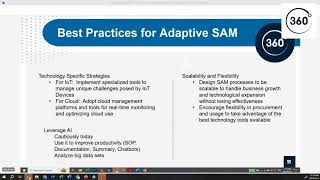
Okay. Good morning or afternoon, everyone, depending on whereabouts you are in the world today. We'll get started here probably and just give a couple minutes. I know got some other people that I know of. Redshirt. We're just going to give it about two minutes, then we'll, we'll kick off things here. Sam. Okay. Hello and welcome to Metrics Data 360's webinar today on emerging technologies and their impact on software asset management. I'm Mike Austin, the CEO and founder of Metrics Data360. I am a expert in the software asset management space. You know, everything from license optimization to compliance and audit to processes and tooling and all of those things. So today I've been getting asked a lot lately, you know, sort of what do we, what are my opinions and what am I seeing in terms of some of the trends or newer trends that are going on in market. So, you know, what is the impact of AI? What do I think that's going to be on the software asset management space? Internet of things, what's going on there? As more and more organizations are building out and adopting strategies of that, we're going to touch a little bit on the cloud, although not one of the newer things. It's an always adaptive, you know, always changing venture, the cloud and sort of how you manage that and how you do cost optimization there. So we'll talk a little bit about that. We're going to get into, you know, sort of how to adapt your strategies as these new technologies proliferate in the market. And then we're going to have a real world case study, although it's not really a case study. I'm actually going to show you how you can actually utilize AI to help in, you know, software asset management. Some of the, you know, some of the tasks that you may have have there. As always, if this is your first time to one of my webinars, if you do have any questions, please feel free to either ask those in the chat. You can put your question in there if you want to, you know, ask me personally. Please feel free to raise your hand. I'll try and keep an eye on that and answer those questions as we go. Okay, so like I said, I'm getting asked quite a bit about what are my thoughts on start with AI. We'll go to Iot. Then we'll talk about cloud. But I actually just got asked this question or a version of this question by my team this morning, actually. But I think with AI in software asset management, there are a lot of People that are playing with it. There's a lot of practical use cases that will come about. But I think the first thing I always tell people when it comes to AI and when I talk about AI, it could be like the large language models like ChatGPT, Gronk from Axe Bard, I think Google just renamed it Copilot from Microsoft, those sorts of things. And then there's AI in the tooling itself. But I think a lot of people are kind of thinking about the chatgpt pieces of it. They know that it's gonna be built in the tooling. But one of the things that I always warn people is licensing is a very complex topic. I played quite a bit with ChatGPT, probably a few hundred hours now, you know, playing with the various, you know, chatgpt and Copilot and a couple others, trying to understand how to use it to answer licensing questions and things like that. And the thing that I. The reason I say be weary is it misinterprets the rules quite a bit. I mean, I've put in, you know, SQL licensing briefs, for instance, asked it very simple questions, and it's come back and, you know, ignored things like four core minimums and things like that. So I have seen people that are trying to use it. I'd be cautioned when it comes to answering questions about licensing. I think there's better use cases for it today. I think it's just a complex topic that it's going to take a while for the models to be trained to actually do that sort of thing. But I do believe it can be a definite productivity booster. And that's the business case that I'm going to show here a little bit later on in this webinar. I think it can be a time saver around documentation about building out standard operating procedures and things like that. I think it could be a productivity booster when it comes to big data and the analytics. I put big data here. I don't mean in terms of big data, but if you think about the software asset management space and the amount of data that is collected and. Or monitored, I do think that AI has a play on it. I think it has the ability to review data, especially large sets of data, in a way that a human may not be able to. Right. And it might be able to see pattern recognition and things like that, that the human eye can't see. And so I do think that that is definitely an area where there's opportunity. I think that this is the area where the tool vendors, when they say that they're going to start integrating AI into their platforms. This is definitely where I believe that they're going to be playing is looking at that. And I'll talk a little bit more what I think some of those things would look like. Like I said, I think all the tool vendors are going to be saying they're AI driven or building AI into their tools. And it's kind of like the catchphrase right now, if you're not putting AI in your tools, you're going to fall behind. But I caution that a lot of it may be logic and, or algorithms, not so much true AI. If you think of true AI, true AI, you should be able to ask a question and it should be able to answer the question and think of what's next and go to what's next. And I think that is probably a little bit further down the road, particularly in some of these things. But it definitely can assist in that. I think it can really help in root cause analysis. Right. Like, one of the things that it is very good at is if you ask it questions, you know, you can feed it some data and ask it questions about that data and ask it to provide you multiple different suggestions or answers to those questions. Right. So trying to think of an example there, but I'll give a marketing example because it's just the easiest one to sort of demonstrate. If I'm writing a white paper, I can drop in and say, please provide me with a list of 20 titles for my white paper and I can give it the topic and things like that, and I'll come up with 20 different answers very, very quickly. And so I do think it can, that's where it can help. But in root cause analysis, when you feed a data and start asking it questions about that data, you can get multiple answers on different ways to view that data very quickly. Right. Especially if you know how to prompt these things properly. I think predictive analytics is something that it'll definitely play in in the future. I think, you know, if you look at and think about, you know, if you make changes in the environment, what are the costs to do so? From a licensing perspective, I do think that it will be able to play there. I actually think you can use it to forecast changes in cost over time as well, prior to actually implementing them. So I think it can watch and see what has changed, but I think you will be able to feed it as well and say, if we make this change, what is the impact? What is the cost going to be? I do believe that it's probably there Today, if you really know what you're doing, you should be able to do those sorts of things. I think it's going to be able to suggest changes to end users technology. So it goes back to that big data piece up there. I think it's going to be able to analyze usage patterns and make suggestions on other technologies, other ways for end users to do things. I think that's a little ways down the road, but I do think it'll be able to do that. I think it's going to make integration with other systems possible. Think about integrating SAM tooling with your itsm, with your security, with HR systems, those sorts of things. And I do think that you will eventually be able to use it as a chatbot type feature, to use it to answer licensing questions on things like the help desk. Right now, I know the first thing I said is it's complex and hard. I think the use cases there today are probably a little bit easier. Like things like having a chatbot that's like, hey, I need a Project 2019 license, are there any available? And they could go out and look in the inventory if your software asset management system set up and come back and give an answer to that. Right? Answer questions like, I need to procure an Adobe Acrobat. What is our agreement? What is the best way to do it? Like, I think those are the sorts of things that you'll be able to do with, with chatbot type technology here in the near future. Right. And so if you look at that from a use case perspective for AI, I kind of break it down into sort of these five different categories, right? You got content generation. So like I said, think about things like procedure and policy development. I don't know that AI today could actually create your policy from start to finish, but if you, if you fed it the right information, it definitely can help draft it and it can do that in a much faster way than you can write it yourself. Again, I'll go back to like, well, actually I'm going to save this because this is sort of what we're going to do in this content generation section when I get into the, when I get into sort of the real world use case here. But you know, use case development is the example that we're going to use. You know, trying to understand if we do this, what's the impact? If we do that, what's the impact? Can you help build a business case, those sorts of things. And then I think you can use it to create knowledge bases and things like that. I think a good Example of where AI has a good use case is, you know, we don't hear as much about the sort of brain drain. You know, you take all the legacy and you like all the legacy employees that you have that have knowledge how systems and things work in their head. And, you know, every anytime you need to know about product, actually just go over and talk to so and so because they're the expert, they know everything, but it's in their head, it's not in paper. I think that this is a way to start creating knowledge bases to pull that information out of their heads. I know, for instance, you know, there's a lot of talk about, you know, say Cobalt developers that are still needed in the marketplace. There are none of the, you know, potentially using AI as Cobalt developers. Definitely some, you know, you want to make sure there's some concern, you know, things done there. But good example of where AI would play there is you take Cobalt code and put it into AI and have AI tell you what that code's doing and then have it rewrite that code in something newer. So look at the business functionality and then rewrite that business functionality in newer code. That's it. That's an example of content generation, in my opinion. We talked a little bit about data mining and integration. If you think about understanding deployments, doing the data analysis, I think that normalization of software titles and things like that is something that AI can do. I think from a security perspective, there's definitely plays there. I know if you look at security and AI and security products, you think about the amount of log data that you get. You could probably have AI monitor that better than a human to identify abnormalities and whether they're an actual problem or not, and then flag those to go to a human versus trying to get through all that log data yourself. I also think that inside of data it'll give you a lot of opportunity to look at your data and run risk analysis and things like that. Do we have this code because there's a security vulnerability or whatever? What's the best way to mitigate it? Where is it? How does it interact with other systems and things like that again, down the road. But I do think that that's the type of thing that it can do. I think change management is something where you're going to be able to use it. Probably not data mining integration, but that's kind of where I dropped it here. But think about the impact. We have a client right now that is looking at moving M365E5 license users to the Microsoft 365 F5SKU because they're, you know, shared workstation users and things like that. Well, there's a change management process that goes there. So how could you use AI to understand, you know, their work patterns? So we talked about looking at work patterns and things like that, but also, you know, developing the documentation and things like that that's needed for those users that are going to have a little bit different experience with Office as an example there in the future. So you could create your training content around change management, things like that. I think you could look for problem detection, right? So have IT monitoring systems, you know, are my connectors all, you know, connecting properly. If they're not troubleshoot root cause analysis on why, you know, certain things aren't reporting things like that. Obviously alerting talked a little bit about that on the security side. So how do we look at data and start, you know, having AI do some predictive analytics around it and doing some alerting. A simple example there. I know alerting is not a new concept, but a simple example there would be if A happens then B happens alert us. Example as I don't know, I got an Exchange kiosk user, their mailbox hits a certain size and or they use SharePoint for the first time and do something upgrade their license to this Again, I think that those sorts of opportunities are going to come. There's obviously, like I talked about the use patterns. I think that that is a big use case scenario. I think when people look at, you know, we have a lot of conversations with clients that are like, hey, I own, you know, Microsoft 365 for instance. It's got a lot of products in there. What else is out in my environment that, you know, I can get rid of? So you can start to look at the use patterns inside of M365, look at the other products, identify those. Maybe look at where people are using other products that other users in the organizations are using products from this so that you can determine that we thought that only this product could do it, but this product, we have use cases in it that are very similar. You can move those over. I do believe that those things are going to happen. I think automating feeds and understanding data feeds between systems and having the system determine what data needs to be moved, where and when and how. Again, not right away, but I do think that that's an opportunity. An example there would be in a SAM play is I need to have HR information to supplement my usage information so that I can get, I don't know payroll, job codes, whatever it is and you can automate, go and get that data, applying it, figuring out how to do that. It seems like it's something that is easy to do today. But if anybody's been in a project where they do that, there's always challenges. I think AI can make that more efficient. I talked a little bit about Chatbot, but like I said, I think that there's an opportunity for help Desk and procurement and licensing type Q and A there. If I do this, is it compliant with our contract? When does our contract expire? How many licenses do we have? Those are some simple things, but I do think eventually it will be able to answer the here's a deployment scenario. Tell me how many SQL Server licenses I have in a complex thing, but I think that that is quite a bit away. Knowledge base is a huge opportunity. I think creating standard operating procedures. So if you think about all the operating procedures that you need in software asset management, how do you onboard a user, off board a user, how do you procure software, how do you determine what profile user gets what all of those sorts of things. What is our policy around vendor audits? How do we address what's our vendor audit policy? You can create all of those things. I think you can develop frequently asked questions, not just related to software, but go back to that brain drain that I was talking about. Getting some of that knowledge out of the heads of your employees and into some sort of centralized knowledge base. I think that you'll be able to put repositories of contracts in there and be able to query against the contracts and ask the questions like hey, do we have a clause that speaks to disaster recovery in our Oracle contract for this product? What is that clause? Please pull. You know, please, please provide that with to me, right? And then, you know, I do think you can do like white paper summary and things like that. White paper business case probably is a better, better way to put it. And again I'm going to show that. So I'm not going to talk a little bit about that and then I think it will. This is where, this is where I really meet the road is when it starts to give advice, right? So I've analyzed user A, they can do B, it'll save, save X, go and do this remediation or optimization of their licensing. You know, we recognize that this happened. It's a compliance issue. You're going to have, you know, a risk there, go and mitigate that in whatever way. I do think that the security play is definitely there and I do think that you can use ChatGPT today for negotiation tactics. It's actually not bad if you know how to actually go and ask it. Quite the right questions on how do I negotiate, what should I position, how do I state this to them, how do I do it more aggressively, how do I do it less aggressively, how do I draft this letter back to the vendor to respond to whatever they sent? It's very good at that stuff, actually. I think that's an area that is probably underutilized by a lot of people in SAM and cost optimization space. I'm going to move, move from AI over to IoT. I know they're kind of disjointed topics, but the one thing that I want to say is like AI, AI is a supplement. I see it as supplementing SAM and increasing productivity. IoT is more like. This is more like a traditional asset management problem. There's all these Internet of things devices out there and I got to go and manage them, right? And the IOT world. So you think about, like IOT is, you know, think about anything physical devices that use sensors and software to connect and exchange data. And so like this could be, we've got a manufacturing line that, you know, devices going down and we're recording the torque and how much torque we put on the bolt and, you know, whatever it is, there's all kinds of these, these devices, like even in our homes nowadays. Think about our smart TVs, our smart fridges, our smart stoves. Anything that's connected to the network or Internet that provides Data is an IoT thing. In the business world, this is becoming. There's a lot of these. You think about hospitals and all the connected devices that they have now that maybe weren't as connected in the past and how they're just automatically monitoring things and the data that you're connecting, it increases the complexity of managing assets. There is going to become a time, I do know of some organizations that are already starting down this path where the asset management teams, whether that's hardware or the software, like HAM or sam, you know, just put it into that ITAM category, is going to be asked to manage these things. And it is complex, right. It can be a potential license challenge in the software asset management thing because the licensing rules are very different. It could be like API calls. It could be based on data usage. It could be, you know, open source software that you need to be monitoring in the environment because it may have risk for whatever, right? Whatever reasons. So it can definitely be a license challenge. And from A licensing perspective, many of these devices, if not like most of them, have embedded license and embedded licensing agreements. So it's not like, you know, going out and procuring Oracle or IBM or Microsoft software. These things come with the embedded licensing and the rules are embedded in there. And so that is unique and they differ significantly from traditional licensing. And the challenge is going to be how do you track this stuff? Right? So I would not say that this is an area in the SAM space that a lot of organizations are doing today. Some organizations are starting to think about it, but I do see it becoming eventually down the road an issue, right? Like I believe at some point in time that software vendors will start to charge, like the Microsoft's, the Oracles, the IBM's of the world, the SAPS, the Salesforces, they already have some models that are charging for the usage of these devices against their systems. But I do think that we will get to a place at some point in time where microtransactions are the licensing. And so what I mean by that is if you sort of think about the app, iPhone apps and the microtransactions that happen. So, you know, you play Candy Crush or you know, I'm an Xbox, my kids are big into Call of Duty or whatever, you're buying stuff inside the game, the microtransactions inside of the game. I think that microtransactions are going to be a big license revenue generating thing for software companies in the future. So you know, you might, like I said, you might have to pay per the API call, per the amount of data that you're sending over, per the number of device, you know, the number of scans that you make on a scanner, whatever that microtransaction is. I think that that eventually will be the licensing model and it will be very, very lucrative for the software companies. And so if you start thinking about that, how the heck are you going to track that stuff? How are you going to optimize it? How are you going to ensure that you're not wasting money in these things? It might be like, you know, 0.0001 cent, you know, 1,1 millionth of a cent for every transaction. But you know, if you've got hundreds of millions of transactions an hour or a day on some of these sorts of devices, it adds up very quickly, right? So to manage, you know, to manage Iot like you, you're going to have to have an automated tool discovery. There are some, there are some tool vendors out there that are starting to think about this and and push these things out into the market. But you know, it's going to have to, it's going to be the same sort of thing. You're going to have software that's on these devices, you have to catalog it. You're gonna have to be able to track its usage per whatever the required microtransaction, if you want to call it that is. Right. You're going to want to be able to integrate that into your traditional SAM or ITAM practices. Right. So how do I put that into ServiceNow? How do I put that into Snow Software or Flexera? How do I build dashboards around it? How do I incorporate those into our current dashboards? All of those problems are still going to be out there and those are the sort of strategies that you're going to have to think about. And compliance is going be something that you're going to have to watch. Right? Because once you identify these devices and understand as these new things start rolling out, understand the metrics and things like that, you're going to want to conduct frequent audits to ensure that you're compliant and that you're cost optimized. Because this is going to be one of these places. I mean, I believe this to be a very lucrative area for the software companies because they're going to charge fractions of a penny per transaction and people are going to be like, it's only a fract of a penny, but then it's going to be cost hundreds and hundreds of millions of transactions and it adds up fast. Right. So I think that is definitely an area that needs to be, needs to be thought about. And really, really, what's the word I'm looking for really, you know, needs to be something that you're going to have to put a lot of thought into. It's going to be a big challenge. Like I said, it's not something a lot of organizations are thinking about today. There are a few that are starting to think about it. You know, I know of a couple of companies that have a lot of devices connected to the Internet. You know, a good example, there would be something like smart meters, you know, utility meters and things like that. That would be a good example. Right. So definitely need to be starting to think through that. So now I'm going to dive into a little bit around navigating cloud because this is still something that I get asked all the time, like, what are my thoughts on this? Because as much as cloud's been out there for a few years now, I think the SAM aspects of it weren't necessarily thought through all the way. Right. Because the adoption rate of it has been so quick and it is dynamic and it is scalable. Those pose all kinds of challenges for SAM professionals. Like when you can just log into a dashboard and throw up a bunch of VMs that cost tens of thousands of dollars a month or more without much thought, that becomes a big problem in the SAM space. Right. And so the other thing is, a lot of the times what's happening is, especially if you think about migrating workloads and stuff like that, you're taking on premise workloads and migrating those to the cloud, you got applications in there that think about traditional VMs, you got applications in there, but then if you start to do things like containers and stuff like that, you got applications in there. Normal discovery processes are not going to discover your applications inside of containers. Right? So now I got a visibility problem and I got a. I got a compliance risk. But not to mention that what we see happen is a lot of people are like, I got a bunch of servers, I'm just going to move them over to the cloud. And they think about licensing from the perspective of, you know, Windows os, Linux, Red Hat Linux and database stuff and things like that. There are very few that actually look at the applications and all the other software that's in there. And so, you know, the licenses that you own may or may not transfer. Right. We worked with one client where there was something like 20,000 different software titles that they were moving to the cloud and they needed to figure out, are these things compliant to move? And you know, really what, what we found out very quickly was there were buckets. There were buckets where the software publisher was like, yep, you can use them. We don't care where they're used. No problem. Your licensing transfers, byol, no problem. There were a lot, a significant number, and we were shocked as we were going through this project of the number of software publishers that do not allow you to take those licenses over. So you would either have to go and renegotiate or a lot of the cases, these legacy vendors didn't even have models for it. And that was the third bucket, which was, there's no answer. We don't know whether you can or can't. Right. I don't think a lot of organizations are thinking like that. And I do think that at some point in time that will become a audit risk. Now the question really becomes, whose audit risk is it? Is it yours or is it Azure's or AWS's? Because if I'm a software publisher, I'd probably audit Azure before I'd audit individuals. And if I didn't have much success there, I'd go after the individuals because I'd be like, how much of your stuff is out there and are you licensed for it to be in a public cloud? Because it's your, your infrastructure right Now I'm sure Microsoft and them have indemnifications against that and things like that, but I do think that that is a problem and I don't think a lot of organizations are thinking, thinking about that and, or even thinking through it. Right. And this stuff requires a lot of continuous monitoring to avoid and optimize your costs. Right. And so this is not something that you know, we kind of do once and we're going to look at every year on a true up your Azure costs. You know, we monitor organizations, Azure, AWS and Google costs for them on a daily basis. I don't know how many times in a month that my team is like just found another one. Somebody spun up a bunch of things and it increased cost by this and talked to the client. They didn't know somebody, some engineer did something or whatnot. And we shut it off and saved all this money. Not even talking waste, just things that happen in a normal operating operating environment. So you have to monitor that stuff continuously, which is different than traditional. Sam. A lot of the times, Sam, you know, on premise software asset management was like, I have an annual true up. I'm going to look at it once a year on my, my true up time frame. And that's all I got to worry about. This cloud stuff, whether it's you know, AWS, Azure, GCP or whether it's SaaS applications, Salesforce, Microsoft 365 Adobe Cloud. You need to be looking at it monthly again. I just got word from my team that we just helped a client on their office 365. You know, we pulled 660,000amonth out of their cost. This was not, this is not a large organization. They're only spending about 400,000amonth. But we pulled 60,000 of that out based on, you know, waste and things like that that we were able to identify. Now it took them, we identified it a while ago. It took them quite some time to get the process changes and things like that. But they were able to save that money. But you to be watching that every month, right? I have clients that are doing reservations buying new licenses in Office 365 and we look in their environment, we're like, hey, you guys got like 500 users that haven't even logged into the network in 300 days. Like why are, why not just pull those licenses back? Right? So it requires constant monitoring, right? So we talked about, you know, this constant monitoring. You have to work with the cloud providers to understand the terms and the cost models, right? So it's, this is not a pure licensing play, right? It's you know, pay per use, pay for the amount of storage, pay for how, how many minutes we use it, all of that sort of stuff. I talked a little bit about understanding legacy application and licensing rules. Do not just assume that anything that you're moving over there that you can license over there. I think that's a big red flag if you're doing that, that you may end up having problems down the line. You should be looking at what's in those workloads that you're moving, not just can I do Azure hybrid benefit on Windows, what's in there and what are my rights to move those things over? Then you have to embrace and I would say use to your advantage the flexible licensing models in the cloud. So scale up and scale down. Look at meter payday as you go. I can give you an example here where there's significant savings that a lot of organizations don't realize. If you take Power bi, it's got these premium nodes. I can buy those in my enterprise agreement and I pay a per month price on it. Basically that per month price covers my usage for 24,7. I might get a price advantage over buying that on pay as you go because I can buy that in Azure and just pay for the actual time I use it. Well, if that Power BI is only used during business hours, let's say seven in the morning till seven at night, 12 hours a day, I'm paying for full day inside of my EA and most people are buying it over there where they can put it in Azure, do auto scaling and only pay for it for 12 hours a day and basically drop the monthly cost 15%. Right? So the EA has to be priced better than 50% in that scenario for it to make sense. Otherwise go pay more per minute, so to speak, and buy it in Azure and take advantage of that flexible metered pay as you go. So that's just a simple example. I do believe that in the next 24 months there's going to be a meeting of the mind, so to speak, of FinOps and SAM. I think FinOps believe they do Sam and I think Sam believes they do finops and neither do each other. Finops is much more around cost and visibility into cost and Sam is much more around licensing and cost optimization. I think FinOps thinks they do cost optimization. They do some, but not to the level that Sam can. And I think Sam thinks they do finance, but not to the level finance do. But it is a natural place. I'm talking to more and more companies where they now have finops teams. They tend to be the bigger ones, but companies are starting to think about that. I think that FinOps as a service is definitely something that we haven't offered to our clients because I think our smaller clients need that discipline. But I do think these two, two disciplines are coming together. One of the things that I would say more so than ever is that you need regular and frequent training for your teams. It all changes so quickly, right? Like, you know, just the frequency of things changing and how they change and the rules changing. You need to be constantly being up to date, right? Like it's, it's no longer. I'm just going to learn about licensing once every three years when I do a contract. This stuff, you know, you may be even in a contract for three years where they make a change that if you take advantage of it right away, you start to save money right away. Right? And so you have to be on top of it. You have to have good partners that are helping you understand this. You need to be understanding and learning from the vendors and having constant, you know, focus and conversations with them about the changes and things that are doing there. And that I can't emphasize that enough. There's definitely a need for policies around procurement and using retirement of the cloud to prevent sprawl, non compliance and overpayment. We see people retiring stuff, leaving zombie resources. Those of you that don't know zombie resources, it's disk and other things that are associated with the vm. You destroy the VM in Azure or AWS and the storage is still there, you're still paying for it even though it's not used because it wasn't actually destroyed. So you have to have policies around that sort of stuff, right? And so I think that there's definitely a need to relook at your policies that the policies that you had, if you refresh them two years ago, are not going to meet your requirements for what you need to be doing in the cloud. So I talked a little bit about showing you how this works. So basically I'm going to jump into ChatGPT and just show you. You know, one of the things that I said is that you can use ChatGPT to create business cases and things like that and to be much more effective at doing it. And so I have a scenario where it's a power apps usage scenario. I have 2000 users on an application and those users, it's an application that's used only in case of emergency, and there might be five or six of these emergencies in any given year. And so I have a proposal from Microsoft for 2000 user licenses for PowerApps. We do have a couple hundred users that use power apps pretty much every day, very regular users of it. But 1800 of our users only use it these 4 or 5 times when they have to, when they use this emergency app. Right. And so I'm negotiating with Microsoft, trying to figure out how best to do this, because Microsoft has given me a proposal and I'm just going to put this on the other slide screen. Sorry. Microsoft has given me a proposal and I'm trying to figure out what I should buy. And I have to build a business case to take to senior management on, on this. And so I'm not going to type all this out, but I'm going to drop in this prompt here. Okay, so for those of you that haven't used Chat GPT when, when you're asking chat BGBT questions, that is called prompting, by the way. I think prompt engineering is going to become a big thing. That's what I think. If you know, you, if you become proficient at prompting, you'll be able to, to do, to do a lot. Okay, now you'll see in my prompt, I've started as a prompt engineer. Review the following prompt for me. Optimize it, make it better, and ask any questions you have before rewording. And then here's the prompt. And so I just summarize what I just said. This is the use case here. So I'm asking it actually to review what I'm asking it to see if it understands it, if it has any other questions. That's where the AI comes in. So this, I'm using ChatGPT4. This is the paid version. The free version is 3.5. 3.5 couldn't do this or wouldn't do it nearly as well because it's not an AI engine. It's more just an MLM large or, sorry, a large language model. So I'm just going to hit enter here. Now watch how quickly this comes up. Right? It's going to come up and say, hey, I want to specify the role. Here's who you are. Let's talk about the use scenario rates, because I told it I'm a software asset manager and it's like, here's an optimized version of your prompt, right? So you can see mine was just a bunch of words and it was very kind of scattered. It's going to take this prompt and organize it in a very organized fashion. Like something like this makes a lot more sense when you read this. A lot more sense than I had. That I had, right? And so it's coming up and saying, this is who I am. I work for this company. We have the 200 users. There's an enterprise license costs this much. There's a 2,000 regular license costs this much. It's a pay as you go option. It costs this much, right? And so I'm like, this is good. But I forgot to tell it something. I forgot to tell it that under the pay as you go, you don't need to pay. You only pay the monthly charges. Okay, so I'm just going to clarify that. Oh, I forgot to put. Yes, let's see what I cut and paste wrong there. And let's see if it understands that. Actually, I probably confused it with the S. So I'm just going to reach it, replace my prompt. I should clarify that, you know, you do not need to pay if you're not using in a month, right? That's basically what I'm saying to it here. So it's gonna, it says, yep, I get it, I'll revise the prompt, right? So it's going to rewrite the prompt. And then it says, hey, Mike, does this revision make sense? Now? I'm obviously reading this. If I'm doing this. I've run this scenario before, so I'm like, yes, this is great. Please proceed. So now it's going to take that and going to build out our cost analysis here, Right? So not only I've asked it to give us the pros and cons, right? So it's, it's telling US Enterprise option one is going to cost 800,000 a year. Here's the pros, here's the cons, here's the regular users, plus pay as you go, right? So here's what it's coming up with here, right? So it's basically calculating this based on, you know, total cost for three emergencies a year. Because I think that's what I told it in the prompt. And you know, there it goes, right? So now it's giving me our total cost, right? And it's giving me the pros and cons of the Three scenarios that I asked it asked it to run, right? You know, so I'm like, that's great, but how many months would the emergency app need to run to justify buying the 2000 options? Right? I'm not very good at math. I don't want to figure this stuff out myself. So it's, you know, it's going to come and it's going to do this calculation for me, Right? So it's going to recap the scenarios, it's going to tell us how many months here. And you know, there's, there's, There it goes, right? So now it's giving me our total cost, right? And it's giving me the pros and cons of the three scenarios that I asked it asked it to run, right? You know, so I'm like, that's great, but how many months would the emergency app need to run to justify buying the 2000 options? Giving me a lot of detail how it's doing it. Right? But the good thing is now I can actually go through. This is where I said sometimes makes errors. So I can go through and follow this and go, yeah, this actually makes sense. And it, this is the, this would be the calculation. I don't have to figure this out. This, right. I'm not very good at math. I don't want to figure this stuff out myself. So it's, you know, it's going to come and it's going to do this calculation for me. So it's going to recap the scenarios, it's going to tell us how many months here, This calculation is not all that complex, but think of some of the more complex ones, right? So, Okay, so I'm good with this. I think this, this has what I need. I'm like, now I'm going to ask it, are you able to create a summary chart that would go into a PowerPoint for the business case? Let's see what it comes up here with here. So it's going to come up with a header and the columns. Just give that a second. So it's like giving me a lot of detail how it's doing it. Right? But the good thing is now I can actually go through. This is where I said sometimes makes errors. So I can go through and follow this and go, yeah, this actually makes sense. So see, now it's going to create, it is even going to be able to create a visual representation. Again, Chat, the free chat GPT3.5 couldn't do this part. The 4. This is definitely a feature of chat chat GBT4 which is the, the paid. The paid version here. So now it's giving me a nice. See, it's even giving me a nice slide Bob. And it, this is the, this would be the calculation. I don't have to figure this out. This, this calculation is not all that complex. But think of some of the more complex ones. Right? So, Okay, so I'm good with this. I think this, this has what I need. I'm like. Now I'm going to ask it. Are you able to create a summary chart that I could use if I wanted to? Right. So I could actually use that image in my slide if I wanted to. So it's gonna. Now it's asking me, let me know anything else. I'm like gonna remind it that it's a prompt engineer. And I want you to create a, you know, content for three or four slides to go into a business case that needs to be presented to management. So basically now what I'm asking it to do is create my outlines for, you know, my slides, create the content that goes on my slides. So I don't know about you. To do create a business case slide deck like this would probably take me a few hours. I'm not very good at it, to be honest. But you can see how quickly it is creating. This is what I would go into a PowerPoint for the business case. Let's see what it comes up here with here. So it's going to come up with a header and the columns. This is where it becomes a productivity enhancer. Right. So this is very, you know, very quickly giving me, you know, some information. It's probably building out the slides. All right, so is there anything else? You know, I think this is good. I think Chart 1 could. Slide 1 could use a chart. Can you, you know, redo that? Right. So I just get it to redo slide one, put a chart in. Just give that a second. So now it's going to create it. It's even going to be able to create a visual representation. Again, Chat. The free chat GBT 35 couldn't do this. This part, the four. This is definitely a feature of chat chat GBT 4. Okay, so anyways, it's gonna. Then what? The last thing I would ask it to do here is just to re. Summarize all the slides. I'm not going to do that part. I'm gonna. Because what I want to do is get them all into one sort of prompt here. Right. Because what I can do is I can actually copy its answers. But I, I would ask it to Put all, you know, just put all the slides into one, resummarize them all so that I had them nice and organized. I did that and I put it into a word doc because I want to show you how, you know, how else you are, which is the. The paid. The paid version here. So now it's giving me a nice. See, it's even giving me a nice slide that I could use if I wanted to, right? So I could actually use that image in my slide if I wanted to. So it's gonna. Now it's asking me, let me know anything else. I'm like gonna remind it that it's a prompt engineer. And I want you to create a content for three or four slides. Can use AI to really help, Right. So what we just did is we built a business case for this scenario. This is a scenario where clients got to think through this, figure this out. We built the business case and we built the content for a presentation. Now I'm going to go back into PowerPoint here, just pop out. I'm just going to create a new one and I'm going to use Copilot, right? So go into a business case that needs to be presented to management. So basically now what I'm asking it to do is create. So what I'm going to ask Copilot to do. Just one second here, I copied and pasted just so you know, what I'm doing here on my other monitor, I copy and pasted the mystery outlines for, you know, my slides, create the content that goes on my slides. So I don't know about you, to do create a business case slide deck like this would probably take me a few hours, not very slides. The summary of the slides. And in order to use Copilot, it has to be on a OneDrive. So what I'm actually going to do is I copied and pasted the slides into a Word document. I'm going to ask Copilot to create a presentation from that. Right? And so this will take a couple of seconds, but it's going to take this Word document that I had and it's going to take what Chat GPT put together and pull it together into good at it, to be honest. But you can see how quickly it is creating. This is what I mean. This is where it becomes a productivity enhancer, right? So this is very, you know, very quickly giving me, you know, some information. It's building out the slides, Right? So there's a.
More from Mike



Microsoft Add-Ons Hidden Costs Explained | EA Renewal Risk & License Optimization Expertise Sharing

SaaS Sprawl Explained: How Decentralized Software Buying Destroys Negotiation Leverage.

Microsoft EA Renewal Strategy: Mike Austin Explains How the War Room Method Works.





