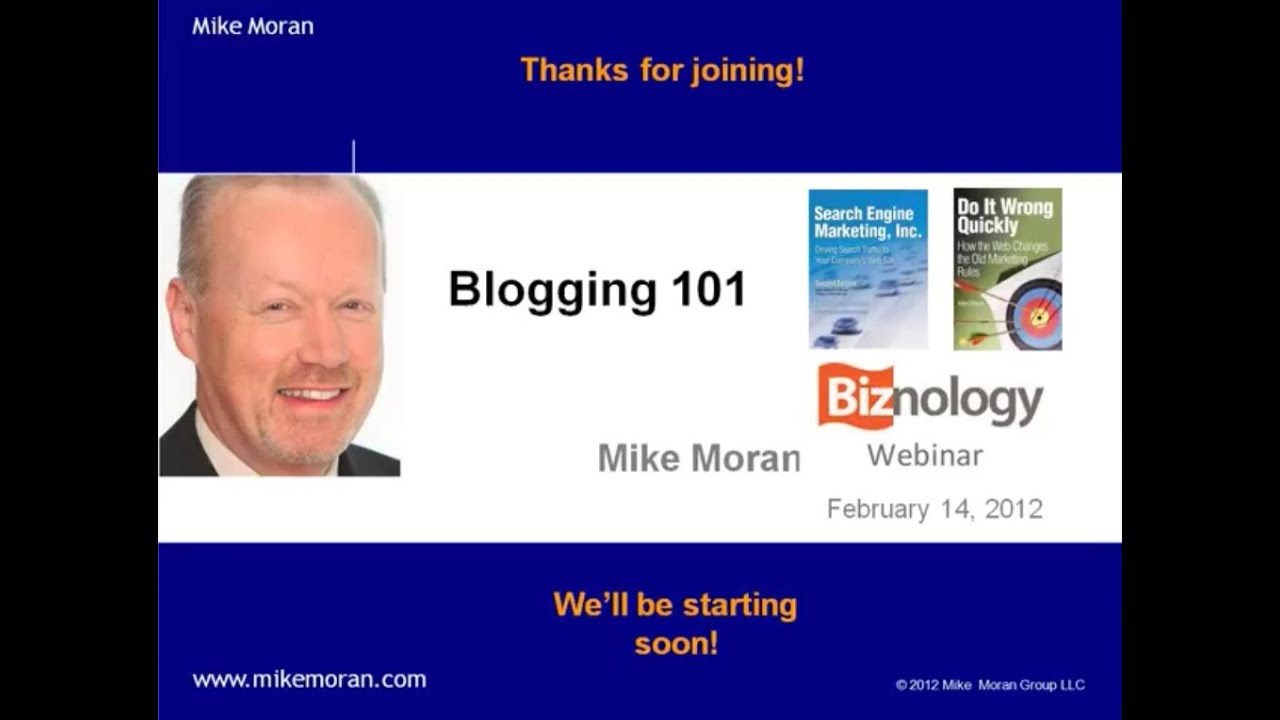
Mike Moran, founder of the Biznology blog, walks through launching and running a corporate blog for marketing. Set measurable goals like subscribers and leads, build an audience before launch by engaging with other experts, and use analytics tools like Google Analytics and FeedBurner to track what works.
Chapters
Hey everybody. Welcome to today's Biznology digital marketing webinar. My name is Frank Reed and I'm one of the bloggers here at Biznology. I'm also the managing editor of the Marketing Pilgrim blog, which is currently number 17 on the Ad Age Power 150. And I also work with companies and individuals by providing education and training services regarding internet and social media marketing. Enough about me though. Today you will be hearing from Mike Moran who is the founder of the Biznology Blog. And today Mike will be presenting Blogging 101. But before we get to Mike's presentation, we would like to recognize our sponsors. We have Abraham Harrison LLC, the true experts in online public relations. We have Brick Marketing which is a full-service SEO solutions company that increases website visitors. Then we have Marketing Pilgrim which you've already heard about, an Internet and social media marketing news blog. We cut through the bull so you don't have to. And SourceMedia, publisher of American Banker, American Banker Magazine, and Bank Technology News, serving the banking and financial services community. So as we wait for more attendees to join because more people are hopping on, let me just review the format of our webinar. Our Biznology webinars, they last about 30 minutes, so you can easily fit them into your busy schedule. We do record each webinar, and we'll email you that link later this week. During Mike's presentation, you can go to your GoToWebinar controls to ask any question that you'd like regarding the topic. That orange arrow opens and closes your webinar controls. If you have a question, simply type it into the box labeled Questions at any time during the event. And press the send button. I'll select a few questions at the end of the webinar and pose them to Mike. So while we're waiting for a few of the last attendees to join us, I'd like to remind you that the Biznology newsletter and blog are available for free at biznology.com. So if you've not already become a subscriber, we hope you'll do that now and sign up. Thanks again for all of you for spending the next 30 minutes with us. We know how valuable your time is, so let's introduce today's speaker. Mike Moran is the founder of the Biznology Blog, a well-known expert in all things digital marketing, and he's the Chief Strategist at Converseon, a leading social consultancy. Mike is also co-author of Search Engine Marketing Inc. and the sole author of Do It Wrong Quickly. Mike is a veteran of IBM, managing groups in IBM.com for 8 years. and then retiring from IBM in 2008 as a distinguished engineer. So if you've ever struggled with starting and maintaining a blog for your company, this is the webinar for you. So Mike, take it away.
Thanks, Frank. So probably most of you know what a blog is. For the few of you that don't, it's a more personal form than a web page. So often there's a single author, but even group blogs usually have kind of a personal voice. So you usually write in first person. Person. You don't have to have it any particular size, but most blog posts are 300 to 1,000 words. And one of the really distinguishing factors is that it accepts reader comments. So you can think of it as almost the editorial page or the op-ed page of the newspaper where there is opinion there, and then there are people who write letters to the editor, and then you can interact with them. So that is probably the best analog offline to what a blog is. But what you want to know is how can you use it for your marketing? What is it that you are going to be able to do to take advantage of the power of blogging to really advance your social media marketing? So the first place to start as you ask that question is to think about how you are going to measure success. What is it that you want to see out of your blog. So you need to have some kind of business purpose. So you could be doing personal blogging. So maybe you are trying to get a job. You could also be doing blogging on behalf of your business, and even a large company where maybe you are trying to improve your reputation for certain public issues. Or maybe you are trying to sell things. You want to be shown to be the expert in an area. And you want to have customers find you and decide to do business with you. No matter what your purpose is though, and you need to have one, you need to be very explicit on what it is. You need to decide how you are going to measure your progress. You need to understand what is it that you want to see. Is it subscribers? Is it people coming and reading your blog, so page views? Are you looking to capture leads out of the blog? What is the metric that you are going to use when you start to think about whether that blog has been a success or not, because that's the only way you are going to know whether the things you are doing are right. So the first area you really have to tackle is to choose a topic. So you need to be an expert on whatever the topic is, at least to the extent that you can then read information that other people are writing, and you can then formulate opinions based on at least what you read. Now you probably want to pick a topic that is at least somewhat popular. It doesn't have to be wildly popular, but you at least want to have enough that people are likely to pay attention when they are in your target market. So if you are trying to reach people, you are trying to get a job, or you are trying to sell things, you have a certain market of people you are trying to reach. So you need to think about who they are, and what kinds of things they are interested in, and how you can show your expertise on a particular topic. And you also have to think about the competition. If you've already got lots of entrenched blogs out there that are very successful that talk on that topic, that could be a sign that there's a lot of interest in it and that you can sustain that. But it can also mean that maybe it's harder for you to break through and you might want to specialize a little bit more so that you have more of a niche audience that will allow you to really succeed within a smaller pond. Now, one of the things that you should start doing that a lot of people might not think of is you should start by listening. If you think about the topic that you're choosing, you want to make sure that you know what other things are already being written about that topic. Who are the existing experts that speak about that? And so it's not just even you as a blogger, but when you are representing a company, especially a larger company, you want to not only listen to what is being discussed about your topic, but you want to know all of the things that are being talked about with your company. Because you might try and start a conversation on a certain topic, but because your company maybe is in hot water reputation-wise on some issue, people might come and comment about things that you aren't actually even writing about. So you need to have some kind of idea of what the lay of the land is so that you know what it is that people might be talking about and might be interested in. So how do you do that listening? So you can use Google Alerts. There are other kinds of free tools out there. There are also, especially for larger companies, there are reputation monitoring tools out there, social media listening tools they are sometimes called. As we said, I'm the Chief Strategist at Converseon, so that's one company that does it. But there are other companies that do a very good job of those things as well. And after you've done your listening, then you want to start to speak. And it might not be the exact time to start your blog at that point. You might find that it's easier for you to start doing other things to try and find your voice. So you might want to start commenting on other blogs, those other experts out there that you found by listening. Maybe start having a conversation with them. Or maybe start tweeting about things where maybe you can show who the posts are that other people have written that you think are good and comment on those, or retweet what some of those other experts say. All of these things will start to allow you to make connections so that by the time you are starting your blog, there might be some people that are interested in knowing what you are talking about, because maybe they started following you on Twitter. Maybe you could even comment on someone else's blog and link to a post that amplifies your point even more. So any of those things might give you somewhat of an audience to get started with. And once you start to find your voice, then you need to have a plan. So you need to know what you are going to say, how frequently you are going to post, where you are going to host that post which we will talk about in a minute, and understand why you are doing this. So come back to your original purpose. And now that you have done some listening, how do you know that this is going to work? Are you still confident that your original idea makes sense? So plan your first few weeks of posts. So if for example you are posting twice a week, pick 8 different ideas that will just kind of get you to the point that you know you've got something going here. And maybe write a couple of those posts in advance so that you are not getting to the day that you think you are going to post and saying, okay, now I have to write something. But on the other hand, you don't want to write all 8 of them for something you are going to post 4 weeks from now because blogs should be somewhat topical. So it is okay for you to have ideas for things you want to write about. And if the day comes where you see something that pops up in the news that you want to write about right away, that's great. Go ahead and do that. But you want to have something in your back pocket in case you don't get inspired. And so think about how you are going to plan, especially in the beginning when maybe you are a little less confident about your writing, and you are a little more concerned about coming up with ideas. You want to really think through what kinds of things you should write about and plan some of it in advance. We talked about how it is important to decide where you want to host your blog. So there are 2 major choices. One of them is your own website. So you can use software from WordPress, for example, or some people use Movable Type. WordPress is by far the leader though. And you can install that WordPress software on your own website. The advantage of that is that you are getting all the attention to your website. So you are getting more links attracted to your site, and that helps you with search marketing. So it might help you from a branding point of view, and all those things are good. It is a little harder to do. You need to have more technical expertise to do something like that. And it also means that you have to draw all the attention to your site. You could host it on a third-party site, a free site like perhaps Blogger. And that's very easy because all you really have to do is sign up, register, and then you've got a blog and you can start to update it. So all you really need to know how to do is write basically. It will give you more search listings because you will be able to have your blog post show up in search as well as your regular website. Whereas if you put it on your website, you are probably only going to get 1 or 2 listings from that one site. But you might have less control. You might have less control over what the domain of the blog is. You might have less control over the way it appears. So there are a lot of things you will have less control over. But either of them are perfectly valid ways to go. So now you are ready to publish your first post. So you are going to tell other people about it. You are going to link to it from every place you can, your website, your newsletter, newsletter. You've already gotten on Twitter. You're going to tweet it. You're going to ping all these other sites with your RSS feed, especially a site called Ping-O-Matic because that pings lots of other places. You're going to start writing guest posts in other places that link back to your blog. You're going to do all of those things and really market the heck out of this, and then you're going to get completely depressed because in the beginning, no matter how hard you work, you're probably going to have a fairly small audience. You probably won't get that many comments. The ones you do get will probably be spam. You probably won't get that many people retweeting you. In the beginning, you will likely get very little reaction. Now there are a few people who have such brilliant things to say that people automatically jump in and start paying attention to them. But for most of us, it can take quite a while. And I've been blogging for years, and the first few years were very difficult. It took a long time try and work up an audience. And now we've got a successful blog, but even at that, I've had to bring in other bloggers to help me. And it's not necessarily so that you're going to jump in there, you're going to write some posts, and then the world will beat a path to your doorstep. I wish that it was that easy, but it kind of isn't. So you have to be ready to be in this for the long haul. You have to be committed to this, and that's the reason why we talked about how important important it is to understand what your strategy is, what your business purpose is, to know how you are going to measure success, because you are going to need to stay committed to this for a while. It can't be something where you think, oh, I want to do a blog. Let me write a few posts. And then when nothing good happens, then you say, okay, that didn't work. I mean, if that's the attitude you are going to go in with, I would say don't bother, because it's very hard to have a blog take off in just a couple of months. Now as you are thinking about how you are going to measure this, there are lots of ways to do that. One of them is FeedBurner. It is a very good resource. It is a Google free metrics facility that can tell you how many people are subscribed to your blog. So that can help you a lot. But the other thing that you need to know is that even though a lot of people might subscribe, there are going to be probably even more people that read your blog because they are following you on Twitter, or because they find you in search. And they just come to your website and look at the blog and read it. And they would never show up as a subscriber. So you need to have Google Analytics installed or some other analytics program installed if you have hosted it on your own website. If you have used Blogger or some other third-party hosting site, you can get statistics from them to tell you exactly how many people are coming to your site and reading each different post. One of the things that some people might tell you is to do a teaser feed. So this is less important than it used to be. It used to be that almost everybody would read your blog from an RSS reader, but fewer people are using RSS readers than before. People are using Twitter as almost a surrogate for an RSS reader these days. And so you don't get as many subscribers. But there are 2 kinds of feeds. One of them is this teaser feed where all you see is the title and maybe a sentence from it, and a full feed where you get all the entire post in the RSS reader. I would argue that the right thing to do is to do full feeds because it is just better for your audience. If you are trying to get people to read it, why make them click on something else in order to see what you are looking for? Other people want you to do teaser feeds because they say that you can't tell how many people are reading you in the feed reader. And so instead of just thinking about guessing at how many people are reading you, by making them click you will know that they actually came to your site and read. I don't think it is worth disrupting the user experience just to get better metrics, but other people disagree. So as I said before, you have to have some kind of commitment to this because you are probably not going to succeed right away. So you need to give your blog at least 6 months. You have to really think about how long it is going to take to work on this. You have to keep interacting with your network, keep commenting on other blogs, keep talking to people on Twitter. All of those things are things you are going to need to focus on because all of those things that you started to do in the beginning to try and get some traction as you get started, You have to continue to follow through on that. The nice thing about having a blog is that it gives you something to say on Twitter. You can always tell people, hey, I wrote a new post. And some people will probably read it. They may comment on the post. They may retweet that you have written a new post. And you can then talk to them about it and see what they thought of it. And you can get some conversation going. And you don't have to have everything spring straight from the blog. But what happens to people is very quickly they start to feel like they're running out of ideas. It doesn't happen to everybody, but for most people, they get a little concerned because they think, well, after I've done the first 10 or 15, I can't think of what else to say. So I'm giving you some tips here of ways that you can continue to have fodder for your blog because as you do this and you are writing, and if it becomes successful and you are writing year after year after year, you are going to constantly have to come up with ways to do this. So one really interesting way to do it is to think about what people ask you. So if you are an expert and you are talking about a certain topic, there are probably other places that you are talking about it. So yes, you can pay attention to blog comments. And so if people ask questions in the comments, You can sometimes answer the question in another comment, but maybe the question needs a full-blown post, and so go ahead and do that. But other people are going to be asking you things in other places. If I'm at a speaking engagement, I pay attention to what the questions are. At the end of this webinar, I'm hoping you're going to ask me a bunch of questions, and we're going to mark some of them down because some of them may be good enough questions that I'd say, you know, I've never blogged about that. Let me answer that question in a blog post. So the other thing that you can do is you can ask for ideas. So if you start to get a substantial number of people following you on Twitter, start to ask them what they are interested in. You are still going to continue to read other experts on the subject. And when you read things, that often can spark your opinion of something where you might disagree with someone, or you might want to amplify something someone else is saying. So what you need to do is to have some system for yourself to keep track I keep track of all the different blog ideas I have. I have dozens of things just sitting there. And so when I have a day that I'm just feeling dry and I can't come up with anything, I go in and look at all those ideas and usually one of them pops out as something I feel like writing about today. The other thing you can do to really help yourself is to make it easier to post. There are lots of tools out there that can let you write offline. So if you're on a plane or you're somewhere where you're disconnected and you can't can't write, or you feel like you can't write, using an offline blog editor, and there are loads of them out there, can help you to write an idea down that will then let you expand it into a full-blown post later. You can also email posts. There is a tool called Posturist that lets you do that. I use a tool called Zemanta which suggests links to you while you are writing. So you can then do research and look for other other people writing about the same subject. And it also lets you put a royalty-free image in your post so that it just looks a little nicer. So as you are going through your experience of blogging and you are starting to look at the fact that some posts seem to attract more viewers than others, you want to take a close look at your writing and ask yourself what can be improved. So can you improve the topics you are choosing? Or can you Can you put more of your own viewpoint into it? Can you make it more conversational so it isn't something that people feel is a little stilted and formal? Do you make sure that you tell the most important stuff up front? With blogs, it's really important to do things up front because often the first paragraph is what gets syndicated around the web when people are pointing to your post. And you want to choose really good titles because that's what's going to cause people to click through on those syndications. The first paragraph in your title might show up in many other places, and what's going to make people click on it is going to be the fact that the title and the first paragraph seems interesting. And definitely link to other people, comment on other people's posts, keep that dialogue going so that people will pay attention to what you write. You also want to look a little bit at your blog's appearance. Now most blogs aren't anything fancy to look at, but you at least want to think about if you have longer posts to make sure that you break up strings of text, that you use images or videos. And if you can, you should probably keep your posts as short as possible because we find that the shorter posts are ones that people tend to read and share more. Now think about how you are going to distribute. Now one of the things that we use is an ability to automatically tweet your posts. We actually use a WordPress plug-in that does this, but you can also use a facility called TwitterFeed so that every time we post we automatically tweet that post so that we don't have to then go to Twitter and do that manually. You can also send your posts out through email. We used to use a program called FeedBlitz which worked really, really well. But we have other ways that we do that now. FeedBurner is another one that people use. Those are both free, but there are also paid ways of doing that as well if you have an email program. And think really hard about search. Search is one of the most critical things that you have to do because you have to make sure that your blogging software is pinging every post to the search engines so it gets indexed quickly. You want to use really good keywords so that people will find you in search. And use them in the title. So use the words that people think of for your topic. And then you want to publicize it with links and other ways in social media like we've talked about already, so that there is a link to those posts. Now if you are doing blogging for a company, you might want to consider team blogging. Sun Microsystems which was later bought by Oracle, they did team blogging. And so you might have to really convince people that this is a good idea. The legal team is a group that often is concerned when you are starting a blog. And so you know that people are going to be reading this that maybe you wish weren't, but this is the price you pay to be able to get publicity. So you need to help people understand what it is that they are allowed to do and not allowed to do. One of the big things that has changed in the last couple of years is that the Federal Trade Commission in the US has said that there are certain rules that must be followed by anyone using social media including bloggers. So you have to report any conflict of interest. So for example, earlier in this presentation when I mentioned a few different social media listening companies, I told you that I serve as Chief Strategist for Converseon. So you know that I have a bias there. Those kinds of things are things you have to do when you are blogging. And how do you do this when you are doing it across a big company? So you coordinate it. By having policies like a social media policy or blogging policy. My colleague at Conversion, Chris Boudreau, has a website that's loaded with social media policies from big companies called socialmediagovernance.com. If you don't have a policy, you can go there and steal one. And what you really need to focus on is evangelizing the need for blogging throughout the organization, training people as to how they are going to do it, and mentoring them. And then putting policies in place that show them what it is that they're allowed to do and not allowed to do. Now, we had a lot to talk about, but I'm sure you've got questions and we're really looking forward to it. So I hope you join us next month when another of our bloggers, Chris Abraham, is doing Google+ for Business. But for right now, I want to throw it back to Frank so that he can ask me some of your questions.
All right, thanks, Mike. I'm sure our attendees have a much stronger idea now how to use blogging to market your their company. And as always with all of our webinars, we didn't get to every question. I've got several good questions from our audience and they're teed up for you. And I'd like to remind our audience that it's not too late to ask your question by typing in the questions box in your GoToWebinar controls. But before we get to that first question, we need to thank our sponsors again. So please, if you have an opportunity, please visit these folks. We have Abraham Harrison LLC. The true experts in online public relations. American Banker, the leading information resource serving the banking and financial services community as well as its sister publications American Banker Magazine and Bank Technology News. Brick Marketing, a full-service SEO solutions company that increases website visitors. And finally, Marketing Pilgrim, the internet and social media marketing news blog. As we said before, we cut through the bull so you don't have to. So now, on to your questions. I've got several questions here, Mike. The first one I'd like you to talk about, I guess people are concerned about being able to write as much as they think they have to. One question we have is about how do you approach guest bloggers? What do you do to— how do you identify people that might be like you did to expand Biznology? What was your process to do that?
We actually don't do guest bloggers at Biznology. We have regular contributors. But a lot of blogs do use guest bloggers. It's a great way to expand the number of voices that people hear from and to make it easier for you to keep up with putting fresh content out there. And I think whether you are going for regular contributors as we do at Biznology or whether you are looking for guest posts, you do the same thing. All of that process that you went through to try and understand who the experts are out there, who's talking about this subject, who are the people that you find interesting, just as you're commenting on their posts and you're retweeting things they say on Twitter, you can ask them. I mean, I have lots of people that— most of the people that are posting for Biznology, in fact almost all of them, I went and invited them. I asked them. I said, I read you. I think you are really good. I would love it if you were interested. And you can do the same thing. So there is no real clever stratagem here. It is just you know who the people are who talk about the things in your area of expertise. And so the ones that you think really have smart things to say, go ask them. You would be surprised sometimes how easily you can get people to say yes, because they are interested in having another platform for the things they have to say.
We have a couple of really good questions. So for everybody, just so you know, we may run a few minutes over just because we have several questions lined up. So I just wanted to give everybody that heads up. This one is about banking blogging in particular, Mike. How would a bank use blogging as a competitive advantage?
I think that anytime you are in a regulated industry, you always have to be especially careful about what you are doing. But there are lots of things you can do in a blog that you don't have to worry about what the regulations are. One of the major things that blogging can really help with is positioning you as an expert. So if you think about the kinds of services that banks offer, be an expert on investing. Be an expert on money management. Be an expert in certain areas. You do not have to give any investment advice. In fact, you are not allowed to. And you certainly shouldn't be talking products on there. So definitely meet with the lawyers, your compliance department, and make sure that you understand all the things you are allowed and not allowed to do on social media. But within that, there are lots of very helpful things that you can be talking about that will attract the audience that might decide to do business with you. So stake out a certain area. I work with a certain bank that happens to be an expert in what they call special needs trusts. One of my children has a disability, and so they have a blog in which they have had all sorts of information about special needs children and what kinds of financial setups you need to do for them. And eventually that caused me to pay attention to them, and I understood who they were. And so those are the kinds of things that that you can start to be an expert on. So pick specialized things that you are especially good at and go after those kinds of things. Maybe you guys have a very good way of helping people who have had credit problems, or maybe you have a certain way that you handle checking accounts that's different from other people. Think about who the people are that would be interested in such a service, and then talk about the things that they would care about, not necessarily related to the product. The consulting that this bank provides on special needs trusts, they weren't writing about those things. They were writing about other kinds of financial issues that people with special needs children might have. That's what caught my eye. They gave me a lot of helpful information. Those are the kinds of things that you should really think through is what are the helpful, informative things that mark you as an expert in an area that will then cause people to then find out more about what you actually sell.
Do you want to take a couple more, Mike?
Sure.
Okay. What do you use to manage your content calendar? Do you use a service? Is it Excel? Do you have an editorial calendar set up? What do you do?
I actually have a very simple editorial calendar. All I'm trying to do is to make sure that all of my guest bloggers are contributing on a regular basis. I have such trust in them that the topics that they choose I know are going to be good topics. And we also have feedback that we give them that shows them which posts really had better uptake than others so that that can help them to do more in the future. But I don't have a formal editorial calendar the way perhaps a magazine would. And maybe for some that makes sense, especially if you are trying to sell advertising, you might want to do something like that. But for a normal blog where you are trying to just sell expertise and get people to notice you and contact you, I think that it is not necessarily needed to have an editorial calendar that is as formal as maybe a periodical might have. Maybe we will take one more, Frank.
Okay, great. There is a good question here that if your purpose is for marketing your company, How do you avoid, and using quotes here, advertising? And if you know of any rules or any— I know there are not many rules per se in blogging, but there are unwritten rules. If you know of any, that would be of help.
Okay, so we talked about the most important written rule is anything you do in social media, you have to identify what your conflicts are. So if you have an affiliation with a company, and you write about that company or you write about that industry, it's really important that you point that out in the post that you are writing. So that's the most important written rule. If you are in a regulated industry, you've got a few more rules to be following. If you are in, for example, financial services or pharmaceuticals, you have to be very careful about how you do things there that other industries don't need to worry about. So work with your compliance department and find out what their advice is. But the unwritten rules, I'd say blogs shouldn't be very salesy. Don't be writing things that are trying to get people to buy now. Those are not posts that people are going to share. You really want to be informative. For some it makes sense to be entertaining, but most people that's not the way they are built and they don't need that. But I'd say being informative and being helpful and providing information, showing off your expertise, I think that's the most important thing to do. To me, that's the way to really make blogs work for you because you will attract a following of people who at some point might decide to use you for whatever products and services you provide.
Okay, well great. Thanks, Mike. That's all the time we do have for today. We want to be respectful of everybody's time. We do this with the Biznology webinars on a monthly basis to make sure you can get back and get back into your busy day. Thanks for those great ideas, and thanks especially to our audience for participation and your questions. That always makes things much better. If you had any questions that Mike didn't have time to answer, you can email your question to Eileen. That's eileen@mikemoranngroup.com, and she'll be sure to get them to Mike for an answer. Later this week, we'll send you all a link for a recording of the webinar. So you can listen again and share with others. And lastly, we invite you to mark your calendars for the next Biznology webinar, which is Google+ for Business, which is scheduled for 11:00 AM Eastern time in the US on March 13th. So thank you everybody for spending time with us today. We hope you got a lot of information about blogging. And we look forward to hearing about your adventures in blogging. Thank you, and have a great Valentine's Day. Take care. Bye.









