How to Use Web Analytics and Search Marketing for Better Decision Making
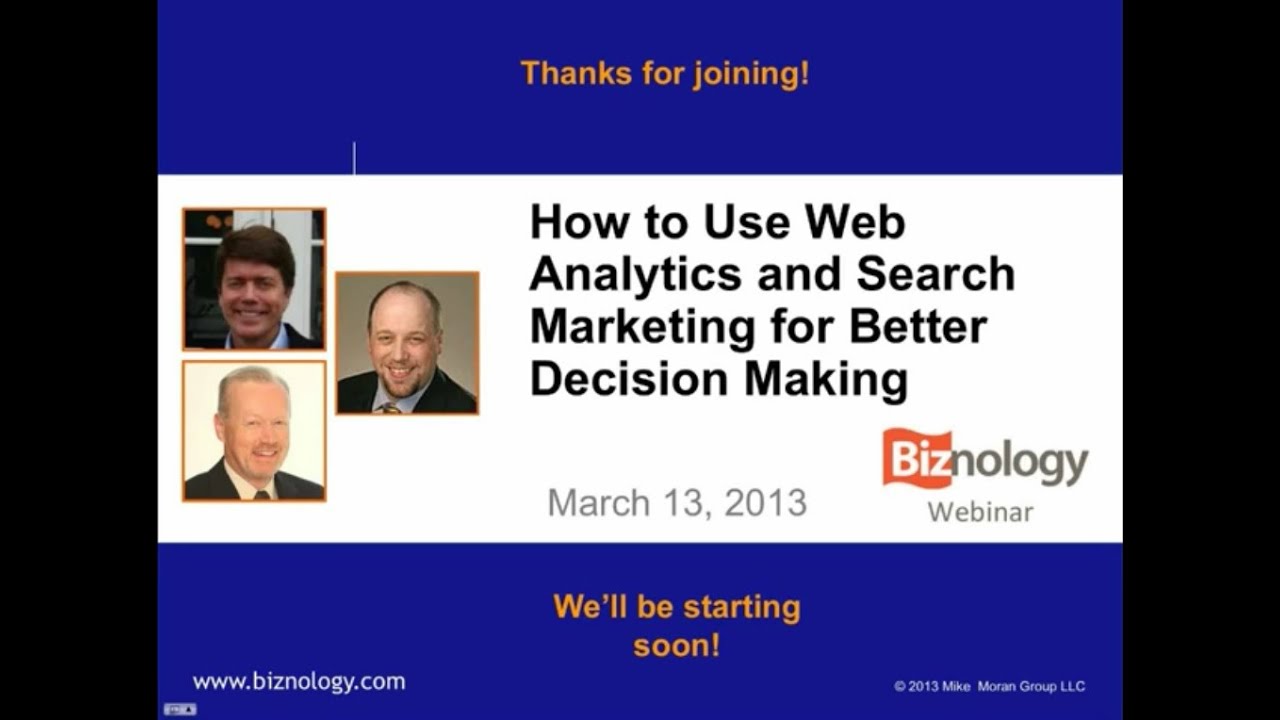
Rob Peterson, Tim Peter, and Mike Moran walk through using web analytics and search marketing to make better business decisions. They cover keyword research, visitor personas at each buying stage, and how social signals affect search rankings. Mike Moran shows how to translate search performance into ROI numbers that executives will fund.
Chapters
Hi, and welcome to today's special Biznology digital marketing webinar, How to Use Web Analytics and Search Marketing for Better Decision Making. I am Melanie Mitchell, the Director of Management Marketing and Business Programs at UC Irvine Extension. UC Irvine Extension develops and delivers high-quality, university-level learning solutions to meet challenging professional and personal needs of local, national, and international communities of learners. I am also— it is also my pleasure to introduce my co-moderator, Peter Methot. Peter Methot is the manager of Rutgers Center of Management Development. Rutgers MCMD has been recognized internationally as one of the top U.S. university-based Executive Education Organizations by the Michigan Business School Report.
Thanks, Melanie. It's great to be here. Today you'll be hearing from 3 expert digital marketing consultants and trainers, Rob Peterson, Tim Peter, and Mike Moran, who will present how to use web analytics and search marketing for better decision-making. This webinar introduces you to important principles you'll need as you improve your own search marketing program. And throughout the webinar, we'll preview for you several training offerings from Biznology, UCI Extension, and Rutgers that feature these same instructors, whether you want training online, in person, or on-site for your company's whole team. As we wait for more attendees to join, let me review the format of our webinar. We will be recording this 1-hour webinar, and we'll email you that link later this week. During our speakers' presentations, you can use your GoToWebinar controls to ask a question. That orange arrow opens and closes your webinar controls. If you have a question, simply type it into the box labeled Questions at any time during the webinar and press the Send button. Melanie and I will select a few questions at the end of each section and pose them to the presenters.
Well, thank you in advance for all those questions, and thank you for spending an hour with us today. We know your time is very valuable, and please let me now introduce our first speaker. Rob Peterson is one of our Biznology bloggers and the president and founder of BarnRaisers, a digital marketing agency. He is also on the MBA faculty for Rutgers University, where he teaches core courses in web analytics, SEO, social media measurement, and ROI. He is also a new instructor for UC Irvine Extension, where he co-teaches a course in social analytics. Rob has also been recognized by the American Marketing Association for building billion-dollar businesses. Rob, take it away.
Thanks, Melody. I'm going to cover in 30 minutes with Tim and Mike, some highlights of the search marketing and web analytics onsite training that we do in a series that we call JumpStart Workshops. And to move to the first slide, the 3 highlights that I'm going to cover are really about content and keywords, how you write for the different people who come to your website, and some case studies of brands who have put insights and strategies that they they've developed in search into actions and produced return on investment results. Before I get to those 3 points though, I just want to cover— let you know one key statistic that's relevant to all that myself and Tim and Mike are going to talk about. And that's that 90% of all the decisions that we make when we buy products begin in one shape or form online. And that's because the internet, and particularly the search engines, have made it so easy for us to just go to a query box and write in whatever it is that we might need and have more solutions than we could possibly ever imagine come in front of us on a screen. And now, if we move to the next slide, we've all heard the phrase content is king. That phrase actually was coined by Bill Gates in 1996. But in the 16 years since Bill Bill mentioned it. Really, that phrase today is content is king if you know what are the right keywords for your business. And to know that, you really need to know what the search engines value. The next slide, please. Because there are really 2 fundamentals in getting effective search engine optimization and search marketing. And that is that the search engines really crawl your site to see how the content on your site matches what the consumer has put into the query box of a search engine. And not only do they want to make sure that there's a good match between the content that the consumer and the business offers, but they want to make sure that the sites that have come to that site also value that site as a place where those particular needs are met. So for a business to be effective with search engine marketing, 2 words are very important: relevance and authority. Next slide, please. That's because of these simple facts. 80% of the traffic that comes to a website is going to begin with somebody typing keywords into a search query box. And when they get to that search engine rank page, Over 40% of us will go to the website that's in the first position. 90% of us will go to a website that's on the first page. I'm sure these statistics, as large as they are, probably reflect your own behavior. Next slide, please. So keywords and getting a good position on the search engines with those keywords are important, not just important for tactical reasons, but important for your strategy as they recognize the needs of your target, how you position your brand, how you draw them in, and how you differentiate yourself from your competition. Next slide. You might think that this leads to an area of what do I write and how do I put those keywords into sentences and paragraphs and on pages? Well, that's one— content is one of the areas that you need to think about where you put keywords. But keywords are also incorporated in a variety of other places. Not only on page content, but whenever you might put a link to another website. Think of a keyword as that text in blue, that anchor text as we call it, that would link that link to the other website. Think of it as even the domain for your business. Or whenever you put an image on your website, you have the opportunity to anchor it, to put a keyword to describe what the image says. Think of it as the the words you can incorporate when you put different URLs for different pages on your website. Keywords can be put in at least half a dozen to a dozen valuable places on a website, all of which draw back to relevance and authority for your brand, for those keywords, and for getting customers to come to you. In thinking about how you select your keywords— and I'll give you in just a slide or two with this next slide on generating the keywords and how you get to them. The idea is to look at, through tools that are available online, the traffic that comes to those keywords, how often those keywords convert to people coming to your site and taking the action that you want them to take, and how often your competition uses those keywords in ways to get to what are the final keywords that I want to use to get my business visible on the web for my customers. Next slide, slide 14, please. One of the major areas when we get to the subject of keywords and what do we choose is the subject of the short and long tail keywords. Most of us will immediately gravitate toward the industry that we work in or the product that we sell, but the fact of the matter is that in most cases, those words are too competitive and there's too much search volume in there, and so the conversion rate for people taking the actions that you want will be too low. So if we were selling real estate, real estate as a keyword would be way too broad and competitive for us to really generate any impact in. But if we were doing it in the state of Washington, we might consider words like Washington real estate or Seattle real estate or a suburb where we are operating. In this way, we might get a little less traffic, But we would be getting a higher rank on the page and we'd be getting a higher rate of people taking the actions we want them to take. 2 tools that are very valuable on this next slide to getting people to select the right keywords are made by Google. The first is called Google Trends. It used to be called Google Insights as well as Trends, but today Google has put it into one tool called Google Trends. And just thinking about one of its— it's very valuable because how it operates is that just like a search engine, you put the words that you want to have investigated and trended into the query box. In fact, you can put more than one word into the query box as long as you separate them with a comma, as we're doing on this slide here. If you look at this slide from Google Trends, this trend line, you can see that it's It's not a bad time to be in the wedding business. It seems like business is up and growing in a positive direction, especially if you're selling wedding dresses. But if you're a wedding planner, it's not growing up— going up as highly. So when you think about the keywords that you use, if you were in the wedding business and you were a wedding planner, you might think about wedding planner and wedding dresses, or you might think about wedding planning with wedding dresses, or words that really get you to be included in the business that you're in, but also drive traffic to other services that more people are seeking. Next slide, please. And one tool that gets to the exact number of words that, that people are searching on a month or a year or however you want to set the timeframe, and also how many how competitive that index is, is the Google AdWords tools. So with just this simple list of a couple tools and an understanding of why keywords are important and what are the ones that might best describe your business, you can get to a fundamental place that's important for effective search, which is how you rank highly with the search engines and getting consumers to put this— to be seeing you in a high position. Now, at some point, you really want to not write for the search engines, but really understand the people who are coming to your website to take the actions that you want and turn them into business. So on the next slide, we're going to talk about how we write for our audience and how we don't really write for the search engines. Next slide, please. Search engines really are dumb mechanisms. They're really robots that kind of crawl your website to try to understand what it's about by looking for patterns in words that might describe how— what the patterns in words that somebody has written into a query box. But they're not the people who buy from you or even who might come back to you or recommend you to somebody else. Next slide, please. What we see is that there are recognizable types of readers, some that all have a specific importance because they are all valuable to you at some point in time as an audience that can build your business. Next slide, please. Who they are and what they do is we find that generally they fall into 3 types of categories. And here is who they are and here is how we talk to them. The first type of segment that we see that comes to a website once they found that, hey, this website might have something that is of interest to me, are the readers that we call the researchers. They want to be educated, but they expect you to be doing the educating for them. So what they're looking for when they come to your website is some type of Cliff Notes or bulleted encapsulation of what your product or service actually offers, because they want to understand what, what it is that they need to know to make a smart decision. The next group of people that comes to a website are what we call the shoppers. Now they're in a little bit more of a consideration mode. They're looking at a couple products, and one of them might be yours. So they're looking for some type of comparison. They're going to want information, but information as it relates to how you are different from somebody else. Or they're interested in reviews or testimonials of your products that will really drive them to the next step of being buyers. When they're ready to take action, and they're most going to be recognizable by really what is the price, what do they have to do to get it, and, and a minimal presentation. They're all important to your business because in many cases a researcher will then become a shopper who will then become a buyer. So when you're writing to your audience and you know the keywords that you want to put in place, you really want to make sure that your website has content that can appeal to these 3 basic groups. But all this is great. What about people who take this information and really turn it into results that generate a return that shows that there's a gain for all the work that they're putting into this. I'm going to give you 2 case studies that show me the money. The first case study on slide 22 is the Dickies brand. Dickies, as you know, sells— or I think you know— sells work clothes. And they sell them through an e-commerce site as one way that they sell them. And they were interested in what they needed to do to drive e-commerce business from the Dickies website. So with as broad a product line as possible, what they tried to do when they were selecting their keywords were to include the Dickies names in as many different types of apparel as they possibly could. Not only Dickies, but Dickies work shoes, Dickies work pants, Dickies shirts, anything that somebody might be looking for. So as a result of this strategy, What they effectively did was anytime anybody typed in Dickies or any word associated with Dickies, they effectively dominated the whole first page where 90% of people make a click. And as a result of this, what they saw from this search strategy was a 63% increase in their website traffic, which resulted in an almost 50% increase in sales. The second case study that I'll give you for a brand that was again able to turn search insights into a strategy to business-generating results was Millennium Hotels. When Millennium looked at the visitors that came to their website, what they saw was that most of the people that came to their website came during specific seasons. So what they tried to do was to make sure that they were most active in search and most active in keywords that that had seasonal promotions attached to them during the key seasons when people were coming to their website. So it was an approach based on seasonality. And as you saw from the Google Trends document, something that would clearly have been identified if anybody was researching words related to a brand over a period of time. And what they saw as a result of this seasonal strategy to search was 250,000 new visitors per month coming to their website, which was generating an almost 90% increase in their search and a 70% increase in their online bookings. So these are 2 examples of how businesses have taken some of the areas of keywords and writing to their audience and tools that I showed you into insights to strategies to revenue-generating results. And before I turn it over to Tim, I'll offer up any questions that Peter or Melanie might want to ask about these 3 areas.
Thanks, Rob. Let's get right to our questions from the audience. I've got several teed up for you. And I'd like to remind the audience that it's not too late to ask your own question by typing into the questions box in your GoToWebinar controls. Before we do, I want to remind you that Rob, Tim, and Mike collaborate on Rutgers Mini MBA course in Search Marketing and Analytics, where anyone can sign up to work on a search marketing plan for a real company, even presenting the plan for feedback from that company's executives in the last class session. It gives you a chance not only to learn search analytics, but to put it to work in a real-world environment. For more information on all the offerings we're talking about in today's webinar, Point your browser to biznology.com/events. Okay, here is the first question for Rob. So Rob, the question is, in terms of keyword research, oftentimes an agency is tasked with going after certain keywords. Any recommendations on how to best work with your agency to go after the right keywords versus just the keywords that they assume are appropriate for you?
Sure, that's a good question. I would suggest that there be a— what I'll call a discovery phase put into the keyword process. And that would be one where, first of all, the keywords that the agency goes out and researches are done according to categories that have been somewhat agreed upon between the business and the agency so that there's a broader perspective that both people— parties have collaborated on that can look at the keywords by category and make some decisions based on what's been discussed between the two as important to the business overall.
Great.
Thank you. One last question, kind of as a corollary to that, is there a certain amount of time that you usually find necessary to test keywords before moving on to either Put them in the good box or the bad box?
Excellent question and something that should be mentioned. Generally speaking, in the area of search marketing, I would say that in the area of organic search, that is the keywords that come up in the center of the search engine pages, I think we all know, it really takes between 4 and 6 months to see some demonstrable progress on how well you're doing. And I know we haven't talked about it, but in the area of paid search, I would say that the range these days and where you're paying on a pay-per-click basis on the right-hand side of the page, that's generally between— that's a bidding process and it's between $1 and $5 is kind of a general overall range, I think, what it costs for a keyword to cost on a pay-per-click basis.
Okay. Thank you very much. That's actually all the time we have for Rob to keep us on schedule. So Melanie, if you could introduce our next speaker, please.
Sure, Peter. Next up is Tim Peter, another one of our Biznology bloggers. Tim has worked since 1995 developing innovative ecommerce. and internet marketing programs across multiple industries. An expert in online marketing and ecommerce strategy, Tim focuses on web analytics, content strategy, and optimizing web channels for ecommerce. He's also a member of Peter's Rutgers Mini MBA faculty. You're up, Tim.
Thanks so much, Melanie. I really appreciate it. What I'm going to spend the next few minutes talking about is how we can tie search and social data together, how we can tie those 2 channels together and how they support one another as your customers conduct their activities online. Now, as Rob pointed out just a moment ago, content is still king. Content is really the key to making social work well to improve your search results. And the reason is because the content, the content that you have on your website will drive people online to either share your content or like your content and really help push that forward from a search results perspective. That will help drive rankings as you go forward. Now, when we talk about this in terms of content marketing, there's really a lifecycle to this. It starts with, first and foremost, making sure you have the right targeted content and landing pages to attract Not just regular consumers, but also those people who will like it and who will share it with their friends. Of course, if you just— it's not just a build it and they will come type scenario. You also have to do social outreach. You want to attract people to the pages that you've created to get them interested in it and tell them about it. When we talk about content marketing, I think there's a strong tendency to emphasize the content part and not always so much the marketing part. But you have to do that outreach to get people to share your content and to like your content. Doing so will help improve your search ranking and help improve your quality score, which actually comes into play when you're doing paid search. This in turn helps you drive increased traffic to your site, which can help you do things like drive greater business results or increase your customer list, which allows you to target customers more effectively and drive them to the targeted content and landing pages that you've created.
Created.
So this then becomes a virtuous cycle where one element feeds back into the next and improves your overall results, both from a search perspective as well as from all your online marketing. Now, of course, the big question is, does social media actually improve your search ranking? Well, according to Google, it sure does. As Google has said, Matt Cutts at Google, we do use tweeted links and retweets as a sign It's also used as a signal in our organic and news rankings. And we also use it to enhance our news by marking how many people shared an article. Bing says the same thing. We look at the social authority of a user. We look at how many people you follow, how many follow you. And this can add a little weight to a listing in a regular search result. Now, of course, social and search work very closely together. Here, I'm looking at a search results— a search engine's results page for restaurants in Las Vegas. And I'm seeing— actual reviews and ratings incorporated right into the results. Now, while I cannot prove this from a data perspective today, if you take a look at it, notice that the rankings of these in the local search results actually reflect the quantity of the reviews they've gotten on Google themselves. So there's a clear influence there among the ratings and reviews that occur within Google's tools and within other tools that drive how you rank in the search results. Of course, if you want real evidence of how far this has gone, notice what Google has done. I'm sure many people on this call are familiar with Google+. Google has created its own social network because it recognizes that the content and the value that's being driven by people online is actually so critical to understanding what's really relevant to their customer and what really provides the correct authority for any given search query, just like Rob talked about before. By providing a social network that allows customers to talk about what they want to talk about, share what they want to share, like what they want to like, and link to what they want to link to, they're actually gathering more data still about what is the most relevant response for any search query and what actually has the most authority for a given customer. And ultimately, that's Google's primary purpose, is to ensure that it's returning the right result. So tying social together with search is going to matter a lot. And of course, tying those together leads to business results. This is actually out of Google Analytics, noticing how search and— organic search and social networks contribute to increased conversions. This is for a specific customer I've worked with. That we see that social networks alone contributed 8% of their conversions. Organic search contributed a third of their conversions. And then there's this piece of overlap right here where the search and social actually contribute together to conversions. Those assisted conversions actually make a huge business difference for this specific client because the two were working together. So where do these links come from? Well, the simple answer is everywhere. Whether it's SEO, whether it's email, whether it's social, whether it's blogs, whether it's Facebook and Facebook likes and Facebook shares, they all play a role in working together to drive traffic to your pages, to get people to like your content and to share your content with their friends, family, fans, and followers. So you need to make sure that your landing pages are shareable. Now, I said before, you don't just want to say, build it and they will come. You actually would— it's a great idea to have a call to action, such as you see in many cases where you've got these social tools right on your landing pages that make it easy for your customers to share with the people they want to share with and actually tell people about your content. Not only will that help drive your improved search ranking, But it also can drive more just direct traffic right out of the gate from the social networks. So putting those 2 together obviously compounds the benefit and increases the value to your business. As we talk about those activities working together, there are really 4 components that drive your ranking. They are the on-site authority and on-site relevance and off-site authority and offsite relevance. And as those all work together, they will drive your search engine rankings page rank up. Obviously, when you talk about onsite, you're talking about the quality of content. You're talking about, did you place the content in the right places, like Rob showed in terms of the H1 tags and in your content appropriately? And when you talk about offsite, we are talking about the social activities that your customers take. Those activities include getting fans and using your brand messages to reach fans in their newsfeed. When they talk about that newsfeed content, it creates deeper engagement. And then when they spread that to their friends and fans and followers and family, it's actually increasing and amplifying the value. Too many brands do the first step and they do the last step, but miss those pieces in between. You almost want to think of it in terms of PR. It's about outreach, plus the benefit that you get while waiting for search lift. So some examples. This Four Seasons Hotel— Four Seasons Hotels is very active in terms of what they do with Twitter and Facebook to engage their fans and followers to actually share their content. And what they really do is talk heavily to the influencers. They make sure that the people that they are engaged with— notice the responses here— they are responding to people who are active on Twitter to get those people to help tell their story for them. Of course, it's not just Twitter. Facebook is another option. Obviously Facebook has both shares and likes. Now the difference between them is very simple. A like, thumbs up, this is something I enjoy. Whereas a share is a customer actually saying, I'm going to promote this content. I'm not just going to say I like this shit, but I'm going to forward this on to all my friends on Facebook. And actually, there is a lot of data that suggests a share is more valuable from a Facebook— from a search engine ranking perspective than a like is. So what you want to do is work, as I said, almost like a PR effort, connect with those who share and like your content. Find the people who are most apt to share your content, most apt to like your content, and increase your outreach to them. It's about building influence with those influencers. Now obviously there's more than just Twitter and Facebook. There are tons of social channels. Twitter and Facebook and Foursquare and Instagram and YouTube and LinkedIn and Pinterest and Google+ and so on and so forth. There are lots and lots and lots, but the key is to develop a strategy that focuses on what works for your business. Now, how can you do that most effectively? Well, it comes down to making sure that you've got the right social media metrics, which include things like raw numbers. How many likes do you get? How many shares do you get? How many followers do you have? How many LinkedIn connections do you get? How are you doing in terms of bloggers? Are people creating videos and talking about you? What ratios are working for you? Is there a large number of comments or a heavy conversations thread? Are you getting downloads? Obviously you can do surveys. And fundamentally, you can talk about sales. You can understand what's happening from a sales perspective to see what's working for your business. As I showed before on that Google Analytics slide, you can actually see how the various social channels are tying back to conversions. And make sure what you're doing works for your business. The best part, of course, is that you can create the conversions that you need. You can set up the goals you need in Google Analytics, so that if you're not an e-commerce site, a conversion could be somebody downloading a white paper. It could be them opting into your email form. It could be sharing your content, and using those to actually drive value back to your business to say, We actually can say what the value of a social customer is to us. And then, of course, see the value in terms of how effective it is at improving your search engine ranking. So to tie this all together, as we said before, this is really about relevance and authority. And you want to make sure that your social activities work together with your search engine activities to improve your overall ranking and your overall business. And with that, I'll open it up for questions.
Thanks, Tim. If you have any questions for Tim, please type them into the question box now. While Peter is collecting the questions, let's remind you that the Biznology team provides their own Biznology JumpStart webinars for corporations who want to apply what they learn directly to their own businesses and have their team create a plan for executive approval right in the workshop. And Tim, Rob, and Mike will be there to guide you and help you persuade the executive to say yes. Remember, for more information on all of the offerings we are talking about in today's webinar, go to biznology.com/events. Peter, do you have any questions for Tim now?
Sure, I've got them right here. Tim, the first question is, towards the end there you spoke quite a bit about influencers. Any tips or tricks to not only finding, but connecting with influencers?
Sure, certainly. This is such an interesting area where you really have to focus on building a relationship. If you think about it, social really is about people. And just as you wouldn't call up somebody in the press and say, hi, I think you get a great audience, so I want you to talk about me. You need to engage with that individual and say, I've checked out what you're talking about. I think what you're doing is really great. How can I help make you more successful at what you do? You know, put the focus on that individual and work to build a relationship with the individual by making them successful. The more you can do that, the more effective you'll be at building that relationship and getting them to talk about you.
Great.
So the next question has to do with content. And the question is, is there any data out there in terms of what content is generally more shared? For instance, video, pictures, text, anything like that?
Sure. First of all, what creates shareable content varies widely. However, there are some rough rules of thumb. Certainly images can work very well. We all know the old expression that an image is worth 1,000 words, or a picture is worth 1,000 words. Obviously an image that makes it very simple for people to share quickly is often a lot easier to get somebody to share than the too long, didn't read article of 2,000 words. Humor can be very effective with of course the fact that you have to be careful to make sure that what one person finds funny another person might find offensive. So you've got to be very careful there. And then the third thing is again useful information that people can promote to their friends and say, hey, this is really cool. This made me more effective, and I think it might help you too. So those are the types of areas to look at. We can also put up a link. I've got a couple of links, as I'm sure we do on the Biznology blog, of some great articles that actually talk about shareable content and what makes for shareable content. And we'll make sure to get that up on the blog so you can see that as well.
Okay, and our last question for you has to do with landing pages. So obviously one of the pieces that you talked about was Getting the right customer to the right place. Do you really recommend unique messages depending on where they are in the buying cycle?
As much as possible, yes. There's an old expression. I've always tried to find a better one, but there's an old expression about maintaining a scent trail. If you think about your customers, they're obviously very goal-focused and very goal-oriented when they're in the shopping and buying process. And to a certain degree, that almost makes them like bloodhounds. So you don't want them to ever have a situation where they lose the scent of what matters to them. So if you are talking about a specific topic, you want to make sure that the landing page they come to continues to talk about that topic. If they are looking for a different product or a different service and you link to that, you have to make sure that you keep the scent trail there as well. As they move through the process, it's certainly possible they could return to the same page repeatedly, but you need to make sure that there is a continuing scent that drives them forward and a call to action that drives them forward to the next step in the process. Otherwise, they'll just be stuck in this endless loop of going back to the same page again and again and again and never actually able to pull out their credit card or pick up the phone and contact you to close the sale.
Okay, it seems like we actually have a follow-up question to that. Any advice on how to do that, how to track them through that process?
That could be a whole other webinar in itself, but I will try to answer that in 1,000 words or less in the interest of time. The answer is yes. Obviously, the way you configure your analytics plays a big role in ensuring that you understand where people are in the purchase cycle and where they are in the funnel. If you notice things like high bounce rates on repeat visits, it's a good indicator that they're not actually finding new information that drives them forward in the purchase cycle. If you find things that say there's a high bounce rate on initial visits, again, it's telling you the same thing, but showing it at a different stage in the process. So you really want to look to those things, as well as items in Google Analytics like purchase— funnel setup and visitors flow that can lead— that can help you understand how customers are moving through your site at various interaction points in the purchase cycle.
Okay, thank you very much. That's all the time we have for questions for Tim, but Melanie, if you could introduce our final speaker, please.
Sure, Peter. Our last speaker is Mike Moran, the founder of Biznology Blog, a well-known expert in all things digital marketing. A chief strategist of Conversion, the leading social media consultancy. Mike is the co-author of Search Engine Marketing Inc., the sole author of Do It Wrong Quickly. Mike is a veteran of IBM, managing groups in IBM.com for 8 years, retiring from IBM in 2008 as a distinguished engineer. He's also faculty of Rutgers University and a UC Irvine Extension instructor. You're on, Mike.
Thanks a lot, Melanie. So after listening to all the inspiring words from Rob and Tim, I know you guys have religion. You're excited about this. You've learned a lot about search and social. You understand how social is important for search. You understand how your content is the key to both. And you're ready to go do something. There's just one little problem. You need the executives to pay attention. So how do you do these things? So all of these things we've talked about, they're all very important. You're obviously here because you think they're important. But the question is, how do you get the people who hold on to the purse strings, the folks who have the resources, the folks that actually decide the priorities, how do you get their attention? Well, I'll give you one guess. What they're looking for is for you to be able to communicate the importance of search, not by saying, well, we need to get the number one ranking, or we need to have more visitors come to our website. What you really need to be able to do is communicate in terms of money. You see, we might get really excited about having people share our content on Twitter or getting more people to come to our website. But the truth is that those are only means to an end. Unless we can understand what it is that our website is for, what we're trying to do with all of these searchers, what's the business value behind it, unless we can answer those questions, we're likely to run into a lot of executive inattention. And so we have to start with the very basics. We have to start with the analytics that really prove what the value is of the marketing that we do. So the first place to start with that is by examining what your conversions are. So what are the things on your website that you are trying to get people to do? Now most people look at this and they say, well, I don't have a shopping cart on my website. And the truth is most people don't. And so you could look at this and say, well, it's only shopping carts that really this can work for, but it's not true. What's really true is that all the things that Amazon and those other clever e-commerce companies know about driving more people to come to their site and driving more of those people to buy You can do the same things on your website, whether you're trying to get people to fill out a contact form, go to the store, call you. When I was at IBM, one of our big ones was to get you to download a white paper.
Why?
Because we knew that a certain percentage of the people that download that white paper were going to spend money on consulting, or on servers, or on other products that we sold. Now, how did we know those things? Well, what we did is we put a phone number on that white paper that was nowhere else. So anyone who called that number must have come from the white paper. So then we could track it through the customer relationship management system. We would then know how many people downloaded the white paper. We knew that from the web analytics system. We knew how many people called us up from the white paper. We also knew how many of them actually bought something. You can put together the same kinds of things for your offline conversions. How many of you have filled out one of these pages on a car company's website? Now, why does the car company go to so much expense to put together this kind of application? Think about how complex this is. They have to make sure that they know every part that works with every other part. They need to make sure they know every choice that's possible for you. They have to be able to price it. They have to be able to send you to the dealer near you. This requires constant upkeep as models change. There's all sorts of work that's involved in this. And why do they do it all? Well, they do it all because when you print this out and walk into the dealer and say, how much for one of these? They're going to mark that down. And what they're figuring out is we know how many people came to our website. We know how many people filled out one of these applications. We know how many people pressed the print button. And now we are going to know how many people walked into the dealer and asked for it. And when they take all the rest of your information down, they are eventually going to know whether they sold you a car. So if you sell offline, you have to think through all the incentives that have to be put in place. So we talked about easy ones like putting in a special phone number. There are some companies that put a different phone number on every webpage.
Why?
Because they want to know what page you were on when you called the call center. You could also print a coupon that people redeem at the store. And your point-of-sale system can say, this was a coupon that came from this particular webpage. And so you can take all sorts of actions in your offline sales to make sure that you are counting things properly, and you are attributing or crediting your web marketing and your search marketing, if search is how people came to the site, in order to know what its value is. Because if you can explain the value in dollars of people coming to your site from search and then buying, whether it's buying online or offline, you're going to get the attention of the executives and you're going to get approvals to do some experimentation, to spend some resources, to really work on search marketing. So what are the kinds of numbers that we use to keep score? Well, We want to know how many people are coming to the site from search, and we want to know how many conversions we get. Now, the web analytics system can tell you both of those answers, and from that you can calculate your conversion rate. Then there's basically 2 things that you can do to improve your business. One of them is to increase your conversion rate. Mostly this doesn't have to do with search. It mostly has to do with you focusing on Making all of your marketing messages, your copy, your pictures, your offers better, basically making your website twice as persuasive. That's good because you'll double your conversions. The other thing you could do is to leave that same crappy website alone but have twice as many people come to the site. This is where search and social come in. If you do all the kinds of things that Rob and Tim talked to you about with search engine marketing and social media marketing, you will then get more people to come to your website and you'll improve your conversions then. Now best obviously is if you can do both. If you can double how many people come to your site and you can double the persuasiveness of your site, you will quadruple your conversions. And so the place to start when you're trying to make this case is to say, well, what kind of traffic do we already get? You can use your web analytics system to show how many search referrals you get. Those are the number of people coming to your site from search engines. And it can tell you not only which search engines they come from, but it can also tell you how many of those came from particular search keywords. And you can use the same tool that Rob showed you earlier, the Google Keyword Tool, and it will tell you how many people were searching And so then from there, you can say, well, that— we get this percentage of the traffic of that keyword through search, and here's how many missed opportunities we have. Now obviously, you'll never get 100% of the people putting in a keyword. But if you see that you have very low penetration for some search keywords, ones that are really good matches for your site, that might be an indication of what your opportunity is for improvement. Then you want to project improvement. Now this isn't an exact science, but what you can look at is how many clicks come for different search rankings for different kinds of searches. So if you have searches that are informational searches rather than searches that are brand searches, you're going to get fewer clicks because the clicks will be more spread out on the page.
But if the—
for your brand, you're not even getting strong click-throughs, then what you need to figure out is how you can move up in the rankings so that you will improve your click-throughs And then you can project a new ranking as you make your improvements in search and a new number of clicks that will come in. And those clicks will then tell you how many more sales you will get. So if you can project that you're going to get many more sales, and you then figure out what your conversion rate is, and you know what your transaction price is, then you can start projecting real revenue. And this is the thing that gets the boss excited. He's going to want more than a revenue projection, because anybody can put together a convincing-looking spreadsheet. You're going to need a plan. And to really make that plan work, you're going to have to work with a lot of other people. There are a lot of cooks in the kitchen. And so you have to get the other people on your team that have to do these things to really step up. You have to show them what the value is of search, just like you're ready to show your executive. But you also need to make sure that they're on board for the things they need to do as long as the executive gives them the resources. But you're going to get a lot of hard questions before you're done. The boss is going to want to know what is this and why should they care about it. Luckily, your ability to show that spreadsheet that shows those projections will cause the boss to care. You're also going to want to know why this helps achieve the corporate goals. So you need to be familiar with what the goals are this year. What are this year's goals? And you should be able to talk to them. And he's going to want to know where you stand against the competitors, where you stand in your search rankings. He's going to want to know what your plan is, what you're proposing to do. He's also going to have some more hard questions. He wants to know the business value, and you should be able to answer that through those revenue projections. Because you did all that work on planning and talking to your colleagues, you should be able to also tell him how much it's going to cost and how long it will take. One of the key questions is, they're not minting any new money. And so in order for the executive to give you to do this, you have to make sure that he understands why this is more important than other things that are being worked on right now. And one thing we didn't talk about, what are the risks? Now if you've put together a good plan, you should have mitigated those risks. It should be that there are fewer risks because you've planned everything out. But you need to be able to explain, look, this might take longer than we think. You heard when Rob and Tim were talking that it's not a slam dunk that you just start up these things and they happen immediately. It takes time. It's the kind of thing that will eventually work, But it takes time for you to do it. So one of the risks is that you are going to spend some money on it for a while without necessarily seeing what the payback is. Now I'm hoping that you understand now not only what the value of search is, and that you've got religion, but you now know how to communicate that to someone in your organization that can give you the go-ahead to take search to the next level. That's all I've got. Peter, do we have any questions? Or is it Melanie? I think Melanie.
Yeah, thanks, Mike. We do have some questions. Go ahead and continue to please type in more questions into the questions box. While Peter is collecting the final questions, I want to remind you that Mike's courses that fit into your schedule, he serves as an extension— I'm sorry, he serves as an instructor over at UC Irvine Extension and teaches our online courses. And if you have a digital marketing need, we have courses that may fit into your schedule. Come check out Mike's classes in search marketing, social audience profiling, and agile marketing. That's a new course. Each one helps build a digital plan for your business that you can execute after you leave the class. And remember, for more information on all the offerings that we are talking about in today's webinar, Go to biznology.com/events. Peter, can you take away and have some questions for Mike now?
Sure do, Melanie. Our first question, Mike, has to do with— you talked about increasing the conversion rate. Any tips or tools to use to begin to refine your on-site conversion?
There are plenty of them. I mean, the ones that I think people like to talk about the most are things like A/B testing and multivariate testing tools. Those are the kinds of tools where you can put together a number of different variations of your content, and then the testing tool will automatically tell you which ones seem to result in higher conversions. Some of these tools can be quite expensive, and in the right situation, those expensive tools really do matter because they might save you a lot of time with your IT team in a large site. But if you've got a small site and you want to do something for free, you can use Google Website Optimizer. It doesn't cost anything except your time, and it gives you a good way to get started if maybe you're not sure that multivariate testing is the right way to go. And so a lot of people focus on that piece of it. There's one piece of it that you really can do that's part of search marketing. One of the things that's often overlooked, and Rob talked about this when he talked about keywords, is that sometimes the reason you have a low conversion rate from search is because you're actually focusing on the wrong keywords. You might be focusing on keywords that are popular. You might even have been able to create content that's high quality enough that Google is bringing people to your site for that content. But maybe you're not attracting the kinds of customers that would buy from you. Maybe you're not really focused on what the differentiator— you're not focused on the audience And what they're looking for. And so you can do a great job in search marketing, but maybe not sell very much if you focused on what the wrong keywords are and you have the wrong content message for your product.
Great. The last question we have for you today, Mike, is you talked about the selling points of getting executive buy-in. Do you find that it's better to push the sell on the benefits of search marketing, or is it better to use the fear of loss? By what you're losing by not being more easily found.
What we know from psychology is that most people are more driven by the fear of loss. And so that's one of the reasons that when I went through the questions from the executives, I put in questions about what the competitors are doing. So most executives who have risen to that level of a company, or even small business owners, are very competitive. They want to win. They're always trying to beat the competition. They're always trying to do better than they did last time. And so some of that can be fear-based. Some of that is they're afraid of losing what they have. They think if they're not moving forward, they're moving backwards. And so, but here's the thing. You work with these people. You probably know whether they are fear-based or whether they are really looking for the upside. And so for any particular executive, You should be able to figure that out, and you should be able to talk to him or her in a way that's going to make them move. I've had some people tell me about executives who are extremely fear-based, and one of their problems is that they're they're afraid to try anything new. And so one of the things you can do in that situation is you can scare them more about staying where they are than about trying the new thing. So if people are fear-based, if people are motivated by fear, then you need to find a way to appeal to that. Now, because understand, folks, if you're marketers, marketing isn't only to your customers. You need to be able to market to your executives. You need to be able to market to your colleagues. If they have objections to going forward with search marketing, you need to be able to overcome them just like you would spend time overcoming them with your market segments and your customers. And so I really challenge you as marketers to take this on. If you're convinced that search marketing is the right thing in your organization, then you need to understand the kinds of things that are going to cause your colleagues to agree with you, that are going to cause your executives to agree with you. And those are the very concepts that we go over in all these courses that we're talking about. It's not just about technology. I mean, search marketing is way more about marketing than about search. And so while the technology is important, It's just as important for you to understand how to make things happen within your organization, big or small. What are the kinds of things that will cause people to go along with the thing that you're looking for? That's just as important as it is to know how to execute it once you get that go-ahead.
Well, thank you very much. Well, that's all we have time for today. Thanks to Rob, Tim, and Mike For these great ideas, and to you, Melanie. Thanks especially to our audience for your participation and your questions. If any of you have had questions that we did not have time to answer, you can email your questions to Eileen, eileen@mikemorangroup.com, and she'll be sure to get answers to you as quickly as possible. Later this week, we'll send you all a link to the recording of this webinar to listen to it again and to share with others if you choose. And if you'd like more information about any of the courses we described today, please check out biznology.com/events. Thanks again for everyone and have a wonderful day.
Thank you.









