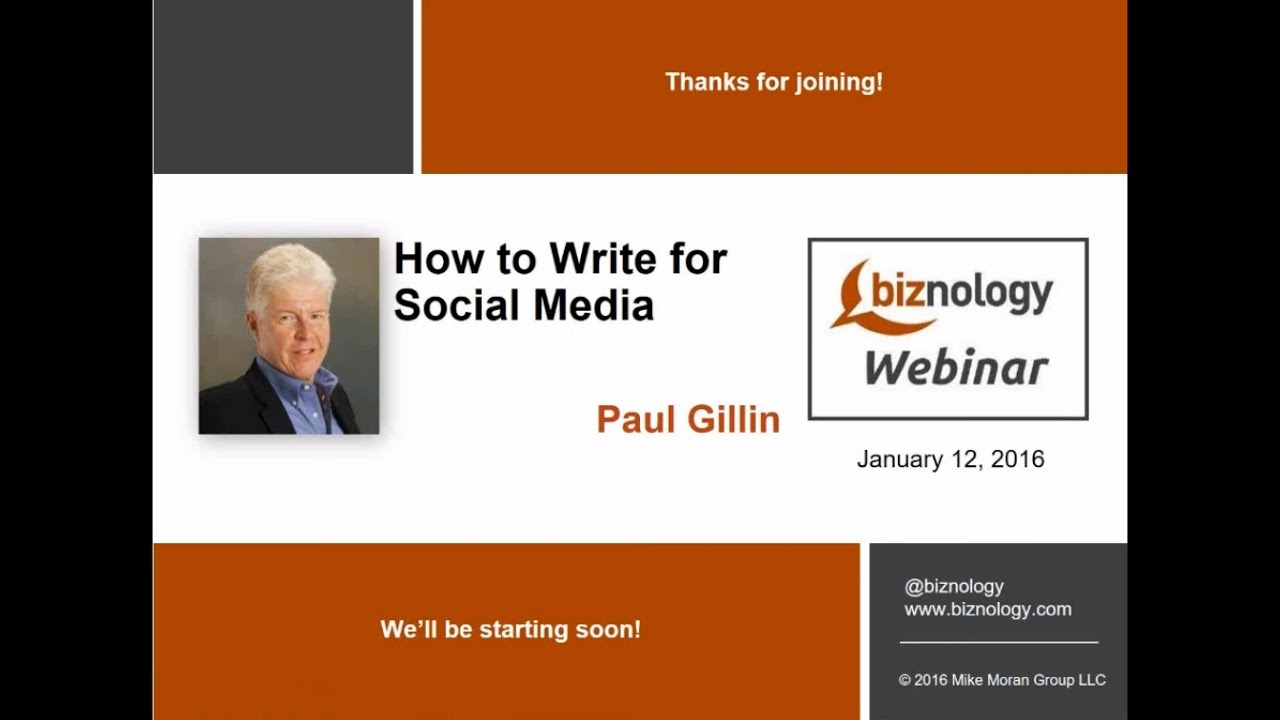
Paul Gillen shows how to write social media posts that actually stop the scroll. He breaks down what works on each platform: Facebook needs fun and images, LinkedIn wants full sentences and questions, Twitter demands brevity. Skip the buzzwords and cross-posting the same thing everywhere.
Questions this video answers
Start with the platform where your customers are most active, master it, then expand. Use tools like HootSuite for quick cross‑posting only after you have a solid foundation on the primary platform.
Avoid using the same scheduling tool for both to prevent misfires. You can have multiple accounts, but keep them minimal; blend personal connection points into your business stream to build relationships.
Blogging is part of the social ecosystem. Focus on unique topics, concise, picture‑rich writing, and avoid boring, wordy posts. Treat blogs as a hub that feeds into your social channels.
Chapters
Hi, and welcome to today's Biznology Digital Marketing webinar. I'm Mike Moran, founder of Biznology and a senior strategist at Converseon, a leading social consultancy. I'm the co-author of Search Engine Marketing Inc., now in its 3rd edition, and sole author of Do It Wrong Quickly: How the Web Changes the Old Marketing Rules. I'm a veteran of IBM, managing groups in IBM.com for 8 years and retiring from IBM in 2008 as a distinguished engineer. Today, you'll be hearing from Paul Gillen, who will present How to Write for Social Media. But before we start, we need to recognize our sponsors. BarnRaisers, a full-service digital and social media solutions company that builds brands using proven relationship principles and ROI. GaggleAmp empowers companies to amplify their social media content by leveraging employees, partners, and resellers. Try GaggleAmp for free today. Geris Digital, a full-service digital strategy firm that reaches deeper into the conversation than any other agency Anywhere. Paul Gillen Communications. Paul's a popular speaker and award-winning author who can define the value and the pitfalls of social media in plain business terms. As we wait for more attendees to join, let me review the format of our webinar. Our Biznology webinars last just 30 minutes. You can easily fit them into your busy schedule. We record each webinar and we'll email you that link later this week. During our speaker's presentation, you can use GoToWebinar to ask a question. The orange arrow opens and closes your controls. If you have a question, simply type it into the box labeled Questions at any time during the event and press the Send button. I will select a few questions at the end of our webinar and pose them to Paul. While we're waiting for our last few attendees to join, I'd like to remind you that the Biznology monthly newsletter and daily articles are available for free at biznology.com. So if you're not already a subscriber, we hope that you'll sign up now. Thanks again to all of you for spending 30 minutes with us. We know how valuable your time is, so let's introduce today's speaker. Paul Gillen is an author and strategic advisor whose books, speeches, and hundreds of published articles have helped demystify social media for audiences across a wide range of industries. He's particularly interested in how social media is bringing new transparency to markets and creating informed buyers. So if you've ever struggled with your social media messages, This is the webinar for you. Paul, take it away.
Thank you very much, Mike. Thanks everyone for giving me a little bit of your time today. I'm trying to compress what is really a full day, or actually a 2-day seminar, into about 20 minutes here. So you'll excuse me if I, if I move quickly through these slides. There's a lot to cover. The task of writing, I think, has become more important than ever, not just because it's the principal means by which we communicate, online these days, certainly in a B2B context, but also because there's just so much information out there and being heard above the noise is so difficult. So having high-quality angles to the work that you do, being unique about the way you approach your topics, writing in clear, energetic language that motivates action and hits people in the gut is more important than ever. I'm sure you've all seen slides like this: within 60 seconds on the web, 600 new videos. All these domains registered and such. There are many slides such as this. But what it really comes down to is there is an explosion of information. We've gone in the last decade through a complete inversion of the information landscape. 10 years ago, we didn't have enough information. That's why we had publications, because they filled that gap. Today we're drowning in information, and the problem is to get through it. At the same time, our audience, according to a Microsoft study that was published last year, the average reader has an attention span that is shorter than that of a goldfish, about 8 seconds. I don't know how you measure a goldfish's time span, attention span, but that's not the point. The point is that you have really a matter of about 3 or 4 seconds to make an impression on someone, if you're lucky. And so choosing a unique angle, a grabby angle, choosing words that have energy and that that spark, grab people's attention, and spark a reaction is more critical now than ever. We're not doing a very good job of this. According to research, and I should point out my specialty is in B2B, according to research published by Forrester last year, they interviewed hundreds of top B2B executives and asked, how much do you agree with the following statements about the content that salespeople provide? You can see, that more than 60% scan it and throw it away. And a large majority agree that they get too much material. And I think the problem is that the material isn't distinctive enough, and it really isn't matched to their needs. And that's where really the rubber meets the road, is understanding your audience, being able to profile your audience, and give them material that is finely tuned to their interests. And that's where we're going to start. In the 4 or 5 areas we'll cover here, One is knowing your audience. And when I say know your audience, I mean not demographically, I mean psychographically. When you ask a lot of marketers to describe the audience they're trying to reach, they'll tell you buying power and title and company size, but people don't make decisions based on buying power. They make decisions based upon much more personal factors, such as a need for prestige, for supporting the organization, for feeling a sense of achievement, for recognition. And in fact, studies have found that in B2B scenarios, these personal factors are actually more important than in B2C scenarios, because people's careers are on the line. So with that in mind, think about your audience psychographically. Now, I'm not going to go through this grid in detail. It's in the download if you want to do that. This is an example of a psychographic profile of an enterprise CIO. This is an audience that many, many marketers certainly want to reach these days. And what I've done here is look at that person based upon my knowledge of CIOs, having spoken to many hundreds of them over the years, of what motivates them, what are their demotivations, their likes and dislikes. And when I talk about psychographics, I'm talking about these kinds of factors that you see in that column on the left. It's not about buying power, it's not about the size of the organization, It's about what motivates them. Recognition, organizational excellence. What demotivates them? Indecisiveness, details, disobedience. They worry about letting down the organization, making bad decisions, things that will hurt their career, things that will disappoint their higher-ups. Their idea of accomplishment is leading a group toward a decision, public recognition, innovation. These are the kinds of factors that I recommend you apply to any audience that you are planning to address, and that will automatically help to fine-tune your content to hit them much more directly in the areas that matter most to them, things that influence their decisions. Secondly, think like a reader. Use words that are relevant to the decisions that readers are making. Readers— your audience doesn't want to buy your product. Your audience wants to solve a problem. So can you frame your message in that context? Your audience wants options to consider. They don't want reasons to buy, because they want you to help them make a decision, not make the decision for them. Look at the chart. If you're using terms like in the column on the left, I encourage you to use alternatively the terms in the column on the right. Why customers choose us. What's in it for you. Not what's in it for us. This will help you to think like a reader, to turn around that equation. And once you're thinking like your audience, you can speak to them much more effectively. Secondly, to borrow a phrase from Apple's famous ad campaign, think different. One thing I hear a lot is that marketers say we run out of topics. Content marketing is challenging because we run out of things to say. Balderdash, I say. Just take a— steal a line from any popular magazine and look at how they can come up with different angles to address the same topic. And if you can really have fun with this, and you can create something really distinctive, and take a topic even if thousands of other outlets are covering it, you can come up with a new way. Now I'm going to give you a list of 20 here, and I'm not going to go through them in detail. You can look at the slides for that. This is just an example of how to tackle a topic, online privacy, an issue that is relevant to many people now. You can do it as a quiz. You can do it as a skeptical approach. You can explain it. You can do a case study. You can take a completely contrarian view. You can do how-tos, how-not-tos, the inverse of how-to. You can do lists, comparisons. You can take an outrageous approach. You can even do it as a haiku. These are 20 different ways you can approach a topic that many, many other people and companies are writing about and do it in a way where the format itself is distinctive. So think about that. Think about that format. Why do you see so many top 10 lists out there? It's because top 10 lists work. But what I don't see is a distinctive approach being taken to even some very obvious examples. Now, we just finished the holiday season, and shortly before, in November, December, we were deluged with predictions articles. They've become very common tactics that marketers use these days to try to raise awareness. I looked at a lot of these articles, and most of them were unremarkable. There was nothing new. There was nothing really daring about them. It was people playing it safe. If you're playing it safe, no one's going to pay attention to you. The marketers could have taken a cue from this slide and tried— how about doing your predictions as a song, or doing them as— or making simply your predictions more outrageous? People are not going to come back and question you about those predictions. They're going to enjoy the fact that you gave them something entertaining to read. Third point I want to cover is making every word count. And this is, this is an issue for which I really blame the American educational system, of which I was a product. I was taught in school that the longer a paper was, the more important it was. So the 10-page term paper was a lot more important than the 3-page paper. And so, and I'm sure that many of you who graduated from the same school systems came out the same way. And what did that teach us? Did it teach us to do more research? Did it teach us to go deeper, to think more? Not really. It taught us to stretch. It taught us to add more words, to take more words to say something. But we've got an audience now that doesn't have time. You have a few seconds to grab their attention. So take a cue from the Wall Street Journal. And if you ever want to read an excellent book on this, The Art and Science of Feature Writing by former journal editor Bill— his name will come to me in a second. It's called The Art and Science of Feature Writing, though you can look it up on Amazon. A fantastic book that tells how the journal works. And one of the things he points out is the journal approaches editing with the idea of How many words can we take out? They spend more of their time taking words out than they do putting them in. And as a result, you get that unique journalistic Wall Street Journal style. It's very tight. It's very condensed, easy to read, very efficient use of your time. So let's start by dumping the gobbledygook. And this is a list of words that are meaningless. You see these words all the time in press releases— successful, exceptional, remarkable, high-performance, scalable. Fast-growing, tremendous. What do all these words have in common? They can't be proven. They're simply embellishments. They're empty embellishments that we add to our work in the belief that it somehow influences our buyer. But buyers don't care about these words. They're tuned to bleep right over them. In fact, this list, by the way, that I assembled was assembled from reading through 4 press releases that arrived in my inbox. 4 simple press releases assembled this list of about 45 words. These are all words that are essentially meaningless. They're a waste of space. Start by dumping the gobbledygook. Get rid of these words that have no meaning, that don't add anything to your narrative, and in fact get in the way of what you're trying to say. Think of writing for the platform as well. This is where we get into sort of the meat of the talk about writing for social networks. This is another thing that I think taking the easy way out does you more harm than good. By easy way, I mean using the cross-posting tools that are available that enable you to write once and publish in many different places, identical messages in many different places. If you're doing that in social networks, you're not paying attention. You're not being— you're not respecting the unique culture of the social networks. And social networks do have unique cultures. So let's look at them. Facebook is a big party. Facebook is personal. It's friends connecting with friends. And it's people chatting and encouraging each other on and trash talking in some cases. But the idea is that Facebook has a certain lightheartedness to it or a certain spunk to it that you don't get in other social networks. If you're using Facebook, you need to be consistent with the personality of the Facebook community, which is edgier than what you see in other social networks. LinkedIn, of course, is about business professionals. LinkedIn is intended to be focused, efficient, and transactional. It's intended to get you an answer. In fact, the average LinkedIn a user spends less than 20 minutes a month on LinkedIn, whereas in Facebook that number is closer to 8 hours last time I checked. Is that a bad thing? Not really. I think it indicates that LinkedIn is doing its job very well. It's getting people to the information they need quickly, and that's what it's all about. It's about getting business done. Twitter has evolved and continues to evolve. From originally a conversational medium, I think Twitter has become much more of a broadcast and a news support medium. So it's a way to support messages that you are delivering through other channels, and it's a way to deliver information quickly to an audience that has chosen to follow you. Now this demands that you approach the way you message on these different platforms differently. Just an example from a speech by Seth Godin, taking a cue, a clip from that speech where he said, meetings are people trying to figure out who will foolishly take responsibility for what happens next. If you're sending that message on Twitter, you want to be sure to include the Twitter user's handle as well as the hashtag that relates to the event at which the quote was heard. You also may have to shorten words in some ways to fit them within Twitter's 140-character limit, which I understand may be expanding 70-fold soon, but for right now it's still 140 characters. Now on LinkedIn, we want to share this quote But we want to invite response because LinkedIn is a more responsive platform. But we want to invite response that is consistent with the LinkedIn culture, which is it's a business problem-solving culture. It's not fun and goofy. It's getting business done. So we'll lead that question— that quote with a question. Can you relate to this? In an effort to spark some discussion and get people talking about the quote. Or we might end after the quote and say, what's the worst meeting experience you can ever have? What frustrates you most about meetings? But it's in a business context that we want to spark a discussion. Twitter, statement. LinkedIn, discussion. Facebook, also a discussion, but the angle we take on a Facebook discussion is going to be a little edgier. It's going to be a little bit more offbeat. So we'll share the quote, meetings are people sitting around trying to figure out who will foolishly take responsibility for what happens next, and we'll follow it with, what's your worst meeting experience or something that's intended to provoke more of an emotional response. 3 different platforms, 3 different approaches to sharing the same message. Facebook, it's all about surprising, provoking, and inquiring. You want to be upbeat. You want to have fun. You want to show people smiling. You want to show stuff that's funny. Funny works so well on Facebook. You want to finish with a question mark on Facebook because it's an excellent responsive platform. The idea is to get people talking with each other. Posts with images, don't forget, get about 80% better engagement. In fact, one of the reasons that you see images on every news site in every story on every news site is so that when those stories are cross-posted to Facebook, the image will automatically appear. Incidentally, if you're in the public relations profession and you're not providing reporters with images to support your clients, you're doing a disservice to your clients. Because those reporters need those images. Make the images provocative or self-explanatory. A little bit outrageous works well. Beauty works well. Infographics work well. Have personality. Be informal. Have your posts signed by the people who are authoring them. Use contests, quizzes, brain teasers, but be relevant to your business. When Intel asks quizzes involving a Rubik's Cube, it's because Intel is a geeky company and they're trying to draw those kinds of people. Look at companies like, if you're in the B2B realm, what Intel does, Cisco, Constant Contact, FedEx, all examples of B2B companies that do an excellent job at using Facebook. Now LinkedIn is efficient. It's about sharing news about your business, industry strategy, managing the workplace. You want it to be practical. You want to propose questions that will spark a response, a professional response, keeping in mind that often when you post a question in a LinkedIn group, the people who respond to those questions can be business leads for you. So if you're asking a question that is relevant to the industry that you're in and you're trying to reach people who share a concern or may have a common problem to solve, remember that those customers who respond may be prospects for you. So keep it— you don't want to be as edgy and goofy as you are on Facebook. You want to keep it more buttoned down. Always offer practical advice. Write clear declarative headlines and prose. One of the things that drives me crazy about LinkedIn is when you see ow.ly links and hashtags and Twitter handles in LinkedIn headlines. This is people using social sharing platforms recklessly without customizing the message to the platform. Simply adding something, posting something on LinkedIn is not going to get you anything. If you post— I would submit that if you post something on LinkedIn that looks like a repurposed tweet, you're actually shooting yourself in the foot. If, on the other hand, you take advantage of the additional space that LinkedIn offers and you write in complete sentences and you compose a question that is relevant to a business audience, you'll get much more value out of LinkedIn than if you're simply tossing tweets over the wall. Offer to connect whenever possible on LinkedIn. It's a great way for LinkedIn to be a lead generation device. And curate discussions. I think this is very important. When you start a discussion, you own it. So come back and check on that discussion, and if people have responded to your discussion, Move the conversation along. Don't just start a discussion, wipe your hands, and walk away. That will reflect badly on you. You own a discussion on LinkedIn, and it's your responsibility to move it along and bring it to a successful conclusion. Let's close up with talking about Twitter, because the culture of Twitter has so many nuances to it. These are a few best practices I recommend when using Twitter. One is to add value. Don't simply mindlessly retweet other other messages. This had value at one point. I think the longer, the more mature Twitter becomes, and as other short messaging media such as Snapchat and Instagram have emerged, simply retweeting other people's messages has less and less value. Try to do something like add a little snippet, a little message at the front of the retweeted message to move the conversation along, to endorse it, to disagree with it, or somehow to add value to that message. Thanking people and recognizing people is very important on Twitter. As raucous as Twitter can be, the fact is it is a very polite culture essentially, because a lot of what people do on Twitter is recognize the good works of other people by mentioning their Twitter handles, recommending their work, recommending a follow. It's all part of the culture of Twitter which is mutual support. How does that pay off to you? Well, when people recommend you or when you recommend another person, that person has a chance to see your recommendation to create a relationship, a touchpoint that can lead to perhaps business for you. Look at the Twitter feeds of even high-ranking executives in the technology field. You'll see a lot of what they do is recognize their business partners and their customers because that's a sign of courtesy. It's an endorsement that creates a stronger relationship. Recognize, tease, but don't deceive. Do not take advantage of the Twitter short-form message to deceive people. Tell them exactly what they are going to get when they click on that link. Because if you deceive someone, if you link bait them and you lead them to a destination that is not what they are expecting, it is not going to reflect well on you. Finally, use labels when you can. If you are sending someone to a video or an infographic or a white paper download, be sure to tell them that. So that they're not going to waste their time. Basically what it comes down to is don't confuse people on Twitter. There's a great deal of information to navigate through. Tell them what they're going to get. Be courteous. Recognize, support other people, and that will come back for you. Here's an example of some good tweets and some practices to consider. One is attribution. When you tweet something that you have received by way of another user, recognize that user. That's considered courteous and it's a way to support them and also may generate a follow in return. Label with labels such as tip or video. Use the author, recognize both the author and the source of the content as a way of thanking them and potentially generating a follow and a relationship in return. This particularly works, by the way, with people whom you really want to speak to, people you really want to meet. Prominent folks— I'm not talking movie stars, I'm talking prominent folks in your industry— when you use their Twitter handle in tweets, there is a chance for them to see that you have recognized them and to create a relationship. Shoutouts occasionally recognize other people and commending their good work. Using hashtags in moderation, no more than 4 per tweet I recommend. Hashtag use easily gets out of control and can obscure the message. Some things you shouldn't do: simply creating messages that have no context, watching article commenters arguing with each other. What's the context for this message? It has no value. Auto-posting was popular in the early days of Twitter. I recommend not using auto-posting anymore. I think it just contributes noise and spam. The fact that you've watched a YouTube video should not be a reason for YouTube to send that out to your Twitter following. Misfires. If you have control over more than one Twitter account, and this example here is a very famous one involving the agency that represented Chrysler several years ago sending out a nasty tweet, a sarcastic tweet under the Chrysler account because the person who was sending the tweet had access to the Chrysler account and mistakenly did that. We have many ways now to share accounts, and you want to be sure that people who are sharing them know exactly what they're doing whenever they send a message. As a rule of thumb, just don't be negative. It doesn't help you. The hashtag spam in the 4th example here. And finally, use a spell checker because the easiest way to look like a dope is to, is to have bad spelling, bad grammar. If English isn't your first language, use a spell checker or a colleague who does speak English well And just be sure that your sentences make sense. That's it for my prepared remarks. I'm going to hand it back to Mike at this point.
Thanks, Paul. I'm sure our attendees have a much stronger idea of how to write for social media, but you didn't answer every question. I've got several good questions from our audience teed up for you, and I'd like to remind our audience that it's not too late to ask your own question by typing it into the questions box in your GoToWebinar controls. Before we get to the questions, I'd like to remind you that the Biznology team provides jumpstart workshops for corporations who want to apply what they learn directly to their own business and have their team create a plan for executive approval right in the workshop. Tim Peter and I teach the content marketing course, and we'll be there to guide you and help you persuade that executive to say yes. Go to biznology.com/training for more information on all our offerings. We're about to start firing questions at Paul, but we need to thank our sponsors once again. BarnRaisers, a full-service digital and social media solutions company that builds brands using proven relationship principles and ROI. GaggleAmp empowers companies to amplify their social media content by leveraging employees, partners, and resellers. Try GaggleAmp for free today. Geris Digital, a full-service digital strategy firm that reaches deeper into the conversation than any other agency anywhere. And Paul Gillen Communications. Paul is a popular speaker and award-winning author who can define the value and the pitfalls of social media in plain business terms. And if you didn't know that by the time you finished listening to this webinar, we have no hope for you. So now let's get on to your questions. Our first question for Paul: You said not to share the same thing everywhere on all different social media platforms. If I don't have the budget to share on all platforms, Should I just use one?
Well, if you don't have the budget or the time, the fact is if you have the right tools in place, browser plugins and such, sharing across multiple platforms is very quick. It's a matter of seconds to flip over and share something on another platform or to recast a message for use on another platform, even if you're sharing through a tool like HootSuite or Spreadfast. My recommendation though is you should always start with the platform that works best for you, which is the one your customers are using. I would rather see you master one platform before moving on than spread yourself too thin across multiple platforms. So in short, the answer I think is yes, choose a platform that is the best one to reach your customers. Get really good at that one before you start to spread your wings.
Thanks, Paul. Next question, any advice for people regarding managing personal accounts and business accounts?
Yes, I recommend that you do not use a tool such as SpreadFast or HootSuite to manage both personal and business accounts. It is too easy to misfire messages under a branded account that are intended for your personal network, and that's never good. I mean, even when it's benign, it doesn't reflect positively on the brand. There are many examples of Twitter gaffes that have involved this. Now, there may be the implicit question is, should I have one account I use for business purposes and one for personal? It's one of the most common questions I hear, and the answer is it really is up to you. There's nothing wrong with having multiple accounts. I recommend trying to use as few Twitter accounts as possible, however, because I think that a well-crafted Twitter account does include elements of personal experience, even if it's within a business context. I call these connection points. In fact, my most recent post on the Biznology blog was about this. We have many ways to connect with people that are not exclusively business-oriented. It may be because we share a passion for a football team or cooking or photography or who knows what. If we blend those elements into our professional Twitter stream, I think we create more opportunities to connect with people at different levels. So I recommend that you don't use separate personal and business accounts unless you really don't feel comfortable Last question, Paul.
I don't know if you consider blogging to be social media, but do you have any tips for how blogging fits into writing for social?
I have a day-long seminar on this, and it's a very involved topic. Absolutely. I mean, the question that I had— the point I had earlier about writing too much, about we write too long— we write too damn long. And that is something— that's the first habit we've got to break. And then we've got to— it involves everything I talked about really. It involves coming up with unique topics, it involves using more powerful language, what I call writing in pictures. And there are so many elements of good blogging. The most common mistake I see in blogging is being boring. It's saying what everybody else is saying. The second most common mistake I see is The writing is just atrocious. It's too wordy. It dances around the topic. It doesn't get to the point. It's not forceful enough. So there is so much that needs to happen to make a blog really sing. And unfortunately, we don't even have close to the time to talk about that right now.
Well, Paul, we really appreciate the answers to the questions as well as the great presentation. Thanks for all these great ideas. And thanks especially to our audience for your participation and your questions. If any of you had questions that we did not have time to answer, you can email your questions to Eileen, E-I-L-E-E-N, at MikeMoran.com, and she'll be sure to get them to Paul for the answer. Later this week, we'll send you all a link to the recording of this webinar to listen to again and to share with others. We also invite you to mark your calendars for our next Biznology webinar, 10 Social Media Metrics Every Marketer Needs to Know, with Rob Peterson. Scheduled for 11 AM US Eastern Time on February 9th. We hope to see everybody back then. Bye everyone! Bye!









