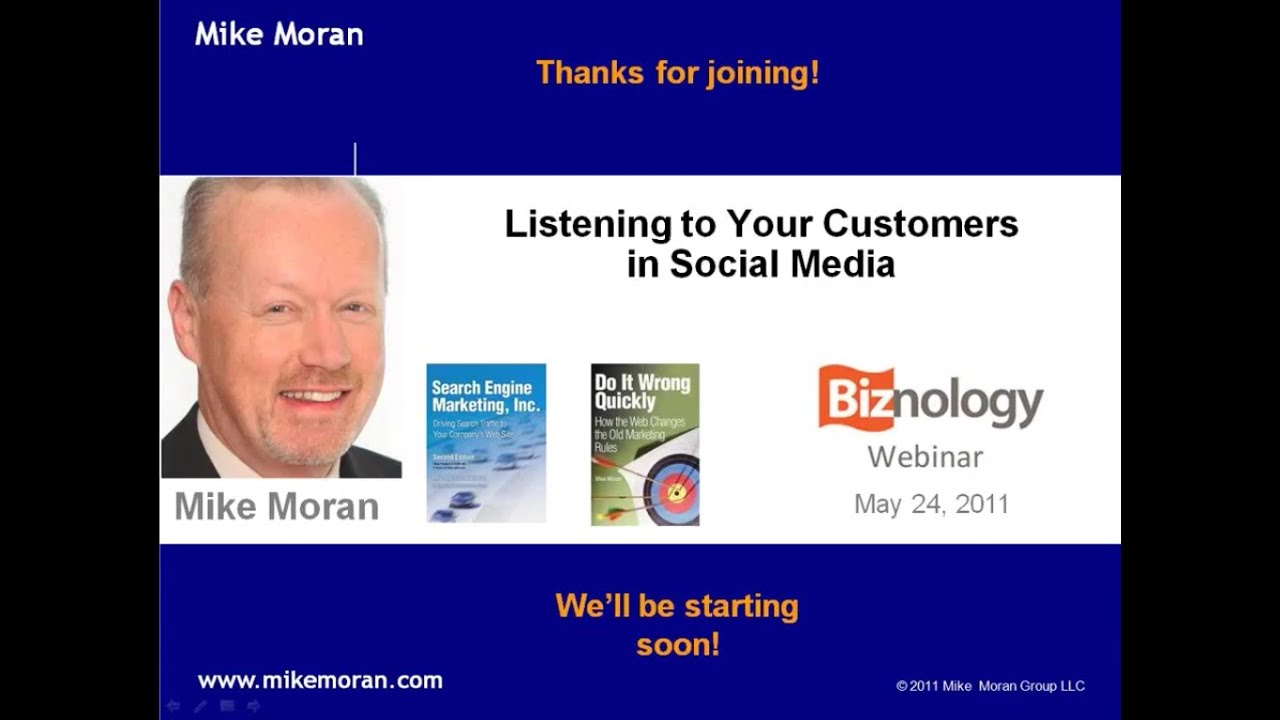
In this 30‑minute Biznology webinar, host Frank Reed introduces Mike Moran, a digital‑marketing veteran and Chief Strategist at Converseon, who explains why and how companies should listen to social media. Moran defines social media broadly (blogs, Twitter, YouTube, forums, reviews, etc.) and distinguishes three data categories – public, private, and semi‑public (reviews). He positions listening as the first step of a larger engagement cycle: listen → plan → engage (reactive and proactive) → measure. Real‑world case studies (Ford, Graco, Dell, Comcast, Starbucks) illustrate how timely listening enabled reputation repair, product recalls, customer‑service improvement, and idea generation. Moran reviews low‑cost tools (Twitter search, TweetDeck, Hootsuite, Google Alerts) and contrasts them with enterprise platforms (Converseon, Nielsen BuzzMetrics, Radian6) that offer Boolean filtering, multi‑source aggregation, and sentiment analysis. He highlights the limits of automated sentiment (sarcasm, context, 70 % accuracy) and recommends human analyst oversight. Visualization techniques (word clouds, topic‑volume ovals, relationship lines) are presented as ways to turn raw data into actionable insight. Practical advice on tool selection (start with free tools, iterate, scale up) and a brief Q&A address how companies should act on the data and the crowded tool market. The session ends with logistics for the recording and a preview of the next webinar.
Questions this video answers
Successful companies start with a clear objective (e.g., fixing a reputation problem or generating sales leads), feed the data to the relevant teams (customer service, sales, product), and act on it—responding to customers, correcting misinformation, or turning conversations into leads.
No, I haven’t. The industry is moving toward comprehensive platforms that aggregate all sources rather than single‑purpose tools like a blog‑only listener.
Chapters
Hi everybody. Welcome to today's Biznology digital marketing webinar. My name is Frank Reed and I'm one of the bloggers here at Biznology. I'm also the managing editor for the Marketing Pilgrim blog, which is currently number 10 on the Ad Age Power 150. I also consult with small and medium businesses the SMB market about effective online marketing through my business which is called Local Basics. Today though, you'll be hearing from Mike Moran. Mike is the managing editor of the Biznology blog. He will present Listening to Your Customers in Social Media. As we wait for more attendees to join, let me just review the format of our webinar. Our Biznology webinars last about 30 minutes. The idea is that you can easily fit them into a busy schedule. We record each webinar and we will email you that link later this week. And during our speaker's presentation, you can go to your webinar controls to ask a question. And the orange arrow opens and closes your webinar controls. If you have a question, you can just type it into the box labeled Questions, makes sense, at any time during the event and press the Send button. I will select a few questions at the end of the webinar for Mike to answer. So while we are waiting for the last few attendees to join, I would like to remind you that the BizKnowledge newsletter and blog are available for free at MikeMoran.com. So if you are not already a subscriber, we hope that you will sign up now. So thanks again for all of you for spending the next 30 minutes with us. We know how valuable your time is, so let's introduce today's speaker. Mike Moran is the managing editor of the Biznology blog and well-known expert in all things digital marketing. He is the co-author of Search Engine Marketing Inc. and the sole author of Do It Wrong Quickly. Mike is a veteran of IBM, managing groups at IBM.com for 8 years and retiring from IBM in 2005 as a distinguished engineer. Mike currently is the Chief Strategist at Converseon, a leading digital marketing agency. So if you've ever struggled with how to listen to your customers through social media, this is the webinar for you. So Mike, take it away.
Thanks a lot, Frank. So one of the things that a lot of companies are asking is, what is being said about us? We know that social media is the world's biggest conversation. And there are all sorts of different things that we mean when we say social media. All the way from blogs to Twitter to videos to all sorts of things, including things that even predate the term social media such as forums and newsgroups and message boards. All those things are now considered social media, but they actually have been around since even before there was a web. So those kinds of things are all places where your Customers and the public and your competitors have things to say. Sometimes they're saying them about you. Sometimes they're saying them about other companies in your industry. And all of those things to one extent or another have impact. They have impact on your company's reputation. They have impact on whether people are more or less likely to buy from you. And for you to be aware of those conversations, and more importantly, to take action based on what you see, to have those conversations help you make better decisions in your business, that's why people listen to social media. That's why people want to know what's being said about them. Another question you can ask is what are they seeing about you. Increasingly, social media is a place in which people are talking about your brand, and those things show up in search results. In fact, now they show up more than ever before. This is actually a Google screenshot from a few years ago, and today you can see even more information that pops up from social media, as Google is doing something called blended search. But this was an example of the kinds of things that might show up in social media. If you look on the second part of that page where the Diet Coke Mentos video, that viral video that was going around a couple years ago, that showed up in the search results. The one under that, Killer Coke, that was an organization in South America that was alleging all sorts of ties between Coca-Cola and some government death squads. And so those kinds of things pop up in social media. It turns out that that was completely untrue, and that whole website was false. But these are the kinds of things that come up, and Coke needed to know about that because it is affecting their reputation. So it is what is being said about them, what is being seen about them. And they needed to take action in order to make sure that this kind of misinformation is not perpetuated about them. So one of the things that is a little bit confusing about social media is that there are really 3 kinds of data. There is public data, so that is data that is absolutely in the clear. Anyone can see it. Anybody is allowed to make use of it. It is public discourse. So that is Twitter. In fact, it is almost all of Twitter. There are a few people on Twitter who do something called protecting their tweets which means making them private so that only certain followers that they have approved can see them. But the vast majority of Twitter data is public. Blogs are always public or almost always. YouTube videos are public. Most message boards are public, although some require IDs and you have to be approved before you can get an ID. There are certain communities like that. Most Facebook on the other hand is private along with LinkedIn. So most of the stuff you do on Facebook can only be seen by your friends, same with LinkedIn and your connections. And as we said, some message boards require approval before you can get an ID to be able to see what is in there. There are some in-between areas. The most important in-between area are reviews. Sometimes reviews are public data, but sometimes they're not, even if they're displayed on a public site. So for example, a lot of the reviews that you see on commerce sites are actually owned by the company that owns that site, and their terms and conditions decide whether listening tools are allowed to see that data or not. So they may not approve that that information can be taken from their site and used for social media listening. So some things are in between and they are a little murky. But for the most part, social media companies can show you all the public data and they can show you private data that you are allowed to access. So how does listening fit into a larger social media strategy? So one of the things that you might look at is that the listening is actually the first step in a bigger engagement strategy. So you might listen to find out what's being said about you. What are people thinking about you? What is your reputation among customers, among the public? And at that point, you might want to do some planning, especially if you're a larger company. You might want to identify how you are going to begin to use this social media data. You may want to figure out how you are going to help your employees and other people associated with your company to take action based on this data. And then you start engagement. So engagement can be two-pronged. It can be that you are responding to something that has come up from listening. Engagement can also be proactive where you are doing a social media campaign or you have a public relations effort that you are doing outbound social media to try and affect what people are saying about you. And the last step is obviously to measure. You need to know what your key performance indicators are. What are the things that you are trying to get out of social media? If you are using it for marketing, you probably want to see your direct marketing people tell you that the sales have gone up. If you are using it for public relations, you might want to see that the sales the sentiment, the tone, the positivity about your company is going up. So whatever it is, you need to know how you are going to measure what you are doing so that you understand that what you are doing is having an impact. So let's look at some examples of companies that have used social media and they've used listening in particular and how it has worked for them. So Ford is one of the leading companies in social media. Scott Monty is someone who is fairly well-known within the social media community. And he's been very engaged. He's out there tweeting all the time. He's constantly paying attention to what's being said about Ford. And one day, he noticed that there was a Ford fan site that went public and actually posted a cease and desist order that Ford had sent to them about— and that became something that went viral across the web, that many people were talking about this, how terrible it is that Ford is shutting down this fan site. They're telling them they can't do what they do. And this is Ford's fans. Why would Ford be so ham-handed to do something like that? So when Scott heard about it, he tweets, well, boy, that doesn't sound good. That doesn't sound like a good story. So he immediately responded, even though he didn't know what was going on, and said, boy, I agree with you guys. This doesn't sound good at all. And then what he did is he went and investigated it quickly. It took him a little while. But he figured out from the legal team that the thing they were sent was not something that told them to stop being a fan site. It was something that said, stop counterfeiting Ford items. So don't be selling hats that have a Ford logo on them when they're not approved by Ford. So that was what was really going on. And then Scott got that story out. And within 24 hours, no one was paying attention to the story anymore. They said, oh, all right. I understand why Ford did that. That site shouldn't have done that. The issue was over. So this is what can happen when you are paying attention. When you are paying attention, then you can take action and you can figure out exactly what you need to do to get the story where it needs to go. Another company that has had a lot of success in social media is Graco, the folks who make baby strollers and other baby products. So they unfortunately went through a recall where For safety reasons, they had a recall of some of their strollers. And so what would normally happen in this situation is that they put out a press release. They might update their website with all the serial numbers. Well, what they also did though was they were on Twitter. And every time someone was tweeting about how they were worried about this recall, they didn't know if their stroller was affected, they would directly interact with that consumer and say, okay, tell us— we'll tell you where your serial number is. Go find that. Type it into Twitter, and we'll tell you if you are affected or not. And if you are affected, we will send you right to the webpage that shows you exactly what you have to do to get your stroller repaired. And afterwards, even though this was a recall of a product that people were really concerned about being safe, Graco got a lot of praise for the way they handled everything on Twitter. They didn't just say, okay, hey, go to this website. Type in your serial number. You go figure out whether you are affected. We have all the information out there. You deal with it. Their customer service people on Twitter figured out exactly what they needed to do, and they jumped in and handled it. Dell started out with a huge problem in social media. When they first started blogging, people erupted with upset over their poor customer service. So they not only went out and fixed their customer service, they were very open about that. But now they put together a whole site in which they ask for ideas from their customers and they build new products based on those ideas that come in. And so that's an example of them being very proactive of even establishing their own community to listen to what's going on. Comcast also had a very rocky start. The first time they started in social media was a defensive move where they weren't on social media at all. And one of their customers posted a video of one of their servicemen who was on hold with Comcast trying to fix a problem in the house. So the serviceman couldn't fix it, and he actually had to call back to the main office to say, here's the problem I'm having. And he was on hold for so long that he actually fell asleep. And they put a video up on YouTube about this, and it was obviously terribly embarrassing for Comcast. But then what Comcast decided to do is they became one of the first companies to be monitoring Twitter for customer service problems. And they were jumping in and answering people, and helping them, and telling them exactly what it is that they could do to help. So Starbucks, just like Dell, they solicit ideas from customers too. So they had a My Starbucks Idea program, and they actually launched 48 ideas in restaurants that were donated to them by 250,000 people. So those are the kinds of things that can happen. So you can set up active things that help you listen. You can also respond to things as they come up. So how do companies do these kinds of things? So what are all those companies doing that lets them take advantage of this? So one very simple thing that any company can do, large or small, is you can use Twitter to just do regular searches. So a couple of— a few times a day, just go on and see what's happening on Twitter. See if they are using your company name. Perhaps you have a hashtag that you know about that talks about a certain issue associated with your company. A hashtag is a word that begins with a pound sign that people tend to use to say what topic things are about. So all those kinds of things can be things that you can monitor yourself. And you can do it a few times a day and see if any interesting results are coming up. You can also go a little further. You can use something called engagement tools, so things like TweetDeck which has now been purchased by Twitter. So you could probably start to see TweetDeck implemented inside Twitter soon. Or you can take an extra one like HootSuite is another one that is that is mostly an engagement tool. It mostly helps you to respond to people, but it does allow some simple keyword searches or hashtags just like Twitter search does. It doesn't look at all of social media. It only finds Twitter data. It might find a few blogs if you've told it about certain blogs to look at, and possibly Facebook. So those kinds of simple tools are things that can be used. They are relatively inexpensive. Some of them are free. And they don't do a very comprehensive job of looking at social media, but it is much better to use something like this than not to be monitoring at all. Google Alerts is another free tool. It is much more comprehensive than some of these engagement tools, but it is also slower. Google Alerts doesn't typically give you things in real time. So if something is happening right away on Twitter, you may not find out about it until hours later. And sometimes people set it up so they only get alerted once a day. So you might be seeing something in an email, for example, that happened yesterday, and only now are you finding out about it. So this is still a good thing for small businesses. Even if you use one of those more real-time tools, you still would want to use Google Alerts because it's much more comprehensive. It looks at blogs and message boards and all sorts of areas of social media that you wouldn't find with those more real-time tools. Now one of the things that's hard about it though, is all these things so far have had to do with using search, and using what's usually thought of as simple keyword search where you put a couple of words in and you're trying to get all the data back. So let's look at an example of how search maybe doesn't always work. So if you think about just in the cellular industry, If you're looking for the word T-Mobile, you're very likely that all those things come back and they're correct. Sprint, maybe not such a great possibility there because with Sprint you're going to see all sorts of races and all sorts of other uses of the word sprint that have nothing to do with the company. Verizon Wireless is also a problem because most people just refer to it as Verizon. But Verizon is actually a separate company that does landline phone service. So that you might not be finding the right company when you look at that. And so the other thing that happens is if all you've got is these algorithms, these search algorithms, you miss all sorts of details. Because some of them won't find the fact that there are several different pieces in this blog post, for example, that each talk about this particular drug and whether there are side effects with it. Some of them are positive. Some of them are negative. And so a lot of times they'll do something called sentiment analysis, where they'll show whether things are positive or negative. But they might just show it for the whole blog post instead of for each individual passage. Because Google Alerts and a lot of these tools treat everything the same. They don't separate positive from neutral from negative. They don't differentiate by where it came from. And a lot of times they don't show the volumes of the competitors. And so even though Google Alerts is comprehensive and it's free, it doesn't actually give you all the information that you can use to take action. So there are some social listening tools that are out there. I work for Converseon, and they make one of the leaders. And you can see from this Forrester Wave chart, Forrester is a consulting group that often provides advice to companies about what are the best tools to use. So Converseon, Nielsen BuzzMetrics, Radian6, these are the 3 leaders, but there are lots of other companies that might be useful for you. They make social media listening tools that combine many sources, so all the sources we talked about, but they also combine Boolean filters. So a Boolean filter means that you can have much more detail about what things actually match. So what are the things that really work for you? How do you get rid of all the stuff that is wrong, and how do you get added to it all the things that you really do need? So we talked before about sentiment analysis. Most of these tools can do sentiment analysis even by particular venues, so where the stuff was found. So you can find that Engadget and Gizmodo might be a lot more positive than Uber Gizmo for this particular phone that was being looked at. And so you can figure out which places are positive and negative, and maybe that will help you reach out to some areas where you know they're going to have a more positive story than somebody else. The other thing that happens though with sentiment analysis is that automated sentiment a lot of times misses sarcasm. So you can tell just from reading this, oh, the iPhone is a beautiful girl, no doubt. You can tell just from listening to that that this is actually negative. But most of the automatic sentiment analysis algorithms are going to tell you that this is positive because they see the word beautiful. It also misses a lot of nuance. If someone says, I waited on line for my entire lunch hour at my Wells Fargo branch today, You know that's negative because you have the context. But most of the computer algorithms can't tell that. There's lots of examples where people say things, but there aren't any real positive or negative words in them. And for that reason, they're not able to— the algorithms aren't able to tell you accurately whether they're positive or negative. The other problem is context. So sometimes the same words can mean different things. We like unpredictable movies, but not unpredictable food quality. Small cell phones are great, small hotel rooms not so good. So even the same words used in different contexts can mean positive or negative. And so what happens is that there's about 70% accuracy of pulling out the right information, and about 70% accuracy to get the sentiment right. So it looks sometimes as though they're hit or miss. It looks like only half of the time are you even getting correct information with the state of the art today. So one thing that you can do, and this is something that Conversio does, is you can have human analysts that correct those algorithms. So they can look at all that data and figure out which ones are right, which ones are wrong, and correct that before it comes to you. And so for a lot of, especially the larger companies, they are interested in using this kind of additional service. So you can definitely get the service without this facility, but some companies like Conversio offer you this kind of service as well. And then you need to think about how visualizations are going to help you. So it's not just about getting the data back and seeing percentages or seeing particular incidents, but you want to know how things are related to each other. You want to see word clouds as we have in the lower right corner, where the larger the word, the more often it's being used in the conversation. You want to be able to see trends in the data. You want to be able to see related topics. So the upper left corner, For example, that shows you that different topics have different volumes of conversation. The larger the oval, the more the conversation about them. And the lines between them show you which ones are related to which other ones. So you might find that the most negative conversation is related to another conversation that maybe isn't so negative. And that might help you understand what people are complaining about and how you can reach them in a different way. So I know we had a lot to say and we went through that very rapidly, but I'm sure we didn't answer all the questions. So Frank, I know that you are actually going to be the one presenting next month where we're looking at local internet marketing with Google, and I'll be your moderator as we turn that about. But for right now, Frank, if you could help me with a few questions that may have come in from the audience, I'd be happy to take the last 5 minutes to answer them.
Sure, no problem, Mike. I appreciate that. Our attendees definitely have a stronger idea how to use social media to listen to their customers, but you're right, we didn't answer all the questions. There's a couple that came up from our audience and we got them ready for you. I'd like to remind everybody that it's not too late to ask your own questions. By typing it into the question box in GoToWebinar controls, you can ask a question. The one that we got here, the first one we have, Mike, is from Lisa. She says, what do companies typically do? You kind of covered it earlier to some degree. What do companies typically do regarding all this data that you are going to be gathering from listening? Is it about strategy, or does there have to be a strategy in place? If you could, I guess, add a little bit to that conversation a little bit.
So the most successful companies know what they want to do with the data that they are finding. They may know, for example, that they have a reputation problem that may be on— like, for example, when we showed Comcast, they got into this because they knew that people had a very negative perception of how they dealt with customer service. And in fact, that's true of most companies in the cable television industry. And so they went into that saying, we need to turn that reputation around. We do not want to be thought of as this awful group of people that are just making life miserable for everybody. We want to figure out how we are going to help our customers in new ways, and how can we change our reputation as being a company that does a better job of customer service than people think of us today. So they went into that with that being their idea. So that drove how they were going to use the data. So they weren't just going to collect up all the information and say, here's how many people were tweeting about us. They were instead going to get that information, get it to the customer service people, and have them individually respond to customers because that's how they were going to turn their reputation around. So it depends on what you are trying to do with the data, how you use it. So other companies might be trying for sales. I mean, there is one client that I've worked with where it is a B2B client. And sometimes people are discussing a problem that their product solves. And so what they do is they sometimes go into those conversations and say, I understand a lot about that problem. I can help you with some questions. If there's anything I can do to help, let me know. And here's the answers to some of the things that you asked about. And by getting into those conversations, at some point some of those things become sales leads because the person that they're helping is so impressed that they're like, well, tell me more about what you can do to solve this problem. And so they are using it to track sales. So it depends on what your purpose is as to how you figure out how to take action.
Great. We still have a couple minutes and I have one other question. This is actually, I think this is about a particular tool asking if you've heard of this particular tool. And I know there are a lot of them out there. This comes from Louise. Have you ever heard of a tool for blog listening called Textarity. I don't know if I said that correctly.
I haven't heard of that one, but you're right. There are a lot of tools out there. Some of them are free. Many of them have at least a nominal charge per month where particular companies then pay to be able to get access to this information. And some of the— More comprehensive ones have multiple features to them so that you only have to buy the features that you really need. So very large companies that need many, many features might buy a comprehensive package, but smaller companies that want some serious social listening but they don't want to pay the price tag that a big company would pay, they would pay a much lower price to get that. I'm not familiar with Textarity, but one of the things that is a trend in the industry is the trend is to more comprehensive listening. So if Textarity from the description is a tool that only helps you listen to blogs, the industry is kind of moving towards tools that aggregate in one place information from all across the different sources. So because people want to look in one place for all those things, they don't want to have to look in one tool to listen to blogs and then look at this one to listen to Twitter. They would really like to look in one place to see everything.
And while some of our listeners may find this a tiny bit discouraging, the last time I heard I think there are about 200 different tools that exist in the marketplace currently. So there is a lot of research to be done if you want to figure out which one is exactly right for your company.
That's true, Frank, but one of the things that people could do is they could just pick one and try it and learn from that. Maybe pick a free one. If you are not using Google Alerts, go start with that. Then try and figure out what does this not do that I really need? What could help me more? And then try and figure out the tool that gets you to the next level. So if you are a large company and you have big needs, then spending a lot of time researching it and engaging with several different vendors to find out what they think, that makes a lot of sense. But if you are a small company and you are just trying to get started, It's really okay to just try something. You don't have to have the perfect things at the beginning.
Well, great. We want to be respectful of everybody's time here. We do have a quick question about the PowerPoint being available, and we'll address that. The webinar is going to be available later in the week. So in fact, I'm going to wrap up so that everybody can get back to their busy day. And I want to thank everybody for coming by. Thanks to Mike for the great ideas, and thanks for your audience participation and your questions. If you do have any questions that we didn't have time to answer, or if there is something that kind of pops into your head, a lot of times when you attend one of these webinars you think of something afterwards and you are like, oh gee, I wish I had a chance to ask that. Don't be afraid to continue to try and ask those questions of Mike. And you can send your questions actually to the following email which is Eileen, it is eileen@mikemorangroup.com. Eileen will be sure to get that to Mike for an answer. Later this week, we'll send you all a link for the recording of the webinar so you can listen again and share it with others. We'll also remind you to mark your calendars for our next BizNology webinar, which I will be doing. As Mike noted, I will be the presenter and Mike will be your host, Local Internet Marketing with Google. That's scheduled for 11:00 AM Eastern on June 21st. So thank you very much everybody for attending. And like I said, if you have any questions, make sure you send your emails to eileen@mikemorangroup.com. And we hope you have a great day. Thank you.









