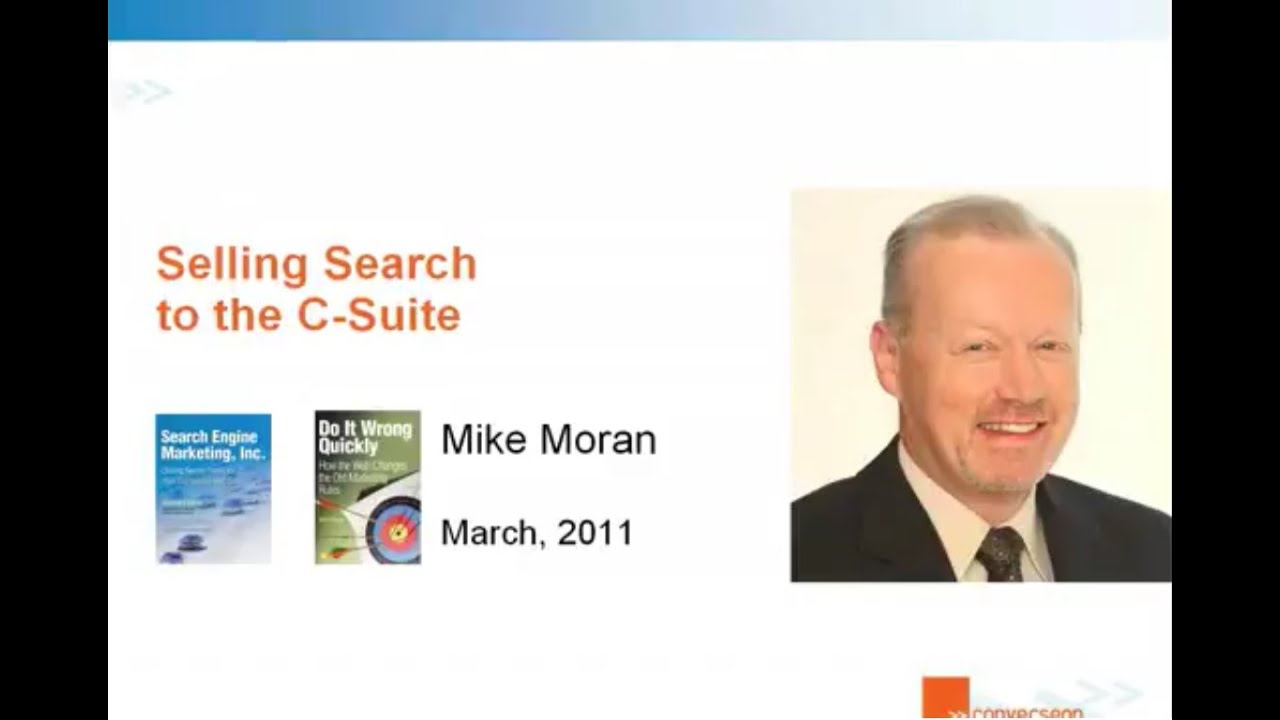
In this Leadformix webinar, Mike Moran teaches marketers how to secure C‑level support for search marketing by speaking the language of revenue and ROI. He explains that executives care only about money, not technology or marketing jargon, and outlines a step‑by‑step methodology: identify the website’s true conversion actions, calculate their monetary value, measure current traffic and conversion rates, project improvements in traffic and conversion (both organic and paid), and translate those improvements into dollar forecasts. Moran also covers how to craft a business case that answers the typical executive questions—current performance, competitor benchmarks, proposed tactics, costs, timeline, risks, and expected value. He stresses the importance of equipping CIOs and CMOs to advocate to CEOs/CFOs, using scorecards to drive cross‑department cooperation, and continuously reporting progress. The session includes a Q&A on B2B vs B2C nuances, competitor research, handling skeptics, and leveraging awards and social media for credibility.
Chapters
The broadcast is now starting. All attendees are in listen-only mode.
Welcome to Leadformix's webinar titled Selling Search to the C-Suite. Leadformix is a marketing automation 2.0 platform. It delivers a real-time marketing automation solution to convert online visits into qualified sales leads. Today's presenter is Mike Moran. Mike is the author of the acclaimed book on internet marketing, Do It Wrong Quickly. On the heels of the best-selling Search Engine Marketing Inc. Mike led many initiatives on IBM's website for eight years, including IBM's original search marketing strategy. Mike holds an advanced certificate in market management practice from the Royal UK Charter Institute of Marketing. He is a visiting lecturer at the University of Virginia's Darden School of Business and is a regular columnist for Search for Search Engine Guide. Mike frequently keynotes conferences on internet marketing for marketers, public relations specialists, market researchers, and technologists, and serves as Chief Strategist for Converseon, a leading digital media marketing agency. Prior to joining Converseon, Mike worked for IBM for 30 years, rising to the level of Distinguished Engineer. Mike can be reached through his website at www.mikemoran.com which is also home to his Biznology newsletter and blog. If you have any questions, please send them via the questions function in GoToWebinar, and we will address them at the end of the session. If you would like a copy of the presentation and a set of links to the information mentioned, please send an email directly to Mike. His contact information will be given at the end. Thank you, Mike, for presenting, and I'll turn the webinar over to you now.
Thank you. So welcome, everybody. I know you're all busy. I really appreciate you taking time to spend an hour with us today. So what we want to talk about today is selling search to the C-suite. So what does that mean? What we're really talking about is chief executive officers. So chief-level officers. So the CEO, the CFO, the CMO, all those C people. We're trying to figure out how can we explain to them what they need to know about search. And how can we get them to approve what we want them to do so that we can bring our companies forward in search marketing? That's really what the topic is today. So the first question you have to ask is, how do you get executive attention? They're mired in their BlackBerrys. They've got email. They have a million people looking for their attention. You have to ask yourself, do you know what to do? In order to get an executive to even pay attention to you. A lot of the time, the problem isn't that you don't know what to say, but that you never have a chance to say it. But I have a secret for you. There is a surefire way to get executive attention. And I'll give you one guess what that is. You see, a lot of the times when we come to talk to executives about search, We don't think clearly about what they're interested in. Instead, we're thinking too much about what we're interested in. So one of the things you have to understand is that search marketing is a lot more about marketing than it is about search. Oh sure, there's lots of little technologies that you have to understand. I mean, geez, I'm a distinguished engineer, so I love all that technology stuff. The truth is the executives couldn't care less. They're not interested in that. In fact, search actually combines 2 of the things that executives are the least interested in, technology and marketing. It turns out that executives care a lot about sales. That's where the money comes in. But they don't really understand either technology or marketing. So it becomes a lot harder for you to get their attention unless you have a hook. where you're talking that universal green language that all executives understand. It can be even harder if your idea is that you approach the CEO and the CFO through some of the people who are responsible for technology and for marketing. One of the things that can make it difficult is that if you try to use the language that CEOs and CFOs use, which is money, but you try and use that language with CIOs and CMOs, you're going to have a problem. Because sometimes the CIOs are spending a lot more time thinking about cost reductions than they are thinking about revenue. And CMOs sometimes are in even worse shape. Those heads of marketing spend a lot of time thinking about things even fuzzier than bringing cash in the door. So they're thinking about brand awareness and all sorts of other fuzzy metrics. And I'm not saying this is true of every chief information officer or every chief marketing officer. It's not. But the truth is that these 2 C-level executives have the shortest shelf life of any of them. And one of the reasons is because they often aren't speaking in terms that CEOs and CFOs understand. And so we need to understand how we're going to first talk to the CIOs and the CMOs, but we also need to think about how we're going to talk in terms of money. So one of the things you might need to do is as you talk to your CIO, as you talk to your CMO, you have to think about how you're going to equip them to talk to their bosses. How do they talk to CEOs and CFOs? If you're able to do that, if you're able to teach them that they need to be thinking in terms of revenue, they need to be thinking in terms of dollars, that, that will help them to be more effective with their bosses, and it will allow you to bring your message forward on search. Because one of the things that we know is that senior executives appreciate the value of search engine marketing. Understand what that means. They don't appreciate search engine marketing. They actually couldn't care less about search engine marketing. Search engine marketing is just a means to an end. It's a tool in their large toolbox of making the company successful. But what they care about a lot is value. And what we see is that even though this survey is a couple of years old, you still saw that there were many, many people at the C-level that really thought that search engine marketing is a high priority, and it's something that really brings value to the company. And that's only more so today. With each passing year, that message gets through more and more clearly. And so we have to think about how we're going to talk in terms of value. We can't be talking about page rankings, and traffic to the site, and all these exciting little statistics that might make our hearts flutter, but the truth is that they're not going to get the attention of executives at all. We need to be thinking about money. So how do we do that? I mean, it's easy to say, right? Anybody can say, well, tell them about the money. But the problem is that most of us don't know how to do that. And so what I want to do is quickly take you through a methodology that will help you understand how you can start to think about internet marketing in terms of dollars. So we want to start with principles of direct marketing. So think about the catalog marketers. Think about the people that stuff those credit card letters into your mailbox. And think about what their job is, what they're trying to do. And so think about that catalog marketer. And suppose he says to the boss, I shipped February's catalog on time, and it's under budget. Customers like it. And it looks beautiful. Want to see it? You know what the boss says? You're fired. Now why would the boss say that? Because that's not what the boss is interested in. The boss wants to know which products sold more this month than last month. Which are the ones that are the worst sellers that we ought to clear out of the catalog to make room for some new stuff? Of the ones we changed the pictures for, which ones sold more and which ones sold less? How are our sales month over month, year over year? That's what the boss wants to know, because the purpose of the catalog is not to create the catalog or to create it under budget or to find out whether the customer satisfaction survey says they love the way the catalog looks. The purpose of the catalog is to sell things. Now, all of that may seem correct to you, and not all that insightful. But suppose I said to you, hey, I shipped— excuse me, I completed the website redesign on time. And it's under budget. And customers like it. They say it's our best site yet. Want a demo? The problem is that we often say things like that about our websites or about any kind of internet marketing. And we can't continue to do this. We can't continue to treat these things as some kind of technological tour de force. Where we somehow say that the purpose of the project is to complete the project. It's not so. What we really need to do is figure out how we're going to make money with our websites and with all of the marketing that drives traffic to our websites, including search marketing. So the first thing you have to do to understand how to speak in terms of dollars to these executives is to ask yourself, what your conversions are on your site, to ask yourself, what is it that the website is trying to get people to do? What would make me happy if our visitors to the website did these things? And depending on your site, there could be all sorts of different answers. If you are an e-commerce company, that's fantastic. All you have to do is get them to dump things in the shopping cart and you are done. But most companies don't sell online. Most of them are trying to get people to troop over to the store to buy something, or to call on the phone, or to fill out an email contact form. When I was at IBM, one of our big ones was to download a white paper. Now I don't know why we never used any other color paper, but we never did. But why did we want people to download a white paper? Well, it was because by downloading that white paper, we gave them a very compelling persuasive piece of material that we knew led to offline sales. How did we know that? We put a phone number on the white paper that was nowhere else. So we could track how many people downloaded the white paper. We could track how many people called the phone number. Then we also could track how many of them actually bought. We knew, for example, that 4% of the people that downloaded this white paper would be able to spend $50,000 in consulting. What was it worth to us to download the white paper? That's right. It was worth 4% of $50,000. And so if you understand what it's worth in real money to be able to get people to do things on your website, pretty soon you can do the math backwards and you know what it's worth for them to come to your website. But it all starts with conversions. It all starts with identifying what it is that you're trying to get people to do. Now, I gave you one example of an offline conversion, but here's another. So suppose you have a car company. And what is that car company trying to do? It's trying to get people to go to the dealer and buy a car. So what do they do online? What they do is they put together a configuration program where people can walk through the configuration and say, I want the GPS system. I want the leather seats. They print it out and they walk it into the car dealer. And when the car dealer takes their information, they mark off that they have printed out one of these forms. And so what happens is that if they end up buying a car, that sale can get credited back to the website because they know that's where the person started. For other businesses, there might be other ways that you need to do it. You might give them a coupon that they turn in at the retail store. We talked before about using a special phone number on that white paper. You can use a special phone number on your website. You could use a special phone number on each different page of your website. I know a company that's working on a project where they're going to put a different phone number up on the website for each different visitor that comes to the website. So not only are they going to know exactly what they did, they're going to know who they are. Now you don't necessarily have to be that anal-retentive in what you do, but the truth is you have to figure out some way of taking your offline sales and matching them to the activities that happen online. Otherwise, you're never going to know which marketing expenditures were the ones that paid off. So what is the math that you have to do to keep score? I mean, I know a lot of people in marketing went into marketing as a refuge from math, but I have bad news for you because the math has found you. And so what is the math that you need to focus on? So let's say that you get 1,000 visitors a month, or if you're a really popular site, maybe you get 1,000 visitors an hour. It doesn't really matter what the period is. Say you get 1,000 visitors and 10 of them actually execute the conversion that we talked about that you chose earlier. That's a 1% conversion rate. Well, suppose you do a great job on your site. You lower your prices, you change your offers, you put in new pictures for everything, you make your site much more persuasive. And you double your conversion rate. Well, that's fantastic because now you've doubled your conversions. Suppose you don't do any of that. Suppose instead you do all sorts of work on search marketing and social media and email marketing and every other kind of marketing you can think of, all designed to drive more traffic to your site. And suppose you double the number of people that come to your site. Well, that's great too. You also double your conversions. Best of all is if you do both. If you double the number of people coming to the site and you double the conversion rate, now you've quadrupled your conversions. And folks, this is really all we have to work with. Everything you try and do in digital marketing ought to be designed to either get more people to come Or get more of the people who come to buy. And you should be able, for each tactic, to identify what it's trying to do. So search marketing is trying to bring more people to the site. Changing the copy on your landing pages is trying to get more people to buy. And so each of these things have to be a way that you can focus on each marketing tactic and figure out exactly what you're trying to get it to do. And then you can test to see if the tactic actually did what you expected it to do. And this is really what the work is. The work is in paying attention to what it costs to do each kind of marketing, and then paying attention to figuring out what kind of revenue it brings back, and then setting priorities that says the kinds of marketing that seem to bring back the most revenue are the ones we're going to allocate the most funds for. So, so far I haven't talked much about search at all, have I? So the reason for that is that the way that you keep score for search marketing, the way that you talk in terms of dollars, are actually the same things that you do for every kind of internet marketing. And so let's now get specific about search. So there's 4 things that you need to do in search. I wrote a 600-page book on search marketing, so this slide is not going to make you an engineer at Google. But whether it's organic or paid, the things you do are the same. The first thing you have to do is figure out what keywords people are looking for. What is it that they're typing in? One way of thinking about it is that those keywords are your market segments. So just as you segment people in any area, you need to segment people in search marketing as well. So whether it's organic or paid, you need to understand what your customers are typing in if you're going to figure out how you're going to appeal to them. The next step is to get seen. Well, the way to get seen in paid search is pretty easy. You plunk down your credit card and you put an ad in associated with a keyword. In organic search, it's a little trickier. You have to put pages up on your site that have the keyword on it, and you have to have to wait for the search engine to find them and then put them up on the results screen as well. Now, it's not quite that simple because you also have to get ranked, because it's not good enough for you to say, okay, we're in the search results. You actually need the search results to be the ones at the top of the screen. I mean, if you're on page 16, it's okay if you're targeting the obsessive-compulsive, but most people are not going to go that deep. So you really need to be at the top of the list. So for paid search, the way to get at the top of the list is to pay more for your bid or to make your ad so relevant that many more people click on it. For organic search, the way to be at the top of the list is to be the best answer for the question. So you need to have the kind of information people are looking for. You need to attract links to your site from other sites that shows the search engines that you have a very high-quality page. And the last thing you have to do is to get clicked. So getting clicked means that Whether it's your ad or whether it's your search result on the organic part of the page, what you have appearing there, whether it's the title and snippet in organic or whether it's the ad that you have written, the copy you've written for paid search, it has to be something enticing to the visitor, to the searcher. It has to be something that they're going to want to click on because it seems like the thing they're interested in. It has a call to action. It has something that tells them this is the place I want to be. So how do you now figure out how you're going to quantify what you're going to do in search? So the first thing you want to ask yourself is, how much traffic do you already get? So you want to look at how many search referrals you get. And that's a fancy word that your analytics system can tell you, whether it's Google Analytics or whether you're using WebTrends or CoreMetrics or Omniture. It doesn't matter what your system is. They can all tell you how many people come to your website with that keyword. And so that will tell you how many people are coming, and then you can figure out what your missed opportunities are. So what is the universe of people that could be coming to your site that are not? Now obviously, it doesn't make a lot of sense to assume you could ever get all of them. At most, you could probably get, even for the most high-ranking keywords and the best click-through rates, maybe you could get 6%, 7%, maybe 10% of that missed opportunity. But you want to start by at least figuring out how many people are you getting now. Then what you want to do is project improvement. So let's look at how we would do it for organic search. It's not an exact science, but making a projection is better than nothing. And so if you think through what you're trying to do, you're really trying to say, where is the ranking on the page that we get now? And what could we do to make it better? So the first thing to think through is if we could get to a number 1 ranking, what kind of clicks would we get from that? And so that's what you need to think through. So for informational results where it's a very broad term and people are just looking for information, or it's a brand result, you're going to get a different set of clicks than you would get for each of those kinds of queries. Then what you want to do is to focus on how you can take that and figure out where you're going to go next. So if you project your improvement, you might say, okay, I can get from number 3 to number 1 on a keyword that has my brand on it. Say your company is Snap Digital Electronics. And you make the snap cameras. So you can go from 3 to 1 in that, because you think, boy, we ought to be number 1 for our own. But if somebody types in digital camera comparison, like they have at the bottom of the screen, you might say, well, we're nowhere to be found in that one right now, because we don't have any pages out there for that. And we can look at our competitors and see, well, one of them is number 8, one of them is number 17. Well, maybe we could get to number 10. Let's be optimistic and say we could get to number 10. And then what you use, use that previous chart to figure out what the new set of clicks could be. And then from there, you figure out how many of the missed opportunities you're able to get. And that's what we do here. So let's say that the current rank for digital cameras is 45, and we think we can get to number 10. Then we can add a very high percentage of the missed opportunities, and that tells us how many more visitors come to the site. So by looking at a number of different popular keywords before we start our search campaign, we can then project how many people we think will get to the site. Now let's be clear. This is not an exact science, as we said earlier. It's not something that you can take to the bank. It's not something that you can say, this is exactly how many we're going to do. It's a guesstimate. But that's the purpose of this. The purpose of this is to talk in terms of business results, not to talk in terms of rankings or traffic, because executives are not going to understand that as readily. So what you need to do is to use these kinds of formulas so that you can walk your way through the process and say, now I can put a dollar amount on it. And that's what we do on the next slide. So for this company, they were going to add over 100,000 new visitors. They had a pretty high transaction price, and so they were going to add an awful lot of revenue. And for them, this is a great deal of money. If your company is a lot smaller than this, you might have a much smaller number, but it could still be a very big deal to you. And that's the point of this. The point is to try and figure out how can you walk your way through the process so that you can understand approximately how many people can I get coming to the site through search that I do not get today? And how much are they on average going to spend? What's the percentage of them that are going to buy, and what's the average price? And that's going to tell me the revenue that I expect to get. Now if you want to, you can do all that work. You can come up with a number, and if you think that you don't need to promise that number to be so high, then you know you can lower it by a factor of 10 for all I care. You can give them a much smaller number because you think to yourself, well, I'm pretty sure I can get them to do it even if it was really small. And that way you're building some safety into it for yourself because Even if things don't go as well as you projected, then you're still going to do a lot better than what you estimated when you talked to the executives. So you can play with this number and figure out what it is you're going to do, but you at least want to start with some kind of number that gives you some kind of semblance of realism so that you know you're not just shooting in the dark. So now when you come to the executives, you have to expect that you're going to get interrogated. They're going to be asking some difficult questions because guess what? People walk in every day with bright ideas. Most of them can't really back them up. And so they're going to ask you a lot of questions. We have some of them here. So they're going to ask you, why should they care about search marketing? And so you need to tell them that because it's going to make them a lot of money. They're going to ask, how does this help me achieve my corporate goals? You need to be able to help them understand what particular goals they have it's going to fit. I got news for you. Every year one of the goals is about increasing revenue, or increasing profit, or increasing revenue in a particular set of countries, or for a particular product line. So what you need to do is to line up your first campaign with some of those corporate goals. They are going to ask you where we are now. Well, you already did that exercise. You figured out where we are by doing the exercise of saying how many people are coming to the site now. They are going to want to know what your competitors are doing. So be prepared to explain to them what Kodak is doing, what Canon is doing if you are in the digital camera business. And whatever your business is, look at your competitors. Figure out what they are doing. And they are going to ask, what are you proposing to do? At this point they want to see a project plan. They want to know who has to be involved, how much is it going to cost, and they want to understand what the endgame is. So when you do this thing, how will I know you are done? But they are not done with you. They are going to ask you, what business value do you expect to achieve? Now we just worked that out with that exercise that we just walked through. And this stuff is explained more on my website if you would like to get it for free, and if you are too cheap to buy my book. But if you buy the book, it is explained in detail there. And they also want to know how much it costs. So how can you explain to them This is what we are going to pay to do this. We have to bring in someone to help us do this. We have to get the content management team to do X. We have to get the marketing team to identify the keywords. They are also going to want to know how long it will take. And one of the things that is very important is they are going to want to know why they should fund this over something else. I mean, no matter where you are, there is no new money. There is only the money we have. So whatever it is that you are proposing to put resources and money on, They're going to have to take away from some other place. And you have to figure that out. And here's a question that many people are not prepared for. What are the risks? And you have to walk them through what the risks are. I have a risk that all these people in the company I need cooperation from, they're not going to help me. I have a risk that we might do these things, and it might not work the first couple of times. It might take 3 or 4 tries before we really start to get these results. And that would be a risk. You may have other risks that are unique to your firm. Those are things that you need to be prepared to discuss, and you want to be able to ask for help from them so you can mitigate those risks. Sometimes getting that approval at the top helps you to work through those risks throughout the rest of the company. Now you might be sitting there smiling, saying, "Oh yeah, yeah, but my executive never does anything new." This is actually his standard posture, and he doesn't see anything wrong right here, and so he's perfectly happy to let things go along the way they seem. A lot of the time, you get executives like this who are fear-driven. The reason they don't do anything new is because they're afraid of failing. They're afraid of making a mistake. And if you're in this situation, my advice to you is to scare them worse. About staying pat. Right? So if they're afraid to do something new, scare them about what's going to happen if they don't do it. So our competitors are going to take over. We're going to lose traction digitally. We have all this stuff moving to digital marketing, and we're not going to be able to take advantage of it. Look at all this opportunity out there. If we don't take it, our competitors will. There might be lots of different ways for you to explain this to them. But most executives are pretty competitive people. You want to appeal to their sense of competition. So if they're afraid because they think that doing new things is something where they could make mistakes, you have to make them understand that it is a far bigger mistake not to do this than to do it. Now, after you get that approval, you don't want to stop selling because Guess what? You walked in there and sold the executive on something, and what did he do? He or she took that money from somebody else who had sold them on something a few months ago. You don't want a few months ago to wake up and find out that your budget is gone because you didn't keep coming back and reinforcing how important this is and how well you're doing. And so you want to give your executives something to do. So every month or so, come back and show what your progress is. And as we talked about earlier, one of the big risks is you might need a lot of other people in the organization to cooperate with you. So come back each month and let the executive know who's cooperating and who's not. And let the executive wield their power so that she can come down on all of those people who are not cooperating and make sure that they're doing what you need them to do. One thing that I did when I was at IBM, and I've done it with several other companies now, is I came up with scorecards that actually let the divisions compete against each other. And you can do this for any size business unit. So I put together some spreadsheets that basically showed which divisions were doing the best at all the things I needed them to do, and which ones were doing the worst. And we actually color-coded them because it's executives. You have to make it really simple. And so we had red for the ones that weren't doing a good job at all, greens for the ones that were meeting the minimum requirements, and yellow for the ones that were in between. And so we would show this to the executives, and then we'd take it around to all the divisions and show each of the division executives where they were. And then the big executive would come down and ask them, how come you're still red? How come you're not doing this? This is an important part priority of mine. I want to make sure you're doing this. And honestly, they didn't really understand what was going on, any of them. They just knew they were red, and they didn't want to be red anymore. So they went down and talked to their people and said, I don't know what Moran is telling you to do, but whatever it is, do it, because I don't want to be red again next month. And that's how power works in corporations. That's how big organizations operate, is you have to figure out how you're going to motivate teamwork. And these kinds of scorecards are easy for executives to manage to, and then they end up telling the people who have to actually do the work what they need to do. Well, I know I had a lot to say, but luckily I wrote it all down. So I'm looking forward to answering your questions. I know that it can be like a roller coaster ride that comes to a stop, but I hope you've typed in a few questions into the GoToWebinar interface, and I'm looking forward to hearing them now.
Great. Thank you, Mike, for presenting. We'll open the webinar up to questions. Please type in your questions in the questions area of GoToWebinar. Okay, Mike, here's our first question. Would you give the same advice to B2B and to B2C marketers, or are there differences?
I think mostly the advice I would give is the same for both, that you have to in general make sure that you're identifying things properly. But there are differences. The differences usually don't cut across B2B or B2C lines. So one of the differences would be If you have a product where it often takes people multiple visits coming to the site before they make a decision, so like the car companies we talked about, instead of them figuring out how many visits have come to the site and figuring out their conversion rate that way, they might want to do it based on unique visitors, because the same person would come back 5 times maybe before they eventually went to the dealer and bought a car. On the other hand, if you're Amazon.com, somebody who comes back 5 times might actually purchase 5 times. So they'd want to divide their conversion rate by visits rather than visitors. And so that I think is a big difference. I think the other thing that's different is that some products are really high consideration products. They're things that are not bought very often, and they're things that take a long time for people to decide. Those kinds of things, whether they're B2B or B2C, they usually are more of a group purchase. So when someone buys a car, they're typically talking about it with multiple people. And in a lot of B2B service purchases, it's the same way. You have to convince not just the person who is interested in it, but you need to convince the people who have to cut the PO in the purchasing department, and you might have to get several executives' approval. High consideration purchases for big ticket items or for things that you don't buy all that frequently, those are things that can take a long time for those selling cycles to pass through. And they're the kinds of things that are mostly done as a group. Whereas whether it's B2B or B2C, if you're buying things that are low priced or things that are supplies, you buy them all the time, they're small decisions, there's not a big risk associated with them, Those things happen fairly rapidly, and often they're decided by one person, whether they're in a company or not.
Okay, great. Thanks, Mike. I have a question here. Let me see if I can read this. How far is it helpful to do research work on search engine marketing? of the competitors, especially for B2B marketers?
I apologize, Michael, I couldn't hear the beginning part of that question.
Sure, let me reread this. Basically, how helpful is it to do research work on the search engine marketing of your competitors, especially for B2B marketers?
I think whether it's B2B or B2C, it's always helpful to do that. There are several different ways that that can help you. We talked briefly in the presentation about one way that can help you. If you're trying to make a case within your organization that you are behind on search marketing, then one way to do it is to show for common keywords that your competitors are ahead of you. So for— not for branded keywords, but for keywords that are the products or the product categories in your business, if you can show that your company consistently ranks lower than other companies, that's going to light a fire under people to say, boy, I think we need to do something here. Another way that it's helpful for you to look at competitors is if you analyze their pages. And so you see which pages are coming up, and you see what words are they using on the pages. How are they describing the material? What are the kinds of things that they say? And this can be helpful from a few different angles. From the angle of organic search, using the right kinds of words on a page is a big part of what causes you to get that search ranking. Also, if you look at the tone of the page, you look at the kind of information provided, the more interesting the content, the more valuable the content, the more entertaining the content, the more helpful the content, the more links that are going to be attracted to those pages. And that can help explain a better ranking as well. For paid search, examining competitors' ads and competitors' pages can tell you a lot about what it is that they're doing, because for paid search, a lot of what drives how much you can bid on a particular keyword is what your conversion rate is. So think about it. If you have to pay the search engine every time somebody comes to the site, and you have a 1% conversion rate, that means you can't pay that much because you need to get 100 people to come before they buy something. But on the other hand, suppose you have a 5% conversion rate. You can pay 5 times more than that other company that has the 1% conversion rate. So if you see companies that are at the top of the listings, you know a couple of things. You know that that ad has very compelling content in it that people are clicking on, and you also know that they're probably paying a significant price for it. And so the only reason that they could be paying that price is because they convert very highly. Otherwise, they'd be losing money to do that. And so examining What their path is, you know, their landing page and whatever other pages are there before they sell something. Understanding how valuable that is could help you a great deal when you're doing your search marketing.
Okay, great. Thank you, Mike. Next question, what do you do when you run into someone who just won't listen to the facts? No matter what you say, he thinks marketing is about brand awareness.
Well, Those things can be problems, I have to admit. And I also have to admit that I have run into that situation in my career. I do remember a time when I was at IBM when there was a person who was in charge of all of the internet marketing advertising budget. And I came to them and showed them the value of paid search. And at the time, this was years ago, I think it was back in 2002.
Yeah.
IBM was spending all of its money on banner or display ads. And now that would be considered crazy, but back then there were a lot of companies that were doing this. And what I showed him was that he could pay far less for paid search ads and make a lot more money. But he wasn't interested because he wasn't paying attention to how much money the banner ads made. He just said he was using those ads for brand awareness, get IBM's name out there. And we don't really even care if people click on them. I mean, it would be better if they click on it because then they see a couple of pages from the site and they have even more brand awareness. But that was his mentality. And no matter what I did, I really couldn't sway him. So eventually what I did is I went to his boss and I said, here are the facts. Here's your man. Here's what he's doing. Here's what he ought to be doing. And this is what we need to be doing as a company. And his boss bought it. And a few months later, that guy wasn't in that job anymore, but we were doing a lot of business in paid search. And so sometimes you can convince somebody and you can use the facts and you can get them to pay attention. But maybe I'm reading a little into your question, but if the person really doesn't have an open mind and they really can't be swayed and you've really given it a good shot, you might have to go above them or around them. Because someone's going to listen to reason. The kinds of things that we're talking about today, are not these fantasy ideas. These are real dollars and cents that you can explain how it's going to help the business. And so if you run into somebody who isn't interested in that, you just gotta keep scouting around till you find somebody who is. I mean, if you're in a company that's making money, somebody there must understand this, and you have to find them.
Great, thanks, Mike. I actually have a question for you. I see there are a lot of awards here on the slide that you have, and a lot of our clients, you know, they, they they have awards as well and they go ahead and they put them up on their website on the homepage. Is there something that they should be doing beyond that? Is there any way they can be using social media to kind of take advantage and leverage the awards that they've won?
Oh sure, there's plenty of ways to use awards. So a lot of these awards that I'm showing you are from Conversiyon, which is a company that I serve as chief strategist for. So Conversiyon has won an awful lot of awards and because it's a social media agency. These are all social media awards. But it doesn't matter what kind of award it is. There are a few different things that are really important about awards. The first thing is that you shouldn't think in terms of the old marketer's game which is to use a lot of hype-laden phrases. So instead of saying to people, we are the best, instead you say, we were awarded the best social media marketing agency in 2009. That is a different kind of claim. It's understandable. People get it. I mean, and they realize that it's credible. And so using that kind of language marks you differently than all the normal fog speak that comes out of marketers. And that makes a big difference when it comes to search, because with search, not only can you, can you use that kind of language so that when people come to the site, they're going to be more persuaded. So we talked about ways that you can raise your conversion rate is to be more persuasive. These kinds of awards can be very persuasive. The other thing that happens is that you will get attention through the media. So all of these organizations that give out these awards, they issue press releases that show up in the stream. They do social media work to help you. They have pages on their site that explain what the award is. They have links back to your site which is also helpful for you. So all of these things are ways for you to take advantage of winning an award. And it's true even when your clients win awards. I mean, this award that Converseon won for the best social media marketing agency in 2009, that was a very exciting award. It was the first time that that organization had ever given it out, that DigiDay Sammy Award, and that was great. The next year Converseon wasn't up for the award in 2010 because they had already won it the year before. But guess what happened? What happened was that Converseon's biggest client IBM won the SAMMY Award for the best social media business. And so that was just as exciting, maybe even more exciting for Conversiana. And so by constantly focusing on telling the story of the awards, what's really happening is you're letting other people tell your story for you, people who are a lot more credible because they're perceived as not having an axe to grind.
Great. Okay, thank you, Mike. Looks like we have no more questions. So Mike, thank you for presenting today. It was a great webinar.
Thank you, Michael.
And thank you to our attendees. We're gonna have a recording of the webinar up on Leadformix at www.leadformix.com, so you could take a look at that, take another look at it, pass it on to your colleagues as well. And I think, Mike, we're gonna put it up on your site as well, right?
Yes, I'll do that also. And if anyone thinks of a question that they'd like to ask after we hang up, I mean, please be— you know, I'm happy to take an email from you at mike@mikemoran.com. If you come to my site, you can also subscribe to a monthly newsletter or subscribe to my daily blog. And obviously those books are available for you as well. But if anybody does have a question, I'm happy to answer those. And I appreciate your attention today.
Great. Thank you, Mike. And thank you to the attendees. And have a great day.









