The Top 10 Tricks for Sales Lead Generation with Ruth P. Stevens
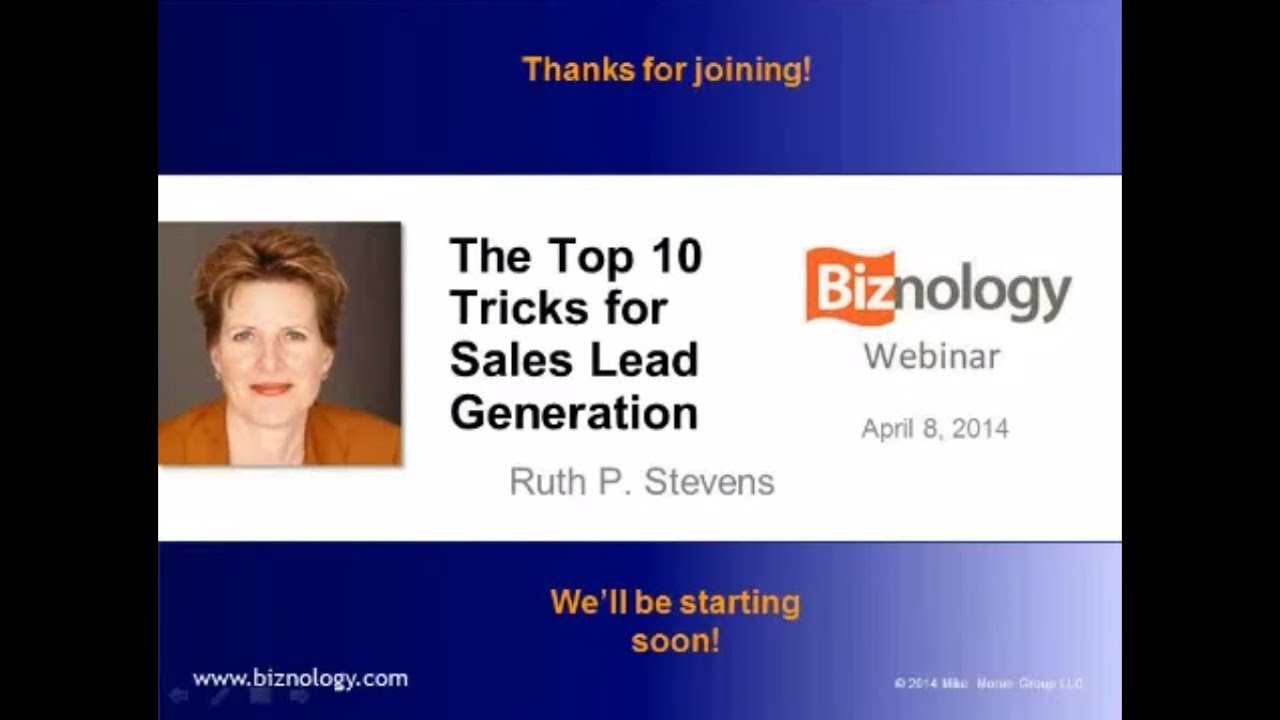
Ruth P. Stevens, a B2B lead-generation expert, walks through ten concrete steps for generating qualified sales leads: define what a lead is, calculate required volumes from sales quota, rank channels by profitability (search marketing and telemarketing win), place offers on every website page, use IP identification to capture visitor data, and score leads with nurturing workflows. Metrics matter: track both activity and closed-won revenue.
Questions this video answers
Have a planned, queued series of outbound communications—email is the primary channel, supplemented by phone and creative direct mail (e.g., a personalized letter from a company executive).
Establish the full lead‑generation process; you need to do it all, not pick a single tip. The process itself is the competitive advantage.
Use an information‑based offer—well‑titled, valuable content such as a research report, white paper, or case study. The title must be irresistible.
Yes, the same principles apply, though you may need to adjust for consumer‑buyer behavior. High‑ticket B2C categories (e.g., automotive) use similar processes.
Chapters
Hi, and welcome to today's Biznology Digital Marketing Webinar. I'm Mike Moran, founder of the Biznology blog and a senior strategist at Converseon, a leading social consultancy. I'm also co-author of Search Engine Marketing, Inc., sole author of Do It Wrong Quickly: How the Web Changes the Old Marketing Rules, and a former IBM Distinguished Engineer. Today, you'll be hearing from Ruth P. Stevens, who will present The top 10 tricks for sales lead generation. But before we start, we need to recognize our sponsors. Barnraisers, a full-service digital and social media solutions company that builds brands using proven relationship principles and ROI. GaggleAmp, empowering companies to amplify their social media content by leveraging employees, partners, and resellers. Try GaggleAmp for free today. MENG, Marketing Executive Networking Group, New Jersey Chapter. We aren't just about networking to land a great job. We're about staying current to grow in our careers. eMarketing Strategy, B2B consulting from Ruth Stevens with a special focus on sales lead generation. Unison, the unagency, your secret weapon in the noisy world of 21st century brand communications. As we wait for more attendees to join, let me review the format of our webinar. Our Biznology webinars last just 30 minutes, so you can easily fit them into your busy schedule. We record each webinar and we'll email you that link later this week. During our speaker's presentation, you can use GoToWebinar to ask a question. That orange arrow opens and closes your controls. If you have a question, simply type it into the box labeled Questions at any time during the event And press the send button. I'll select a few questions at the end of our webinar and pose them to Ruth. While we're waiting for a few last attendees to join, I'd like to remind you that the Biznology newsletter and blog are available for free at biznology.com. So if you're not already a subscriber, we hope that you'll sign up now. Thanks again to all of you for spending 30 minutes with us. We know how valuable your time is, so let's introduce today's speaker. Ruth Stevens is one of our bloggers at Biznology and president of eMarketing Strategy, a consultancy in New York City specializing in B2B marketing, especially sales lead generation. Ruth is the author of 2 business books, Maximizing Lead Generation: The Complete Guide for B2B Marketers and Trade Show and Event Marketing: Plan, Profit, and Promote. Sorry, that's Plan, Promote, Profit. You should do all 3 of them. We don't care what order. Crain's B2B Magazine named Ruth as one of the 100 most influential people in B2B marketing. So if you've ever struggled with generating qualified sales leads or reading the titles of books, this is the webinar for you. Ruth, take it away.
Thanks, Mike. You crack me up. I'm really happy to have a chance to talk about this subject, my favorite. And I'm breaking the process of lead generation into 10 tips which are really steps. And before I begin, let me mention to the audience that truthfully the secret to successful ongoing lead generation in support of a sales force is a process, and the company with the best process wins. So let's dive in, beginning with a bit of background that explains why this is so important in business-to-business marketing? It's because most business buying— well, about 7% isn't, but most business buying is done through a relationship with a salesperson. And for a salesperson to generate a relationship with a new customer, an entirely net new customer, that usually means cold calling, and that's not good use of a salesperson's time. So, a marketing department is usually empowered and funded to eliminate the cold calling that a salesperson has to do by providing the salesperson with a steady stream of qualified leads. So naturally, when you ever ask— and here's an example of a survey from last year— a business-to-business marketer what is on their minds, what are they supposed to be doing, sales lead generation tends to be number one. You see this again and again. How do we get this done? Well, let's begin with trick number 1, which seems a little obvious, but it's surprisingly a problem in some companies, which is deciding what we mean collectively around the organization by the term lead. And one of the reasons this can be complicated is that the word lead is bandied around a lot. A little bit too aggressively, I think. Sometimes companies that are selling contact data or prospecting data will call their product lead lists, and certainly these are not leads. Another problem is that we sometimes confuse a qualified lead with a sales lead, and a sales lead with a prospect. So with this slide, I'm offering a definition that you could socialize around your company. And this will eliminate a number of problems when everyone is speaking the same language. But my point is that if we're going to be delivering a steady stream of qualified leads to our salespeople so that they can reduce the amount of cold calling they have to do and triple their productivity, We need to all be in agreement about what is a qualified lead. It is not a scanned badge from a trade show. This is my point about let's all get some agreement. The second tip is about planning. If you do some simple math like the kind I've offered on this chart, you can calculate by dividing the number of deals that your sales team needs to close into their expected quota. And actually, you're dividing the average order size of those deals into their quota, subtracting out the amount of their quota that they can generate without marketing help, and then divide those sequentially by the conversion rates from lead to sale conversion, and then you can take it a step further by dividing the inquiries to lead conversion rate as well. You can do some pretty careful planning for your campaigns that will allow you to limit the amount of waste. You certainly don't want to be generating too many leads. Because the sales force will, you know, it's human nature, cherry-pick among them and you will have wasted marketing dollars. And if you generate too few, you're not going to help them meet their quota and you can possibly threaten your company's financial standing. So it's important to do this math in advance. And this is just one way to do it, but it's a pretty simple one and I found it effective. Over the years. Now the 3rd trick is about selecting campaign media. And this is a pretty controversial subject because everyone has an idea of what works. And I also have an idea. And I've listed the media options that I found to be most effective. And remember, if we are trying to generate a steady stream of predictable, reliable, leads that our salespeople can then go work and meet their quotas, we need predictable, reliable media channels. So, this is my favorite list in order of relative profitability. And I'd love to hear your thoughts on this. But I'm going to focus in particular on the top 2. So, let me just review the rest very briefly. Search engine marketing, meaning pay-per-click advertising, which can pick up prospects when they are already searching in your category, is absolutely essential. After that, outbound telemarketing. I know it sounds awful. We all hate being called during dinner, but in business-to-business, the phone is still the most widely used productivity tool for communication, and it still really works, including voicemail. Direct mail including dimensional mail which means putting something in a box or some kind of bulky envelope can be effective primarily because the availability of postal mailing lists is so mature, so broad today. You can find any target. Using direct mail. And then trade shows, if you can figure out the most niche or targeted shows, that's a terrific way to generate leads. And finally, you should be experimenting with syndicated content pay-per-lead generation programs. Now, I'm going to talk a little bit about the first 2, so let me dive into that. It's an underleveraged opportunity in business-to-business to convert your website into a lead generator. And there are 2 ways to do this. One is to ask for a registration on your homepage, and I would also recommend every other page on your site, by offering an irresistibly titled piece of content or otherwise motivating prospects to leave behind their contact information so you can add those names to your database and continue to market to them and build a relationship over time. And of course, the reason is that these are relatively cheap. It practically costs you nothing to convert a visitor to a lead. But more important, if someone is already at your website, they are likely to be highly qualified. So these are prospects you don't want to miss. Now, only a certain percentage, it may be as small as 1% of visitors will be persuaded to leave behind their contact information. So I also recommend using the new software available today known as IP address identification software. One of the leaders in this category was VisitorTrack. They have a lot of frankly cheaper competitors who I've listed in the box in the upper right. But the idea here is that the browser of a company can be identified through the IP address when a corporate visitor comes to your site. And in business-to-business, this makes a lot of sense. And you can not only know which company a visitor came from, but also how long they stayed, and which pages they looked at, and so forth. So I really recommend that you use software like this, and then determine how you are going to deal with the data that you collect, an outbound call into that company to probe around. And you certainly don't want to say, hey, I noticed someone is visiting my site. But you might want to find out if there is a need, or if someone is searching in that category who you might be able to help. So those are the 2 lowest cost and highest value sources of leads that I recommend. Now let me also add a quick discussion about the media that are not working as well today. And cold email to rented lists tops my list of difficult, less productive media. Due to spam. But also broadcast is very difficult to work in B2B. Most of us simply can't afford it. There's too much waste. And ditto for print advertising unless you have extremely targeted media available to you, trade publications in your industry for example, and if you're using direct response communications which I'm going to mention in a bit. And trade shows if they're not targeted enough. And finally, I'd like to talk briefly about social media which is all the rage today, extremely productive. If you already have a relationship with prospects, it's terrific for lead nurturing and development of leads. And it can also be used for inquiry generation through pass-along if you are using very appealing content. And motivating people to share. But at the same time, if you have to generate 150 leads every quarter for every salesperson, the problem with social media is that it's difficult to scale. And more importantly, it behaves like PR. You can't rely on it. So you need to supplement it with more workhorse, predictable, scalable media like the ones I mentioned earlier. So let's move on to trick number 4 which is about the nature of the communications that you should be using for lead gen. It's direct response communications. I've listed the characteristics of direct response communications here. And these are communications driven by offer, driven by calls to action to motivate a response. And they are fundamentally different from corporate communications or brand awareness communications which focus on trying to get people to think differently or feel differently. This is about motivating action. The other element of direct response communications is including an incentive offer. And all of us who have been in this world for a while have talked to product managers who say, hey, just tell them about our fabulous product. They are going to want it. It is so wonderful. But you need an offer to stimulate an immediate action and overcome inertia. So the offer doesn't need to be about price or anything relating to the deal itself. But what it does need to be is of appeal to the target. And here's a checklist of the offers that have worked in business-to-business for for many years and you can rely on. You can test your way into some of these. But the number one offer in B2B today is content or information-based offers that condense information that is useful and helpful. It is not salesy. It might be a research report or a white paper or something of value that the prospect understands will help him do his job better. And this is where you want to begin with offer development, both as your offer on your homepage registration button, and also in any other campaign medium that you choose to use. Okay, we are halfway there. And let me move on to trick number 6 which takes us into campaign management where we've made the offer. We've understood the target audience. We figured out how to get a hold of them. And now it's time to plan to deal with them once they've raised their hands. These days this is less of an issue because usually they are downloading or we are emailing them the white paper, or we are calling them to set up But I do want to call this out because it's too easy to forget to plan for campaign responses. I've seen it happen myself. Without that, we're going nowhere. Trick number 7 is about lead qualification. This is all about making sure that the prospect is worth the time of the salesperson. There are 2 ways to do this. One is to follow up the inquiry with an outbound message usually by email, or it could also be by phone to qualify the prospect. But I also recommend that you consider including the qualification questions on your initial response form, especially if it is web-based. You can see the so-called survey in the upper right-hand corner which is used for this purpose. This is the response form and we're asking the qualification questions there. The benefit there is that you save the expense and the time of the outbound follow-up communication. The downside of course is that the response rate will be lower. So it's a decision you have to make. But you also have to determine what are the criteria by which you will qualify the lead. These criteria need to be established in concert with your sales force. They will give you more qualification criteria than you really want to use because they only want to talk to someone who has a budget and is ready to buy tomorrow. But at least you can probe with them the ideal characteristics of a prospect in terms of demographics or their behavior. And you may want to rely, if you are in a large enterprise environment, on the traditional criteria about budget, authority, need, and timeframe. Although this is getting a little bit stale and people are getting much more creative today. Here is an example from a large enterprise marketer, RightNow Technologies, which sells enterprise call center software. And you can see that they include their pretty stringent qualification questions right on the web response form. Makes a lot of sense for them. You can also get creative by establishing criteria that are consistent with the way your buyers buy. I heard this example from King Industries, which is a chemical manufacturer. They know that their prospects, and they mostly are generating leads at trade shows, are not going to ever become a buyer unless they request a sample. And the the chemical sample actually works in their lab. So anybody at the trade show who asks for a sample is instantly viewed as qualified, and that makes, makes a lot of sense. But the rest of us are usually forced to rely on pretty sophisticated lead scoring techniques. This is trick number 8. You can make it as simple as a few buckets that are organized by various categories, or you're more likely to want to get a bit more sophisticated and assign some weightings to a range of answers that your prospects may offer to the various questions that you're setting up. And then you can assign a point score that gives you a lot of flexibility and allows your salespeople to see the best prospects pretty pretty quickly. But only a percentage of your prospects are going to be qualified right away, so you need to also establish a so-called nurturing process. This is why I say lead generation is more process-oriented than it is campaign creativity. But the reason that justifies nurturing is that when someone responds to a campaign, and is searching for information in your category, about half of them are eventually going to buy. I mean, they're in the market. They need this solution that you're offering. And if they're not qualified today, you still want to stay in touch with them and be there when they are ready, because otherwise they're going to go to your competition. So a nurturing process is a series of outbound communications designed to keep you in touch with the prospect until they're ready to buy. Marketing automation is extremely important in helping you get this process going in a workable way. But without it, you're going to be losing as much as 80% or 90% of your business opportunity. Here's a sample. This is all hypothetical but quite reasonable of how 100 responses generated from a campaign might only generate 5 qualified leads, and the rest will be put into a pool. And as they are nurtured, you can increase that 5 by another 11 through outbound communication, and then add another 25 through a nurturing process and turn your campaign productivity into much better numbers as a result. And then finally, the last trick is about campaign metrics. The typical metrics that B2B buyers use can fall into 2 categories, what I call activity-based metrics. On the one hand, these are controlled by marketing. And results-based metrics, which of course are preferable, but you have to have actual sales results to calculate these. And sometimes if you are, especially if you are handing off the lead to a third-party distribution channel partner and they are unwilling to report back to you, you can't get a hold of these numbers. Although there are some techniques I could go into in Q&A. But my point is that you want to determine what metrics you are going to use. Both activity-based metrics and if possible results-based metrics, and apply those to every campaign over time so that you can gain some understanding of the best campaign media, the best campaign seasonality, and other variables. You'll have an apples-to-apples comparison over time, and I think that will really take your campaign, your lead generation program to the next level. So with that, Mike, I've—
Great.
I'm wrapping up here. I would also offer the folks on the call the chance to download a free sample chapter from my book. And Mike, I'll hand the podium over to you for Q&A.
Thanks, Ruth. I love to see that you're taking your own advice by making an offer to our audience.
Thank you.
I'm sure our attendees have a much stronger idea of how to generate more sales leads but I'm sure you didn't answer every question. I've got several good ones from our audience teed up for you.
Great.
And I'd like to remind our audience that it's not too late to ask your own question by typing it into the questions box in your GoToWebinar controls. Before we get to the questions, I'd like to remind you that the Biznology team provides jumpstart workshops for corporations who want to apply what they learn directly to their own businesses and to have their teams create a plan for executive approval right in the workshop. Ruth and I teach the B2B Digital Marketing course and we'll be there to guide you and help you persuade that executive to say yes. Go to biznology.com/training for more information on all of our offerings. We're about to start firing questions at Ruth, but we need to thank our sponsors once again. BarnRaisers, a full-service digital and social media solutions company that builds brands using proven relationship principles, and ROI. GaggleAmp, empowering companies to amplify their social media content by leveraging employees, partners, and resellers. Try GaggleAmp for free today. MENG, Marketing Executive Networking Group, New Jersey Chapter. We aren't just about networking to land a great job, we're about staying current to grow in our careers. eMarketing Strategy, B2B consulting from Ruth Stevens with a special focus on sales lead generation. And Unison, the unagency, your secret weapon in the noisy world of 21st century brand communications. Now on to your questions. Our first question for Ruth is, what is the best nurturing technique?
Great, great question. Well, the best technique is to have a plan, because if you are going to have a series of outbound communications, You want to make sure they're in the queue and ready to go. As you saw on the slide that I showed on nurturing, email is the top technique today in terms of media channels. Phone can also work. And then you can get really creative. Like how about if you had a postal letter signed by your own company's counterpart to the prospect? Like if you're talking to a finance executive, maybe have a letter come from Our finance executive. There are lots of creative ways to mix up the communication stream and keep it interesting. But email is the place most people start.
Terrific. Let's see, the next one is, we are a fast-growing B2B company, but we haven't done any of your tips. Which one should we do first?
Well, it's not a— this isn't a mix or match situation here. You need to establish a process. Do it all. I hate to say it. The company with the best process wins. So you might want to buy my book which lays the process out end to end, or I'd be happy to talk it over with you by phone.
Terrific. You can get a free chapter just to start out, but don't be so cheap you don't buy the whole book too. Let's see, next question.
It's less than $20 by the way.
Exactly, exactly. If you're not going to make $20 on this, I don't even know why you're spending a half hour listening to Ruth on the webinar. So let's see, next question is, if we've never done any offers, do you have a favorite on which ones would work best without just trying a bunch of things?
Yes, I do. Thank you. Yes, this is one of the few examples where I actually know the right answer. It's an information-based offer, namely content. And the secret to content development is to put together an informative, but irresistibly titled document. And it could be a 10 tips document. It could be a case study. But the secret is the title. It has to be titled in a way that your prospect has to have it, is salivating, I've got to get that. And the PDF document, whether it could be a video, but it needs to be informative and non-salesy and beautifully titled.
Terrific. Let's see, here's one. I am a B2C marketer, but we sell with a sales force. So would all of these tips work for me too?
They tend to, yes. Now I've talked about business buyers who are different from consumer buyers. So you may need to make some adjustments. But in high-ticket considered purchase categories in consumer like automotive, Marketers use these same kinds of processes.
So Ruth, that's all the time that we have for today. I want to thank you for all these great ideas, and thanks especially to our audience for your participation and your questions. If any of you had questions that we did not have time to answer, you can email your questions to Eileen at mikemorangroup.com. And she'll be sure to get them to Ruth for the answer. Later this week, we'll send each of you a link to the recording of this webinar to listen to again and to share with others. We also invite you to mark your calendars for our next Biznology webinar, Improving PPC Performance: 10 Competitive Monitoring Tips Every Search Marketer Should Know, with Laurie Wyman. It'll be held at 11:00 AM US Eastern Time on May 20th. We hope to see you all back here then. Bye, everybody.
Bye.









