Achieving Career Success in the New Hybrid World of Remote & In-Person Treasury Teams
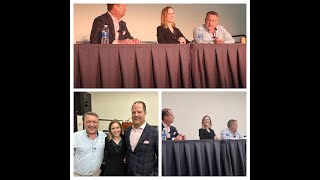
Mike Richards, Leanne, and Joel Campbell discuss how treasury teams navigate hybrid work. They share practical advice on staying connected across remote and in-person setups, and what it takes to advance your career when your office isn't in one place.
Good afternoon, San Diego. No, no, no, we've done this before, haven't we? We're post lunch, had that little lull, few people falling asleep, just the panelists wake up. Good afternoon, San Diego. Oh, well, we are awake. Thank goodness. Exactly. As my FP colleague there said, hybrid world. It used to just be to do with cars. Now it's about you lot. Now we will each introduce ourselves and why we were chosen to explore this topic. Obviously there are other people available, but we said yes, the structure of it will be we will introduce ourselves, we will then go through the main session, we'll then do Q and A and then we'll wrap up with our takeaways. As I said to many of the audiences, if you don't get involved in the Q and A at the end, you're stupid. Why? You've got three amazing, well, two amazing treasury professionals and me up here. We've come all the way. I've come what, five and a half thousand miles to do this. If you don't take the advantage of it, it's your loss. And I came to a very good session earlier with Nicole for social media. And was I, as I put after then, was I engaged? Was I present? Not really. Not because of them, because of me. And I can see a lot of you on your phones. Do us a favor, you've come here 3,5000 miles, put your phones away for an hour, make the most of it. So who am I? So, Mike Richards, very big head. I run the treasury recruitment company. I move you guys around the room and then send out a bill. That's right. So I recruit treasurers and treasury analysts, move them up the scale, treasurers, move them across companies. So I do that again, not as a sales pitch, but that's why I've been invited up here, because I talk to you guys about remote working and everything on a day to day basis. How do I get this knowledge? Very successful podcast. Got actually some of the podcast guests here. I had actually the amazing Leanne and Joel on the podcast in the past and I said to a guy in Chicago when I spoke there, I said, look, it feels a bit salesy to tell the people. He said, mike, we need to know who you've spoken to. So had the treasurer of Caterpillar, treasurer of Dow Chemicals, treasurer of Porsche, so some of the best treasurers, the leading global treasurers, that's how I've got my knowledge session. We're going to talk. Well, in fact, as I say, we're going to pass across the panel members to introduce them, and then we will actually go through about the main topic about hybrid and remote and how you guys are handling it. So, Leanne.
Hi, everyone. It's so nice to see so many familiar faces and friends in the audience. And I think this is a great topic for all of us to talk about and explore. It's what we've all been going through for the last three, five years. So thank you for joining us, particularly after lunch, and it's always hard to follow Mike, but we'll do my best.
We'll translate for you.
Thank you. So I've been in treasury for about 19 years. It is my passion and I think of my treasury career as both my prose and my poetry. My prose is that it's something I do on a daily basis. It's how I communicate my story of treasury and what I do. But the poetry of treasury for me is being in the advocacy of the function and of just uplifting the Treasurer into the future. I think treasury is such an amazing yet understaffed function in a company, and it's really coming to its own these days. And I have been so fortunate to sit on many boards and committees where I can help to uplift the treasury function, where I can make new changes and advocate for regulations in the industry. One of my favorite things to do is to be on the board of nacha, where we helped as practitioners to raise the same day ACH limit to a million dollars. So there are just so many great things I've been involved in, and that's where I think I get my passion from and where I want my career to go in the future. I've done a lot of things over the years, from starting as a Treasury analyst to reaching my goal of being a treasurer of both a private and a public company. So I've really worked hard. I've educated myself through the years, and during COVID was, I think, for me, the pinnacle of my education. Getting a Treasury license in the uk, it's the hardest thing I've ever done. I'm never studying ever again. It was really great. So I think, to sum up in a nutshell, I just really love Treasury. I love the function. And anyone who wants to talk treasury is always welcome to talk with me and hear about how I have moved myself up my career path and just still enjoy the passion for what I do.
Okay, and over to Joel Leon is.
By far the most passionate treasury person I think I've ever met. The rose between two thorns is the way I would describe her. So my name's Joel Campbell. I'm Chief Financial Officer at a company called Trevipay. We're a B2B payments company based in Kansas City. Prior to that, I had a 27 year career in corporate treasury and four large public companies and have done just about every kind of function within treasury that you can imagine. I also have a passion for Treasury. I fell into treasury back in the late 1990s, had no idea what treasury was, became my passion as well. I've been fortunate enough to kind of segue out of treasury now and even though I still love it, I've segued out into a broader CFO role of a private equity owned company and have broadened my horizons using my treasury experience and the background I brought to help grow a company very quickly and generate a return for our private equity owners over time. So I share the same passion we have perhaps different perspectives which we're going to share with you today. We got the band back together. Some of you may remember we did a very similar session last year on Career, kind of Career Progress with the treasury, which was really well received and a lot of fun. So please be interactive with us today and thanks for joining us.
Okay, so the topic of the day post pandemic prior to, you know, hybrid wasn't even a word. You know, it was about cars and everything else. Then suddenly it's like, are you in office? Are you out of office remote? What do you do? Well, there you go. They've even turned on the lights for us.
Wow.
There you go. Now we can't see any of you. Actually, that's much better. Turn them up a bit more. Thank you. So let's talk about remote hybrid for each of you. We'll start with Leanne and then we'll go to Joel. What's your experiences, particularly to share with the audience about remote and hybrid for you?
Well, I've been remote since March of 2020 and I think we all had that experience when Covid hit and we all suddenly had to go home and work. It was supposed to be for two weeks. Mask up and we'll be back in the offices. Turned out to be, you know, three years for some of us. But there was definitely a learning curve when we were all sent home. I didn't necessarily have the IT things at home to help set me up properly. Fortunately had a house big enough to be able to have my own office, but I certainly wasn't equipped to work well at home. But, you know, it took a while and we all realized that you have to be agile in order to succeed. And we just, you know, we all learned about zoom. We all had to figure out how to install that on our machines and get it to work, how to get a camera to work. You know, we all went through that. You were always on pause on your microphone, but it took a while, but we managed. And my company that I was with never went back to the office, so we all stayed at home and we all just figured out how to do it. There were definitely some difficulties at first where we didn't have boundaries. Where you started work at seven and you finished at seven because there was so much to do. There was so much stress in the industry that I was working in. It was oil and gas. So the times were really bad. It was very difficult. So we had a lot of capital market transactions we did from our homes. I remember my boss having to work from his car with his cell phone charger to help the kids be at home and his wife be at home and work. So we all just did what we had to do to get through. But it was definitely challenging. But in order to make it work, we all shifted our attitudes. We got what we needed. Supply chain was tough, but we all got a microphone and we all got a screen and we just carried on working. And then I think we also just settled into a rhythm. We didn't have to get up and drive for an hour each way to get to work. We just used that time wisely. And then you had to learn things like boundaries. So once work was done for the day, you shut your door and you move on and you enjoy your evening and start again the next day. So it was definitely a learning curve. But for me, it worked out really well. I am the type of person who likes to wake up really early, get started for the day, and then I'm done by like 6 o' clock. I don't think anymore after that. So it worked out well for me. I was home and I could get on with the rest of my life. But it. It has also been a time where I just like to work by myself. If you give me something to do and you can consider it done, because I'm just going to sit down, work it out and figure it out. I don't necessarily need direction from my boss or a lot of interaction. So I'm the kind of person that I think remote work is well suited to. And I know there were team members and there were people in my office who struggled. They needed that in interaction. They're more extroverted than me, so they. They Got the energy from other people and I'm not, you know, that way inclined. So while I like being interact, you know, interacting with people and being in teams, it wasn't necessary for me. So I think, you know, for my personality and for what I do in treasury, it works out really well.
And Joel, what's it been like?
Yeah, I started out very similarly. Maybe some of you will relate to this. I started out in my basement and what I would call a Barca lounger, but it was a little nicer than that, sitting at a game table for the first three months when I went home, because I thought, hey, this is two weeks, we're going back to the office. Why would I invest in creating an office? You know, four months later I was in the middle of doing a debt deal for my prior employer, which I had done dozens of debt deals before, but had never done one from home in my basement, sitting in a Barca lounger. We pulled it off. We were actually very successful in what we did. But it taught me a lot about I'm a little bit different than Leanne. I'm an extrovert. I thrive on being around people. I get my energy from processing things out loud with other people. So for me, going and working in my basement for 12, 14 hours a day drove me absolutely crazy. The fact that I got really frustrated with sitting and having to be on zoom calls after zoom calls, after zoom calls. And anytime I wanted to talk to someone, I had to get on a calendar and wait for them to be available. And I actually found myself working more than if I had gone to the office. Maybe some of you experienced that you could walk by your computer and yeah, I'll just check email for 20 minutes and three hours later, your family wonders if you're still alive in the basement or not. So my experience was a little bit different. I would say, though, as Leanne said, we settled into a new way of doing things. So I actually got an office chair, I got a desk. I set up a proper office to make it feel more like something that was professional, that at least gave me a space to go to something to do, and then I could go retire to a different life, hopefully after hours. The thing I would say that I learned through hybrid working, though, once we kind of morphed two years after Covid, I work for again, a private equity owned company, they were very forceful and very big on us being back together. So we actually built out an office. We are now in a true hybrid work schedule. And that for me has been a very welcomed Opportunity to get back and be with people, to be around people and interact and collaborate and solve issues quickly. Those are things that I got frustrated with in a hybrid environment. Maybe some of you did as well. The thing I saw in some of my staff is you really started to see kind of the bifurcation of the introverts and the extroverts and you could really start to see who did really well. You could see people who are struggling. We had to get a lot more intentional around having team meetings and drinks over Zoom at 5 o' clock on a Friday night just to make sure people were staying connected. I think we all suffered through all those issues. Now I think we're in a post pandemic environment now. What do we do? I think we're facing into maybe this is the new norm, but what does that new norm look like and will it evolve and change even further? God forbid if there's another pandemic or if there's another crisis that we have to go through. I think as leaders of your companies, we all have to think through those issues and the impacts that they have on our people.
And for me as a recruiter, it's quite a weird world. I was just looking down some here. Some of the questions prior, when I was recruiting prior to Covid, I'd be asked, so what's the job? Who's it for? What's the salary now? And maybe a brave 1 in 10 people might say, what's your flexible working policy? I say flexible out the door. Now if I did that, I'd have no one working for me. And you know, if I don't ask that question of my clients, I don't get to help them recruit because that's what I get asked. I just recently I was talking to Leanne before that. I've been recruited for a client in Texas, thankfully placed the role. But I approached over 150 candidates for the role and it was weird. The responses I got back, I would get the following list of questions and here we go. Just so I got it right. So I'd send out the job description, I'd send the link to the job. And then the first bit was, so is the job in the office hybrid or remote? What's the salary? Where is it? What's the job again? And you guys laugh. But I was literally doing this and I'm like crumbs. And what happened? We actually got to the final stages with this one cad they fell in love with. So it was really great. And what they were finding is he Said, actually, I'm not going to be in the office. I'll be hybrid. And the company itself has actually changed because they realized that their IT teams were a bit sort of separate. They were in the office two or three days a week, but all the finance was coming in five days a week. And they're like, well, actually, do we need to. We've just had two years of working from home. And it's just. As Joel talked there about intentionality, I gave a session in New York, Cash Exchange, and Steve Rosenthal from Broadridge Podcast Guest, he talks about the first fact that within their offices, they were finding they were going back to their offices. Everyone's. Everyone's back in the office. Back in the office. And then he would go into his cubicle or his nice office, and the fact was then at 5 o' clock, he'd leave and he wouldn't have seen any of his team. They were just doing the job. So what they actually did is they pivoted a little bit. I can't remember the exact phrase, but it's about intentionality. He said, if you're going to come in, come in for a reason. Have meetings in your diary. Don't just come in for the sake of. It actually make a difference. Otherwise you're just giving money to the state for your travel and all this, and you're wasting time. You've proved it. So we're going to keep going with some of their bits on here and I'm going to push back to Joel because he is a boss, and Leanne as well. You know, why are bosses reluctant? Why are senior staff reluctant, would you say? I mean, I, you know, we just talked through some of the. Oh, there you go. Yeah, it wasn't that good. Drop in productivity could have a lack of trust. How do you train your junior staff? Creation of a team ethos becomes more difficult. How do you deal with that yourself, Joel?
Yeah, I think that the two things I've struggled with as a boss is one is collaboration. I touched on that before. I'm big on collaboration. I'm not necessarily consensus decision maker. But having people and getting input and perspectives from multiple people, I think that really became a challenge in the Zoom world. You could set up a call and you get people together, and some people are better on Zoom than others. Some people would have their camera on, some people wouldn't. They'd have kids in the background or the cat crawling across the keyboard. It was really hard to have kind of a normal conversation in a controlled environment where you could actually talk so that collaboration for me, just started to fall apart, and I would get frustrated with that. So we would do things where we would have, all right, everybody has your camera on. Everybody looks presentable today. Everybody's cat is in a different room. Like, we would try and do things where you could actually have a conversation and try and get business things meted out so that you could actually have meaningful conversations. So collaboration was a big one. And then I think most of us have undersold the social aspect of work. I'm a social person. I love that social aspect. I love. I could talk about Ohio State football until the cows come home Ohio. But I love that aspect of work. And I will stay at work for an extra hour or two to make up the time that I've been social throughout the day. Because I think those social interactions, particularly for the younger generation with senior people, the things they can learn from the experiences we've been through, what we have to share in terms of our career path, whatever that looks like. I think that social interaction goes a lot further in a work environment than people give credit to. And so even if you are an introvert and you love being at home in your basement, in your barker lounger, working, that's great for you. But I think you're missing out on social opportunities to interact with senior people. And those interactions can pay dividends down the road when it comes to, you know, whether it's your performance or whether it's job opportunities or being seen as someone who could potentially interact with more senior members of management and be pushed forward to it to a different level. So those are two things that I think that I went through. I still even consciously. A couple team members here today, I still consciously work through those things because I think it's really important that we collaborate and that we realize that the social impact of work.
Just want to jump in there quick. And I agree with what you're saying. I think what we do have to be careful about, though, is leaving behind some people who don't have the same personality. So, you know, there's. There has been intentionality in the first few years of COVID where bosses have said, oh, well, we realize this person needs a little bit more attention or.
More from Mike



Why Treasury Professionals Don’t Show Up to Events (And What Organisers Get Wrong)

AFP 2026 Las Vegas | Use My Exclusive DISCOUNT Code and Join My 2 Treasury Sessions

Treasury Technology, AI & Cybersecurity: Felix Meyer (ABB Capital) on TMS Projects and Future Skills




AI, Cybersecurity, and a Fast Track TMS Rollout with ABB Capital’s Felix Meyer