Bounce Back 2 Week 1: Treasury Skills Wheel
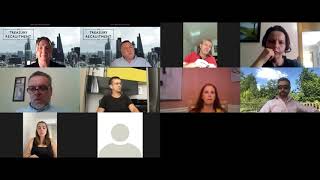
Mike Richards leads a group discussion on treasury skills development, covering self-assessment, goal setting, CV advice, and LinkedIn tips. The session happened in July 2020 during the pandemic, with participants from Luxembourg and the USA sharing market insights and career guidance.
There you go. You're fine.
Are you still working from home, Carol?
I do, yeah. Our offices are closed for the rest of the year.
Okay.
Yes.
I was saying to Katie earlier that I did this summit earlier, this group treasures exchange, and five minutes before, if not less, four minutes before, one of my lights fell over. Boom. And funnily enough, because I've been so busy this afternoon, I've still got lots of broken bits of glass all over my desk.
Oh, God.
I have to get a full vacuum cleaner and everything else. There's a bit broken glass everywhere. So just be careful.
So how was your speaking experience with the act?
It was actually quite nervous. Horrible. It was all right. Everyone was, ah, it's nice. But it was really scary because it was, you know, senior people were on the call. I liked it, but, you know, there's a thousand people watching. Whoa. You know, And Caroline, the head of the act, she said. Oh, I'm surprised. I thought, well, yeah, because it doesn't make any difference to her business. She's. She's. What's the word? She just represents the organization rather than anything else, I think. So, yeah. It's a little bit different.
So.
Look at this. And a little select crew. It's great, isn't it?
I think Ava may still be having problems.
I've literally tried three times, and it's not video. It's annoying me. I'm getting frustrated.
So what's that, then?
What?
My video is not working.
Was it video on your laptop or on your phone?
Yeah, it's on the Mac.
So.
So I don't know why. Usually it works for all the other bounce backs. Didn't have a problem.
You went on the phone, didn't you, before? I think eventually, yeah, I might try.
That quick and see if that will let me. So I'll leave and then hopefully, if I come back, you get to see my face.
Maybe. Maybe we'll just stick with your Mac. It's fine.
I will try. I'll be back in a moment.
That's great. So, Shanita. Hello, John.
Hi, everyone.
Hello, Vincenzo. You know, can you hear us or not? You can hear us. I said. You did the first program, so this is a repeat of this one. So if you do get bored, just go off and just say, now, enough of this, Richard. I'm going home. That's it. Well, you're already at home, so you can just go off. That's fine. Go do the gardening. That's cool. Say again, John Clancy. Yeah. Hello, sir. How are you? Good, good.
So we should be Audio on phone and video on screen. Is that it? Or we could do both on screen.
Or it's whatever you. It's sort of. It's up to you, really. You know, basically what we're trying to do is now this is a bit more of a feedback session and you guys to say, oh, that was good. That was. Not that. We'll go through it a little bit. Katie was know and I were brainstorming before a little bit about the, you know, we sent the homework out, which is. Which is much more about where you are today in the treasury skills wheel. I was just going to bring that up on my screen as well because someone asked me before how we'd put it together. Didn't we, Katie?
Yeah, it was just. Yeah, yeah, yeah. So I think it would be good just to find out what was your sort of thoughts behind creating the Bounce Back program and I guess what prompted you to do this at the time that we did do it?
I think when we first had this idea, we were about. We were in the midst of. About to launch a series of advice videos for clients. They were attached to lots of articles that we'd done before. They were these videos that were telling clients how to think about you guys as candidates, not just to think about themselves all the time. Because we were sort of trying. We try and coach them and say, don't just think about you. Think about when you're interviewing someone, what would attract them to the job, What. You know, it's not about you anymore, it's about them. And then what happened? This weird pandemic came across from Wuhan and it was just like, whoa, hang on. We're going to do all this chat to all these clients and there are no jobs? What are we doing? So we just put that on hold and we sort of brainstormed as a team and we said what we're going to do to help. And it was just much more. I think it came as a result of that. We put together all the questions we were being asked by you guys, literally. So, John, Shanita, Jenny, Evgeny. Yeah, see, I'll try my hardest. Can I pronounce it? Yevgeny. Yevgeny. There you go. Bit better. I'm getting there. Slowly getting there slowly. And I've got someone on three one something. But I'm 6:06. I'll just call you Mr. 606. Hello, Mr. Curtis. I'll have some extra free wine from you at some stage, sir. Yeah. So we put together all the different things that people were asking us and they were asking us things about salary survey and, you know, salaries, rather, they were asking about CVs and resumes. That's one of our most popular weeks. But then when we went back on it, everyone sort of said, well, where do I start? You know, what's the, you know, where am I now? And we didn't sort of send you guys. Well, we sent you guys the treasury skills wheel and I hope you had a chance to have a look at it and things, because that I created. I was going across to Chicago and I do. I've done. By that stage, I've done about 60 or 70 podcasts. And what we did was we summarized from every podcast what every treasurer had said was the key to success. So what's going to make Carol successful at something? We've got two carols. That's good. That saves time. If we're going to get a couple of johns, that'd be great. But basically we were finding out from these treasurers and one was saying, study, saying Sarah Jane said, do all the study and everything else. And if you actually look at the treasury skills wheel and I've got the PDF there, we then boiled it down to the project management diverse experience, qualifications and technical expertise. They were very much the middle hard circle, if you like. They were, you know, very much looking at these are the skills you need to really nail down. And you've got, you know, have you got little experience on it? Very little gray experience? Yeah, I'm doing all right. Or very experienced. And it was for you guys to then sort of do a bit coloring, maybe do a couple of crosses there. I said, right, I've got little experience of project management. I've got a great arrangement. I'm really. I've got diverse experience. I've been in three different places, you know, and then technical expertise, actually, I need to study and everything else. And then the flip side of that was also looking. This is the other thing that everyone told me about was about change, resilience, about risk tolerance, about strategic personal drive. And it was trying to work out for you guys where you're weakest. You know, what things do you need to do. So if you can imagine, it's soft skills, very experienced, hard skills, very experienced. These treasurers are operating in the outer, darker circle. They were operating in the outer, darker green circle. You know, they've got amazing relationship builders, but some of them, when I've spoken to them, they say, oh, I still need to work at that. You know, it might be a global treasure. It was funny, the treasure of Dow Chemicals. He said, I think it was relationship communication he was brilliant at. But one of the things he said was his resilience to change. He said, I'm stuck in the mud. I was like, all right, really? He said, I just don't like change. And I said, oh. He said, I constantly have to work at it. You know, we talked about it a little bit on the podcast, but that was what we were trying to get across that, you know, the areas that each of you guys need to improve upon. And Katie, you, you know, you've seen that as well, haven't you? When we've discussed it with people and neighbour, what have you thought?
Yeah, and I think, you know, there's a lot around, a lot of things that are coming out is how we put together the content for the program around, you know, we're constantly being asked about how to improve CVs. We're having a lot of traction around, especially over the last few months around virtual interviews, you know, and how to actually perfect those versus sort of your normal kind of face to face in person type interviews. You know, a lot of people are asking, you know, as Mike touched on, is it just qualification driven? Is the market just qualification driven or is it experience driven or is it a mix of both? A lot of questions that we have been asked, which is one of the things we were going to talk about is also what's the current state of the market and how are we seeing it recovering and what should you guys do throughout that recovery period to make sure that if you are in the market for a new role, how are you best going to get that?
I mean, I think, you know, just now when you signed up, when you guys signed up for, I mean, Avra. Anything else to add to that as well?
No, I think Katie and yourself have kind of covered it really. I, I would only say I've only noticed that candidates who aren't employed at the moment who are looking for roles, you're seeing some who are kind of asking a lot for help, which is brilliant. Some that have been proactive. Like you mentioned the studies, lot of people started to think, well actually I've not been working for three months and they've started to maybe get qualified for their ACT and use that time in a productive way and getting ready, which is all kind of blends in well with what we're doing with the Bounce Back program.
And again, one of the things then as I say, we sort of coming back to the Bounce Back program itself and what you guys are going to do we said to. Katie and I were talking earlier, we said we not going to do next week because there's only a limited amount we think we can add. Unless you guys said oh no, we definitely want it, definitely want it. But we were talking about. So this week was plotting where you're standing now, then it was about looking at which direction you want to head. So it's about goal setting because you know, quick show of hands. Actually this is quite a good one because of it. It's less. Well, Shanita, you can't show your hand because you're all black and stuff like that. But, but of just of the 1, 2, 6 people there and I expect you. Well, have any of the six of you got a defined goal for how much you want to earn in the next 12 months over and above what you. They go. So you know what, you know what you're going to earn but what you want to earn or have you actually got that as a goal set? So other Carol as well. So I'm going to use Carol. So Carol, how did you come about that? Because that's really cool.
Well, as you know I'm looking for a new role in treasury and I know what I can afford and what I can't and I know that I probably won't find a new role in Luxembourg because of the tax reform and corporates moving away and I want to go to, to another corporate so I don't want to end up at a bank. So that leaves me with my home market as I have the double nationalities with Luxembourgish. I could go back to Switzerland or I can move to London with my AMCT qualification but London is really. I mean I would love to move to London but when you look into salaries at the level that I probably have to start, I know that I cannot afford that with my family so I had to come up with a.
Number and so you've got your base number of how much you'd like to earn or you have to earn, then you like to earn and things.
I know I have to step back in terms of salary but I have to make sure I can afford a bigger step back. And I had to set a boundary of an amount that I can accept and whatever is below. I just cannot accept the role.
It's quite amazing actually because when we did this with our last Bounce Back program and maybe it was because we were quite fresh to it and everything else. When I asked the people, people, they were like, no, don't have a defined. And actually week two or this next bit which we send to you is about some of the goals and, you know, how you improve yourself and stuff. And one of the key things in there was about salary and doing our salary survey and actually defining the next sort of level. And when I asked the group and people put their hands up, no one was. There were a couple of hands that went up. But this is. I'm really impressed. I'm really. So I was going to say without too much detail, but other. Carol, how do I say it?
Carol?
Is it Carol Sabag? Saybag. I'll unmute you. Come on, you can unmute yourself. Ask to unmute. There you go, Carol, you're back in Sabek. That's it. Lovely. So have you got defined goals? You seem that you did, Carol.
I do. My situation is a little different. I was the vp, finance and treasurer of a billion dollar company, multinational company in the States. And they, they were public, they became private, they did a merger. We went permutation and combination, you can imagine, of corporate finance. And at the end they were acquired by a company in Colorado. And I chose not to move. I would be moving for what wouldn't be the treasurer's position anyway. And I took some time off because at that time I gave birth to twins and had an elderly parent who was ill. So in January, I came back to the job market. I had been doing some consulting on my own and sort of looked at where salaries were for positions at that level, whether they were called treasurer or something else. And what I noticed is that at a certain level below taking a pay cut, the functions would also be something that I did years and years ago where I needed to be in the market, which seems I've run it by a few recruiters, companies. It's very reasonable, it's modest compared to what I was earning before. And I don't have to earn more than that because my husband has his own business, which is doing fairly well right now. So that's how I came up with my number.
That's wicked. I mean, I just literally said before it was just like a sea of, you know, one little hand sort of popped up and then it went away sort of thing. And it's great that you guys have then got that. I think we've got sort of both subjective and objective goals in the next piece of sort of homework. And we call it that much more. It's very much more reflective. There's also one of the things that, you know, we said this before, didn't we, Katie and Ava, that I then went through the exercise myself. A little bit. And actually it was like, well, this is a bit weird. It's like, I haven't done this and who's asking me this? Oh, it's me. And actually it was really good because it's helped me redefine a little bit more clarity some of the steps we were going to take and some of the mini steps on the way there. But again, so that was the next part of the sort of the Bounce Back program. And then we follow on with obviously the housekeeping stuff. So do your CV resume and we'll give you much more feedback. And actually because we've got a smaller group, it's so much easier. When we first set out the Bounce Back program, we defined it would be successful if we had sort of 20 odd people. And we got 20, I think we got about 30 on this program. The first one we sort of 20 to 30 we aim for. We had 172 people sign up. It was good, but it made it quite a different program. You know, we couldn't have conversations like this. You know, I couldn't reach out to John to, you know, to see Tim in his cool glasses in his nice back garden. Yeah. Looking at the shades, sporting the shades, the Curtis, that's Tim Curtis from Direct Wine. So if you need any discount codes, we'll circulate them later. There you go. Putting you on the spot there, Mr. Curtis. But joking aside, it was just quite weird because it was like, Whoa, you know, 172 people, you know, you're just speaking to one person. We get a Julie a little bit and you get a quick question and stuff. So I mean, do feel free as well, you know, the chat bar as well. If you've got questions or specific things or just, just, you know, just unmute yourself and put your hand up and ask and things. So then we'll do CVs and resumes. So we'll go through it, give you some good tips. You do more the CV stuff, don't you, Katie?
Yeah, yeah. So it's, it's more round, you know, if you haven't got a cv, how best to create one, what kind of stands out to recruiters and potential employers, what to try and avoid putting in and what you don't actually have to put in. And then really if you've got a cv, it's just really how best to sort of optimise that. And a lot of it is around your achievements. So I think, you know, with all of this program, it's around self marketing, which we all find difficult when it's ourselves. But hopefully the guides will be will, you know, give you that confidence to be able to update CVs and do interviews and start networking and things.
Yeah. And then we go into one of my personal favourites, LinkedIn, because you know what I'm like on LinkedIn. I'm all over it. It's free advertising. Yeah, we do LinkedIn, but I'll go through then some of the top tips I've got on there. Some of you might have seen them at the conferences, but they all bear in mind, there's some stuff I was actually saying, actually yesterday I remembered to do it. But a lot of the time, if you're a second connection of people, unless you look at your privacy settings, you come up as a gray circle. So it's worth just doing it, logging out yourself and then doing a quick search of your name. So say John Clancy. Look at yourself. Double check it as if when you're logged out, then try and see it. Because if you're not connected to you, sometimes you just come up as a gray circle. Well, what's the bother with that? Well, you're 24 times more likely to be invited to make a connection or become a connection with someone if you've got a photo. So, you know, if you can make yourself 25 times more successful, 424, then do it, you know, and it's free. It's just a couple of click, click and save. I'll put that. Maybe I'll send that out to you guys on the next invite. I'll try and find the video for that. And then the week after. Is it virtual interview, then?
Yes.
Yep.
And then it's like around working on where to find. Yeah, where to find jobs.
Yeah. So the virtual interviewing, we give you some tips about that. We go through it and then as Katie says the final bit, we sort of summarize, go through some of your feedback and everything else. Just we were going to. Before the show, we sort of did our rehearsal and stuff. One of the questions that we were being asked was to both Ava, Katie and myself. So ava runs the UK desk, so more junior stuff through up to about 80, 80 plus. I then cover UK Europe, but Katie runs Europe. So just charge to Katie. And then I focus a lot more on the us, so that's a lot more of that. Although, as other Carol will say to us, you tell us it's all closed down, you know, it's like, wow. A lot of the roles we're working on are just like, right, guys, it's on hold. It's on hold till September. But general terms, I think we've been quite surprised at how busy it is, wouldn't you say, Katie? And well, Aaron.
Yeah, I think from European side, you know, there was, I was working on quite a few roles before kind of lockdown happened. Some of those were put on hold just because those particular industries were more heavily affected by lockdown than others. Some of them continued, but the process was a lot slower and sort of for those of you who are around Europe, you know, as Mike said, it does close down over summer, but actually I'm finding more, more roles are coming through. I'm working on a relatively large assignment for one client at the moment.
And Marseille, isn't it?
Yes, in Marseille. So they going on.
She wants the field trip, that's all she's saying. I want to go to France, Mike.
I want to go to someone on the beach. So it's getting better. And it didn't close down completely while we were in lockdown. I had two new people starting. They had to start in the UK remotely before they could, before they could actually physically relocate. So it hasn't closed down completely. I think the kind of shift, if you like, is a lot of my clients are looking at how best to phase people back into the office or like yourself, Carol, if at all this year and putting in sort of more things around, you know, having the working from home as sort of part of your role for some days during the month. A lot of my clients are very much around looking at people who have got the experience rather than the qualifications. I'm very much sort of more of an all rounder, somebody who can do the operational side of things but also is quite happy and is also able to do more around the sort of project side of things. A lot of businesses are now looking at different tools and at different sort of ways to optimize their treasury flows over the coming years. So it's not closed down, it's quieter because of the time of year that we're in. But actually there's still things bubbling away.
And Ara, you said that well, when we were talking again on another one of these as well, when you saying that people are able to be a little bit more picky certainly in UK and they are being. And certainly operational wise, I think they are.
I think because clients know that there are going to be candidates looking for new opportunities, they are a little bit more decisive about what type of person they want coming in, how many years extended, whether they are qualified or not. So that's what I have been finding. And sort of during lockdown, we thought it was going to be very quiet for the uk, but we have recruited positions. We had the maternity cover for six months. That was recruited and that was kind of sort of, we helped to sway the client there to get a more. More senior person in, rather than a junior person who could do the role. But if it's a senior person in, they can kind of take over when needed from the manager.
Well, I think they were a bit worried, weren't they, because it was a maternity leave. And he said, well, once he's out of the office, you know what if you do go for the more junior option, you're gonna have to come back to the office or we'll be talking to them. And they sort of opted, actually we go a bit more experienced.
Yeah.
And then I've had the same. As Katie as well, had placed a candidate for a company. But over here in the uk, he's a Croatian national, so he's living in Croatia now and he's working remotely. And kind of once it's all blown over, he'll be relocating over to London. And then had the treasury risk manager for a good client of ours. And I think they knew exactly what they wanted and it was up to us to find that. And we did. That worked really well. So London, it's getting a little bit pickier sort of in the uk, because I think those candidates are out there. So it's really sifting and just making sure that we do our job and match the right candidate to the client as well. But it's getting better. The market's picked up from what I've seen, so should be a lot of good roles coming through.
And one of the things I was making the point yesterday with someone that the past couple of days, and Katie and I were brainstorming as well, that what we've noticed is that if you look at it, what a terrible crap year everybody's had. Okay, everyone's been sent home and you're working from home. But revenues. I was on. I did this treasures exchange earlier. One of the guests was Sally Ding, the group treasurer of Heathrow. They were thinking about a new. Well, last week they were thinking about a new Runway. You know, now they're thinking, oh, hang on, let's put all the. Put all the planes in the shed. You know, it's just literally their business has been, you know, not wiped out. They're still there and they're coping and everything else, but it's such a massive turnaround but what we were then talking about, and I was talking about in the rehearsal the other day with the guys, I was saying to them, you know, do you, any of you think you're going to get a bonus this year? THEY ALL LAUGH no, we're not going to get anything, blah, blah, blah. I think that's really going to have an impact on the market later this year both UK wise, Europe, us. If you can say that. In previous years there was a sort of a reluctance sometimes when it was an okay year, you got to sort of October, November, oh my, I'm not sure I'm going to leave. I'm going to hang on here because I'm going to get a 20 or 30 grand, maybe 100 grand bonus this year. You know, the CFO is going be lucky to have a job. You know, in previous years there was a sort of a reluctance sometimes, you know, it was an okay year, you got to sort of October, November, oh my, I'm not sure I'm going to leave, I'm going to hang on here because I'm going to get a 20, a 30 grand, maybe 100 grand bonus this year. You know, the CFO is going be lucky to have a job mate, you know, or happy to have a job, you know, just keep your job and stop moaning. And I think that's gonna have an impact because there's a lot of guys I've been talking to who are, you know, wanting to move. There's like a log jam of talent, if you like, that are wanting to sort of shift and, you know, explore different things. And I think working from home again. I was talking to Guy in the US just before this and he was saying, well, I'm based in New York but I'll probably consider most of the country. Was that really? He said, well, anything that's travelable, he doesn't mind doing a sort of a two day commute. So he'll stay away a couple of nights of the week. He said the rest of the time, May, Monday, Tuesday, maybe he's at home maybe Wednesday, Thursday and flies about Friday. You know, he doesn't have to just limit it to New York. So, you know, we got changes like that. I don't different in Europe though in Katie because people don't tend to do it that way, do they?
No, I think maybe the only changes, as I mentioned, is just that people are actually putting in the whole working from home as part of, you know, a lot of the HR kind of policies are changing now to incorporate that, but that's Kind of really the only kind of shift, I think.
Yeah. Bit of a difference. One.
Yeah.
So, okay, well, I'll be sending information out to you guys, but any, any last questions or anything you want to sort of chip in with, you know, feel free to unmute yourselves. I can. How do I do that? I know I've done it before. We can unmute everyone. Yeah, unmute everyone. I love to play around with that, but any, anything else we want to say or contribute? No, John, go for it.
My first time. So has everybody else been on this before or last year or is it the first time for everybody?
First time for everyone. Bar Vincenzo, isn't it? Vincenzo, yeah. So he's a second timer, but in some ways, you know, running through the program, it is a one off program, you know, I think, you know, we've talked about doing more advanced stuff and things like that, but we just put this together just to try and help everyone because everyone. So yeah, this is the first time for everybody that's come here to sort of a bit of self assessment. Looking at your CV, looking at your LinkedIn profile. That'll be a fun week, don't you worry. Then doing the virtual interviewing and make sure that, you know, also these zoom calls as well, making sure that you guys are making the most of it. You know, I said to the guys just before, you know, just before I did my bit, you know, making sure you have two massive. I've got two massive plane lights right in front of me or sitting outside like Mr. Curtis, just relaxing on the decking. But I had this five minutes, three minutes before I did my. I was the moderator for the panel session earlier. I had one of these just explode on me. So there you go. That was, that was. Yeah, that was a little bit scary. You've got all the bits of glass here. So I was like, yeah, I'm fine. Nothing to see here. Just move on. Yeah, I literally cacked myself earlier. Yeah. Anything else, you guys?
Well, I think it's a great idea. I'm sorry, I won't be one second.
Carol.
I think most folks are Europe based, but I know Carol is us, so there's at least two of us are us space. So yeah, that's interesting to know where people are and where they're looking as well.
Yeah, we've got sort of. I know that a few people couldn't make this week and I think it's just every week's really busy for everybody, but I think as we, you know, a couple of people saying also they really want to be on the next couple because particularly about the CVs and things, they said that's a real big pressure point for them. But yeah, it's great. And we got, we have, I mean, we had a crazy amount. I think we had 20 nationalities on the first program. But I'm very welcome to US guys and you know, a few UK ones and a couple of Swiss, Luxembourgish. That's it. We'll talk to you. Carol as well. The other Carol. So, Carol from America, what was your question?
My question was on the treasury wheel, the qualifications section. Do you have an extensive checklist of what at certain levels people are looking for in terms of minimum qualifications to see if there are areas of technical expertise that one might be lacking?
Not necessarily. I think it comes down to sometimes a lot of the case, the role and the client and what they're looking for. So if I've got a CFO that's working for a tech company, they're very much into their cash and payments and everything else. They're gonna have a big hang up about blockchain. So any experience or exposure to that, oh my God, that's a big thing. Big thing versus when you go more junior levels. So say treasury analyst Manager. Obviously, as I was said in the UK at the moment, the sort of minimum standard is amct and if you haven't got it, expect yourself to go to the bottom of the list or not even get an interview. The same with the us Other junior levels. Again, if you haven't got ctp, people are saying, why not? You know, just, you should have studied it. I don't think it actually applies. It depends on the client. But I think once you go past the sort of senior treasury manager, assistant Treasurer level, it becomes less applicable. It's not that, you know, the stuff you do on it isn't, but it's much more that people start to look at, oh, hang on, that person works in this industry, they've got this experience, they've done this systems, you know, and I think they tend to. That's what we've certainly, when I've spoken to clients, you know. So I recruited the head of treasury technology for Chanel in New York. Didn't have a CTP to his name because he just never had time. He was doing all the other stuff. I think he actually marked some or he was involved in marking some of the exams and things like that. So, you know, he'd gone all the way through but never actually had it himself. So, you know, that's a different thing. Sort of thing. But yeah, less so from that. Any others? No, everybody else is like, that's it, end of, end of a Tuesday, they're like, oh, go. So cool.
Well, I have a question actually. So the treasury wheel, when we identify our weaknesses, do you come up with ideas how to work on those?
Yeah, send it through. One particular advice. Well, just maybe just, you know, again it was more that sort of 180 sort of reflection on yourself, you know, just like I, you know, I didn't do the skills wheel but I did next week's exercise where it's about goal setting and all that stuff and I was like looking, looking through it myself, you know, as a recruiter. So it's slightly different for me because you guys are moving on with your treasury finance careers as a Treasury finance recruiter. Mine's different sort of angle on it but actually when I look back and I was like, oh, hang on, how do I do that? What am I going to do there? So, you know, maybe again it's to try and be reflective of you. So when you look through it, Carol, maybe just look at, you know, if there are areas you think, right, what do I need to beef up on? What do I need to beef up on? And just like, you know, Carol from the US said, you know, there are, if you were joining financial services and a role like that, you might look at doing an alco. You know, there's the ALMA qualification which is a very long distance qualification, very good actually, but it's much more banking financial services. It's not applicable to Corporate Treasury. The ALMA qualification, which is a very long distance qualification, very good actually, but it's much more banking financial services. It's not applicable to Corporate treasury looks much more eyelids and eyelaps and everything else. So yeah, it's a different way of looking at it. So yeah, just jot down some of your questions, Carol. And the good thing is I am willing to answer them. Last time, last time from the 172 and particularly the CVs I started to get inundated. They would say, oh, can you review my cv? And eventually I started to say no because we got sent, you know, we have a lot of CVs but I think we were getting like 30 or 40 CVs. I went, Guys, I can't do it. Now we will do it. But we couldn't do it in the lead up to the conversation with you guys. I think we can, you know, so spread out between us and we'll make some critiques and stuff and we won't name and shame you. Unless you want us to. Yeah. Should we do that? That'd be fine. Yeah, we don't mind. Yeah. I will name and shame you on LinkedIn. So look at your LinkedIn profile in the next couple of weeks because I will do it. Anything else to add, Katie or Amera?
I don't think so. I think it's just if you've got anything in particular you want to get out of it that we've missed or anything like that, don't be afraid to ask us on the calls or anything, or drop us a note.
Yeah, like that was you, Carol saying. Just said, you know, just drop us an email. It's much more manageable. You will hear Ayra's dog in future weeks because usually the dog, there's always this dog. It's not a joke. Literally, you just ask questions and suddenly the dog answers. That's not criticism, that's your job.
It's usually when Mike's talking, she barks. So I don't know.
Cool. So see you next week.
See you next week.
Next week.
Bye, guys. Bye.
Bye.
More from Mike



Why Treasury Professionals Don’t Show Up to Events (And What Organisers Get Wrong)

AFP 2026 Las Vegas | Use My Exclusive DISCOUNT Code and Join My 2 Treasury Sessions

Treasury Technology, AI & Cybersecurity: Felix Meyer (ABB Capital) on TMS Projects and Future Skills




AI, Cybersecurity, and a Fast Track TMS Rollout with ABB Capital’s Felix Meyer