Do Corporate Treasury Professionals Want To Work From Home?
Ernie Humphrey and Mike Richards discuss whether treasury professionals want remote work, covering recruitment challenges, employee happiness, and job satisfaction in the post-pandemic market.
Yeah, I mean, for me, what I found, and I haven't seen any research that says people are less productive working from home. One of the things that has surprised me is that most people report their work life balance is even harder. People that have never worked from home thought they were going to go around their merry way and not focus on work. And kind of just to dovetail on what you said. I mean, it is important human interaction, right. And a lot of vast amount of people want at least one day of human interaction, which is fine. But when you look at the productivity, right, and we'll start to see more and more surveys and as the writing is on the wall, people will realize you can be productive from home. And I think that'll become the norm. And then as companies don't do that, Right. I think they're going to suffer, as you said, in the battle for talent, because there is a battle for talent and so it's not. So let me go back to that. I should ask you this earlier, Mike, so let me ask you this question. So in terms of the positions that you've seen, do you see more applicants applying or less or the same or what have you seen the last six or 12 months on that?
I think the best way to answer that is around the competition for us. Insofar as, you know, the early days of Pandemic, everyone was, you know, people saying, what's your chief competition? I mean, it's LinkedIn, you know, because HR could put an advert on LinkedIn, 200 people would apply, they'd sift through, and sometimes they would still go 200 down to zero and we still get the phone call. And it was sometimes, well, you know, we can't really help you. You've trawled it, you've made the, you know, scorched earth. I don't want to go out there and chase for people. But what I rapidly saw is as we've moved through it, it's gone from 200 to 100 to 50 to 5 or to 0. I'm seeing now adverts going out there and then, oh, hang on, we need to go to a specialist recruiter, you know, and that's not, oh, look at us, look at us. Or they need to go to a recruiter, full stop, because they know that we add the value now that the market's starting to get busier. Are people actually actively applying for jobs? No. But will they speak to us about stuff? And we talk that sometimes we talk about passive job seekers. You know, if I'm looking at the audience and talking to the audience. But virtually today, if I would say to you guys sitting, watching today, are you actively seeking a job? You know, maybe 5 out of 100 might per job their hand up in an audience. And you might think about this, you sit there. But if I say to you, and look down the lens and say, right, how many of you, though, would answer a phone call from me if I had the right next job for your treasury career? How many of you will pick up the phone? And nine times out of 10, I'll answer your phone call, Mike, I'll speak to you, I'll pick up the phone. Lovely. They will actually answer your call. So people are interested. And so are we being successful in this post pandemic market? Yes, we are. Is it tougher? Yeah, of course it is. Because bringing back the working from home thing, it's about also educating some of my clients. I'm saying to them, what's your working from home? Well, we haven't really gone through that. No, no, no, no, no. I need to know what's your minimum? What's your maximum from working from home? I've got one of my other clients, they're actually looking, they've got their main treasury center, but they know that out in the country, really difficult to get to. So what they're doing is they're probably going to get a regional office center in central London and that's where the treasury team will meet occasionally. And it's a really great way to do it because. Because they know that then geographically they can do this. We're talking to the client I was dealing with in New York. They were saying, well, actually, we don't mind them being at least, you know, only being in the office two days a week. Great idea, because it's costly as well. So. And it's a bit of a schlep to get to their offices.
So I guess I was just thinking when you said LinkedIn, it kind of. Sometimes something clicks on the. On a little light bulb I have in my head. But I guess, I guess, I guess it really plopped popped. Was that when I think about it on LinkedIn. Right. What LinkedIn has done is it's actually made it harder to recruit because I guess I should have said it earlier, quality versus quantity, right? So the quantity of people shoving their name in, because I can push a button on LinkedIn because there's no investment to it, I don't have to write a cover letter. I just say here, yeah, yeah, bang, bang, bang. And they don't they might not even mean it, right? And so the job of the HR person has become even more difficult, right? And if they haven't seen that yet, they should, right? So they might get 300 people, right? And like you said, get zero qualified, whereas they use a specialty recruiter, right? It's like, I'm going to give you someone that's qualified, right? So I can either waste my time going through 300 people or paying someone to do that or I can say, hey, this guy's going to give me who's qualified. So thanks.
I think that without, and only without just being a big stand up advert for us, someone asked me again the other day, said we, well, why would I use a recruiter? Said don't. I said, no, don't. If you don't want to go through the 300, see how you get on afterwards and then give me a call. You know, we also do with some of the roles we recruit, no win, no fee, not all the time, depending on the level of the company or client and things like that. And we'll say, look, we'll give you advice, you know, we, we're an advisory, we're a consultancy, we're not just an agency. And that's where we add the value, you know, after 20 plus years, you know, again, I talked to this client yesterday and I said, look, go, go back to your HR guy. They've got this, they've got this policy. They're going to use hr. I said, use HR and then see if you've got any treasury folks underneath your desk or loads of great quality ones coming to you from LinkedIn. And I said, and we'll talk in three weeks because I know we will.
So, yeah, I mean, I guess kind of think about it, you know, from my perspective as a professional. Here we have dogs howling because they're so excited by Mike.
This is it, this is, this is the working from home policy and trends. Get used to background noise.
That's right, the background noise. Anyway, I have a, I have a psychotic animal. So this is live tv. So what I was trying to say was that when I was a Treasury person, I didn't like recruiters, but I love them now, right, I got to get the background noise. And so for me I value it more, right? So what I do is I try and connect the best talent, right, to the best opportunities. And so for me as a curator of talent in my position, right, I would rather have the company using a specialty recruiter because I know they're going to get me the Right. Opportunity. And when I talk to the people that are building their treasury teams, I want to give them the best talent. Right? And like you said, I didn't. I wasn't a recruiter fan. Right. Seriously, I give Mike a commercial, but I really wasn't because I didn't know what Mike did and how he was doing it, because it's rare. But it's like, if you're in this industry, it's a small world, right? So to get the best of the best. So I always say, get the talent that you deserve, right. And it's worth a phone call, right? Like Mike said. I mean, I've talked to some people, you know, they're like, I'm never using a recruiter. And then I get a message on LinkedIn and say, oh, let me. I need to talk to someone else. And so I think if you want to take ownership of your career, you want to make sure that you're getting the best opportunity for managing a team, you want the very best talent. So the proof is in the pudding, right? Do you want to make a wrong decision about your treasurer, your assistant treasurer? Right. Not that every position is important, but do you want to make that kind of mistake? I don't think so. Right. That can derail your career. Right.
You keep going slides wise, a couple forward, ego, the number of days working. Yeah, we got some. And again, this will change over time as we get more people. This is the key one. This is what I wanted to go into. This is an interesting bit. It's about who's happy. You know, are you happy in your role? Yes, lots of people are happy. You know, this is a weird thing, considering a new opportunity now. That chart, which is quite strange for me, has changed massively. And do you know what? I think people are, post pandemic, slightly scared. And what I mean by that is that chart didn't used to be 66, 34. That used to be happy in your role. We used to have 70, 30. In fact, there was a bit more. At one stage, I think it was about 75% people were happy. But the weird bit was 90% of people were considering a new opportunity pre pandemic. So we're talking a year and a half, two years ago. But again, one of the other things which perhaps doesn't come out there and will give more granularity to it, is as you move up the career curve, if you're a Treasury analyst, are you happy in your role? Yes. You might be happy a lot more. Those guys, we break it down to These. So you'll see some of these figures. But if you're a Treasury analyst, you tend to be told what to do. There's a lack of self empowerment. You are told, you're directed, you know. And I talked to a treasurer about this recently and explained this to him. I said, look, you're treasury analyst, you're telling them what to do every day. Oh yeah, yeah. How often do you treasure treasury manager? How often? Well, we're talking to about once a week, if that stuff. Okay. Your deputy treasurer. Well, we catch up about once a month. I said, okay. And how often does your CFO talk to you? So, well, we talk regularly. I said, no, but when you do, it's what we do, an annual review. We probably do a six month review. I said, so you're being told what to do once every six months. You've been given goals, you deliver it with your team and stuff. I said it's about empowerment of those guys. And as you move up the curve, weirdly enough, you actually, number one, get happier in your role. But also you get happier, full stop, because you're leading your treasury activity. You're doing this now. That also impacts on the considering a new opportunity. If we were to look at this considering a new opportunity as a treasurer, it actually goes down less. Treasurers are actually overall looking for new jobs. Why is that? Well, I think a lot of treasurers are risk averse. I think a lot of treasurers are saying, well, actually I'm happy in this now and I'll see where it's going. And again, it's an interesting one. Although it says 34% not considering a new opportunity, in some ways we ask the question, are you considering the opportunity? No, I'm not. But the fact is, if a new opportunity comes knocking, how many people answer the phone? Nine and a half times out of 10, 95% of people really will answer the call.
I also think there's a generational component. I think the younger generation, they're not like the older folks. We never wanted to change a job. I mean, that was a bad thing. But I think the younger folks, sometimes they job hop a little bit too much and they think the grass is always greener. And it might be, but I think there's also that I'm pull you up.
Right, Humphrey, I'm going to call you out on that one. I don't think that's correct. I think what you. The point you're making. I understand the point you're making. I think the world of work has changed and I've talked to you about this in the past. Let's go back. My daughter, she's now 21, my eldest, but she, she was 16 at the time. She got a job as a server in a local restaurant and she came home and she said, oh, dad, I've got this job, brilliant. She said, what else are they going to give me? I said, what are you talking about? They said, well, they pay you your wages and then you go home. Yeah, well, I'll get a pension. Hang on, you're 16? Well, you talking about that basically. And she was, well, what other benefits will I get? You know, we had that benefits jar earlier. Well, what I get this will I get Flexitone? I was like, hang on, you're waiting on tables. The attitude of people to the world of work has changed. When I originally started the world of work, I went to work, got paid a pay packet and I went home and it. But now it's a totally different way of working and that's what people are expecting. They, you know, they've worked it out that you spend more time and at the working then you generally deal with your, you know, your friends, with your family, you know, and that's a key difference. That's a key change. Now to go back to your point, Ernie, and I think people now have realized that if you don't like a job, you're not going to put it out. There are other jobs out there, there's a greater work. It was harder to get a job before. There wasn't a LinkedIn, there wasn't accessibility to mobility of jobs. If you don't like your boss now, you'll go and get a different boss. Know it's up to the bosses to make those, those guys stay, not just them.
Yeah, no, I, I agree on, on the vast majority. I think the, the information piece is really important. Right. As you mentioned.
Totally.
So, so there's a part of it being more educated and everyone's more educated up and down, up and down the, the, the age spectrum, whatever we'll call it. So we're gonna have to do this. There's not too big of a difference here. I had to look at US vs UK and see if we were happier. I'm surprised we're not more unhappy given.
Well, our pubs are open a bit more. That's one of the things. When we're unhappy we go to the pub. When we're happy, we go to the pub first.
That's right. So not too much of a difference. So 5% there. So I Just wanted to point that out. And so this is another piece of this which I really find interesting. And so the people that were happy, right. Mike said a follow up, okay, why are you happy? Right. And you can select more than one. Obviously good boss, right? Was still at the top, but good, good work. Life balance, right. Was 60% as well. And then competitive salary was, was low, right? It was 41%. Right. In other surveys that Mike's done ranking what makes people happy, that's been even lower. But I think that one of the good things that we're doing nowadays is getting people to think a little bit beyond, beyond the salary. So Mike, any thoughts here?
Yeah, definitely. Well, we used to have this where you could only choose one. So it's a simple ranking and stuff like that. But then actually we discovered that when we were talking to candidates and said, well, actually I go to, I don't go to, you know, work and just I like my team, I like my boss and I like making the difference, but I can only select one. And I found. They found it. So we took that away. So that's why when you see this, you know, you add this up, you got over 200, 300%. But if we have to just to rank it about when I've talked to people, everyone say it's a salary survey. So the key thing is obviously salary. Terrible. No. Out of nine or 10, usually salary ranks about. Sometimes it's about depending on the region between 7 and 8 and sometimes 9 out of 10. And people say, well, hang on, not it's about that self actualization. People don't go to work because of the salary. They want to be paid. That's fine. But actually they, why they're happy. Again, this is the happiness side, you know, the why people are happy. We also look at the unhappy people. Ernie will bring us on to that. It's about your boss, it's about being looked after. It's about getting that balance between life and stuff. Ernie goes, what's the next slide? Is the next slide unhappy? There you go, look at that. It's career progression, it's your achievements. Where's the salary on that? Work does not make teams poor boss. Nothing. Even the features. Because it was so down that there's no point, you know, it's not, it's not about the salary, why people are unhappy. Not even mention of your sat. Oh, you're not paying me enough. It's crazy, you know. Yeah, that's one of the key things.
Yeah, I think, I think that the other, the other Part of this, which we want to look at is if there's differences, of course, across the job titles as well. But it's interesting to see kind of where that goes, right? And so, you know, I'm interested to see if poor boss, right, goes up or down. We should have high expectations. But when you look at what makes people happy, right, if you look at it right, we want to talk about employee engagement, right? How do we retain people? As a leader, we need to make sure that we are good on all these things, right? Do I facilitate this environment, right? So as you start to see that as a leader, am I making sure people are making a distance? Am I a good boss? Am I supportive? Do I give honest feedback? Do I offer professional development opportunities? Do I enable that good life, work, balance, variety of work. But then when you are, when you're recruiting people in, right, as you're a manager, talk about these things, right? Because, you know, they matter. So as a boss, I might not have thought these things were so important. I might not have thought, hey, when I'm trying to get the best person, I want to communicate that we do all of these things, right? So what I want to do is help people get the right talent and just, you need to kind of proactively go out, right, and say, and if.
You go on our website, you'll see some of the blogs and some of the articles and, And a lot of those came from as a result of stuff like this. When I was talking to people, there was one I wrote, it's not about you anymore, it's about them. And that's one of the. And it still sticks in my mind because it was. I had a number of clients said, well, I'm going to go out and recruit someone. I'm brilliant. And then they put down all of their requirements. I'm like, okay. And then they say, and they must have all these filters and they must be qualified like this. I mean, brilliant. And what do you. What are you going to do for the person that comes and joins you? What. And you know, why they, why, you know, why would they come and work for you? Well, because I'm a good boss. Or you just. It's not like the first time they've been asked, but if you were to actually ask them, you know, and I say this to treasurers and say, look, you're going to go join that cfo. Why? Oh, well, because this, this, this. So I actually, a lot of the time have to say, right, can you just switch places, virtually switch places with that person? On the other side of the table and then think about them. And only we've done another session and we about virtual interviewing and things like that. And I think this is one of the key things that whenever you're recruiting, whatever you might be doing, that's one of the things you need to look at as well.
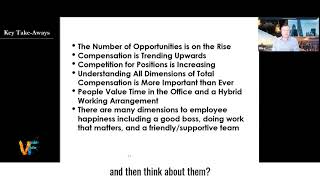
Right. So let's go ahead and give us some closing thoughts here. Again, we have a little bit more of a brief session, but what I'll do is I'll have Mike, once the survey is done, we'll do a webinar on treasury webinars and we'll do the whole hour treatment and maybe doctor Do a series of webinars because there's so much information to go through. And so for me, some of the things that stick out, especially as Mike was talking, so, you know, just from a passive job seeker, like I go and look all the time, I look up treasury manager and there's like 200 jobs and I'm like, woohoo, that's pretty cool. And then I'm like, wait a minute, why would I go and click on all those jobs? So let's be mindful on what we're doing as people looking for jobs. And people need to understand on the recruiting side, it may get the word out, but the people you get the word out to might not be the right people. The competition is actually increasing and on some level there will come, there's some people will make it through. Right. Understanding all the dimensions of total compensation is very important. People value time in the office, but they want that work hybrid work environment. And then especially from the boss side, there are many dimensions to employee happiness, including a good boss doing work that matters and a friendly, supportive team. So Mike, I'll let you make our final comments here on the session. What are two or three things that you want people to take away from this session?
More from Mike



Why Treasury Professionals Don’t Show Up to Events (And What Organisers Get Wrong)

AFP 2026 Las Vegas | Use My Exclusive DISCOUNT Code and Join My 2 Treasury Sessions

Treasury Technology, AI & Cybersecurity: Felix Meyer (ABB Capital) on TMS Projects and Future Skills




AI, Cybersecurity, and a Fast Track TMS Rollout with ABB Capital’s Felix Meyer