🎤 From Journal Entries to Treasury Leadership – Live in NYC with Victoria’s Secret, BMS & Horizon!
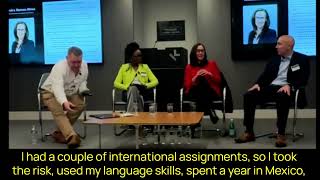
This is a YouTube video titled "🎤 From Journal Entries to Treasury Leadership – Live in NYC with Victoria’s Secret, BMS & Horizon!" recorded in April 2025. It features a live panel discussion hosted by Mike Richards, a treasury recruitment expert and podcast host, with treasury leaders Summer Simmons from Victoria's Secret, Sandra from Bristol Myers Squibb, and Frank from Horizon Blue Cross Blue Shield. The discussion covers their career journeys, treasury leadership, team development, continuous learning, and industry insights in a professional treasury context.
So welcome back. Now, those of you, hands up. Those of you who have come to one of these before, look at that. So we must be doing something right. Whoa, I'm loud. Let's take that down a bit further. Right, so I usually do this bit. I say get a bit of enthusiasm, everyone give me a big. And then we do it twice. It's a bit boring. So I'm going to give a good evening and you're going to give it back because you've got some amazing guests here. Good evening, New York. You didn't let me down. Thank you very much. So you've all made the effort. I don't know if Cisco can turn this down a little bit. You all made the effort to come here. Good thing is there's no WI fi signal, so it means you can't go on your phones now. I don't know why I'm getting feedback. Can we get Cisco? Can you ask Joe? Yeah. Whereabouts? Yeah, sorry about that. Yeah, but I've got to be here. I've got to talk to my guests. This is the thing. You have come here, so be present, join with these, me, the three amazing treasurers. Then afterwards, you get to network with a lot of your peers. You also, by coming here, get CTP credits. Thank you very much. I know. I want to firstly thank as well, Cramer Levin. Where is Ken? Where's our host? That's Ken. You have to be really nice to Ken. He's providing venue. Thank you. And we're getting free drinks even from the guys at Treasury Spring and Kyriba icd Redbridge. Tis. Can you put your hands up, please? Those are the guys you really need to be nice to because they're providing the drinks, they're paying for the venue and everything else. So who am I? Mike Richards. I run the treasury recruitment company. As you can see, I've got a face radio. That's why I do a podcast. We have a lovely team. Got Joe here today, Katie back in London and myself over here. I've been a treasure recruiter now for the past 25 years. After doing it about six years ago, I started a podcast. I thought we'd do 10 episodes. We've now done 375. Every single week, I speak to a treasurer about their treasury careers. I was just explaining earlier to Frank, soon we're just going through the approval process with afp. You'll be able to listen to the podcast whilst you're walking your dog, going to the gym and earn CTP credits as well. I know another reason to Listen to my lovely voice every week. But more than that, you actually get to listen to amazing treasures like these three. So this is what we're going to do this evening. We are going to go through each of our panelists with. They're going to give a quick run through of their backgrounds. We'll talk about the new parts of, well, life, if you like, and this new ways of working, a bit of hybrid and everything else, what they do. Then you're going to get a chance to ask some questions. When was the last chance last time, rather you got the opportunity to have the treasurer, Victoria's Secret treasurer of Bristol Myers Squibb. And Frank, he's going to explain all about his company as well. So, Summer, over to you.
All right, we're jumping into this. Hi, everyone. I'm Summer Simmons. And my career has been shaped by one simple mindset. I always want to be a volunteer, never a hostage to my career. So I needed to live through that. That means I had to say yes, excuse me, to the opportunities that took me outside of my comfort zone. It means that I just had to step outside of my box. I'm an accountant by trade. After about a decade of booking journal entries and planning my whole life, around month end, including my wedding, never being able to take a day off on my birthday, I had an unplanned hallway conversation that just changed everything. So I went from managing the rear view, that's a little historical context, y' all got it. To focusing on the future. And that shift literally happened overnight when I joined treasury as a practitioner. Fast forward about 12 years later. Today, I lead a Treasury team at Victoria's Secret and Company where I'm responsible for managing cash, capital structure, corporate finance, risk, MA and everything in between, given the day. And this audience can appreciate that better than anyone. And if there's one thing that being in treasury has taught me, it's that a successful career doesn't necessarily follow a straight path. After finding myself in this field, I made a promise. I am no longer putting limits on what my career should look like and I'm staying open to what it could look like. Sorry, because the big opportunities don't always follow a roadmap. So here we are today. Super excited to be here, back home in New York for about 48 hours, but more importantly, humbled to share a panel with these esteemed individuals. Individuals and the Mr. Treasury himself.
Sandra.
So thank you. And I will not be as eloquent as some. My journey has been more so about risk taking and opportunities. I too was an accounting major and I'm a cpa. I've done one journal entry my entire career and I'm quite proud of that. I started my career in AT&T in a rotational development program and as my entire career has basically led to every company I joined disappears. So a month into being at AT&T they announced Tribestiture. I chose to go to Lucent. So the unknown. I had a wonderful seven years there. I had a couple of international assignments so I took the risk, used my language skills, spent a year in Mexico, spent a couple of years in internal audit supporting Latin America and then I spent almost a couple of years in Brazil. I decided that I wanted to come back to New Jersey and be close to family. I did not have a job so I came back with a hope and a dream of finding a job and serendipity happened and an FX manager opening happened to come about and that's how my career started in treasury and I've been in treasury ever since. I've been in treasury longer than most. Some people in this room have probably been working or alive. I left Lucent because Lucent also had went through some challenges and some troubles and headcount cut and etc. Etc. I joined a company called Cendant Corporation and their international treasury department which was a broader role. I was there for around two and a half years, always had a keen interest in pharma. I wanted to work in an industry that made a difference in people's lives and who hasn't had someone impacted by cancer in their family. So that just meant something to me. I had an opportunity to go either to JJ as an international treasury manager or to a no name company, Sagene. At the time it was a $400 million Thormite company which could have failed within a few months of my being there. And of course I chose to go to the no name company and take the gamble. And it was the best thing I've ever done in my life. It changed the trajectory of my family and my career frankly. I was there for 15 years, had my kids while I was there, got to grow and build a Treasury organization, touched every single thing in treasury, learned what I liked and didn't like and then we were acquired in 2019, third company down. So I have been at Bristol Myers Squibb since 2019. I did lobby for my role at Bristol Myers. I had a choice do I want to stay or do I just to want to go and look for a different opportunity. I did lobby for a promotion. So when I went to Bristol Myers. I did go as a vp, Assistant Treasurer, and then I did lobby that I wanted to be treasurer one day. So my lesson to everyone here is advocate for yourself because if you don't speak up, people may not even know that you're interested in the role. So I did approach our CFO one day. I said I would like to be treasurer one day whenever the time was right. I got the call in 2021 and I couldn't believe it. Literally. I thought I was getting in trouble. I thought I was getting fired actually, because there was an HR person in the room. I said, oh goodness, what did I do? So I got the job. He told me, you have to fire X person and you have to build the treasury of the future. So we have been on an amazing ride over the last few years building and changing the BMS treasury function. And I have an amazing team that I've been able to build and support me.
And I want to explore a little bit more about your teams as we go through. We'll go across to Frank, over to you.
Sure. So I probably have the opposite way. I got into treasury, so I started off in banking. I worked in two different banks and then I made my way into an accounting firm doing structured finance. So working banking at an accounting firm, I was at PwC for a couple years. Made my way over to a client which was a health insurance company, which probably the last place I thought I was going to work on my career trajectory, which I'll probably cover a little bit in comments later. And now I'm at Horizon Blue Cross Blue Shield in New Jersey. So one thing that perhaps you can take away from today is most people know the name Blue Cross Blue Shield but don't understand how it works. So I'm going to explain it to you real quickly. Each Blue Cross Blue Shield company is an independent company, or most of them are. They share a franchise license and they have governance rights. For example, my company has the rights for the logo in the New Jersey. We share a network. So once you're covered by one company, depending on your plan, you're generally covered by any Blue Cross Blue Shield company. So if you think of it like a franchise, that's effectively how it operates. Probably the most well known is Elevance. That's the publicly traded Blue Cross Blue Shield company. They cover a couple different states, including New York, but we're focused on New Jersey. In terms of my role, I started in treasury at my last company, which is Emblem Health, an insurance company based here in New York City. And Then went over horizon. It's been a good opportunity for me. I've certainly learned a lot. And I think the interesting thing about are different industries. Although we're both in health care, different sides of health care. Treasury has a kind of common bond no matter what industry that you're in. And there's always nuances. So I think one of the things that I think about in my career, I become the expert on health insurance. But it's interesting to interact with other treasurers because I like learning about different industries. And so I'd always say take advantage of opportunities to hear from others and learn those different industries. You'll get a lot out of it that you sometimes take back to your job.
And also you then lecture as well, don't you? At Hofstra?
Yes, I've been. I'm actually a union member, so I'm in the professors union nationally. I've been doing it for about 10 years at Hofstra. Definitely a passion of mine. I love teaching, I love education, I love being part of the university. And quite honestly, that'll be one of my other comments, I think, I think it keeps me fresh. There's a lot to research, a lot to study. And so the fact that I can cite like CAPM formulas and things off the top of my head, I'm proud of that.
We'll start actually with yourself then. Maybe we've got a mixed audience here, so some early practitioners maybe studying CTP as well, and some that have been through the program study wise. Obviously you're seeing that, as you say, every day for the past 10 years. Why do you think that's so important?
I think the pace is just going to continue. I think a lot of times people thought years ago, oh, I go to school, maybe I'll get my MBA and then I'm done for the rest of my life. And that wasn't the case then, and it's even less the case now. Skills are, you have to be relevant all the time. Myself, I challenge myself to study up on things. And the best thing with the way things are structured today is you can go online and you can read, do a podcast. Podcasts are great because you can get exercise and learn a lot at the same time. I mean, that's really important. And so the ability to learn continuously is going to create those opportunities. Because Sandra just spoke about earlier about advocating for yourself, no one's going to say, oh, I think you know this. You have to prove that you know it. And so the best way to do that is to take that on yourself, whether it's a certificate, a course, whatever to say hey I'm motivated, I'm interested throwing on it on your resume. I think that's one great way to.
Advocate for yourself Sandra, with you and your team. Obviously you've got again a range of them, junior guys, mid levels. What do you do to support the education and development of those guys?
Yeah, so we are very keen on developing our team and cross training. We do a lot of benchmarking as well. So we're very involved in the NOI Group organization where we're benchmarking with all of the other mega caps and we're always you're going to learn something because it doesn't matter what industry you work in. Treasury is Treasury. Risk management is risk management. We take advantage of all of the bank the banks have to offer. The banks certainly have a lot of great ideas and sometimes those ideas require a lot of education for us to actually be able to explain them to our senior leadership and to implement. So it is a continuous journey. We have lunch and learns as well so that we're teaching different areas of the department what other areas are doing so that everyone is on par and understands how we're delivering that value for the organization.
Similar to Sandra, we take advantage of the bank's willingness to teach, quote unquote for free and we I personally try to stay really engaged with my peers and encourage the team to find their equivalent in retail and outside of retail. As everyone on the panel has shared, treasury is treasury or industry looks a little different but the things that we're challenged by, we're all challenged by them. I think having access to relevant information, understanding that our role is best elevated outside of the company. Like most people in our four walls can't teach us treasury, we're normally teaching them. And so getting outside of our building, whether it's virtually or in person. A few weeks ago we finally took Goldman Sachs up on an offer to come in and have a teach in and it was fantastic. Right like the team and was like oh my gosh, this is what they're building is. I was like don't get ahead of yourself. See what we pay them. So it was just a really fantastic time to be outside of the cubes or your home office and being someplace else in a quasi classroom environment. So taking advantage of all the access to resources, whether it's podcasts, off the shelf desks that the banks might have or NOI Group just looking for bits and pieces that can help tell the story in bite sized cognitive easily to digest ways that has really helped the team. I have a team that's coming from FP&A. They have no treasury or they had no treasury experience. And so we agreed that they would trade their institutional knowledge and I would teach them treasury and get to be the hero. And now they love it. And so what's valuable in that is just really figuring out what do they need, how do they digest things and giving them access to it.
Cool. Sandra, if you move your microphone up a little bit. Just that one? Yeah, that's it. Perfect.
Even with the mic, I speak too well.
What do you see as key to your success? I'll start with summer and then come across if you like looking back at your career and thinking some of the steps you've made made or missteps you've made as well. The do's and don'ts again for I do that every week when I talk to people on the podcast and I have pre briefed my audio, my my panelists. Don't worry, these aren't tricky questions. When you look back at that, what were the thoughts of yourself?
What did you look at?
So most people, their moms know them best and if your mom were to describe you growing up two, three words, she'd have them tip of My mom would describe as chatty and nosy. She would probably still describe me that way today. And so after years of being chatty and nosy and the benefit of perspective, I realized that that translates into curious and able to establish connections really easily. And so that has been everything for me in the course of my career. So whether it was being an accountant and stepping through what that looked like to networking and engaging and having this unplanned hallway conversation that then allowed me to get into Treasury, I find that I'm still using that. Talking to bankers, talking to our key stakeholders, helping people who really just want to understand the difference between Most people think that treasury is some weird combination of AP and I don't know, accounting. They want to know do we have enough money for me to get paid next week? That's all they care about. And I'm okay with that because that means they know that I exist. And so that's a large part of not just me, but our team exists and that's a large part of the communication and the connection. More importantly, that means that treasury is always thought of in the context of we have this great idea, but do we have the money to do it? And I will take that all day before they spend the money and then we Find out that they spent it and we've got to go looking for it. So from a success perspective, I would say it's just channeling your inner kindergartner and figuring out how that shows up in your day job. And I've been able to do that. Missteps. I think the biggest misstep that I've made during the course of my career is waiting to be perfect or waiting for somebody to tap me on the shoulder, or waiting to be able to hit every single bullet on a job description to say, okay, I'm ready. And you get one boss to many that has no idea what you do. And you figure out, I'm gonna start applying for these jobs because apparently anybody could do it. Not anybody could do it. But I got to a place where I stopped waiting for profession and I finally started saying, to Sandra's point, raising your hand and saying, I'm interested in doing X at some point in life. Raising your hand for the stretch assignment, raising your hand to be the project lead for treasury on some bigger project. And it's really just giving yourself permission to lead with progress. Not permission, not perfection.
Sorry.
Sondra.
So in terms of my success, I think first and foremost it's having a very strong support system and a strong team surrounding myself with really smart individuals and sometimes people that are smarter than me. I don't know everything and I don't have to. I have a great team and I can rely on them. The other things that are on me is my work ethic. I have an incredible work ethic. Actually work a little too much. My desire for results and our focus and just always delivering value for the organization and really see selling that and highlighting for everyone in the company what treasury can deliver for the organization. Because we are not a cash management shop. We actually do a lot of other things within treasury and we do have the ability to deliver value. And it is the only finance function that actually delivers P and L. In terms of missteps, I don't really focus on mistakes because the. To me, they're all learning opportunities and it's more of a personal learning is balance. Because I've always worked so hard, I missed out on my kids growing up. So my learning was. I should have had more balance when my kids were younger and spent more time and gone to the elementary school to go to the class party, to go to the Halloween party. Because when they call you out on it, let me tell you, it doesn't feel good. And they remember.
Yeah, no, I think some really great points from Both of you. From my perspective, when I think about what I perhaps earlier on in my career I didn't think through is I think a lot of people have this view on I want to do this, and, and I don't open myself up to the various pathways. And I said in my earlier comments, if you would have asked me if I'd work at a health insurance company, I would have told you no 20 years ago. And if I told you two health insurance companies, I definitely would have said no. And here I am, right? So sometimes the opportunities that life brings you, you don't expect. And if you're not open to them, you can actually cut off viable career pathways for yourself, be open to opportunities. I think that's a misstep that I've probably been guilty of at some point in time. And I think a lot of us are because we have our own biases and perceptions about what we think certain jobs or roles or industries are. I think the differentiator that you can think about when you go out in the market is one of the things I've learned in my career is some people say, oh, I want the job and then I'll do. And I think, at least in corporate America, that's a really hard proposition to make because companies, managers, particularly at the C suite, they're not looking to reward you and then take a chance on you, right? You have to show your value to them in order to get there. And so you think, oh, I put in my time, I should get it, whatever the case is. Maybe the case, but that's not the world work, in my opinion, and that's not been my experience. And I think the best advice I could give everybody that I benefited from my career is do the role, demonstrate you can do it even though you don't have the title, and sign up for more responsibility even without any of it. And at the end of the day, it's going to give you one or two things, right? Either you work for a great company that's going to notice you and is not going to want to lose you. And now your leverage just went up because. Because they're worried that you're very marketable and so they better promote you or pay you, otherwise you're going to go someplace else, right? Or if it doesn't happen at your company, you've just improved your resume dramatically and you've created better experiences that you can give to another employer. So don't say you have to pay me to do that job responsibility, just sign up. And that's Been the story of my career. People that know me, every time there's someone and they can't figure out where to put it, give it to friends, sure, I'll do it. I don't complain. Get it done. So be a doer, don't complain, be disciplined. I think that's benefit.
And if you're coaching and managing a team to do that, how do you get that across them? Because again, we've got some people here in the audience. They might be freshly. They were a Treasury analyst, senior. Now they're becoming a Treasury manager. They're starting to coach, a mentor. What advice would you go there? And we come back through the panel, I would.
I say all the time, the hardest part, part of my job is managing people. All the technical stuff is really easy. And as you grow, go forward in your career and get promoted, you have to manage more people and more different personalities. And so companies pay you to manage people. They don't pay you for just your intellect. Otherwise they could just hire a PhD to be the treasurer. Right. And so putting together teams that work is difficult. I would say the most important thing to figure out is who's ever on your team. Sit down and ask them what is important to you. Right. Because when you ask somebody what's important to them, you're going to get a different number. Some people, it may be work, life balance. Another person, it might be career progression. Another person might be experiences or exposure they want to get. So figure out what makes each person on your team tick. And then being the manager, figure out, how can I put this team together so that as a whole they function? So if you can figure out what's somebody's strength, the other person's weakness, how can I blend that to make a more effective team that will really help you out? If you just sit there and say, I want everybody to do the same thing, that's great in theory, but really good teams don't execute that way. People are trying to work with each other and partner to cover up where the weak spots are, and it makes the team better. I've been spending a lot of time the last year or two working on my leadership, and the company's invested a lot in that. And I think I've learned, learned a lot in the process. And I quite honestly, I think the teams that I've had have been excelled because of that.
Yeah. Before I get to Sandra, I was just going to chip in as well. I did a session with a number of U. S. Treasurers just at the end of COVID and we were talking about our treasury salary survey and I was talking to them, they said, oh, it's all about the money. I said, do you know what it's not? They're like, well, no, yeah, this is your salary survey, this is it.
I said.
And I went back through and they said, what advice do we need to do to keep our team? And literally just kept. Luckily, I kept the slide here. And it was like I said, go and have this conversation with them. Say, what's your work life balance like? Am I being a decent boss to you? Are we giving you enough variety? How are you fitting in with the team? And then ask about the salary? And I said, why? And I said, 85% of your jobs will go, your problems will go away. Like, really? I said, yeah, these are the top reasons. 80% of staff leave because of these. So, Sandra, for yourself, how do you manage it?
So, to me, culture is everything. If you have a good culture on your team, you'll get the results that you need or even exceed. So when I was building out my team, it was all about fit. It wasn't necessarily about having the. The treasury skills, because we can teach those, but it was about the mindset and the fit and the being open minded to change because change was coming and it was going to come fast, which meant trust and psychological safety was a top priority for me. You have to get the team to really trust you and to buy in to what you're trying to do and change, because people change is hard. There's a lot of fear that comes.
More from Mike



Why Treasury Professionals Don’t Show Up to Events (And What Organisers Get Wrong)

AFP 2026 Las Vegas | Use My Exclusive DISCOUNT Code and Join My 2 Treasury Sessions

Treasury Technology, AI & Cybersecurity: Felix Meyer (ABB Capital) on TMS Projects and Future Skills




AI, Cybersecurity, and a Fast Track TMS Rollout with ABB Capital’s Felix Meyer