Important Tax and Treasury Issues to Consider Post Pandemic
James Harold, Mike Richards, Mandeepa Kaur, and Paul Harrison discuss how tax and treasury teams should work together after the pandemic. They cover liquidity management, intercompany loans, foreign exchange risk, and hedging strategies with real case studies.
And welcome to our webinar today. Really looking forward to doing this and I'm sure it's going to be a very useful session. First of all, delighted to be hosting this with my good friend from the Tax treasury recruitment company, Mike Richards. Welcome, Mike.
Thank you, sir. Great to be here and with you esteemed guests. I can't believe you even let me in this virtual room as much as anything. So, yeah, it's quite nice. Lovely.
So Mike and I are sort of jointly hosting this today, partly to announce sort of our new working relationship. We both, as you might be aware, have a lot of experience in our respective fields in recruitment, mine in tax, Mike in Treasury. And we thought it, you know, we see quite often a number of roles come up now that are jointly for Tax and Treasury professionals, where someone might be jointly running a Tax and Treasury Department. So we thought it made sense that we teamed up on roles like that should someone be looking for someone with experience in both sectors. So if you are looking for people with that type of experience, we'd be delighted to help you. If it's more treasury orientated, then Mike might be the best person to go to first and vice versa. If it's more tax orientated, come to me first. But it doesn't really matter. We can work it out and help you on that and anything you want to add on that, Mike, at all. Before we get started on the.
Well, I just think, you know, without being a complete sales pitch, I mean, 30 years plus experience between the two of us, you know, if you want a conversation and just need advice, that's what we're doing. And as we said before the show, you know, 51% treasury, call us. 51% tax, call James and we'll just give you advice about it. And then later on, we, you know, from this show, both you and I have talked to some of our connections that do both, and Mandeepa and Paul are going to do all the technical piece, but then we've done some interviews with some of the people that are here today about the split between what's happened throughout the pandemic and Tax and Treasury. So we've got firsthand knowledge of how that's affected those guys and we're there to give advice again. And I think that's the key thing that you and I both had from our many years of experience. Although we don't look that old, but we are. So there you go. Yeah.
Do you start with my gray hair? So delighted to have Paul and Mandeepa on the webinar Today who will be presenting the webinar for us. I've done webinars, Mandeepa, before and they've been great sessions and Paul, I know, has done a lot of talks in the past, so welcome both of you and I'll pass the reins over to you both now. And we very happy to take questions from anyone who has any questions and we're leaving a bit of time at the end to do that. If you do have a question, please just pop it in the Q and A box at the bottom of your screen or the chat box will be fine as well. So over to you, Mandeepa and Paul.
Great, thanks, James and hello everyone and welcome, I guess just to quickly introduce ourselves. So I'm Mandeepa, a director in the corporate international tax team at Grant Thornton. My experience is quite broad across corporate tax compliance and advisory for a range of clients. But alongside this, I lead the Grant Thornton treasury tax team, so focusing on all aspects of corporate debt, including interest deductibility, debt restructuring and foreign exchange as examples. Paul, over to you.
My name is Paul Harrison. I lead a consultancy called Dakota Advisory. I've got a mixture of experience where I spent 10 years on the corporate side and the last 15, 16 years on the consulting side working for PwC, PMC and Grant Thornton, where I met Mandiba. Set up Dakota Advisory about a year ago and we're focused on helping clients at the small, medium and large size, private equity and listed. And our offering is both on a consultancy basis where you have a particular issue you want to address, cash management, banking, fx, or we can also assist you operating on an interim treasurer basis where we help you in, for example, in a carve out as we're working on at the moment, where a organisation's been carved out of a larger conglomerate, doesn't have a Treasury function and we're going to look to set that up from scratch.
Perfect. Thanks, Paul. So, before we start, just want to outline our agenda for the session today. And as many of you have experienced, the world has changed for so many companies over the last year, with the focus for many being on maximizing liquidity in order to deal with reduced cash generation, for example. So as a result, we're finding that many treasurers have been taking action to raise new funding, renegotiate existing debts and restructure hedging transactions. And all of these treasury operations have the potential to affect taxable profits to quite a significant extent in a number of circumstances, and even more so when you're dealing with volatile foreign exchange rates. Interest rates and commodity prices. So in the session today, we want to really explore how Tax and Treasury teams both interact. The role of tax and treasury in an organization and how that's evolved over the years. Some of the key tax and treasury considerations for businesses as they start to emerge from COVID 19 and then on top of that, what the future of these two functions will look like going forwards. So on that note, I'll hand over to Paul to kick us off.
Thank you. So, as Mandeep implied, the role of the corporate treasury has been evolving. It's becoming more strategic. The role of the Treasurer we often see in both discussions and papers and conversations has become one where rather than being in an ivory tower, rather than focusing on only specific areas of banking, cash ethics, risk management, the Treasurer is becoming more of a strategic partner externally and within the organization. And certainly from our side, we're seeing the Treasurer and the treasury team and the treasury function having to take a greater and greater role as a service partner that assists the business with its development. Perhaps an example would be with cash management, whereby from a Treasury perspective, you want to make it as efficient as possible, have as little cash as you can in the operating companies, but the operating companies need to know that they have sufficient cash to operate on a day to day basis and meet their requirements as if for due. However, we're also dealing with a world where you need to increase profits. You have an environment of significant uncertainty and that uncertainty in the markets then can drive other activity. And as part of being that partner, you need to work with tax.
Yeah, exactly. And as Paul's outlined, the evolving role of treasury means that businesses may now be seeing more complex treasury and financing transactions than ever before. And as I mentioned earlier, these transactions have the potential to affect taxable profits. So for example, treasury transactions may give rise to market movements which are unhedged for tax purposes and therefore can result in quite significant cash tax liabilities. But also capital structures which are tax inefficient can impact on the company's overall cost of funds and their tax cost, therefore potentially offsetting the work that the treasury team are doing to preserve cash. And clearly the tax implications of treasury and financing activities is a complex area. But this has been made even more significant in recent years given the changing tax landscape globally. So you'll all be familiar with the OECD BEPS initiative which mapped out minimum standards on taxation. And a number of those minimum standards address cross border financing as one of its kind of key aims and objectives to target. And the BETS initiative will have impacted any business that engages in cross border cash pooling or intercompany loans, or where the business runs an in house treasury function that funds the rest of the group. And on top of this, the announcement last weekend on the G7 reaching an agreement on the new global tax framework further adds to the considerations for a tax professional. So now more than ever, we're starting to find that tax needs to be brought into the conversation around treasury activities a lot earlier, with tax considerations needing to be built into the design of any treasury transactions that are being entered into. And this should also include how treasury transactions affect intergroup relationships, which we're finding are not always high on the Treasurer's agenda, but can have significant tax impacts. So in particular, from a tax perspective, it will be necessary to ensure that elections are made on time where possible evidence is retained, on files with appropriate documentation. And I'm not just talking about this from a UK tax perspective. We need to ensure that tax implications in all jurisdictions are considered as that will also be relevant to any decision making.
So I think from my side, Mandeepa, you know where we're seeing with our clients is, as we've noted here on the presentation, it's very important to make sure you manage cash shortages, make sure you get liquidity at short notice, important to raise the debt that you need to maintain the business. It's got to be tax effective.
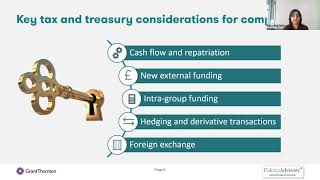
Yeah, totally agree. And that's the kind of key message from our presentation today, is the need for both functions to be coordinating, collaborating on a regular basis. And we'll kind of discuss this as we go on. But what does this role look like? Is it a combined tax and treasury role? So typically we see a Head of Tax and Treasury or treasury and Tax Director, or potentially in our experience, as businesses get to a certain size, maybe separating out this role into two different functions with one individual with overall oversight. So for example, the cfo. And it'll be interesting to discuss this with the attendees later as well. So before we get onto the kind of wider discussions, what we just wanted to do first is provide an overview of some of the key tax and treasury issues to think about in relation to actions that treasurers and tax practitioners are thinking about taking in light of the pandemic and in a response to the pandemic. So I'll hand over to you, Paul, to kick us off here.
So, as Mandeep has said, we're going to cover off five areas which clearly overlap and clearly aren't all COVID 19 related. There's some general Comments here. But where we can we will add in that overlay where the pandemic and so forth has led to perhaps more of an imperative when we're thinking about cash repatriation just as a background. My, my experience in the last 10 or 15 years has been very private equity led and so those organizations are typically highly levered. They also have a very high cost of funds. So when you have a margin of 4 or 5% and almost irrespective of what the LIBOR is, it tends to occupy the mind somewhat. So from a Treasury perspective, what you're really trying to do is to manage a number of contradictions. You're trying to make sure that you minimize the amount of cash you've got in the group, except at the center and even at the centre, then minimizing amount of cash you need so that that can be used to repay debt wherever possible. However, the contradiction with that is of course with allowing the business to run smoothly and we often find the businesses that have either moved from family or owner managed status or large, very large conglomerate status where their cost of funds is very low, to being private equity owned or being distressed, then that, that is a big contradiction. So you need to manage, manage the cash within the group, but you need to make sure that the group also needs to operate. Group is not this Treasury. I think part of that there was a cultural thing and I think we all tend to curl our lips when we hear the term culture because first it can mean whatever you want it to mean, but also it tends to then move away from finance, tax, treasury, which is where I suspect most of the people on this call feel most comfortable. In this context, what we're really talking about is managing that culture that can build up, particularly in an international group where there is a view at the operating company level quite often that the money's their money or that if it isn't their money that they least need to have the confidence that that can be accessed quickly. So yes, that's true and we'll come back to banking in a little while but we need to always emphasize to these people and sometimes put in KPIs that make clear that it isn't their money, that they can have that money back subject to tax. Mandida thanks Paul.
So as Paul has suggested, when you're looking at cash flow and repatriation, the key question firstly is where is there a need for cash and what strategies can be applied to manage liquidity and cash needs globally? And there can be a number of different ways of structuring this and repatriating cash, including distributions, structured lending, including repayments of interest or cash pooling, which all have different tax implications. And often the key considerations on which approach to choose will be driven by the tax treatment in local jurisdictions, because there could be different tax costs per country. But when looking at repatriation of cash, what we're finding is the main tax cost is withholding taxes. So either arising from planned distributions or payments of interest from one jurisdiction to the other, and as you may have experienced, or many of you may have experienced, withholding tax costs can be more significant these days following Brexit, because the UK has lost access to a lot of the EU tax benefits we'd previously been able to access. It's also worth noting here that the chosen steps to repatriate cash out of a particular jurisdiction may also in part depend on the legal requirements. So there'll also be a question as to the availability of any distributable reserves in the company that is making the repatriation of the distribution before it can do so with any of its profits upstream. I don't know if you had anything else to add on this one, Paul.
Not on that, no. Just to point out, Mandeep, you and I have been looking at a couple of projects recently, a particularly large one that was exactly that. So from Dakota's perspective, we were going to be working with Grant Thornton in a project that would see Dakota work with bankers, local finance teams to identify trapped cash and other forms of local funding that could be released centrally. And to think about that very much from a liquidity management on the banking and a loans perspective. But then Mandeepa and her team were going to be looking and determining whether what appeared to be appropriate in that mechanical sense. Really good work.
Yeah, exactly. So I think the next topic, new external funding.
So in new external funding, I'm sure a lot of people here, particularly in certain sectors, have had quite a lot of activity in external funding over the last year or so, for reasons which we don't need to dwell on. Again, from a Treasury perspective, particularly in a Covid environment, but perhaps more generally as well, it's all about maximizing flexibility, it's all about minimizing cost. But that isn't just the covenants and it isn't just the cost of funds. It's also about making sure that other details within things like an RCF and other debt packages are appropriate. So making sure you have enough tranches in an RCF, we sometimes see RCFs with very few tranches. And indeed, even then, as an aside, not all of those tranches being used. So if you are in a situation where you have volatile cash flows, obviously it's important to be able to draw down that cash. It's also important to be able to repay it as well. And so you minimize the amount of cash and therefore debt, cash being held and debt being drawn. At any point in time, it's important to be able to repay the debt you may find over the next year, if some of the economic forecasts are correct, that you can repay debt earlier than you had originally or earlier foreseen and that you have ratchets, you know, credit quality can increase as well as go down. We also find that, and I'm particularly again going back to my private equity roots here, that covenants don't always help from a commercial perspective. And you can have situations where, for example, all the assets being pledged, including cash and bank accounts, now that's great if that reduces your funding cost, but only to a certain point. So you can have a situation where you have pledged bank accounts and it just becomes very, very difficult because you end up having tiny little pots of money everywhere. But if you've got enough bank accounts, that adds up, I would say, I think perhaps we could come back to the highly leverage and complicated debt point here. But you need to ensure that it's tax efficient. And mandeep, I'll leave perhaps that over to you. But finally, on the covenants, making sure that you understand the whole debt package, I have a lot of clients who have from time to time, should we say, politely winged it when it comes to elements of the covenants and particularly other elements of the debt package, including debt baskets and internal obligor requirements. So you need to make sure that all of those models and documents and documentation are in place.
Yeah, yeah. And equally, it's a big topic from a tax perspective. So a key consequence, one things we see coming up time and time again linking to what Paul said about tax efficiency, is with increased finance incomes, increased interest costs. But there is a question about whether those interest costs are deductible for tax purposes. And many companies are now finding that tax is no longer debt is no longer the cheaper option compared to equity, given the number of limitations to tax relief for interest costs. So, for example, in the UK we have the corporate interest restriction, that's a bit of legislation that was introduced back in 2017, but effectively seeks to limit interest deductions to a measure of EBITDA. So particularly over the last 12 months, in light of COVID many companies are finding themselves in a situation where the tax efficiency of debt has been impacted by falling income profiles or EBITDA across their group or where the limitation in certain countries, including the CIR to an extent is dependent on levels of group interest expense and the outcome is impacted where the business has decided to deploy cash that might otherwise be held for investment purposes to repay external debt or reduce external interest costs post Covid. So there's a number of things to think about there and I just want to flag on the corporate interest restriction or the CIR rules. From an administrative perspective, it's worth considering the impact of these rules even if you don't fall below the rules 2 million pounds threshold, because there may be a possibility or an opportunity to still file what we call abbreviated returns, which can allow groups to bank interest allowance in the current period and use this in future periods going forward. So there may be a real benefit here. And CIR isn't the only anti avoidance provision for interest deductibility in the UK. And consideration needs to be given to all the other rules. I can think of about five or six at the top of my head, for example late paid interest rules, unallowable purpose rules, etc. So it is a vast topic and we are seeing HMRC's inquiries start to increase in this area as well. In addition to interest deductibility, one of the other trends we've been seeing in light of COVID is an increasing desire for more flexible ways of raising finance. So greater use of complex financial instruments and non standard debt. So for example, your convertible loan notes, your warrants, your exchangeables and lenders prefer this because they give more flexibility, give them a bit more assurance over, you know, insecurity over their investment. But what we're finding is the financial reporting and tax implications can be quite complex for the borrower company. So companies will really need to understand the accounting treatment of these instruments in order to determine the specific tax treatment. And based on what the accounting answer ends up being, the tax analysis may fall into the usual rules for corporate debt, the loan relationship rules, but could alternatively fall into a chargeable gains basis of taxation. So depending on the outcome, this could lead to quite significant cash tax liabilities as well that companies weren't originally anticipating. Some other quick considerations that we've also outlined on the slide include withholding tax. Again bringing this up because we're still finding it's a real cost to companies for external funding. So in many cases where you are seeking external funding, it's necessary to understand the lender structure as well, and where the funds are really coming from. So, for example, if this isn't another UK corporate, there may be withholding tax costs of any interest payments that are made. And also, depending on what currency the balance is denominated in, there may be foreign exchange considerations as well, which could give rise to tax volatility. And finally, the key question is also, from my perspective, to understand what transactions gave rise to the new debt being entered into, something that's often overlooked. But if from an accounting perspective or a legal perspective, there's been a change to an existing debt instrument rather than a whole new debt instrument being put in, for example, a change in interest rates or an extension of the loan term, this can have significant tax impacts, such as taxable gains or losses arising from the modification, and could result in the elimination of certain grandfather tax benefits as well. So it's definitely an area for tax to be talking to treasury and their accounting colleagues well in advance of the instruments being put in, just to really understand the unexpected tax implications that might arise. Back to you, Paul. I think.
Intra group funding this is going to be in part will be in the case study that we're going to chat about in a few minutes, but picking up on some of the themes that we've already covered here. Integroup funding, we find, is one of the classic areas where tax and treasury interrelate. And for those of you who are T and T directors, this is one of the areas where I think your role in drawing together the two arms becomes crucial. And certainly Mandeepa and I work together quite closely on various projects. This including the case that we're coming back to again to cover off that comment made earlier. Part of this is about having a culture to ensure the local entities don't own the cash. It's not their cash, but they feel that they can get it easily. It's one thing to have cash locally to run the business, it's another thing just to run the business. And having that ability from a banking and a cash pooling perspective, to move funds quickly and easily is vital. The analogy we often use in that situation is it's one thing to have £50 in your wallet and another thing is to have the ability to go to the local cash point, draw out £50 in cash pooling terms. That can often be the arrangement, but from an intercompany loan perspective, you also need to have put in place the model, the process, the documentation, the policy, proper documentation. As I say that to make it work in mirror terms. So don't just focus on the banking, on the discussion of JP Morgan or Lloyds bank or whomever. It's also important to make sure that from an internal perspective everything mirrors so proper documentation.
Yeah, and that would be a theme I probably will mention again when I, you know, as I go through the tax considerations. But generally the tax considerations for Intergroup funding won't be too dissimilar to the previous situation where we were looking at external funding with one of the first questions the tax practitioners, it being to understand the extent to which interest would be deductible for taxpayers purposes and the anti avoidance provisions. So I won't go through this again, but it is worth noting that in our experience those anti avoidance provisions for interest deductions are more likely to target intra group arrangements as opposed to third party situations. So that you know, you will be thinking about those a bit more in this scenario. And I guess one of the key provisions to consider are the transfer pricing or thin capitalisation rules which require lending to be provided on arm's lengths terms. And effectively the think capitalization rules require companies to assess their borrowing capacity and whether this changes the amount of debt that can be taken out from an Intergroup perspective for tax purposes. And I guess coming out of COVID a key question is has an altered treasury need following the pandemic resulted in an increase in intercompany debt that subsequently changes your think capitalisation analysis? So it would be necessary to think about this in advance as well. Also necessary from a transfer pricing perspective to ensure all loans are well documented and that's a requirement of the legislation as well where companies are supporting intra group funding through a cash pooling arrangement which we're seeing being more common these days. There'll be considerations here. So ensuring that interest rates can be supported from a transfer pricing perspective and that any risk to the lender companies are effectively priced into that interest rate. Potential withholding tax cost on payments of interest between jurisdictions and also foreign exchange risk where lender companies have different functional currencies to the borrower companies which could lead to tax volatility. And in the case study we'll come on to shortly, we'll explain how we might have managed this in practice in a real life scenario. And finally, I guess from an intra group perspective, a number of groups may find themselves in a situation where they need to consider a debt restructuring of their intra group debt. So for example to facilitate repatriation of cash, improving the reserves position, obtain better terms of lending from third parties or improve and restore Liquidity and broadly, the default position from a UK tax perspective would be that companies are required to bring into account debits and credits arising on this restructure for tax purposes. But there are a number of tools and reliefs available for companies to enable you to restructure debt on a tax neutral basis. And these typically apply where you have got companies under common control. But to ensure these reliefs are available, it would be necessary to ensure that companies have a full understanding of the nature of the debt and how it arose, as well as the accounting legal implications. But again, this is where the documentation really comes into play. So Paul mentioned the intercompany framework, which is equally important for tax and, you know, from an advisory perspective, but also HMRC perspective, they always look at, you know, how these loans have been documented to ensure that you can access the tax relief that we're talking about, because that supports the substance or the economics of the loan and the nature of it as well. But clearly, again, you know, there's a lot of different tax considerations. So another area where it would be important for tax practitioners to, to undertake an early evaluation of intergroup balances, to assess any risks and then take appropriate action accordingly. Coming to our next topic.
The next and the final topic that there is a degree of overlap here, but we wanted to focus on foreign exchange specifically in a moment. But just looking at hedging and derivative transactions from a Treasury perspective, what we're focused on here is your classic economics view. So making sure that things work, making sure that things are, the risk is being managed in an appropriate way. And so what we try to help our clients with, and we're working with several recently who have been in quite a bit of a tangle with this, if I'm frank, is on thinking about policy, how that works and then how that can be made clear for the board to both understand and approve and oversee. So we always think it's very, very important from a hedging perspective, whether it's interest rate hedging, commodity hedging or obviously FX hedging, to be very clear about what you're doing, to be very clear about why the hedging is occurring, because hedging doesn't have to occur. I had a conversation only yesterday with somebody who made it clear that, you know, they, they will often talk to their clients in a slightly different area and they will make it clear that hedging is not a requirement. It is something you do in order to modify your underlying position. Not doing something is allowed as long as you're doing it if you will excuse the expression, you're actively not doing something, but you need to be clear why the hedging is occurring and you need to get the Board approval on that. A number of people on the call here will be familiar with a situation whereby there's been an informal policy in place for a number of years. And that's fine right up into the point where not so much it all goes horribly wrong, but where you could make a case of saying, if we hadn't hedged, then we would have been better off. The old hindsight trading situation. And you will be familiar with the situation where you have that non exec director who says, well, of course, I always thought that the dollar was going to do X. That can be largely dealt with with an effective policy that the Board has bought into. And it's very important, I think, for many of the people on call here, as a protective device, not so much just protecting your job, but just protecting the integrity of the activity that you've undertaken. The quid pro quo for that, though, is reporting analysis. So the Board or the Treasury Committee needs to know what's going on. And so it isn't good enough to say, have done some hedges. Thanks in an email. You need to have, in my view, a model that shows what the underlying exposures are, the hedging that has been undertaken, how the hedging is compliant with policy, and then the other costs and issues associated with that. And that's something we work with clients a lot. Switching the angle slightly here. We also think that it's very important, wherever possible, to use simple instruments. In most cases, for example, with foreign exchange, a forward contract is appropriate. There are situations where using an option is a good idea. Perhaps in a sales situation where you don't have a load of derivatives on the books that need to be marked to market at the last minute. Perhaps you don't have the credit capacity to do those. Or simply where you need to manage a situation where there's uncertainty relating to the event, perhaps tender risk, for example, and the exchange rate as well. But there are many other situations where options or other structured instruments are used, where they're opaque, they're hard to account for, they're hard to report, and sometimes, dare I say it, they reflect a view. Finally, just think about Libor and LIBOR transition and just sort of bringing on the table. Again, I'm sure everybody here is aware that Libor is. It's not only on the way out, it's nearly out. And that that has implications not just for your financing agreement, not just for your interest rate hedges. It can also have implications for other elements of your commercial business. So we have seen businesses that have commercial contracts that have a Libor linkage in some form. I don't just mean housing associations and like, I do mean others as well. So making sure that Libor is understood and planned or the planning is complete is important as well.
Yeah. And coming on to the tax hedging tends to be quite a complex area from a tax perspective, just because of how vast the legislation is in this area. But ultimately the tax treatment depends on the accounting. I feel like I've been saying that a lot today, but the financial reporting implications will be key. So a lot of businesses will be applying fair value accounting in respect to their derivative contracts, which leads to, you know, which currently probably is more volatile given the current market conditions, but then also leads to cash tax volatility and uncertainty when you're trying to forecast your tax payments. The default treatment with any derivative and hedging transaction is that debits and credits arising in the P and L should be brought into account for tax purposes. So clearly understanding the accounting treatment will be key here and considering well in advance of the year end what alternative accounting options might be available. So for example, is hedge accounting a possibility so that movements on derivatives are recognized in a reserve on the balance sheet as opposed to the P and L, therefore avoiding the tax impact? That said, it is worth noting that where companies are adopting hedge accounting, there is a risk that hedges may become economically ineffective as a result of changes in expected revenues and expenses, which could result in some P and L volatility again and ultimately impact tax. So that's just something to be aware of there. But on top of managing the tax volatility through the accounting, there are tax elections and structuring opportunities, but they do require coordination up front. So for example, the creation of back to back transactions or drafting specific tax documentation to meet the relevant conditions. And in a number of scenarios the tax elections have to be made before the derivatives are entered into other hedges been entered into. So definitely worth reviewing this as early as possible. And one other point I've added onto the slides as well is Libor transition. So as Paul mentioned, many of you probably started to consider this given the pending cessation of Libor. And you're probably already thinking about the impact this has on your business from a tax and accounting perspective. I specifically included in this this slide because this is the area where I consider to be the most significant impact of Libor transition. So Just understanding what impact this has for existing hedging arrangements and whether it could increase tax volatility or change the impact of any elections that have been made. So I think Libor is going by the end of the year, so definitely worth thinking through where you have got tax elections or specific hedging arrangements, trying to understand what that really means for the business and any impact the financial statements would be really important then Similar topic broadly, not too dissimilar to the slide before, but there are some specific points we just wanted to pick up on from a foreign exchange perspective.
So again, as Mandeepa said, some of the same and some people here with COVID 19 will have noticed, however, that the effect of the pandemic has sometimes change the game for them. So that can be where the EBITDA mix has changed and indeed the revenue and cost mix has changed. It can also affect your credit quality and therefore your ability to hedge in the first place. But leaving aside those broader Covid related issues, again, sometimes what we have to work with a client is just take a couple of steps back and not just say how much are we going to hedge and how far, what instrument? But what is the problem? Do you need to hedge at all? Is this an issue that needs to be addressed with hedging? Are there other ways of managing it? And the answer often is yes. So you need to be clear about what the problem is. To start with, I'm going to go back over hedge accounting, but yes or no is an important question. Are we going to have hedge accounting? Is it worth the hassle? Is it worth all the the reporting and everything else versus the volatility that will arise if you don't have it. I've covered some of this already, but supporting activity with the board approved policy and an FX model. So being very clear about what the overall position is, I'm not going to dwell on that again, but perhaps more or less importantly, understanding and really understanding what the FX risk of the group is. We often work with people and I've seen actually in the last year or so some people have been caught with this where they have commercial contracts that can either increase and sometimes mitigate FX risk. So it's really important to understand not just the prima facie figures that you have in the management accounts, but you know, the underlying commercial reality. And then again handing over now for the last time with this section to Mandeepa, just making sure that your ethics approach is effective on a post tax basis. So again, you know, you even sometimes have things like intercompany FX hedging and the like, making sure that all works, rather than just assuming that what goes up here goes down there. Because certainly that isn't always the case.
Yeah, exactly. And kind of similar to the previous slide, typically with foreign exchange movements, specifically on loans and derivatives, these are brought into account as the FX movement goes through the P and L and tax liabilities therefore can arise from exchange gains that are unrealised and therefore unfunded, which can be problematic for many businesses. So FX tends to be a real cash tax cost and an area of tax leakage for a number of companies. From a tax perspective, there are a couple, couple of levers that you can use. So generally tax returns will need to be prepared in the functional currency. So it'll be important to ensure that this is considered and you know what the functional currency is. But there are tax selections available to designate a currency as a functional currency, which typically applies to investment companies where a company might be holding shares in overseas subsidiaries. And similarly to the previous slide, there are other elections, hedging related and otherwise that might be available and a number of beliefs that could apply if the relevant conditions are satisfied. But again, the deadlines for these typically tend to be start of the accounting period in which you want them to apply or before the relevant hedges are entered into. So another reason, you know, tax on related foreign exchange just needs to be considered from the outset and clearly another reason for tax and treasury interactions to be undertaken on a more real time basis. I don't have anything more to add on fx. I don't know if you do, Paul, otherwise I'm going to.
No, I think it'd be good to go on to the case study, actually.
Perfect. So do you want to set the scene?
Yeah.
Thank you. Thank you, Mandeepa. So this is a real case study. Obviously it's on a no names basis. We can't talk about the exact client, but it's a project that we've worked on in the last, well, on and off the last couple of years. This is a very large international client. Several billion dollars worth of revenue over the world, listed in the Far east, with significant activity in the United States and quite a lot of activity here in Europe and specifically in London, was an organization that has been growing in a way that hasn't always been reflected in the finance function. It's been trying to catch up. And one particular area where that had manifested itself as within its intercompany loan framework. As you will almost all know, I'm sure the classic structure for an Intercompany loan framework, where possible, is to have what you call a hub and spoke arrangement that works for both treasury, where you're managing all the risks centrally, and it works from tax, where you're looking at all the exposures centrally and the tax treatment centrally. This didn't have that kind of structure. So this was a business that had, let's call it circa 300, intercompany loan arrangements around the world between different entities, of which only four were documented. So the remaining, let's call it 296, it was slightly more than that. Loans were typically on a mesh basis where one subsidiary operating company was lending to another and then another was lending to another. Peter was lending to Paul, Paul was lending to Peter, etc. Rather than all lending to group and borrowing from group, it was in a situation where it needed a lot of work. So what we did was work from both a Treasury side, which I will talk through here, then a tax side to assist them from the treasury side. It was a case of working through what could be done firstly to boil down those loans. So we were able to boil them down to about 80. So it was a case of calculating net balances, which is a little bit more complicated than it sounded. It wasn't just a case of putting some numbers into a spreadsheet, it was a little bit more than that, but understanding how to boil down all these long and short bonds positions into the most efficient structure possible and then working through what that hub would look like. It was all about also making sure that you put in place cash and FX settlement procedures. So most of these loans had never been settled. So we needed to firstly divide them into three kinds of loans, whether they were cash pools, whether they were then short term loans or long term loans. And we needed to put in place procedures and so forth to make that work. We also needed to change the cash pool mechanisms and in the case of one part of the world, put in cash pool mechanisms in order to make that work from a mechanical perspective, in the same way that it's great to have cash pools and to move money around and make it very efficient, but if you don't have the intercompany loan framework to support that in a mirror and documentary way, clearly the other way around is equally difficult. And then we also need to understand and determine the currency in the denomination those intercompany loans. So we needed to understand why and how that should work. Now from a Treasury perspective, I would always like to have all of the loans being in the currency of the operating company so that wherever possible, the entity out of the two sided relationship, the smaller one with the smaller finance team, with no access to local banking reigns and typically no access to hedging, doesn't take the risk, isn't always as simple as that. But where possible, we were working through that as well. That then led to drafting an intercompany loan policy. It was more than a policy. So there was more than just how this ought to work in a rather breezy and oversight way. It was laying down a lot of what we just talked about there on the right. And that's how we made it work from a, from a Treasury perspective to bring efficiency, bring banking, bring automation, bring treasury management system processes to all of this, make it a lot more efficient than it was before. However, there was more to it than that and that's where Mandeepa and I worked together quite closely to make sure that that all then worked from a tax perspective.
Yeah, so one of the key risks was foreign exchange. So as Paul mentioned, the intercompany balances were denominated in a mixture of local functional currency and overseas currencies as well. So each operating company had their own foreign exchange exposure and that was then quite significant from a tax perspective. So as Paul said, the part of the solution was to consolidate the FX exposure into the treasury hub and really manage that centrally, therefore reducing the risk for the rest of the trading companies because they were only entering into debts that were denominated in their own local functional currency instead. So that put the tax cost into the center in the us, which is easier to manage globally given the nature of the balances. Some of the other tax considerations that were required to be considered included, again, withholding tax considerations on interest payables on all intercompany balances. So now thinking about this on a global basis, what were, you know, looking at the relevant treaties between the US and all the other countries in the group, and what did that mean from a withholding tax perspective? And then ensuring that the relevant treaty clearances and certificates are put in place. There's also a question around transfer pricing and, you know, reviewing the thin capitalisation position and whether the restructure that we were trying to achieve impacted the borrowing capacity of any trading group and therefore we had to significantly change the debt structure as well. Fortunately, in this situation, we found that the transfer pricing thing, capitalization position hadn't been significantly impacted because there wasn't a wider impact to the group. This was already just kind of simplifying what was there already. Again, we've put drafting intercompany loan policy into the middle because documentation was key here. So the first tricky part of this from a tax perspective was trying to understand the nature of the balances. And because not many of them were documented and a number of them had accumulated over time, it was really hard to pinpoint what those actually were. So we had to take steps with the company to ensure that each individual balance now going forwards was appropriately documented and that would satisfy the treasury requirements, but also ensure that tax reliefs could be relied upon as well. And as part of ensuring that any intercompany framework and agreement was drawn up. This is needed from a broader tax perspective just to make sure that there were suitable withholding tax clauses, for example, where we needed to include gross ups. This also supported the transfer pricing outcome as well. And just a recommendation from a wider tax risk and government perspective as well, trying to get them from a position where they had minimal documentation to, you know, kind of something a bit more robust here as well in the event of tax authority challenge. The other interesting point for this client was just looking at, not really a tax question, but whether in each local territory cash had to physically move between each country or whether these could be done via book entries, because that was a commercial question for the client because they didn't have bank accounts in all these countries. So we had to go into local territory and understand the local regulations. But actually depending on the outcomes here, this actually impacted some of the steps we were able to take that would have been ideal from a tax perspective and did result in some tax exposure that we went fully able to mitigate just given the structure we were required to work within in some of the overseas territories. And then finally, so Paul mentioned that we set up a US treasury hub and there was a broader tax question. And this isn't financing related, but whether the US was an appropriate location from a Treasury perspective. We chose it because the group already had a presence there. And from withholding tax perspective, it worked given the US's kind of broad treaty network. But per the BEPS recommendations, these days, where you've got a Treasury company, there's a need to have physical substance in that territory. So really necessary for the group to demonstrate that there was a physical presence in that country that was capable of funding the rest of the group, which we did have here. And I know in similar projects with other clients, that's been sometimes the deciding factor on the whole, on how the whole project progresses, because that need for substance has become more prevalent given the tax landscape these days. I Think that's everything I had from a tax perspective. I don't know, Paul, whether you've got anything else you want to add here before we go to the final slide?
The reason why I went on mute there, Mandeep, was because I had a plane going overhead unhealthily.
No worries.
And where I was rather warm. No, I think that's right. The reason why we chose this as a particular case study for the group here today was to demonstrate that we think from this situation, one plus one equals more than two. And certainly should we say the pure treasury focused approach to dealing with this inefficiency had to be brought in line by tax. And I think it's actually fair to say, Mandeepa, there's some elements of the tax side with your comments, needed to be likewise as well. So it is one of those situations where having the two sides working together, whether that's an. In a voluntary environment or in a corporate environment, clearly is a mutually successful approach and one that really needs to be done.
Yeah, exactly. And that actually leads us quite neatly into the final slide, which we're not going to spend any time on this because actually we do want to open it up now to a broader discussion. But hopefully this slide just shows how Tax and Treasury teams can collaborate and work better together where these functions are not already covered by a joint role. And we've just outlined some suggestions to achieve that better working relationship. But yeah, we will go to questions now and equally, it'd be good to hear if anyone has any questions kind of their own thoughts on this, just based on their own experience. I know, Mike, you've been doing some interviews on this exact topic. So.
Yeah, and it was. Yeah, with a couple of the actual attendees today as well. And it was quite an interesting one when I was sort of saying, have Tax and Treasury got closer or further apart in the pandemic or how has it affected people? And I keep mine short sweet. And the, the, you know, the, the feedback was, particularly from one of my clients, was that the tax team stayed the same throughout. Fine was great. But the shift from them focusing on profits and where to put them and the tax implications through to the shift of being a debt laden company and how do we deal with this? That was that sort of also fed into another interview that we had, was that the tax guys, previously we used to these complicated tax structures, how do we look after this money and things like that. So the treasury guy, you know, and then, you know, him as a head of treasury, having to calm them down, saying look, let's focus on the basics. Let's look at, you know, making sure this is great. You, yes, we might save a hundred thousand dollars, but in order to do that, we have to spend $150,000 to actually get that. So not really a net benefit versus the treasury guy saying, well, actually, let's just sweep it over there, let's just move it there. And then saying, no, go and talk to the tax guy, because this is, you know, going to cause us an issue with tax here. Or guys saying, well, actually, let's just sweep it over there, let's just move it there. And then saying, no, go and talk to the tax guy because this is, you know, going to cause us an issue with tax here or everything else. And when you've been talking to clients throughout this period, it was more so sort of ask the panelists, you know, and Mandeepa, and then maybe, Paul, that, you know, what had you found from your clients? Have you been finding this throughout the pandemic as well?
Yeah, it's definitely a common theme. I mean, I have one of my larger listed clients, the treasury team, came up with a recent proposal that was to simplify their hedging accounting and treasury arrangements around this and they sort of went full steam ahead, tried to get in place. And then post year end, we come to look at it with the head of tax from a tax perspective and you realize that whilst it works from a group ETR perspective, there's actually an underlying cash tax impact. And I think there's probably a kind of a misalignment of objectives here, because I know treasury tends to focus on the wider group rather than the individual entities, which is where the tax arises. So, yeah, it's a common theme and I think tax probably do over complicate matters, but it is that trying to target that point where issues come out a bit too late to do something about it. And there is a lot of flexibility and a lot of release and exemptions available. It's just the earlier you think about it, the more likely you are to be able to benefit from that communication as well. Exactly.
Certainly from a Treasury side, yes. I mean, all of those themes are true. I haven't had a client that's directly moved from being very long cash to very short cash and raising money. But certainly the implications of COVID in terms of impacting on their credit quality, if they're raising funds on one side, thinking about FX on the other, but just liquidity management, so just making sure they've got a better intercompany loan framework, better cash flow forecasting and just a tighter grip over the amount of cash, where it is and how it can be deployed. So I think from my side, it's been more just bringing some of those core issues into starker and starker relief rather than necessarily flip from one to the other. But I can imagine how that could happen.
One of the other bits of feedback, again, I said to you guys, but it seemed that with COVID remote working and everything else, it sort of separated people. So there's been that lack of water cooler moment, you know, having a chat to bumping into the tax person. Oh, we're thinking about doing that. And. And there was a client I spoke to a while ago, the treasurer for Remy Quantreau, and he said one of his key things was he's now artificially making them sit in a room, you know, whether it's a virtual room or real room, to actually talk about stuff, you know. No, with no agenda to it. You know, we're going to do this acquisition. No, I said, why are you doing that? He said to get them to talk about these issues before their issues and to start that treasury tax planning earlier on. And you were mentioning in your slides earlier, when we're listening through that, I think getting, you know, there was a lot you were doing the tax and treasury, but actually, you know, maybe there should have been that middle column about where the crossover was as well.
Yeah.
And when you see that mandeep, I was going to say, what have you seen your clients doing? And things.
Yeah. So I was just going to. Before that, add that one of the reasons that we are seeing a shift towards a better interaction between tax and treasury is just because of the amount of tax legislation there is around governance now. So there are specific tax requirements for tax teams to demonstrate that they've got robust processes and controls in place to minimize tax errors in the tax returns, etc. And a key part of that then is what are your internal processes in terms of coordinating with other teams and really making sure that the process there is robust so that you are comfortable with what's ultimately going in the tax return. And as a result, we are finding that when we're looking at it from a governance perspective, one of the key things that keeps coming up is what can we do to improve lines of communication between tax and treasury, tax and finance, tax and legal, hr. So there's a broader question here, but some of the things that just made me look back at the slide and actually a lot of this comes down to and Tends to be a key recommendation in our kind of risk review reports is how do you formalize these interactions so they're not just water cooler moments. We're finding that where you know, when we do talk to clients a lot of their conversations between Tax and Treasury end up being a result of informal, long established relationships which is fine but then you've got a key person risk is, you know, if the head of Tax leaves or if the head of treasury leaves how do you maintain that? So formalizing that, getting regular meetings and diaries, having you know, kind of a documented policy or framework that you know, forces that interaction on a more regular basis we'll you know, have steps to minimise that risk.
I mean I think certainly from my side what we're seeing is a lot of organisations and without going all salesy we sometimes work on a, as a third party advisor in this context. But that clients are finding that one good discipline is to set up a Treasury Committee which could also be a Treasury Tax Committee, could be a Finance committee and it doesn't have to be every week or every month but certainly every quarter quarter whereby some basic reporting is looked at, cash flow, fx, the like and the like banking but also that then there's an element of that whereby there's an open forum or a topic of the quarter or and what people find is that, that that is a very useful structure because it means that certain more difficult issues can be raised then whether that's anything from a, a bank structure that somebody's been presented with through to a discussion about our banking group and do we have too many relationships and the like. But also it just creates that water cooler, it creates that forum. We're going to have to have this forum, let's use it. And you know, once a quarter seems like often a big gap but they come around very, very quickly and just provides that structure by the way for some of the people that what we also find is a number of our clients find that their internal audit team love it as well because it's just providing that structure for that particular, those issues to be reviewed and overseen especially if the CFO is involved.
Mr. Harold?
Yeah, I was going to say I think we're pretty much at the end, our hours nearly up. I mean I don't know if you've got time to quickly look at this question that we've had come in. Just someone's asked how do you see Tax and Treasury teams changing as an organization grows and gets bigger? It's quite an open ended question I guess but have you got any sort of quick thoughts on that?
Yeah, I mean, I do. We made reference to it at the start, actually, to a certain extent. What we've often find then is that if you think of the, for want of a better term, the life cycle of an organization, it starts up, it then has a small finance function. Gradually that finance function begins to become more specialized and you have somebody who's the tax person and somebody who's the treasury person. And that also continues to grow in terms of complexity and perhaps number of people. And that is often where the tax and treasury role then comes in, as a way of drawing together in a way that we've talked about a lot this morning, I should say, the different area in different touch points that can then paradoxically spread out again. So often you then find that rather than just one or two people in each area, you actually have a Treasury department, you have a tax department, and at that point they do split apart, but that has to be then drawn together at the CFO level. So it's interesting to see how those roles and those relationships can develop over time as the business gets bigger, as it becomes more international. And, you know, I think that can only be positive as long as it's done in a structured and considered way.
Anything you want to add, Mandeepa?
No, totally agree with that. I mean, it's kind of consistent with what we've been seeing. You know, you have two sides to coin. Does it make sense to have it as a dedicated, one dedicated person. But we do find that, yeah, as organizations get to a certain size, there's just too much to think about. And like I said earlier, tax legislation is always changing. So there's only so much, you know, what you can do one or the other, you could do both together. So having that, you know, two separate roles. But then it comes back to the point, you know, we just discussed with Mike is how do you make sure you've got oversight and those two teams really interact on a real time basis, so. Completely agree.
Brilliant. Well, I think that's perfect timing, everyone. I think we're right on 12 o' clock. So thank you very much, Paul and Mandeepa, that was great.
Thank you.
And Mike and I will send your contact details should anyone want to touch base with you after the webinar. And in fact, they're coming up on the screen here now, I think. Yes. And equally, if you, if you like, if you want to have a chat with Mike and I about any recruitment issues, needs, we'd be delighted to do that. Anything you want to add on to that, Mike?
No, Just call us when you need us. That's it.
Great. Well, thank you very much, everybody, and thank you very much for your time.
Thanks, everyone.
Thank you, everybody. Goodbye.
More from Mike



Why Treasury Professionals Don’t Show Up to Events (And What Organisers Get Wrong)

AFP 2026 Las Vegas | Use My Exclusive DISCOUNT Code and Join My 2 Treasury Sessions

Treasury Technology, AI & Cybersecurity: Felix Meyer (ABB Capital) on TMS Projects and Future Skills




AI, Cybersecurity, and a Fast Track TMS Rollout with ABB Capital’s Felix Meyer