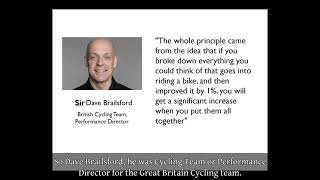
This is a YouTube video titled "The Power of Marginal Gains to Find Your Next Role" containing a motivational talk delivered by Mike Richards on February 2, 2021. In this talk, Mike Richards discusses the concept of marginal gains, using the example of Sir Dave Brailsford's approach to improving the British cycling team's performance by making small 1% improvements. He then relates this idea to personal and professional development, encouraging viewers to make incremental improvements in their careers, such as updating LinkedIn profiles or resumes. The content is a single-speaker presentation focused on self-improvement and career advancement.
So let's talk about marginal gains and the power that they have. Now you've got that phrase, but let's just bring in here Sir Dave Brailsford. He was cycling team or performance director for the Great Britain cycling team. But before he arrived, the Great Britain cycling team was terrible. Since 1908, they had won just one single gold medal. And they were so bad that in 110 years, no British cyclist had ever won the Tour de France. It was so bad at the time, the top bike manufacturers would refuse to sell their bikes to British teams because it would hurt their sales. And they were just worried about it. So he came in and what he came up with and was different was this relentless commitment, if you like, to improving everything by 1%. So what did he do? He did a few things. He redesigned the bike seats to make them more comfortable. He put rubbing alcohol on the tires to give them better grip. The cyclists themselves, they wore over shorts to keep their bums warm, get themselves nice and prepared. Ideal muscle temperature before a race. When they traveled around the world, they took their own bedding, they took their own mattresses so that everyone got this amazing sleep every time. He kept on finding 1% improvements everywhere he could. He looked at different types of massage gels, which would help with the muscle recovery every little bit. There's so many different things. One of the other ones I remember what they would do is they would. They painted the inside of the team trucks white. This would help them spot little bits of dust, but they could degrade the performance of the bikes, painting it white to make sure there was no room for error, as it were. You're like, hang on, so I'm a treasury professional, Mike, I'm not a cyclist. Why? Why would this be of importance? Well, let's talk about a few things. He aimed that within five years that they would actually win one of the major races. Unfortunately, they didn't do it. They did it in three. It was incredible. 2008 Olympics, they won 60% of the gold medals within cycling. Four years later, nine Olympic records, cyclone, seven world records in London. Well, Bradley Wiggins won the Tour de France, followed by Chris Froome, followed by a number of other guys and all these things. And it was just these marginal 1% improvements. Okay, it's all great, and it's all about cycling and stuff. And you're sitting there going, mike, I'm not cyclist. I'm not interested. Really? No, I don't want you to be. What I want you guys to do is to think about the 1% improvements you can make. So next week, or today or tomorrow, you wrote this out. Look at your LinkedIn profile. Is your photo visible to everyone? That's a 1% improvement. Have you asked for one recommendation? How hard is that going to be to just send one email every Monday or make it a regular routine? Put it in. 1% improvement. Could you look at, have a quick review of your resume? Just one thing, just change a couple of sentences. Imagine if you did this and I had one of my ex bosses said, don't do 100, you know, one thing 100% better, do 100 things 1% better. So it's exactly the same. If you do that 52 times a year, once a week, imagine how much incrementally that's going to improve. If you've reviewed, if you just did that for your resume and you did 10 reviews of your resume and 10 improvements, how much better is that going to be? And I'm not saying take hours and hours about doing this. One of the previous conferences I thought, you can't do it. I bought gift cards with $5 things for coffee and lots of people took it away. And I said, look, buy yourself a coffee and I want you to think about what you can do 1% better. And people were sitting there over their coffees, changing their LinkedIn profiles. They were making a couple of notes about what they were going to do, about how they were going to do some more study, how they were change it. But I said don't make big changes. I don't want 100% change. Just want a little bit every week. And by doing that, you guys are going to get successful, the success you deserve. Amazing to talk to you today. Thank you very much for your time. I'm going to come out of the share, I'm going to get rid of this, going to do screen sharing. Boom. It's been amazing, everyone. Chris, thank you for organizing it. And we're out of the session. Thank you very much. Love you all.