Top 10 Tips to Creating a Great CV Resume
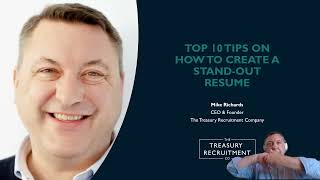
Mike Richards from a treasury recruitment company shares ten tips for building a resume that lands interviews. He covers tailoring your content to the job, cutting errors, leading with achievements, and skipping personal details that don't matter.
Hello everyone, it's Mike Richards here from the treasury recruitment company. Exactly. As you can see over here, I've been doing this 20 plus years in treasury recruitment and one of the key things I've learned throughout that time is about resumes or CVs as you might have also heard of them. And these are going to be some of the tips and tricks and some of the do's and don'ts and some of my pet hates. So hopefully listening to a Treasury recruiter telling you about what to do is going to enable you to give you guys the best chance of success when you go for your next interview or you're looking for your next role and you want to earn your interview, because that's exactly what it is. A CV or resume be like is the key to earning an interview. And then we've got the other video that I've done which talks about some of the tips when you go to interview and how to successfully nail that as well. So hopefully the two of these in partnership will help you. That's exactly what we're about. Okay, so we'll go through some of the tips. I've got a couple of pre tips if you like. I know you're lucky, lucky people. Let's go. First of all, and it's about as exactly as it says, grabbing someone's attention from what is generally a one to maybe three page document. Some people say, oh, it must be a one page resume. Sometimes I think if you're a more experienced treasury professional, it's not enough. I know that Ernie shown us in previous presentations about his sales pitch, if you like his sales resume, but he's in a different role. I think for treasury professionals a resume needs to be, as long as it needs to be, that's fine. But the key thing about it, it needs to reach out and grab your attention. So when you're writing it, you need to make sure that you're writing or amending your resume each time you send it out. It needs to be tailored to your audience because you want to, funny enough, as it says on the screen just up there, that's right, you want to reach through the glass and grab their attention, grab it through and get them, oh, I want to read this. This is a person we should be talking to. And this is what some of the reasons, this is what I want to see. I don't want to see boxes, boxes, boxes, that's good in the doing and dancing and things like that. But no good resume is about presentation. It's about also them knowing you them knowing how you're going to present yourself and how you're going to work with them. If you've got a good presentation of a good resume, that's the first. Oh, actually that person will be good when they do this, when they're writing reports, when they're presenting to our investors, that gives you confidence in them. And it's the successful first start, if you like, and exactly as I say it then earns you that right to be interviewed. So let's keep going. Don't make mistakes. I think it's. What is it? F5. F7 is F7 in word. When. If you want to do any spelling mistakes and when you do that, there are a number of times when I've seen people are very good mangers. That's right. Manger is a word manager is a different word. So please look at both. There are a number of other, you know, errors that I see creep into people's. I've seen detail. That's right. Great. Resume destroyed by. I have exceptional attention to detail. D, E, T, A, L. I don't know how it wasn't picked up by a word, but it wasn't. And a lot of time, actually, there's a point here, a lot of time I will get resumes that arrive on my desk in PDF. Got one from an exceptionally bright great treasury professional while back now and I said, look, have you converted this from Word into PDF and back into Word or whatever, or the other way around, rather? Oh, yes, yes, I did. Said, okay, There are about 18 errors in it. He's like, oh. So he actually proved to me he hadn't. I asked him, I said, look, take it from as he was PDF into Word and back again. Put it into Word when I copy and paste it. Showed him it was littered with errors because of the conversion. I didn't necessarily blame him. And there was still errors after that. He if you. You're going to do that, you are treasury professionals. Accuracy needs to be 100% because you're pressing if you press the wrong button, that could make a massive material difference to your balance sheet. So this is what people is, you know, are looking for. It's your first impression. That's what you want to do. Make it a good impression. Also, you know what, it's free. The longer you know if you do this, you give yourself the best chance. If you don't do it, that's fine. But don't even send your resume because it's pointless. So no errors. Okay. Boxes don't like as you Read through your own resume, make sure that it flows and if there are any gaps in it and you know, we've seen recently with Pandemic, that's probably a decent, you know, reason to have some gaps or some, you know, blips around there and things like that. But if there are other things you've been off, you've had, you know, family, you've had kids or you've taken any time out, explain it because otherwise you're going to just give people questions again. Bullet points. Now, I can't remember exactly why it was bullet points, but they used to say, I think it was bullet points and bullets in a gun. So, you know, in an old Wild west, six bullets points maximum. I tend to think that, you know, anything more than three or four probably is all you want. Someone the other day with 18 or 19 bullet points, is that really, I mean, we, I actually asked my colleague Carly and she dropped down the bullet points on this page just to make that point. But we, you know, kept it in there shorter. Resume is professional email address. That's an easy one. You know, don't have, I like 15 beers@hotmail.com. make sure it's a nice plain professional as. As much as you can or Gmail, whatever you liked, you know, to do and don't cram it. You know, as I say about links to resume, you want to make sure that it makes enough sense to your reader. Let's move on. Oh, bugbear. Personal statements. I had this discussion so many times and I've lectured about it and I've gone to different conferences and some people say, oh, well, personal statement about how great I am and da, da, da. In my experience, over 20 plus years of treasury recruitment, 50% of people at least hate personal statements. 50% don't mind them, put up with them, skip past them most of the time. But what I'm saying to people saying, so you're flipping a coin as to whether someone takes you through to the next round of interview. They're like, well, yeah, I said, so it lands on tails, you're out. What's the point? I said, I don't like personal statements. What I prefer is much more something that states your achievements, which focuses on these, you know, which focuses on, you know what I say you're applying for a role and you've noticed that the key thing they've got is they're going to have future problems with cash management or they're entering into new markets. Well, instead of having a personal statement about how you are A flexible, motivated individual. Because you're not going to put anything else than that, are you? Why do you focus on how you've. In the past, in your previous role, you've entered into new markets successfully, you've hired remote teams, you've done this, you've managed them, and you explain to the potential employer how you match their needs. So get rid of the personal statement, the generalized guff that's in there, just chuck that in the trash. That's exactly where it should be. And instead focus on their pain points, be their paracetamol. We'll come back to that in a minute, hopefully. Might be the next slide. It is. This is what I want. Instead of that fatuous personal statement, look at the pain points. So take the job description they've sent you and things and read through and think, right, that's the top issue, that's the next issue, that's the next. Again, it reminds me of one of my previous candidates who was applying for roles and one of the key things we looked at, I said, well, look, why didn't that company just promote their senior treasury manager or assistant treasurer to the group treasurer role? Why didn't that person? And he said, oh, I don't know, actually. And you'd seen this good progression. And I said, now look at the other people and what happened. There was quite gap between the number one job and the next level. And actually that was one of the key things. They identified that what they wanted to do, this senior treasury manager, slash assistant treasurer, great guy, what they wanted to do was train him up. And in actual fact, they had had a deputy treasurer, a lady, but she'd actually gone off a maternity league and she probably wasn't going to return, she was going to be given the option, but the fact was they had this big gap, so they've been trying to generally train people up. So I said, look, you've trained people. Oh, you have trained people throughout the world, both remotely and in person. Okay, where's that in your resume? It was there, but it was buried right down the bottom. I said, look, we just have a short personal statement up there. And actually he did get the role. Fantastic. And one of the reasons they said, oh, we thought this guy would come in and be able to not only train the team and lead them and be an effective leader, but also be a coach to them and in a way work himself out of a role in three to five years and maybe do other things within our company or move on. That's the fact, is that adapt your message. Make sure that you're tailoring it for your audience, that people listening to it. As it says, be their painkiller. Think about if you were sitting in there and you've got that job description. Okay, these are their main problems. Okay, how can I get rid of their headache? What can you do about it? That's what you need to include in that. Replace that for your fatuous personal statement. I don't care. Your flexible, motivated individual. Please throw that in the trash. Let's move on. Here are some of the actual tips. Yeah, we don't need to know it's a resume or curriculum, pizza, cv, whatever you want to call it, we know it is. It's outdated and unnecessary. What you need to do is put in your name and have a nice personal statement. And when I say that, make it about. Focus on the client, focus on their problems and their pain points. Format it and make it look nicely, you know, we'll send you these slides as well, if you can have them anytime. Photo date of birth. Now, one of the key things is there is ageism out there. Should you have a date of birth on your resume? Well, in actual fact, I wouldn't put it on there. Why? Well, people can work out, you know, roughly your age from when you went to school or university, so there's no actual need to have that information. In a lot of cases, when we get a resume from someone, we often ask them to take off their photo. We often ask them to take off their date of birth and to take off their personal contact information. Why? We've got GDPR across UK and Europe. We also in the US as well. There are privacy concerns as well. We will record that information ourselves. But one of the things you need to be careful about, and most applicant tracking systems will want that information, but they want it securely held, so. So just putting it all the way out on your resume and things. I sometimes see resumes up on LinkedIn, for instance, and I see lots of personal information. I do think to myself, wow, that's, you know, putting themselves very much open for fraud, you know, and that's obviously prevalent in lots of people's minds nowadays, particularly with the rise of cybercrime and everything else. Let's keep going. References. It's just a waste of space. Well, hang on. But we need references yet. You'll be asked for it if you're offered a job. When you're offered a role, it will be subject to satisfactory references. And if they want references, they will ask you for it. Don't just fill up the Page with information that isn't actually going to help you get the role. Having, you know, one of your great previous bosses on there, that's not going to actually help you that much. It just takes up space. So throw it in the trash. Let's keep going. Resume summary paragraph, not personal statement. You know, look at it again. I'm not going to. I could overdo this one thing. I could do as well. One of the other bits, someone did actually have quite a good achievements list the other day and what I said to them is that I really like this. They are great. Shall I list it on there? I went, no, it's going to make your resume four pages. Oh, yeah. So I said, let's take your personal statement out to one side. Let's have that as a separate document. Have a chronological listing of your experience and then what we'll do according to which role you're looking for, then cherry pick. I said, look that way. You've drilled down with straight through processing and IT and technology. Let's put that. That's their big pain point. Oh, yeah, great. So, but this other role you're looking at, they're going to need this about cash management and managing people. Oh, yeah, this is bright. So use that as a bit of a. A pick list, if you like that you can use bullet points again. If you're going to do bullet points, don't make the paragraphs and if you're going to do paragraphs, don't make the bullet points. So you know, you've got a. Your written English has got to be there. So make sure to balance out both of those. No gaps. We talked about this earlier Chronological. Yeah. And most recent first. And actually one of the key things I noticed from someone the other day, they had for one of their roles, so of 10, 15 years ago, I think it wasn't about 12, 13 years ago. They had, in fact more information about a role they did 15 years ago than they had about their role they were doing most recently that had been doing for five years. There was one of their other roles they've done for three years, 15 years ago. I was like, right, that needs to go. Oh, right. I said, yeah, that's 15 years ago. This, you know. Yes. Talk about the progression you had in that role. You were in the. For that company for seven years. Great. But the company name put the three roles you had and how you stepped up and then said, you know, progress from this to this to this. About the end. And the key achievements I had were this and this. Brilliant and they brought it down from nearly. Well, yeah, it was 3/4 of a page to actually a paragraph. And it was powerful and it showed progression. You know, he was really good as well. A lot of the time as well, I would say. I'm saying lots of he's. We deal with as much with ladies as well. And that's one of the key things we want to, you know, that we want to make sure that we are bringing as many women into this as well. We are very happy to help and represent you wherever you may be, globally, and, you know, we just want to help you with your treasury careers. Let's keep going. Have you listed to 10 to 15? Yeah. Concise and relevant. It's about how relevant it is. Again, as you move further down chronologically, reduce the information. There's not enough needed there. If it's 15 years ago, really, do you need to. Some of the interviewers, we're barely out of school sometimes when they're out doing that. So what I would do is what's relevant? Less information at the beginning, more as we come up to date. We did how you did it, but the key thing there is about impact or value or cash. How much money did you save or how much time did you save? What difference did you make to the company? That's what people want to see. They don't care that you implemented that. You did an RFP, you invited 10 banks and then they brought it down to this, and then it was this or RFP for these treasury management providers and did this. God, really? So what, you implemented this treasury system six weeks ahead, in no time at all, in three months from start to finish, you did this. And the effect was you saved one person's job, I. E. You, or you did this, the outcome, what did you achieve? How much money did you save? One of my previous clients, actually, he. His boss, the chairman, actually, of his company, used to have this yearly. He said, like to keep a black book. And he said, all right. He said, what do I put in the back book? He said, how much money? You save me or you make me, but I'm your treasurer. He said, yeah, you are. So I want you to hold yourself accountable. I'm not going to say I'm not going to be knocking your door. Well, what do. You said? Let's review the differences. And it gave him an entirely different mindset. So I have to have a black book. But when you're putting together your resume, you might want to think about what have you done and what have you achieved. And again, it Might also make you reflect and think, you know, this is what I want in my next role. That's what's going to help you as much as a candidate as well. Let's keep going. Eight coming up to nine qualifications. Yeah. Are they listed again chronologically. Put them in there. Keeping the short and sweet, you know, we don't need them to down to high school level or secondary school level a lot of the time if you've got your degree. Mba. Yes. List that and what its relevance and things like that. And if you've got accounting qualifications or you've got professional treasury qualifications, put that lot in there when you did the, you know, have you done them for many years ago and stuff like that Again systems that's very prevalent as well. Lots of people want systems and straight through processing so that definitely keep that in there as well. Let's get towards the end and further advice. Well, you know where we are basically we're the treasury recruitment company. Go to treasuryrecruitment.com you've got lots of other videos. We've got Treasury TV there but just go look up treasurytv.com and that's where you'll find lots of videos a bit like this. Sorry, I've got a face of radio but kind of everything actually talking about radio, what I do host a weekly podcast as well. Go to the TreasuryCareerCorner.com or TreasuryCareerCorner.com interviewed over 170 global treasurers and treasury professionals about their treasury careers. Brilliant. Love it. Talking to amazing treasury professionals each and every week about what they've achieved and everything else. So go there, I'm sure you'll enjoy it and for me that's enough today we'll let Ernie get back to the main program. Thanks.
More from Mike



Why Treasury Professionals Don’t Show Up to Events (And What Organisers Get Wrong)

AFP 2026 Las Vegas | Use My Exclusive DISCOUNT Code and Join My 2 Treasury Sessions

Treasury Technology, AI & Cybersecurity: Felix Meyer (ABB Capital) on TMS Projects and Future Skills




AI, Cybersecurity, and a Fast Track TMS Rollout with ABB Capital’s Felix Meyer